
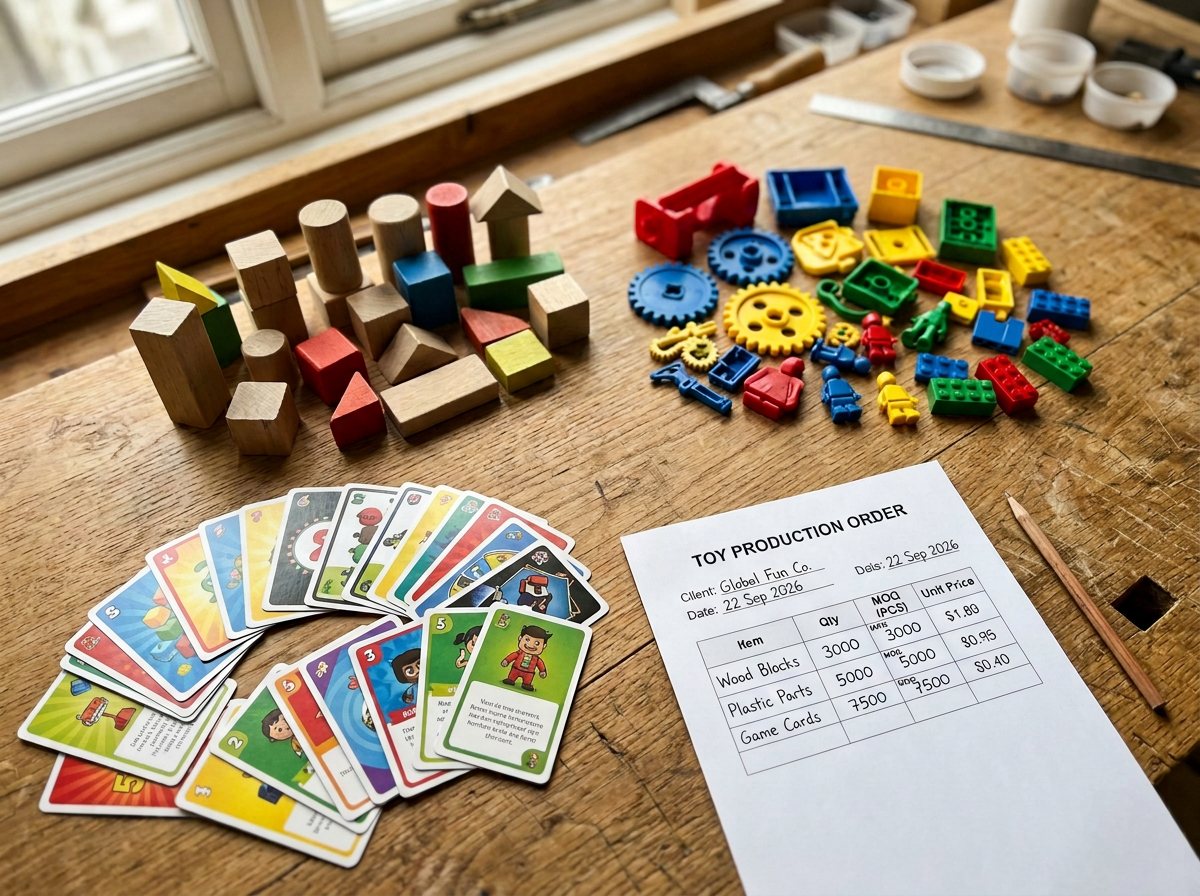
Three quotations for the same educational toy range, three different minimums: 500 pieces for the wooden items, 3,000 for the molded plastic parts, and a print minimum nobody mentioned until the packaging quote arrived. For a team planning a first run of private label toys, those numbers decide how much cash sits in a warehouse before the first sale.
Order too little and unit economics collapse under tooling and testing costs; order too much and one slow-moving SKU ties up the budget meant for the next two launches. A minimum order quantity works as a planning variable, not a take-it-or-leave-it condition — and in a range that mixes materials, there is never just one minimum.
This guide breaks down where the minimums on private label toys come from, how tooling and timelines change across wood, plastics, and printed components, and how to size a first order against real demand.

Why Manufacturers Set MOQ on Private Label Toys
Setup costs are fixed. A factory minimum is not a negotiation tactic — it is the quantity at which a production run stops losing money on setup. Every product change on a line carries the same work: printing plates for a logo, dies for custom packaging, color-matching calibration, and, where a design involves new parts, a mold recovered across the entire run.
Testing repeats the pattern. Safety laboratories charge per material and coating combination, and often per production batch, so a small run of own-brand educational toys pays close to the same bill as a large one. The minimum marks the point where setup, tooling, and compliance costs spread thinly enough to keep the unit price workable.
The starting range runs wide. Published minimums for private label toys commonly fall between 500 and 1,000 pieces for wooden items with surface customization, while fully custom molded parts are quoted higher. Demand keeps shifting toward own-brand lines — the steady worldwide growth of private label educational toys has turned these minimums into a routine planning step for first-time brand owners.
The customization level itself sets the floor:
| Customization level | Typical starting quantity | Main cost driver |
| Logo engraving or silk printing on a stock product | 500–1,000 pcs | Line changeover and printing setup |
| Custom packaging, manuals, and color matching | 1,000–2,000 pcs | Packaging tooling and print runs |
| New mold or fully custom design | 2,000–3,000+ pcs | Tooling amortization across the run |
One range, several minimums. A single own-brand collection rarely stays in one material. The wooden sorter carries one minimum, its plastic components another, and the printed instruction cards a third — so the quotation for private label toys that matters is the one priced as a program, not as separate parts.
Tooling Economics Differ Across Materials
The word “tooling” hides four different cost structures, and each one sets its own floor on order size. Buyers comparing quotations for custom educational toys need to know which structure they are looking at before comparing numbers.
Wood: programs and jigs, not molds
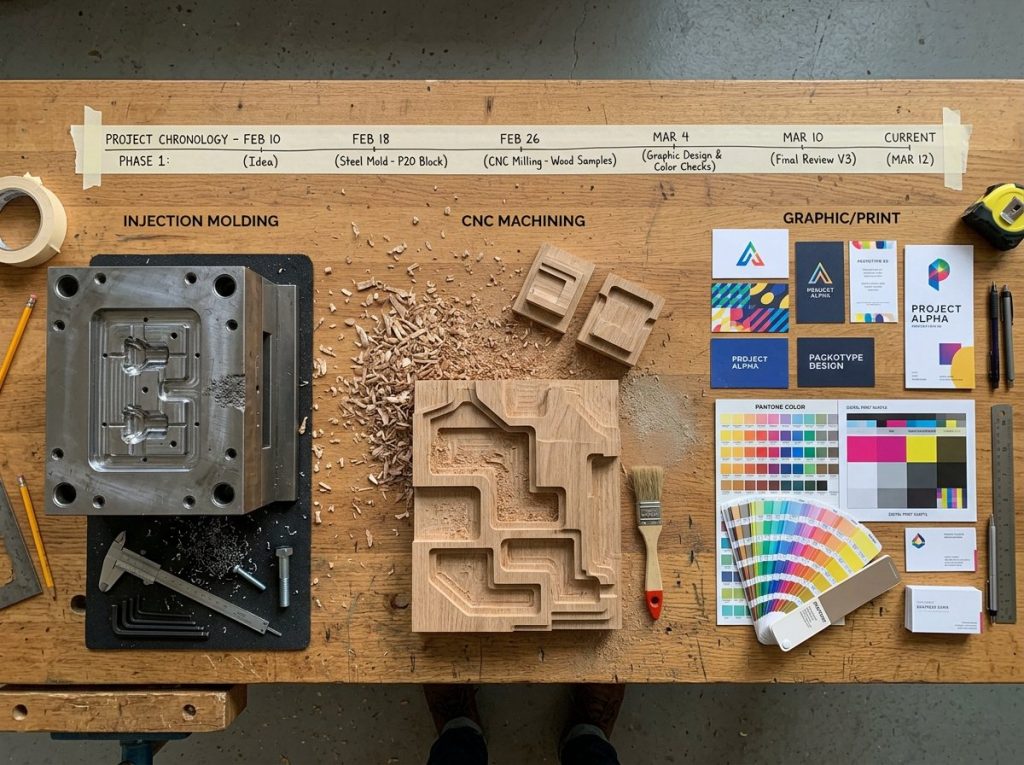
Wooden parts rarely need a mold. Custom shapes are cut on CNC machines from digital drawings, so tooling means cutting programs, holding jigs, and sanding profiles — setup measured in hours, not steel. That is why wooden items carry the lowest entry minimums in most catalogs, and why design revisions stay cheap even after sampling begins.
Plastics: the mold is the budget
An injection mold is a capital purchase. Steel tooling for a custom plastic part is commonly quoted from several thousand dollars upward, and the cost only makes sense spread across thousands of units. This single line explains why molded components in private label toys carry minimums of 2,000 pieces or more — the mold, not the plastic, sets the floor.
Print, paper, and magnets: setup without molds
Printed components live on setup, not steel. Plates, die-cut forms, and color calibration cost a fraction of a mold but repeat with every design change, which is why packaging and card print runs carry their own minimums. Magnets sit in between: no mold, but insertion fixtures and dedicated safety testing, both of which behave like fixed costs on small runs.
Sampling and Tooling Timelines by Material
Each material runs on its own clock. A cross-material program moves at the speed of its slowest component, and the slowest is usually the mold. Planning a launch date for a mixed range means mapping every component’s clock before picking a date, not after.
| Material / component | Prototype or sample | Tooling lead time | Planning note |
| Wood (CNC-cut) | 7–14 days | None — programs and jigs in days | Fastest to revise; ideal for pilot runs |
| Molded plastic | 3D-printed proof in days; production sample after mold | Injection mold commonly 4–8 weeks | Mold amortization sets the MOQ floor |
| Printed and paper parts | Digital proof in a few working days | Plates and die-cut forms in days | Re-setup on every design change |
| Magnets and mixed assemblies | Follows the base material | No mold; insertion fixtures | Adds magnet-specific safety testing |
Mass production converges. Once tooling is done, production of a mixed range typically runs 30 to 45 days, and prototype revisions commonly take two to three rounds. Those numbers decide when an order for private label toys must be placed — and therefore how much stock it has to cover.
How to Size a First Order Around Real Demand
The workable question is not how many units might sell this year, but how many must cover demand while the next batch is being made. A first order of private label toys only needs to bridge the resupply window — production, sea freight, customs, and inbound handling — plus a buffer for spikes and defects.
A worked example with rounded numbers
The calculation needs a handful of inputs, and every one of them is a number a buyer can assemble before signing anything:
| Input | Value |
| Sales velocity (comparable SKU) | 150 units per month |
| Production | 40 days |
| Sea freight | 30 days |
| Customs and inbound handling | 10 days |
| Demand during the ~80-day resupply window | ~400 units |
| Buffer for spikes and defects (20%) | +80 units |
| Order requirement | 480 units |
A 500-piece minimum then matches the sales pipeline almost exactly, while a 3,000-piece quote would represent roughly 20 months of stock at the same velocity.
No sales history. Demand-based sizing has a blind spot: a first SKU has no history. Channel commitments substitute for it — distributor letters of intent, pre-order tallies from an email list, or one funded purchase order from a retail chain anchor the estimate in signed demand rather than optimism.
Reorder cadence beats one large order. Two 500-piece orders per year usually outperform one 1,000-piece order once warehouse fees, capital charges, and revision opportunities enter the calculation. The first batch of private label toys doubles as market research: real customers expose design flaws that no prototype round catches, and the second run fixes them at full margin instead of at liquidation prices.
Before committing, a structured review of materials, packaging formats, and compliance scope prevents expensive changes later — the same preparation behind what to know before ordering custom educational toys shortens the path from quotation to production.
Negotiation Levers That Lower MOQ Risk
Quantity is only one variable in a quotation. Suppliers running OEM toy manufacturing programs generally hold more flexibility than their price sheets suggest, and four levers move risk without cutting quality.
Combine SKUs against one minimum. Two designs sharing material, finishing, and packaging type can often split a single 1,000-piece minimum into two 500-piece SKUs. Across a mixed range the same logic applies between materials: components that share a mold, a print form, or a coating line also share their setup economics.
Trade unit price for quantity. A smaller run at a slightly higher unit price frequently beats a large run at a lower one once storage and the cost of capital enter the math. Asking for a price curve at 500, 1,000, and 3,000 pieces makes the trade-off explicit.
Phase the tooling. Pay for the mold once, run a pilot batch, and scale on reorders. Tooling is durable; inventory is not — and phasing suits private label toys programs that expect design iterations after real customer feedback.
Fix ownership terms in writing. Who holds title to the mold, how deposits are staged against sample approval and shipment, and what happens to unused printed packaging — these clauses decide how expensive a forecast error turns out to be.
Compliance Is a Matrix, Not a Certificate
Every material triggers different clauses. A painted wooden item, a molded plastic component, and a magnetic assembly sold in one box do not share one test plan — each material family carries its own clauses, its own laboratory line items, and its own failure modes. Compliance for private label toys is a matrix to be managed, not a certificate to be collected.
The rules behind the matrix. In the United States, the Consumer Product Safety Improvement Act of 2008 directed the CPSC to make the ASTM F963 toy safety standard mandatory for products marketed to children, a requirement now codified at 16 CFR Part 1250. In the European Union, the Toy Safety Directive 2009/48/EC references the harmonized EN71 series.
Material decides the test scope. Coatings and printed surfaces face EN71-3 migration testing; plasticized components fall under CPSIA phthalate restrictions; toys containing magnets face the flux-index and labeling requirements built into ASTM F963. A range that mixes materials multiplies the line items — which is why testing for private label toys behaves as a fixed cost that shrinks per unit as volume grows.
The question worth asking. Which certificates already cover the factory’s stock materials, and which tests are charged fresh on each new order? Quotations that omit this line hide the difference; requesting the test scope alongside the price curve turns an invisible cost into a comparable one.
Small changes reopen testing. Certificates carry specific identifiers — material codes, coating batches, model numbers — so renaming a SKU, switching a paint color, or changing a magnet grade can reopen testing even when valid documents exist. Listing every planned customization before the first test round avoids paying twice for the same compliance.
What a Cross-Material Private Label Toys Partner Looks Like
Judge specifications, not headlines. Suppliers quote the same minimum in very different ways, so the evaluation belongs at the specification level. Documentation worth requesting: sample lead times of seven to fourteen days, CNC machining tolerances within ±0.2 mm, wood moisture held between 8 and 12 percent, edge radii of at least 2 mm, and water-based coatings tested to EN71-3. Factories that state these parameters openly — the way established OEM wooden toys manufacturers publish them — make quality auditable before any money moves.
One quality system beats three suppliers. When wood, plastic, magnets, and print come from different vendors, the buyer becomes the integrator — reconciling tolerances, test plans, and delivery clocks alone. A manufacturer running several material categories under one quality management system removes that coordination tax, and private label toys arrive as one documented program instead of three partial ones.
Paperwork predicts reliability. EN71, ASTM F963, and CPSIA test reports, FSC chain-of-custody documents for timber, and batch traceability records determine how smoothly customs clearance and retail compliance reviews go. A supplier’s ability to produce this paperwork on request says more about long-term reliability than any price list does.
Spec sheets and certificates describe a standard; a program shows how that standard runs in practice. Vindstier builds its private label toys program on exactly this cross-material model: wooden components CNC-cut in-house from FSC-certified timber, child-safe plastics and magnetic elements integrated into the same designs, and printed packaging with multilingual manuals produced under one ISO 9001 quality system. Every SKU ships with its own CPC based on independent third-party laboratory testing and a CE technical file, with projects moving from CAD drawings and 7-to-14-day prototypes through to mass production.
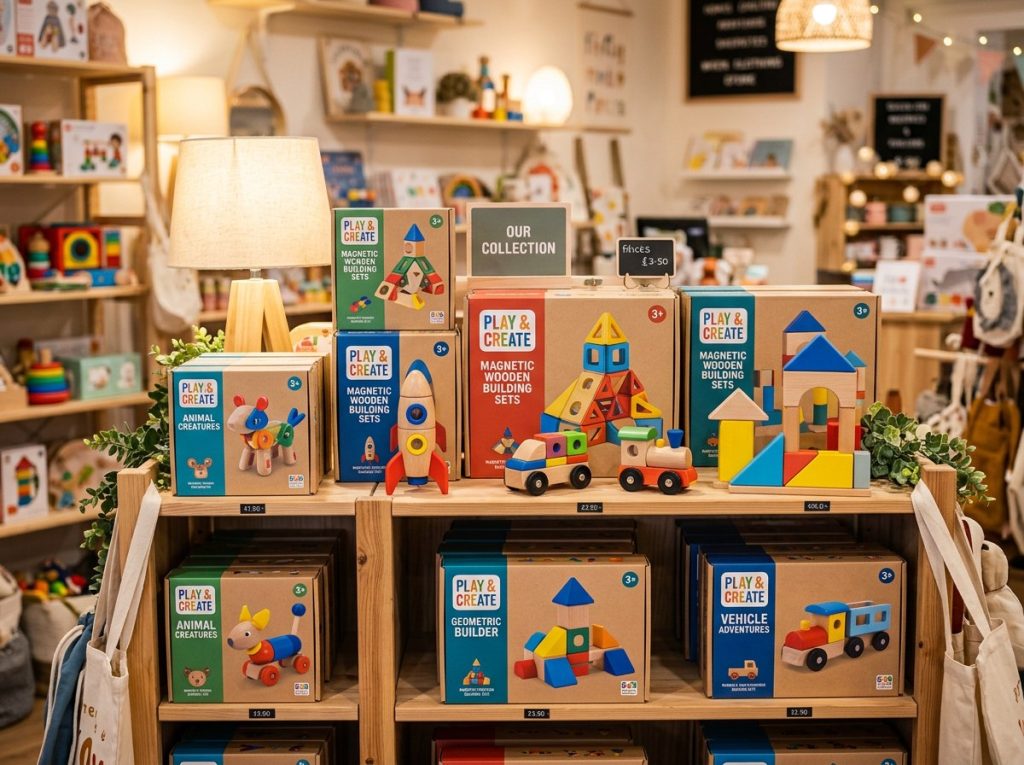
For buyers comparing OEM toy manufacturing partners, the measurable question is which one holds stated tolerances and documentation standards across every material in the range — not which one prints the smallest number on a quotation.
Planning Private Label Toys Around the Minimum, Not Against It
Minimums resist comparison. Quoted minimums for private label toys are not directly comparable across factories. Differences in process, tooling amortization, and testing arrangements mean a lower MOQ can carry a higher unit price; the comparison that matters is total landed cost at the quantity actually intended.
The misuse to avoid. The most common one is chasing the lowest minimum on the market while ignoring unit economics. On a small run, the per-unit share of tooling, testing, and setup can erase the apparent saving entirely — leaving less working capital and a weaker cost structure than a slightly larger order would have produced.
A minimum order quantity is where manufacturing economics and brand cash flow meet. Buyers who size first orders of private label toys against the resupply window, map each material’s tooling clock, and put compliance costs inside the calculation convert a supplier condition into a planning tool.
The number on the quotation matters less than what it buys: realistic stock cover, protected working capital, and room for a second, better-informed order. Programs that treat MOQ this way scale on evidence — each reorder sized by real sell-through data, each new own-brand SKU launched with a number the business can defend.
The next step costs one email. Sending the intended quantity, material mix, and customization scope to a supplier — Vindstier answers private label toys inquiries with sample options, a price curve, and a documented development schedule — turns this guide into a quotation a buyer can actually evaluate.