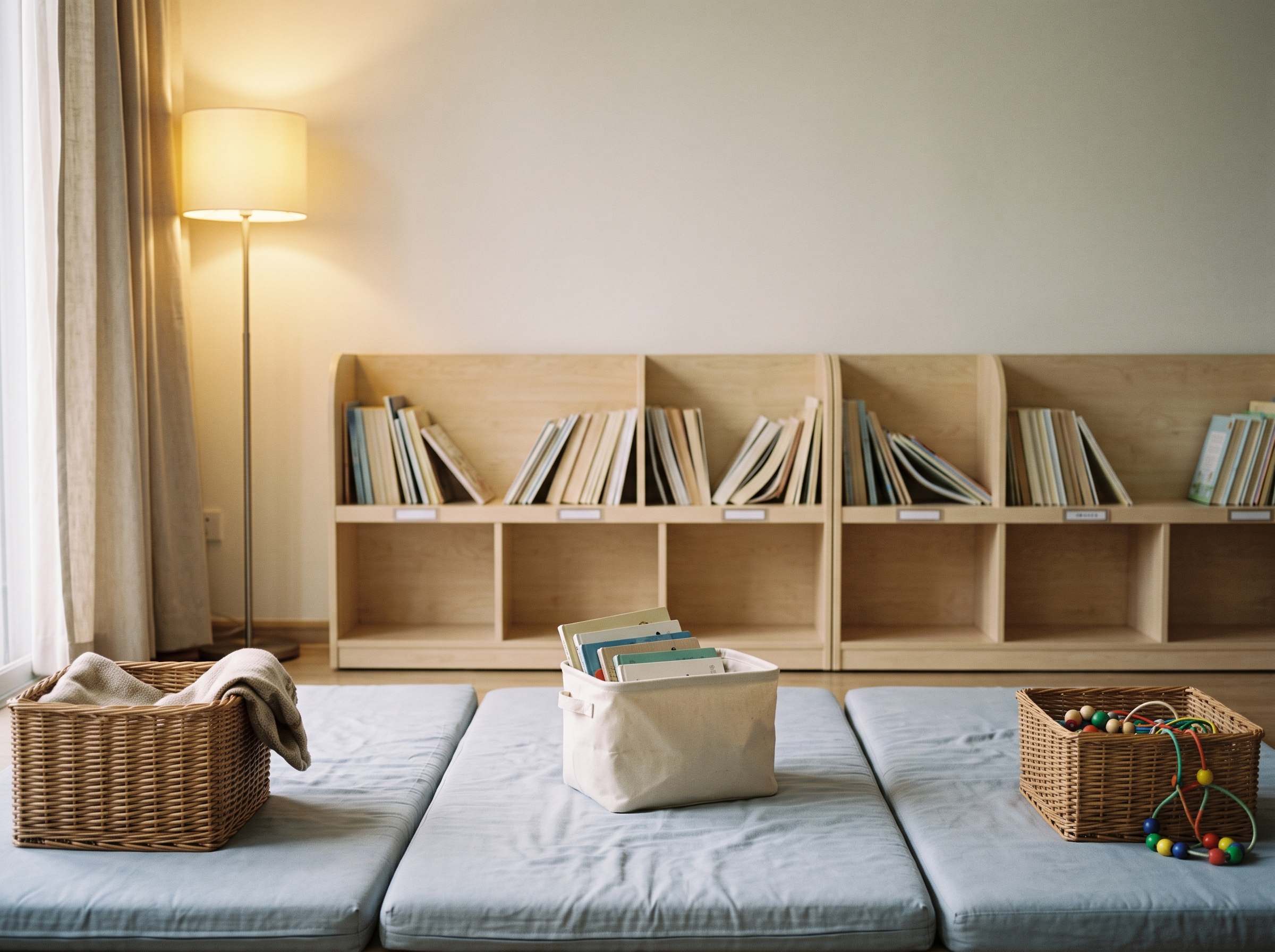
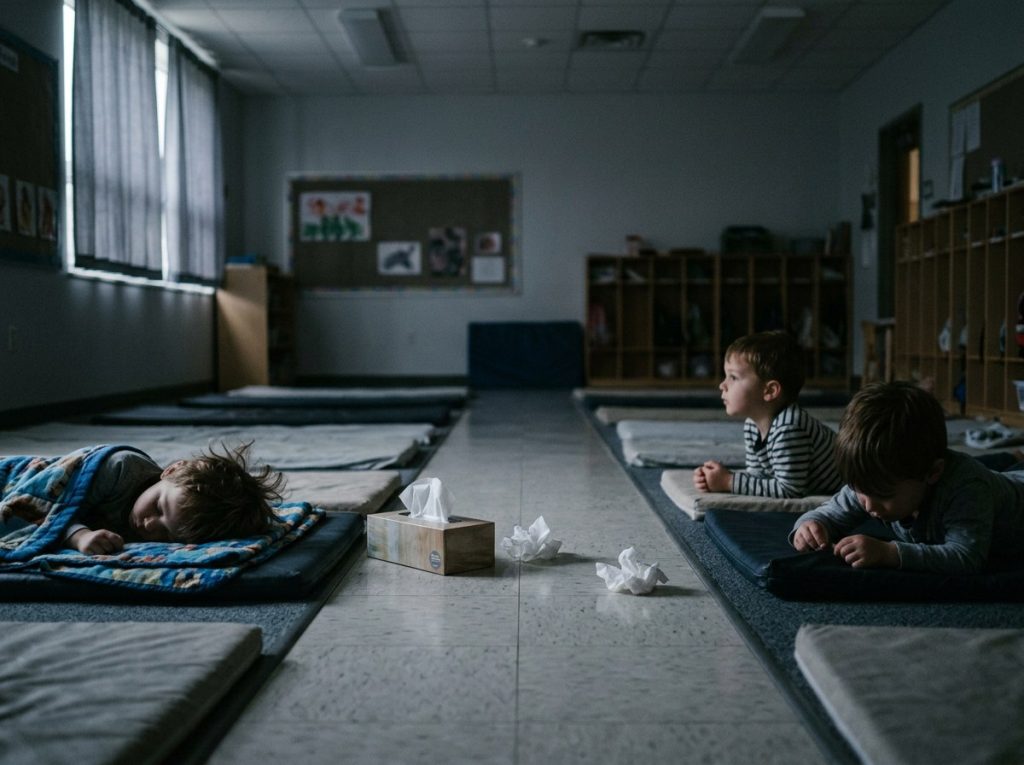
It is 12:40 on a Tuesday, the mats are down, the lights sit at half, and eight of twenty-two children are asleep. The other fourteen held still for eleven minutes. Then the whispering started near the window, a tissue box became a projectile, and a teacher spent the rest of the block enforcing stillness instead of anything resembling rest. Stillness is not rest when sleep is not available.
Quiet time activities for preschoolers close the gap between forced naps and afternoon chaos. They are calm, self-directed play options that non-napping children do on their own mats while the sleepers sleep. A well-run block protects rest for children who still need it and builds self-regulation for the ones who do not. This guide covers what the research says about the nap transition, how to structure a block that holds, and how to choose materials that survive daily use.
Why Rest Still Matters After Naps End
The nap disappears on its own schedule, but the need for a midday reset does not. Two research threads explain why quiet time activities for preschoolers deserve design attention rather than crossed fingers.
The Nap Transition Is Development, Not Defiance
A systematic review of 44 studies mapped how napping declines across childhood (Staton and colleagues, Sleep Medicine Reviews, 2020). For most children the transition completes before age five. Total nap duration roughly halves across those years, and only about 8% of children still nap beyond five. Population data cited in related work suggest fewer than a third of children habitually nap by age four.
The resistance is usually biology, not behavior. A four-year-old who cannot sleep at 12:45 is rarely defiant; the daytime sleep drive has simply thinned past the point where lying down produces sleep. Adults often read the change as a discipline problem, which leads to exactly the wrong response.
Families meet the same pattern at home. A child who drops the nap starts melting down by late afternoon, not because the day went wrong but because the midday gear change went missing. Toddler quiet time runs on the same skeleton, with shorter blocks and a timer the child can see.
What Forced Stillness Does to Non-Nappers
The strongest evidence against enforced quiet-until-sleep policies comes from a University of Queensland team. In a 2018 Scientific Reports study, 43 children around four and a half years old provided saliva samples at four points across two childcare days. Some faced a mandated naptime policy; others sat under flexible rules.
Children who did not sleep under the mandatory rules showed no significant cortisol decline from the end of naptime to bedtime. The authors read the pattern as a bedtime-arousal risk (Thorpe et al., 2018). The same paper cites observational data from more than 130 preschool rooms: negativity escalated between learning sessions and scheduled naptime, and the longest mandated periods produced the most distress.
The problem is not that non-nappers refuse to rest. Enforced stillness with nothing to do is itself a demand on self-control, made at the hour when children have the least of it to spend. The study carries limits worth naming: 43 children over two days in one country is a small base, and a cortisol pattern signals risk rather than confirmed sleep loss. Both caveats point the same way as the observational data — the mat-only policy fails the children it was meant to protect.
What the Guidelines Ask for Instead
World Health Organization guidance for ages three to four pairs its activity targets with a sleep expectation. Children need 10 to 13 hours of good-quality sleep per day, which may include a nap, on a regular schedule (WHO, 2019). The same guidance caps sedentary screen time at 60 minutes, a ceiling that applies to non-nappers too.
Quiet time activities for preschoolers let a room honor both numbers at once. Sleepers keep the window in which sleep remains possible; non-nappers get a low-arousal alternative to staring at the ceiling. A small laboratory study adds a reason to protect that window. Preschoolers who napped about 75 minutes after a memory game recalled around 10% more material than peers kept awake, and the advantage survived to the next morning (Kurdziel, Duclos and Spencer, PNAS, 2013).
What Good Quiet Time Activities for Preschoolers Have in Common
Search results produce hundreds of ideas and no way to choose between them. A better filter asks what every workable option shares, because the shared traits are what make a whole room quiet at once.
Five Filters That Do the Sorting
Quiet time activities for preschoolers earn a bin slot by passing five tests:
- Self-directed. A child can start, use, and finish the activity without an adult. Every facilitation request breaks the quiet for the rest of the room.
- Quiet by material, not by rule. Wood, felt, fabric, and paper make their own silence. Battery speakers put the quiet back on the teacher’s shoulders.
- Contained on one mat. Everything the activity needs fits inside the child’s mat footprint, so the block never turns into room traffic.
- Low arousal. No winners, no races, no collectible rewards. Competition raises the very energy the block exists to lower.
- Readable without print. Pre-readers succeed without instructions, which keeps the block honest for the whole age range.
The first filter does the most work. Quiet time is where children practice independent play without screens at the hardest hour of the day. The materials either support that practice or simply replace it with an adult’s attention.
The Energy Test
The final filter runs after the block, not before it. Watch the room at re-entry. Children who spent forty minutes with the right materials come back calm and ready; children who spent it with the wrong ones return louder than they left. The quiet block either pays energy back or borrows against the afternoon.
Mornings set the table. A day that front-loads movement lands children at the mats genuinely tired rather than wired, so the downshift costs less. Gross motor toys for preschoolers in the morning rotation and quiet materials after lunch are two halves of one energy plan. Energy down while engagement holds is the signature that separates quiet time activities for preschoolers from ordinary busywork.
The Structure of a Quiet Time Block
A quiet block survives on predictability, not novelty. The sequence below fits a standard 45-minute window between lunch and afternoon circle, and it scales up or down with the day. The quiet time activities for preschoolers vary from room to room; the order of events never does.
Phase One: The Wind-Down (5 to 10 Minutes)
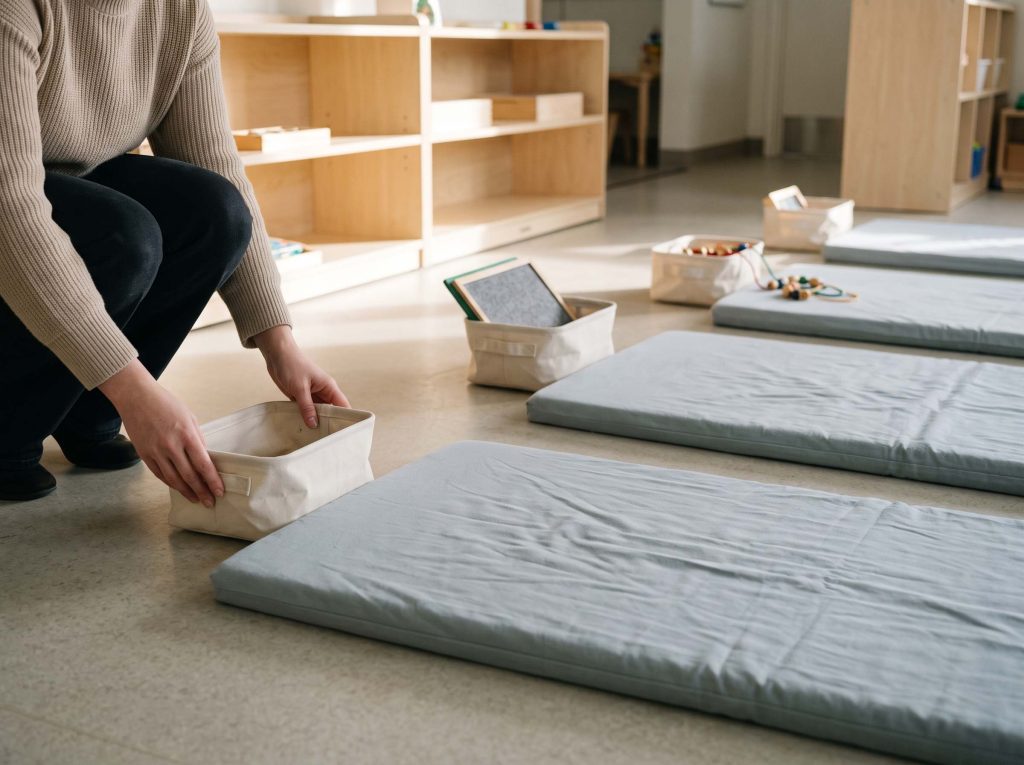
The wind-down is a fixed three-step sequence: tidy the room, lay the mats, then one book per child on the mat. The order never changes, because the order is the instruction. Lights drop to half, and the adult voice drops with them.
Skipping the wind-down to save time costs more than it saves. A room that moves from chase games to mats in ninety seconds buys twenty minutes of settling. A room that winds down buys five.
Phase Two: Quiet Time Bins on the Mat
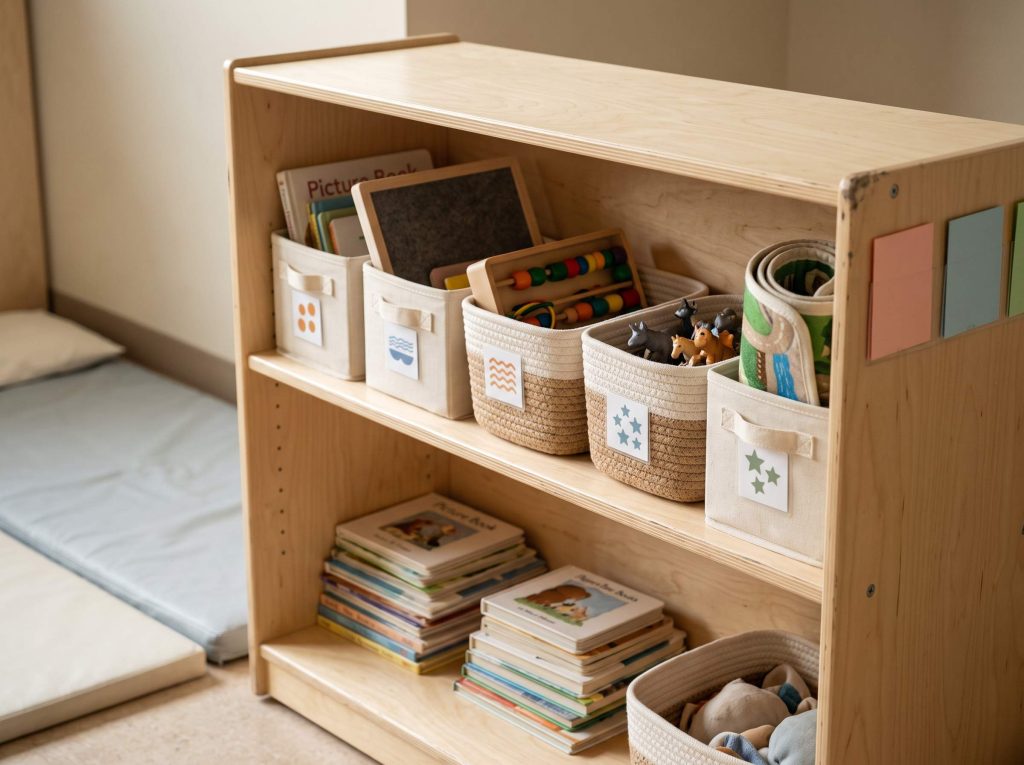
Quiet time bins carry the whole routine. Each non-napping child gets a personal, named bin holding two or three quiet time activities matched to that child’s energy band. The bin lives at the mat edge and never leaves the mat, contents rotate weekly, and bin items never migrate to free play. Rotation keeps a small inventory fresh; separation protects the pieces.
Sleepers keep a book and a comfort item instead. The block stays one event with two destinations. That structure keeps it fair for a mixed group. At home, the same system runs as a blanket corner: a sheet over two chairs, a basket, and a timer the child can see.
Phase Three: The Re-Entry (5 Minutes)
Ending the block well is what makes tomorrow’s start easy. Lights come up halfway, bins return to the shelf one table at a time, then water and a slow stretch. Children who slept rejoin on the same slow ramp, which is why re-entry begins before wake-up wherever the schedule allows. A predictable ending is the least expensive behavior tool in the room.
Sorting Preschool Rest Time Activities by Energy Level
Not every quiet activity suits every child, and the useful sorting axis is energy. Quiet time activities for preschoolers fall into three bands, and matching the band to the child is what keeps a room of non-nappers quiet without policing.
Near-Sleep Resters
Wordless picture books, look-and-find pages, and felt boards ask almost nothing of the body. They suit children on the nap cusp — the ones who sleep three days a week and lie restless the other two. For those children the quiet hour is a nap waiting to happen, and the materials should not talk them out of it.
Busy Hands
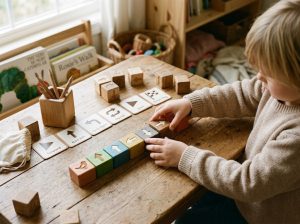
Threading beads, lacing cards, sorting trays, and magnetic pattern sets keep the hands moving while the voice stays off. A mat-sized version of sensory bins for toddlers belongs in this band too, scaled so the scoop-and-pour stays under a whisper. Busy-hand quiet time activities for preschoolers carry the fine-motor curriculum inside the rest block — the same grip and release work that pencils will later demand.
One safety line applies across the band. Any piece small enough to mouth belongs in an older bin, and mouthed pieces leave the rotation for cleaning the same evening.
Quiet Pretend Play
Small-world setups do solitary pretend well: a felt mat, a handful of animals, a cloth road with two cars. The voice rule is whisper or silence, and preschoolers mostly keep it when the setup is worth keeping. Cap shared mats at two children, and give each one enough pieces that sharing is a choice rather than a negotiation.
Some popular options fail all three bands. Screens break the sedentary-screen cap and leave arousal higher than they found it. Sound-button toys, glitter crafts, and competitive board games each break a different rule. The test is never whether an activity looks quiet in a catalog photo; it is whether the room is quieter forty minutes in.
The table condenses the sorting logic:
| Energy band | Example materials | Fits | Watch for |
| Near-sleep | Wordless books, felt boards, look-and-find pages | Children on the nap cusp | Soft spines only; no pop-ups that invite performing |
| Busy hands | Threading beads, lacing cards, sorting trays, magnetic pattern sets | High-energy non-nappers | Mouth-sized parts stay out of younger bins |
| Quiet pretend | Small-world mats, animals, cloth roads with cars | Children who play well alone or in pairs | Two children per mat at most |
Materials That Survive Daily Quiet Time
The bin shelf works harder than the toy shelf. Quiet time activities for preschoolers cycle through every non-napping child, every day, all year, so wear and cleaning decide the real cost of a bin program.
Durability and Cleaning
Daily rotation plus daily handling shortens any material’s life, and a few choices stretch it back out. Solid wood joinery and thick felt outlast foam and card stock. Sealed finishes survive a nightly wipe-down, and washable fabric bags beat cardboard boxes that dissolve by November. Mouthed pieces follow the same risk-based cleaning routine as the infant room, checked and logged each evening.
Durability is a quiet-time-specific variable. A bin item that survives one rotation period effectively doubles the material budget, while a felt board bought once serves three cohorts of children.
Bins, Shelves, and Sizing
A mixed room of twenty typically needs eight to ten quiet bins: one per non-napper, plus spares that make weekly rotation possible. The bin itself should close without strain and sit at the mat edge without crowding a sleeping neighbor. One meter of labeled shelf space keeps the rotation visible, and picture labels beat word labels in a pre-reader room.
Checklists describe what to look for; a catalog shows how the specs hold up in production. The quiet time activities for preschoolers on a bin shelf share one supply question: will the second batch match the first? A bin program is, in practice, a cross-material sourcing exercise, because wooden threading sets, printed lacing cards, magnetic boards, and fabric bags each follow a different production and compliance trail.
Vindstier builds exactly this kind of range under a single ISO 9001 system. FSC-certified wood CNC covers sorting and pattern sets, child-safe plastics cover magnetic components, and printed cards and packaging arrive documented at the SKU level for CPC and CE purposes. Programs piloting one room can test a bin configuration before equipping a building, since sample runs typically move from brief to prototype in 7 to 14 days.
Boundaries and Common Misuses
None of the evidence says children finish napping on the same schedule, and the routine needs room for the exceptions.
When a Child Still Needs the Nap
Individual variation is wide; some children keep a robust afternoon sleep until school entry. A child who falls asleep in the car most evenings, melts down at five o’clock, or sleeps through the block four days a week is signaling that the nap is not done. Quiet time should protect that child’s sleep, not replace it, which is the strongest argument for mats over tables in a mixed room.
Three Misuses That Undo the Routine
The screen shortcut fails twice over. A tablet is silent, but the arousal it leaves behind is not, and the sedentary-screen cap counts non-nappers too.
Punishment framing poisons the block within weeks. “Go lie on the mat” said as a consequence teaches children that rest is exile. The same routine works when quiet time activities for preschoolers are framed as the older children’s work rather than a penalty.
Week-one expectations do the rest of the damage. The routine needs two to four weeks to hold, and rooms that abandon it because nobody was quiet in week one are judging a practice run against the finished standard.
Quiet Time Activities for Preschoolers: A Four-Week Rollout
A four-week build gives the room time to learn the sequence before anyone expects quiet from it. Quiet time activities for preschoolers deliver their full value only inside a sequence that already runs itself.
Weeks One and Two: Practice Runs
Run the block at 15 to 20 minutes with the most engaging bins and an adult sitting inside the pattern, close enough to redirect with a look. Week one targets the sequence — tidy, mats, bins, re-entry, in that order — and silence is not on the rubric yet. The shape of the block comes before the contents. Quiet time activities for preschoolers fill that shape in week two, once the sequence already moves.
Weeks Three and Four: Stretch and Fade
Extend the block toward 30 to 45 minutes and move the adult to the edge of the area. The quiet time activities for preschoolers stay the same while the adult’s distance grows — that distance is the progress. Add re-entry jobs: bin inspectors who check for lost pieces, light-switch duty, mat checkers who confirm nothing sleeps under a cot.
What Success Looks Like at Week Eight
The block has arrived when the adult can leave the area for five minutes and return to the same room. Children who need sleep are sleeping, the rest are engaged at whisper level, and re-entry takes five minutes flat. By then the quiet time activities for preschoolers in the bins have become the room’s default afternoon gear. Before scaling the routine across rooms, a short audit keeps the program honest:
- Every bin passes the five filters, with no exceptions for favorites.
- Contents stay fresh a month in, through rotation rather than new purchases.
- The sleepers’ nap window stays protected rather than disturbed.
- Re-entry energy runs lower than pre-lunch energy on most days.
Quiet time activities for preschoolers solve the hardest scheduling problem in an early-childhood room: what most children do while a few still sleep. Programs that treat the block as designed infrastructure — sequence, bins, matched materials, four weeks of practice — get an afternoon that works for both groups. Room leaders planning next year can start with one shelf, one build, and the five filters above; the routine itself will show what is worth ordering.