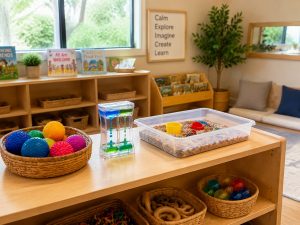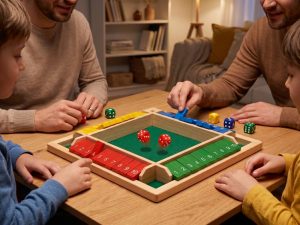
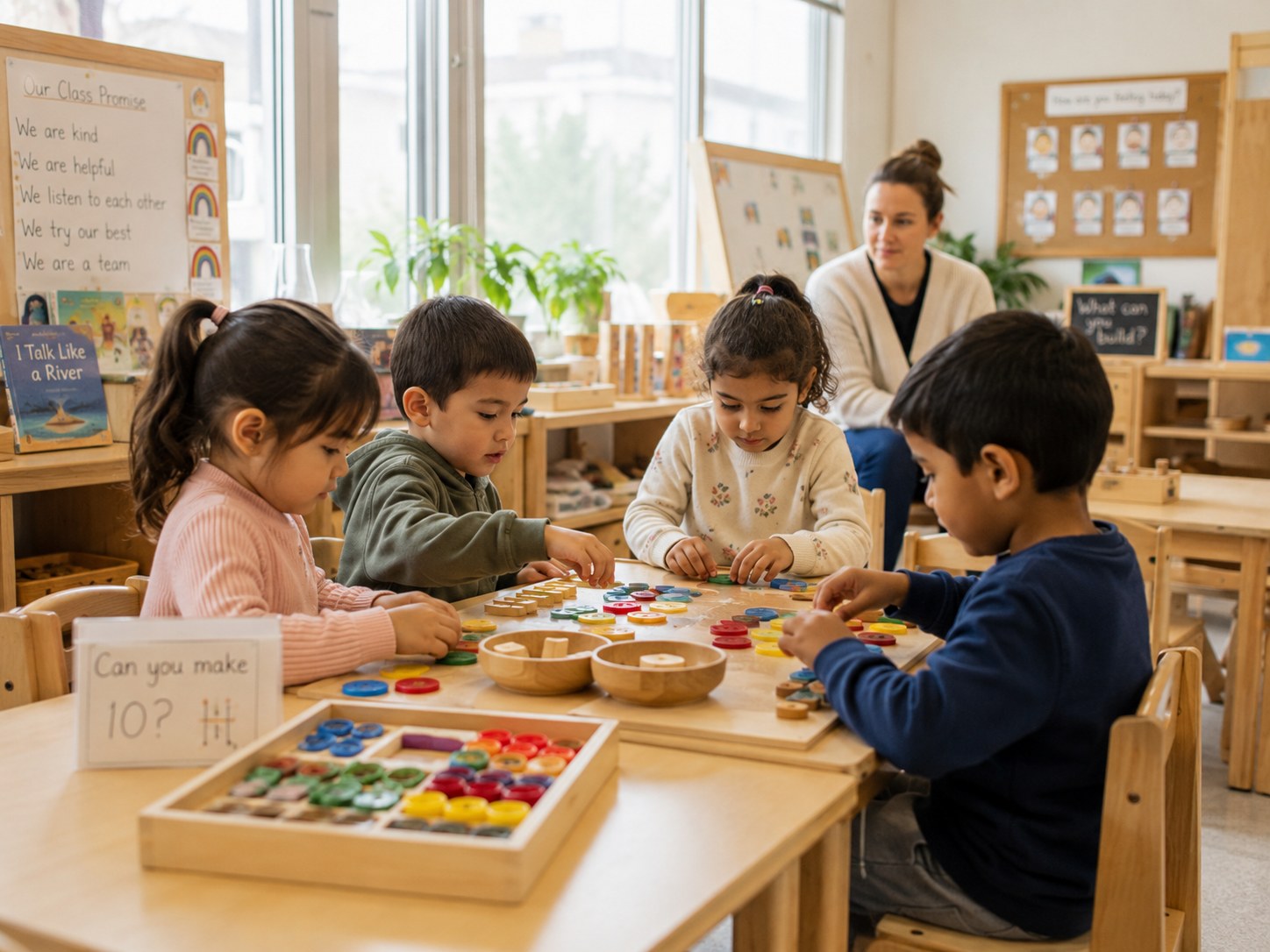
Walk into almost any early childhood classroom where engagement is low, and the pattern is consistent: children sitting passively while a teacher delivers information they’re not yet developmentally ready to process abstractly. The frustration is mutual. Teachers know the content. Children are capable learners. The missing element is often the medium — and this is precisely where well-designed learning toys change the outcome.
For schools, educational institutions, and toy brands sourcing at scale, the question isn’t whether learning toys matter. The more useful question is: which developmental mechanisms do learning toys activate, what does the evidence actually show, and how do buyers distinguish genuinely effective tools from products that merely look educational?
What the Evidence Says About Play-Based Learning
The developmental case for learning toys isn’t anecdotal. Jean Piaget’s theory of cognitive development established that children in the preoperational stage (ages 2-7) build understanding through direct manipulation of physical objects — not through listening or observation alone. Lev Vygotsky’s work on the Zone of Proximal Development extended this, demonstrating that children advance most effectively when interactive tools and guided play push them just beyond their current capability.
More recent classroom research has quantified these effects. A 2018 study published in Psychological Science found that children who learned mathematical concepts through structured hands-on materials demonstrated significantly stronger retention at follow-up testing compared to peers taught through symbolic instruction alone. The University of Denver’s Marsico Institute for Early Learning has documented that classrooms with high-quality manipulative-rich environments show measurably better outcomes in early numeracy and language development by the end of kindergarten.
These findings matter for procurement decisions because they establish a baseline: learning toys are not enrichment extras. In early childhood and primary settings, physical learning materials are the instructional medium most aligned with how children’s brains actually develop during these years.
The Core Developmental Skills Learning Toys Target
Different categories of learning toys address distinct developmental domains, and a procurement strategy that ignores this distinction typically produces a resource collection with redundancies in some areas and gaps in others.
Cognitive development is the most direct target. Learning toys that introduce counting, pattern recognition, sequencing, and early literacy build the foundational cognitive structures that formal academic instruction depends on. The critical design factor here is whether the toy produces genuine cognitive challenge — requiring the child to make decisions, test hypotheses, and adjust strategies — or simply rewards button-pressing with lights and sounds. The latter category is common in the mass-market toy space and consistently underperforms in educational outcomes.
Fine motor development is frequently underestimated in toy selection, yet it has direct academic consequences. Research from the American Journal of Occupational Therapy has linked fine motor proficiency in early childhood to later writing fluency, reading development, and academic performance. Learning toys that require precise manipulation — threading beads onto laces, assembling interlocking geometric pieces, placing small pegs into a pegboard — build the hand strength and bilateral coordination that classroom tasks demand. A child who lacks these foundations struggles not because of cognitive deficit but because the physical mechanics of learning activities create barriers.

Language and communication development accelerates when children have structured reasons to talk. Cooperative learning toys — games requiring players to explain their reasoning, describe what they’re building, or negotiate rules — create these conditions naturally. Open-ended construction sets and role-play materials are particularly effective here because they generate genuine communicative need rather than scripted interaction.
Social-emotional development has become a priority for many school systems following documented increases in self-regulation challenges among young children. Learning toys designed for group interaction teach children to manage shared resources, tolerate frustration, negotiate disagreement, and experience collaborative success. These outcomes are difficult to produce through direct instruction but emerge reliably through well-structured cooperative play.
STEM readiness deserves specific attention for buyers supplying curriculum-aligned materials. Early STEM learning toys develop observation skills, measurement concepts, spatial reasoning, and basic cause-and-effect understanding — the conceptual building blocks that formal science and mathematics instruction builds on from primary grades onward.
Open-Ended vs. Single-Outcome Design: Why It Matters in Practice
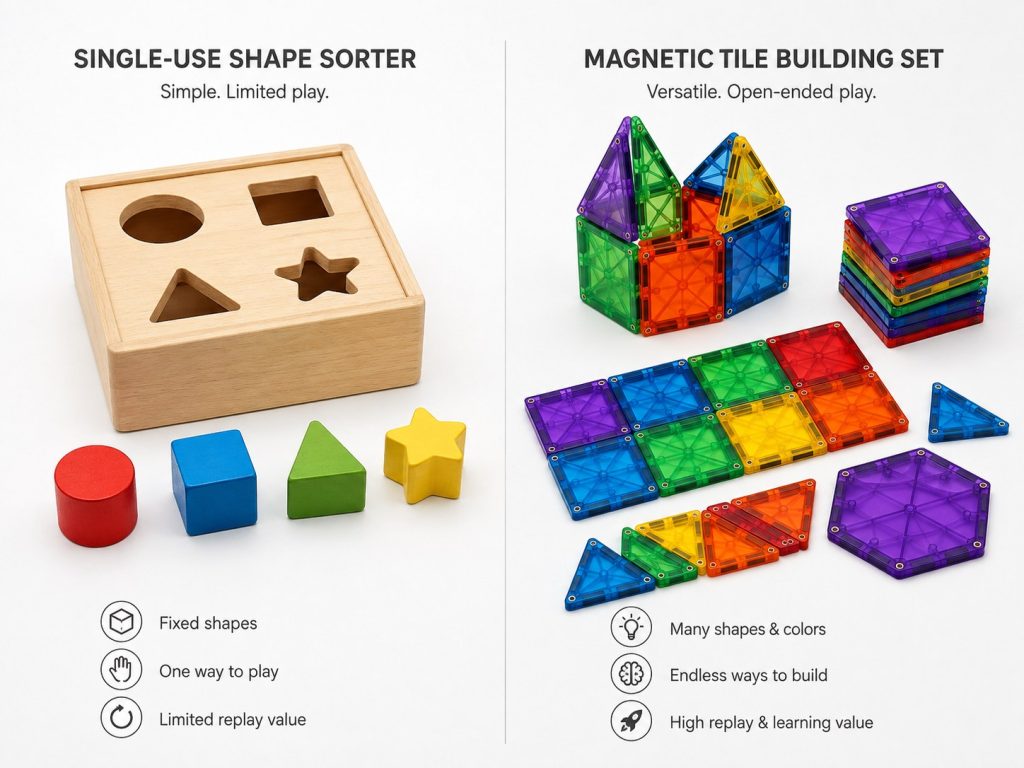
One of the most practically significant distinctions in learning toy design is between open-ended products and single-outcome products. Understanding this difference changes how buyers evaluate catalog options.
A single-outcome toy has one correct configuration or one predetermined result. A simple shape-sorter with fixed holes is an example: once a child has matched each shape correctly, the cognitive challenge is exhausted. These toys have genuine value at specific developmental moments — early shape recognition, for instance — but their classroom lifespan is short because children master them quickly and lose interest.
An open-ended learning toy supports multiple configurations, uses, and increasing complexity levels. A set of magnetic building tiles is a useful example: a three-year-old uses them to build simple flat shapes, a five-year-old constructs three-dimensional enclosures, a seven-year-old tests structural stability principles and explores geometric relationships. The same product serves meaningfully across a three-to-four-year developmental span because the challenge scales with the child’s capability.
For classroom procurement, the practical implication is significant. A school investing in open-ended learning toys gets sustained educational value across multiple cohorts. A school that fills its resource budget with single-outcome toys faces constant replacement cycles as children outpace the challenge level within weeks.
The comparison extends further. Consider two fraction learning products: a printed worksheet set where children circle the correct answer, versus a set of physical magnetic fraction pieces that children can physically overlay, compare, and rearrange to test equivalencies. Both address fractions. But the physical learning toy supports exploration, error correction, peer discussion, and conceptual discovery in ways the worksheet cannot. Teachers in classrooms using manipulative-based fraction resources consistently report fewer reteaching cycles — children build understanding rather than memorizing procedures they can’t apply flexibly.
How Learning Toys Function Across Different Educational Environments
The developmental role of learning toys shifts meaningfully depending on the educational context, and procurement decisions should reflect these differences rather than applying a one-size-fits-all approach.
In early childhood classrooms (ages 2-5), learning toys are not supplementary — they are the primary instructional medium. Piaget’s research established that children at this stage cannot reliably access abstract concepts without concrete physical experience first. Teachers in these environments need learning toys that support the full developmental range simultaneously: sensory richness, physical manipulation, language stimulation, and social interaction. Sorting sets, open-ended construction materials, simple puzzles with increasing complexity, and sensory play resources form the backbone of the learning environment.
In primary school classrooms (ages 5-8), learning toys shift toward supporting specific curricular objectives. Math manipulatives bridge the gap between concrete physical experience and the abstract symbolic representation that textbooks require. A child who has physically grouped and regrouped base-ten blocks understands place value in a way that a child who has only seen it written cannot easily replicate. The concrete-to-abstract learning progression — physical experience first, symbolic representation second — is well-supported in mathematics education research and directly informs what learning toys primary classrooms need.
In special education and inclusive settings, learning toys provide differentiated access points. Children whose learning profiles mean that standard auditory or visual instruction doesn’t reach them can engage with content through tactile and kinesthetic learning toys. This isn’t accommodation — it’s effective instructional design. The same toy that helps a child with dyslexia engage with phonics concepts serves as an enrichment tool for a typically developing peer working at a higher level.
For after-school programs and enrichment providers, learning toys with high independent engagement value are a practical necessity. These settings often involve mixed age groups, reduced adult supervision ratios, and less structured time. Learning toys that sustain child-directed exploration without constant facilitation — building systems, STEM investigation kits, collaborative games — are significantly more functional than teacher-dependent instructional materials.
What Separates Effective Learning Toys from Educational-Looking Products
The educational toy market includes a wide range of products, and the gap between genuinely developmental tools and items that simply carry educational labeling is wider than most buyers realize until they see classroom performance.
Developmental alignment is the first evaluation criterion. A product marketed for “ages 3-8” is almost certainly not optimally designed for any specific group within that range. Effective learning toys are built around what children at a defined developmental stage can do, what they’re ready to learn next, and what challenge level sustains engagement without producing frustration. Piaget’s stage framework provides a useful reference: a toy designed for preoperational learners should support symbolic play and classification; one designed for concrete operational learners should engage logical reasoning and conservation concepts.
Manufacturing precision affects learning outcomes in ways that procurement teams often overlook. A magnetic fraction set where the pieces don’t align accurately teaches children imprecise proportional relationships — the physical experience contradicts the mathematical concept the teacher is trying to build. A counting set where the components vary in size creates inconsistent tactile feedback. Quality control in learning toy production is not just a durability issue; it’s an educational integrity issue.
Teacher usability determines real-world deployment rates. A learning toy that requires complex setup, constant adult intervention, or significant preparation time will not be used consistently regardless of its developmental quality. The most effective learning toys are designed for quick introduction, independent child use, and minimal facilitation — allowing teachers to observe, assess, and target their support rather than managing logistics.
Supplier educational expertise signals product quality. A manufacturer who can articulate the developmental rationale behind their design decisions — why a specific material was chosen, why a particular size supports the target age group’s grip development, how the product sequence builds skills progressively — has invested in genuine educational development. A supplier who describes products primarily in terms of material and appearance has not.
How Vindstier Approaches Learning Toy Development
Vindstier’s product development process begins with the learning outcome, not the product concept. Before design begins, the developmental need is specified: which skills the product targets, which stage it serves, and what the realistic classroom application looks like across a semester of use.
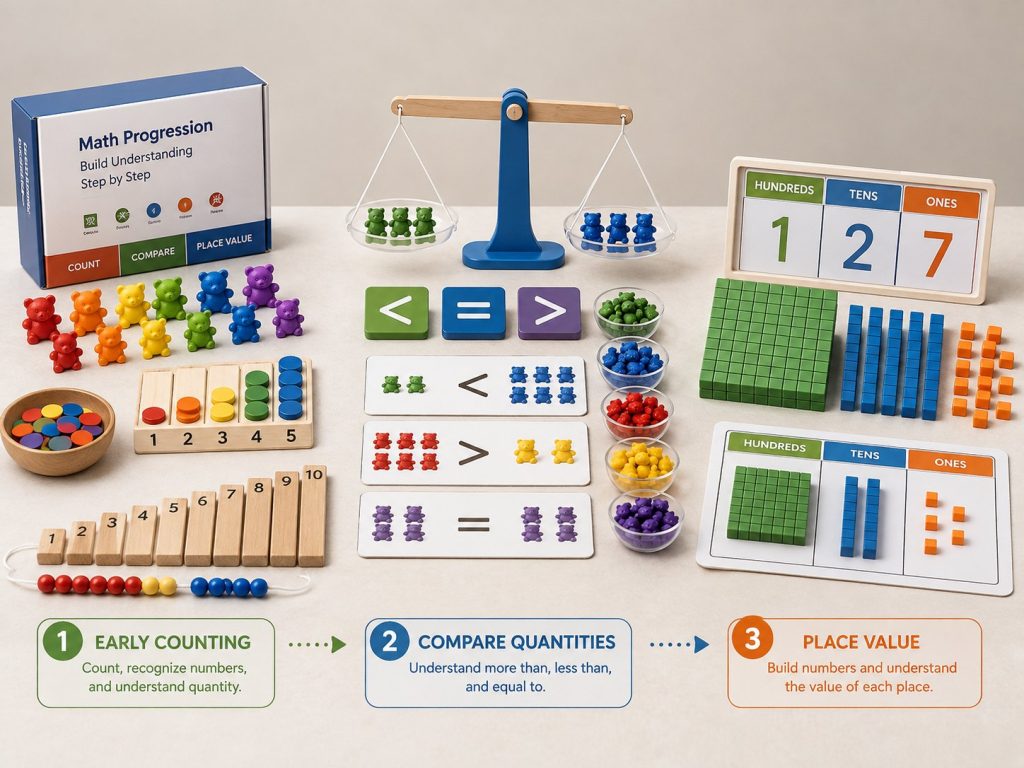
This approach is reflected in how Vindstier’s learning toy ranges are structured. Rather than individual products designed in isolation, each category is built as a developmental progression. The early numeracy range, for example, moves from concrete counting and sorting materials for ages 3-4, through quantity comparison and simple addition tools for ages 5-6, to place value and early arithmetic manipulatives for ages 6-8. A school purchasing across this range isn’t acquiring disconnected items — they’re investing in a resource system that supports consistent mathematical development across three grade levels.
For brands and distributors building their own educational product lines, Vindstier offers OEM and ODM capabilities grounded in this same developmental design process. The difference between a manufacturing partner who understands child development and one who produces to specification without educational context becomes apparent in classroom performance data and in the feedback teachers provide within the first semester of use.
The broader challenge in the learning toy industry is that manufacturing capacity is widely available but educational design knowledge is not. Products that are visually similar and comparably priced can perform very differently in practice depending on whether developmental intent informed their design from the beginning.
A Practical Evaluation Framework for Institutional Buyers
Schools and educational institutions making procurement decisions on learning toys benefit from a consistent evaluation framework rather than relying on catalog descriptions or sales presentations alone.
The core questions worth applying to any learning toy under consideration: Does the product target a specific developmental stage with clear rationale, or does it use a broad age range as a proxy for versatility? Is there a documented learning progression — either within the product itself or across a product series? How does the toy perform after repeated use across a full semester, not just in initial novelty sessions? Can the supplier provide curriculum alignment documentation and classroom activity guidance? Does the product meet relevant safety certifications for the intended institutional environment?
Applying this framework consistently shifts procurement decisions from aesthetic and price-driven choices toward outcomes-driven investment — which is the standard that genuinely serves children, teachers, and institutional budgets over the long term.
Conclusion
The developmental case for learning toys is well-established, and the evidence base continues to strengthen. What remains genuinely challenging is the evaluation and selection process — distinguishing tools designed with developmental rigor from products that occupy the same shelf space without delivering comparable educational value.
For teachers, school buyers, and educational product brands, the criteria that matter most are developmental alignment, design quality, classroom usability, and supplier expertise. Learning toys that meet this standard don’t just keep children engaged; they build the cognitive, physical, social, and early academic skills that determine how ready children are for the formal learning demands ahead.
Institutions and brands looking for learning toys developed with genuine educational depth — and manufacturing partners capable of supporting their own product line development — are welcome to connect with Vindstier directly.