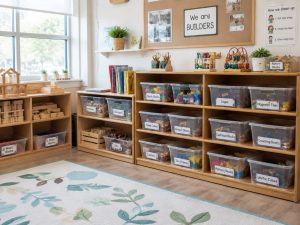
By 8:15 on a Tuesday morning, one preschool teacher has zipped eleven coats, poured eighteen cups of juice, and wiped three tables. The children stand in line and wait. In this room, adults handle everything that involves water, buttons, or breakable objects, so the children have learned that waiting is their job.
Montessori practical life activities exist for exactly this problem. They rebuild the everyday tasks adults rush through — pouring, sweeping, buttoning, food preparation — as slow, child-sized work with its own tools and its own shelf. A well-prepared shelf changes who does the work of the classroom and, over months, what children believe they can do alone.
This guide covers what the approach builds, which tasks belong on the shelf, how to size them by age, and how to keep materials usable through a school year of shared handling. It is written for teachers setting up a first shelf and for program directors weighing what to buy.
Why Practical Life Work Comes Before Academics
Practical life work is not a warm-up before the real curriculum; in a Montessori classroom, it is the first curriculum.
Maria Montessori built her earliest classrooms around daily living exercises rather than letters and numbers. She observed that children between two and six are driven to master the real work they watch adults do, and that this drive peaks before academic interest stabilizes. Modern research has since tested Montessori daily living activities at program scale.
A three-year longitudinal study followed 141 preschoolers who won or lost a public-Montessori admissions lottery in Hartford, Connecticut. Angeline Lillard and colleagues at the University of Virginia (2017, Frontiers in Psychology) reported that Montessori children outperformed peers on academic achievement, social understanding, and mastery orientation. They also scored higher on executive function at age four.
The Executive Function Connection
Every practical life task is a small executive function workout.
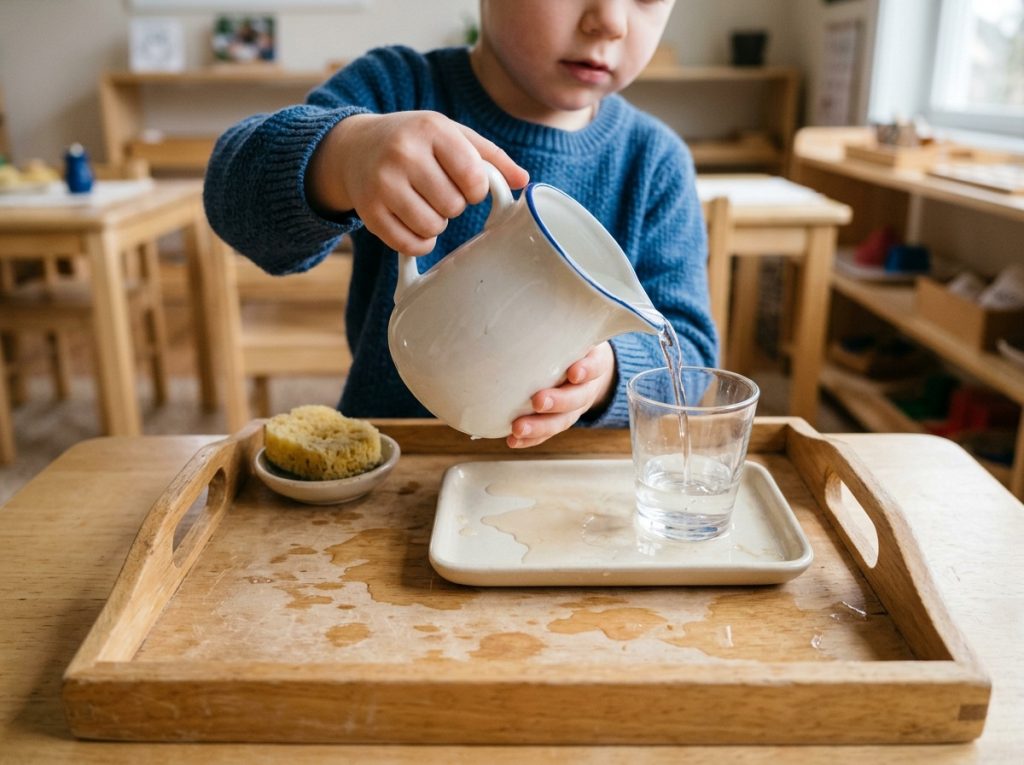
Table washing is the classic example. The child gathers a pitcher, basin, sponge, and soap, then wets, wipes, rinses, and dries before returning everything to its place. That sequence loads working memory, planning, and inhibitory control — the three components the Harvard Center on the Developing Child identifies as core executive function skills.
The design does the correcting, not the adult. A pitcher tilted too far spills visibly. A lid that will not close signals the wrong container. Children adjust their own movements mid-task, which builds the self-monitoring loop that later reading and math depend on.
What Fine Motor Practice Predicts
Fine motor work in the preschool years has measurable downstream value.
Pouring, tweezing, buttoning, and slicing train the precise grip and two-handed coordination that handwriting requires. The association reaches further than the pencil. A Georgetown University team (Cortes et al., 2022, Developmental Psychology) found that fine motor skill at 42 months predicted visuospatial deductive reasoning in adolescence, more than a decade later.
That finding is correlational, and this guide treats it as such. The practical case still stands on its own: daily living tasks deliver high-repetition fine motor practice inside activities children already choose, a combination drill worksheets rarely match.
What Counts as a Practical Life Activity
The test is simple: if adults do it to keep life running, it can be rebuilt as child-sized work.
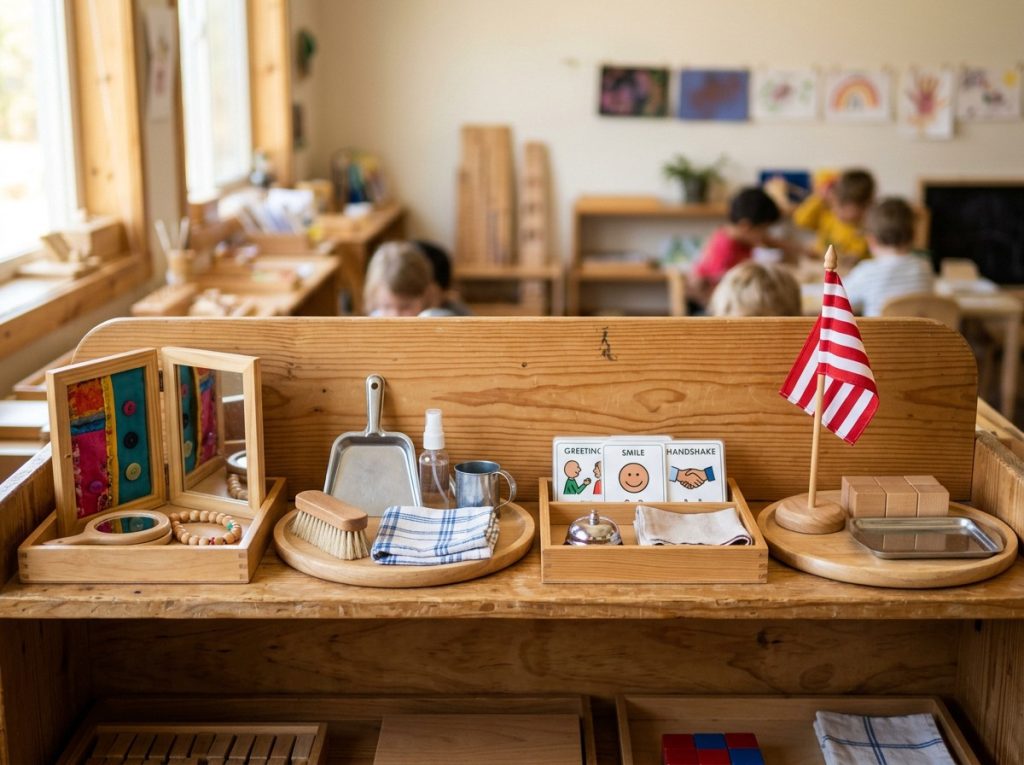
Montessori training programs organize Montessori practical life activities into four domains, and the structure is useful well beyond Montessori schools. Each domain trains different movements and different habits, so a balanced shelf draws from all four.
Care of Self
Dressing frames, hand washing, nose wiping, hanging a coat, pouring a personal drink. These tasks answer the toddler’s earliest demand — to do it without help. Success looks like a child who replaces “do it for me” with “watch me.”
Care of the Environment
Table washing, plant watering, sweeping crumbs, sorting and returning materials to their shelves. Sorting deserves special mention; it is why sorting work anchors so many Montessori classrooms. A child who restores the room learns that the space belongs to the people who maintain it.
Grace and Courtesy
Greeting a visitor, asking to watch a classmate’s work, passing scissors handle-first, walking around another child’s mat. These small scripts give preschoolers concrete language for situations that otherwise end in grabbing.
Control of Movement
Walking along a taped line while carrying a small flag, sitting without knocking over a chair, moving between tables without stepping on a work mat. Movement tasks look like games. They build the body awareness that keeps a working room calm.
Sizing Tasks for Toddlers Versus Preschoolers
The same task scales across ages; only the precision and the tools change.
A toddler pours dry beans between two jugs. A five-year-old pours water to a fill line. Both are pouring, and the progression below raises difficulty one step at a time.
| Skill | Toddler version (18 months–3 years) | Preschool extension (4–6 years) |
| Pouring | Dry beans between two small jugs | Water to a fill line, then into glasses |
| Transferring | Large pieces moved by hand | Small beads with tongs or tweezers |
| Sorting | Fruit pieces by color | By color, then by size, then stacked |
| Food preparation | Washing fruit, peeling a banana | Slicing a banana with a crinkle cutter |
| Cleaning | Wiping a table with a damp cloth | Full wash cycle with soap and rinse |
Everyday Living Skills for Toddlers: Where to Start
Whole-hand movements come first. Pieces should be large enough to grip, containers light enough to carry one-handed, and each task reduced to a single visible step. Expect five to ten minutes of attention, and design the tray so an abandoned attempt still returns to the shelf complete.
Extensions for Four and Five Year Olds
Older preschoolers are ready for multi-step sequences and real consequences. Serving snack to a small group combines portioning, carrying, and social negotiation in one task. Writing a label for the plant-watering jug adds a literacy layer to familiar work. Extensions add steps, not speed.
Setting Up Montessori Practical Life Activities on a Classroom Shelf
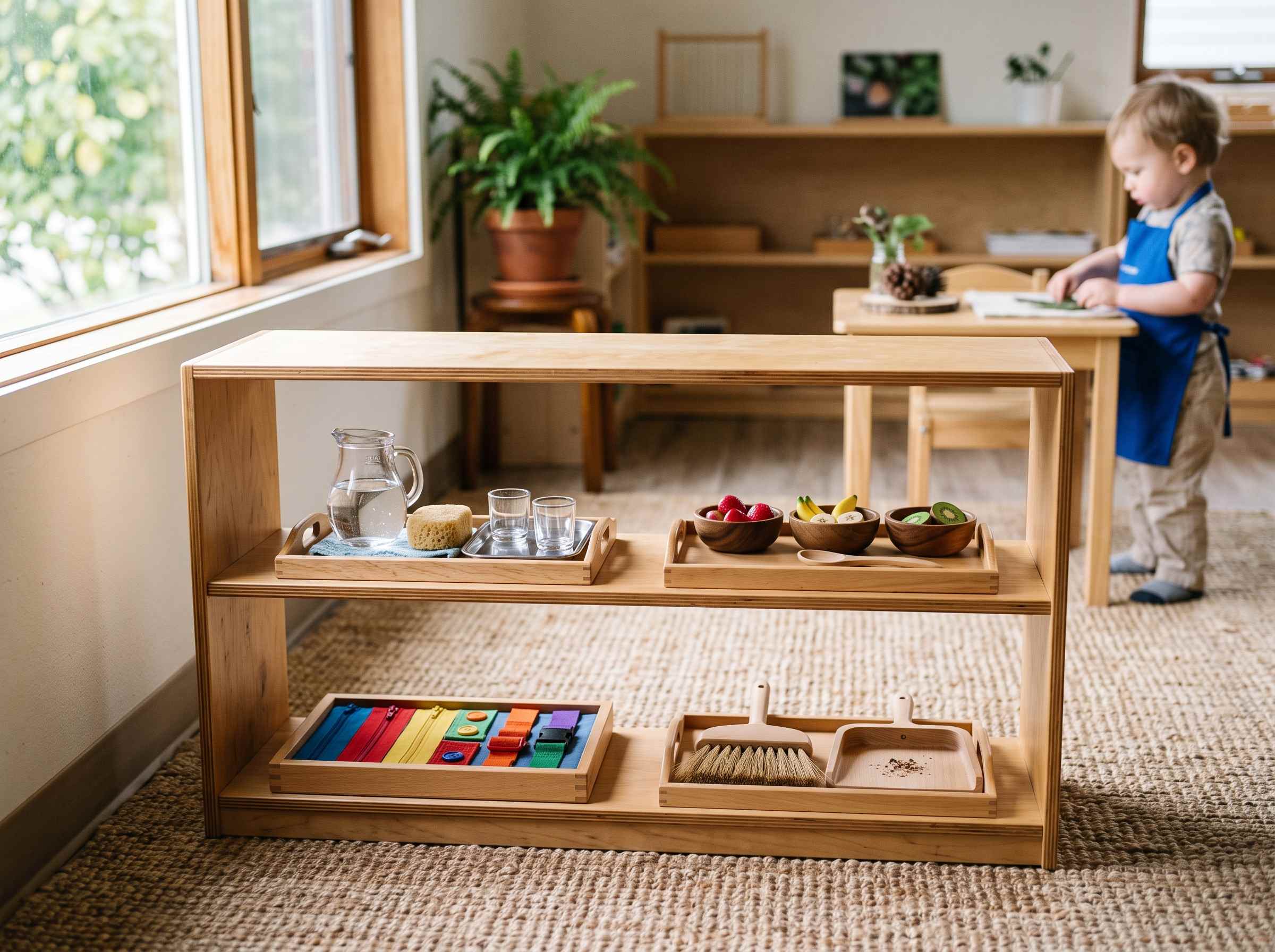
A shelf that runs itself has three properties: one skill per tray, a visible start and end, and errors a child can see and fix.
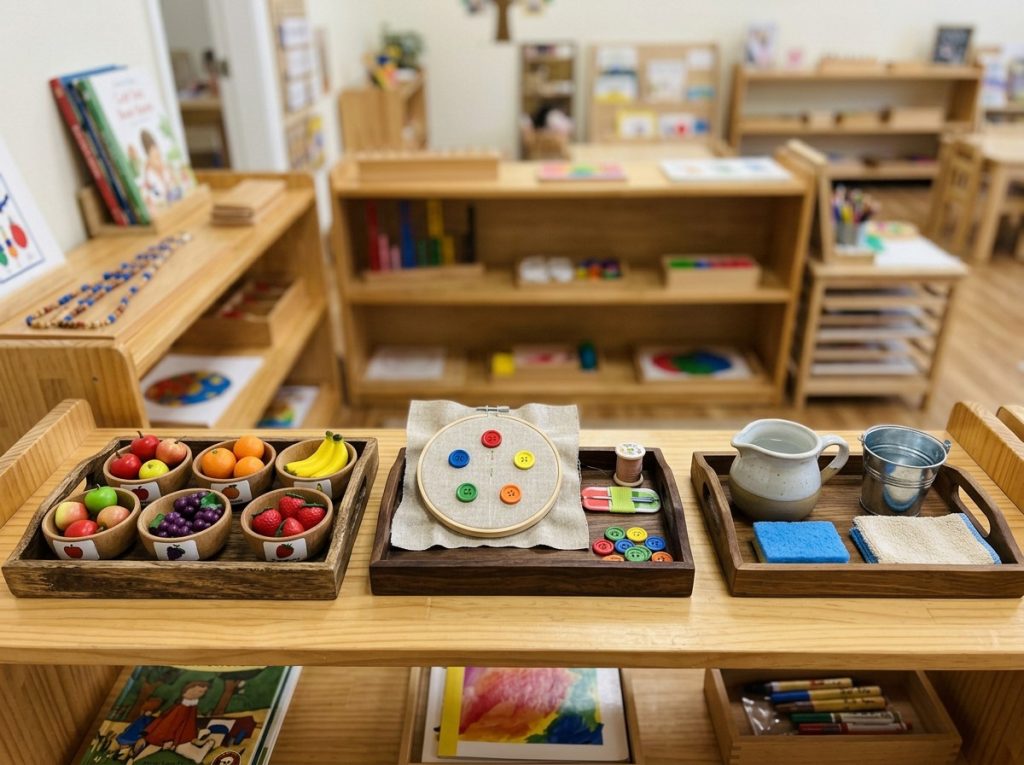
Practical life shelves for preschool classrooms stay low, open, and within a child’s reach.
One Skill, One Tray
Each tray holds a complete activity — two small jugs and a bowl of beans, or one basket of fruit pieces and two sorting bowls. The child carries the whole tray to a table and carries it back when finished.
Completeness makes independence possible. A missing piece ends the work cycle and starts an adult hunt.
Building In Control of Error
Design the material so the mistake announces itself. A spill shows against the tray edge. A lid that fits only one container removes the guessing.
A fill line drawn inside the glass makes “enough” visible. Every self-corrected mistake is a repetition no adult had to supervise.
A Rotation Cadence That Holds Attention
Refresh two or three trays each week rather than swapping the whole shelf. Children return to familiar work to consolidate skill, then reach for the new. The same logic drives an established Montessori toy rotation system, and the mechanics transfer: retire what is ignored, refresh what is nearly mastered.
Materials That Survive a School Year
In a shared classroom, material choice is a hygiene decision as much as a pedagogical one.
Wood, Metal, and Washable Textiles
Sealed wood, stainless steel, ceramic, and washable cloth are the working materials of a practical life shelf. Montessori tradition favors real breakables — a dropped ceramic jug teaches more than a dropped plastic one — though many toddler rooms start with heavier, less fragile options.
What matters is that the material responds honestly. Weight, texture, and fragility are part of the lesson.
Cleaning Routines for Shared Materials
Shared tools need a schedule, not good intentions. A risk-based cleaning routine tested against flu season assigns mouthed items to after-each-use sanitizing and shelf items to daily wiping. Wooden pieces with dents or cracked sealant should rotate out for refinishing, because damaged coatings trap moisture and resist sanitizing.
When Standardized Sets Beat Piecemeal Sourcing
A shelf built from kitchen shops and craft stores can work — and it usually looks like it.
Mismatched jug sizes change the pour difficulty mid-set. A replacement bowl from a different batch sits at a different height. Pieces retire at different rates, and the control of error quietly breaks. Programs that scale beyond one classroom tend to standardize for exactly this reason.
One education-focused manufacturer shows how batch logic transfers to this setting. Vindstier runs wood CNC production alongside child-safe plastic, magnetic, and printed-paper lines under a single ISO 9001 system, and applies the same batch discipline to its education sets. Its wooden fruit sorting and stacking set keeps piece dimensions consistent across production runs, so a replacement piece matches the rest in size and finish.
In the classroom, the set covers the sorting and transferring domain from the toddler table to the preschool shelf. For program buyers, SKU-level CPC and CE documentation plus seven-to-fourteen-day sampling turn a pilot set into a normal purchasing step rather than a special request.
What Consistent Batches Buy a Program
Consistent dimensions keep the control of error intact when pieces are replaced. Matching sets across classrooms let teachers rotate materials without re-teaching a slightly different tool. Predictable reorder availability protects a shelf that took a full term to build.
Questions to Ask a Supplier
Before committing a budget, buyers typically ask four things:
- Is certification documented per SKU, with test reports a program can file?
- Can samples arrive within two weeks for classroom piloting?
- Are individual pieces replaceable, or does one lost piece retire the set?
- Will the same specification be available when next term’s order is placed?
What the Research Does and Does Not Show
The evidence is stronger for Montessori programs than for any single shelf.
Evidence Limits Worth Knowing
The Hartford study measured whole classrooms, not isolated practical life shelves, so it cannot separate daily living work from mixed-age grouping or teacher training. It followed two magnet schools in one high-poverty city, which limits how far the numbers travel. The Georgetown fine motor finding is correlational — longitudinal and strong, but not proof that tweezing causes better reasoning.
None of this makes the approach suspect. It makes precise claims about mechanism premature.
A Common Misuse of Practical Life
The most frequent misuse is turning the shelf into a chore roster. Practical life work is process-oriented: the point is the child’s cycle of choosing, repeating, and restoring, not a clean table produced at adult speed. Forcing participation, or having staff reset trays overnight to keep the shelf immaculate, removes the feedback loops that make the method work. The work also supports typical development only — it cannot substitute for professional evaluation where motor or developmental delays are a documented concern.
Starting Montessori Practical Life Activities in One Week
A first shelf is a five-day project, not a semester rebuild.
Days One to Five at a Glance
- Day one: place the shelf, lay out three trays, and present each one at circle time.
- Day two: teach carrying and returning only, with empty trays if needed.
- Day three: let work happen and observe without correcting, unless safety is at stake.
- Day four: add one harder tray and retire anything ignored twice.
- Day five: note which child returned to which tray without prompting.
How to Tell It Is Working
Watch the cycle, not the product. A working shelf shows children who fetch, complete, and return a tray without reminders. Spill rates drop week over week. Requests shift from “do it for me” to “watch me,” and teachers spend less energy managing routine and more presenting the next step.
Montessori practical life activities earn their shelf space the way any curriculum does: through what children can do afterward. A modest start — three trays, one week, close observation — beats an ambitious launch the staff cannot sustain. Scale by watching children rather than the calendar, and the shelf becomes the room’s quiet engine of independence.