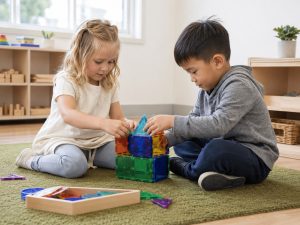
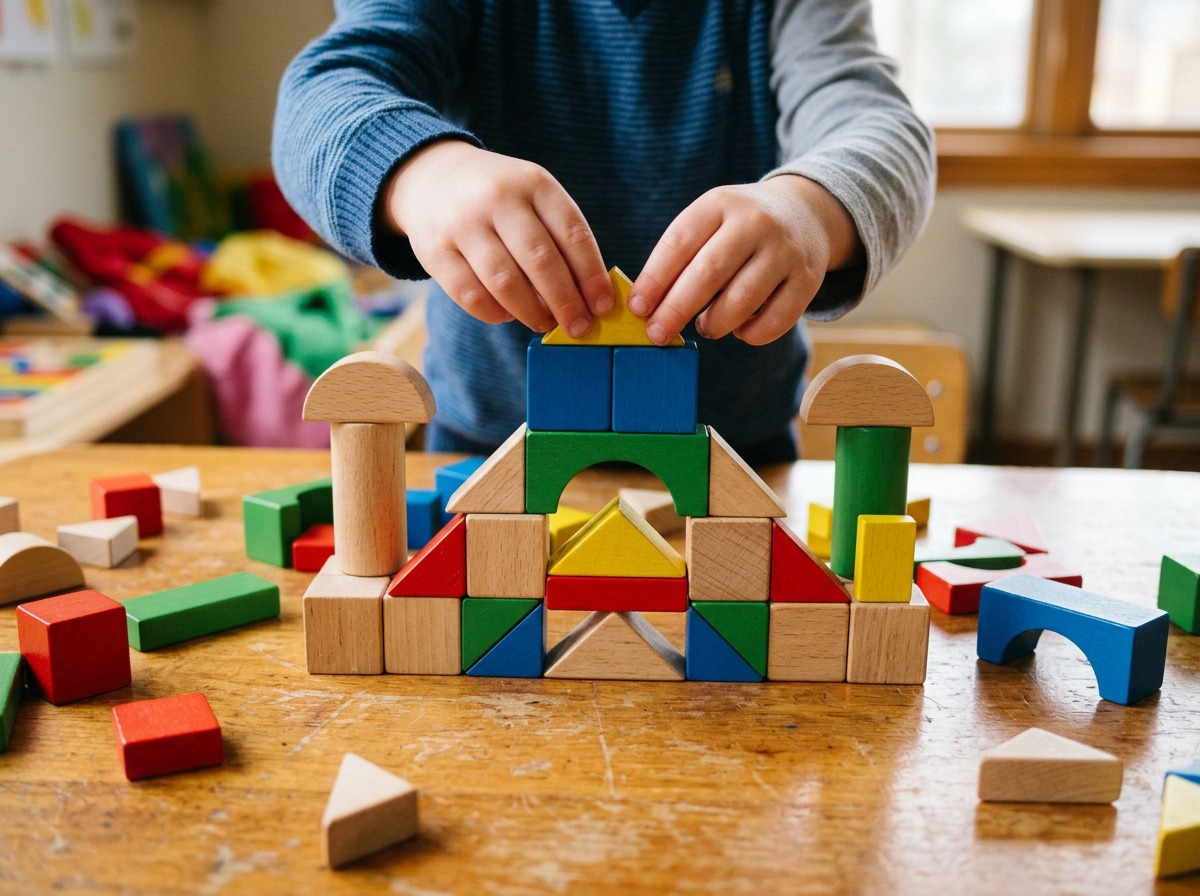
Preschool teachers assembling block structures with four-year-olds rarely connect this activity to later mathematics achievement. Yet research from the University of Chicago found that preschoolers who demonstrate stronger spatial assembly skills — the ability to reproduce block structures from models — score 23% higher on first-grade mathematics assessments, controlling for verbal ability and socioeconomic factors (Verdine et al., 2014, Child Development). The finding reframes a common classroom activity: when children manipulate spatial reasoning toys, they are not merely playing with blocks. They are building the cognitive architecture that underpins geometry, measurement, and scientific thinking for years.
The Research Connecting Spatial Skills to STEM Achievement
Spatial reasoning — the capacity to mentally manipulate, rotate, and transform objects and their relationships — has emerged as one of the most reliable preschool predictors of long-term STEM outcomes. A meta-analysis synthesizing 206 studies (Uttal et al., 2013, Psychological Bulletin) established two critical findings: spatial skills are malleable through targeted training at ages as young as three, and this training produces durable transfer to mathematics performance.
The mechanism involves what cognitive scientists describe as spatial-to-conceptual mapping. When children physically rotate puzzle pieces, construct three-dimensional structures, or trace paths through mazes, they internalize spatial properties — symmetry, proportion, orientation, scale — that later scaffold abstract mathematical reasoning. A child who discovers that two triangles form a square through hands-on manipulation develops a geometric understanding that worksheets alone cannot produce.
The National Council of Teachers of Mathematics (NCTM) identifies spatial reasoning as one of four foundational geometry strands, beginning in prekindergarten. Children who enter formal schooling with strong spatial vocabularies — words like beside, above, between, behind, corner, edge — demonstrate faster acquisition of measurement concepts and fraction understanding.
Why Existing Classroom Activities Miss the Connection
Many preschool programs treat block play and puzzle time as unstructured free choice rather than intentional spatial learning. Teachers document social interactions and behavioral outcomes during these periods but rarely observe or scaffold spatial thinking specifically. The result is a missed opportunity: children engage with building blocks daily, yet the developmental assessment and targeted vocabulary that would convert play into measurable spatial growth remain absent from most program designs.
What Spatial Reasoning Involves in Early Childhood
Spatial reasoning is not a single ability but a cluster of related capacities that develop along distinct timelines. Understanding these components helps educators select materials that target specific gaps rather than assuming all construction play produces equivalent outcomes.
Mental Rotation
Mental rotation — the ability to envision how an object appears from different angles without physically moving it — predicts performance on geometry tasks and physics problem-solving. Children develop this capacity through physical manipulation first, then gradually internalize the rotation as a mental operation. Spatial reasoning toys requiring children to match rotated shapes, fit pieces in multiple orientations, and predict whether objects will fit into spaces all strengthen mental rotation through repeated physical practice.
Spatial Visualization
Spatial visualization involves multi-step mental manipulation — imagining how multiple objects fit together, how folding changes a shape, or how a two-dimensional pattern appears in three dimensions. This capacity underpins engineering thinking, architectural planning, and data visualization. Spatial reasoning toys that require children to combine shapes into complex designs directly train spatial visualization through repeated trial-and-error assembly. Magnetic pattern blocks serve this function when children must mentally plan a design before physically executing it.
Spatial Orientation
Spatial orientation — understanding one’s position relative to objects and navigating environments — develops through both large-body movement (obstacle courses, treasure hunts) and small-scale manipulation (maze toys, path-following games). Children who struggle with spatial orientation often show difficulty with left-right discrimination and map-reading tasks in early elementary grades.
Spatial Perception
Spatial perception — judging relationships between objects without mental transformation — develops earliest and underlies the other three components. Spatial reasoning toys that require size comparison, shape classification, and visual discrimination build this foundational perception capacity across the preschool age range.
How Spatial Reasoning Toys Target Different Capacities
The design of spatial reasoning toys determines which cognitive components they activate. Understanding this mapping helps teachers and program directors select materials that address specific developmental profiles rather than relying on generic construction sets.
Construction and Building Toys: Mental Rotation and Visualization
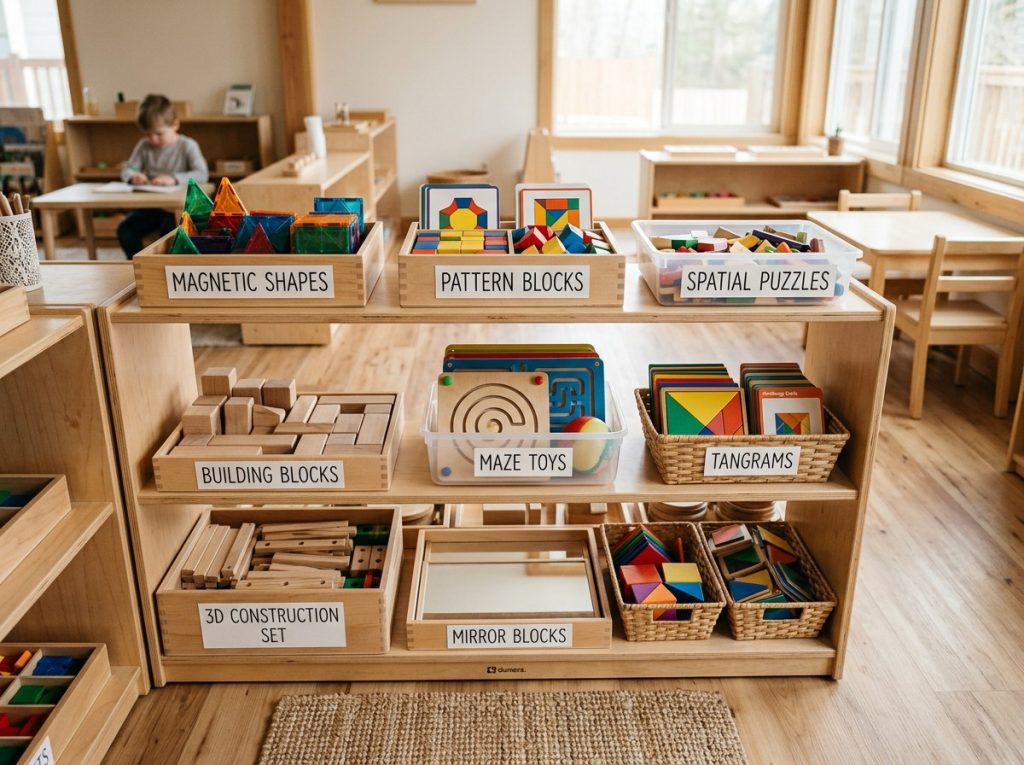
Open-ended building systems — wooden blocks, magnetic tiles, modular construction sets — offer the richest spatial training because they require children to mentally rotate components before placing them, visualize completed structures before building, and adjust designs when physical reality contradicts mental plans. These spatial reasoning toys reward persistence with tangible structural feedback that reinforces iterative thinking. Research from Temple University (Casey et al., 2008) demonstrated that girls who engaged in structured block play over six months narrowed a pre-existing spatial reasoning gender gap by 33%, suggesting that material selection can directly address observed skill disparities.
Maze and Path-Finding Toys: Spatial Orientation
Maze toys require children to plan multi-step paths, hold mental maps of visited routes, and adjust when paths lead to dead ends. These activities train spatial orientation and working memory simultaneously. Maze toys that incorporate magnetic wands or sliding mechanisms add a fine motor component, making them dual-purpose materials for programs with limited shelf space.
Pattern and Tessellation Toys: Spatial Visualization
Magnetic pattern blocks, tangram sets, and tessellation puzzles require children to decompose complex figures into components and compose new designs from geometric primitives. These spatial reasoning toys make abstract geometric relationships tangible through hands-on assembly, building the decomposition-composition cycle fundamental to fraction understanding, geometric proof, and data representation in later mathematics.
Sorting and Classification Toys: Spatial Perception
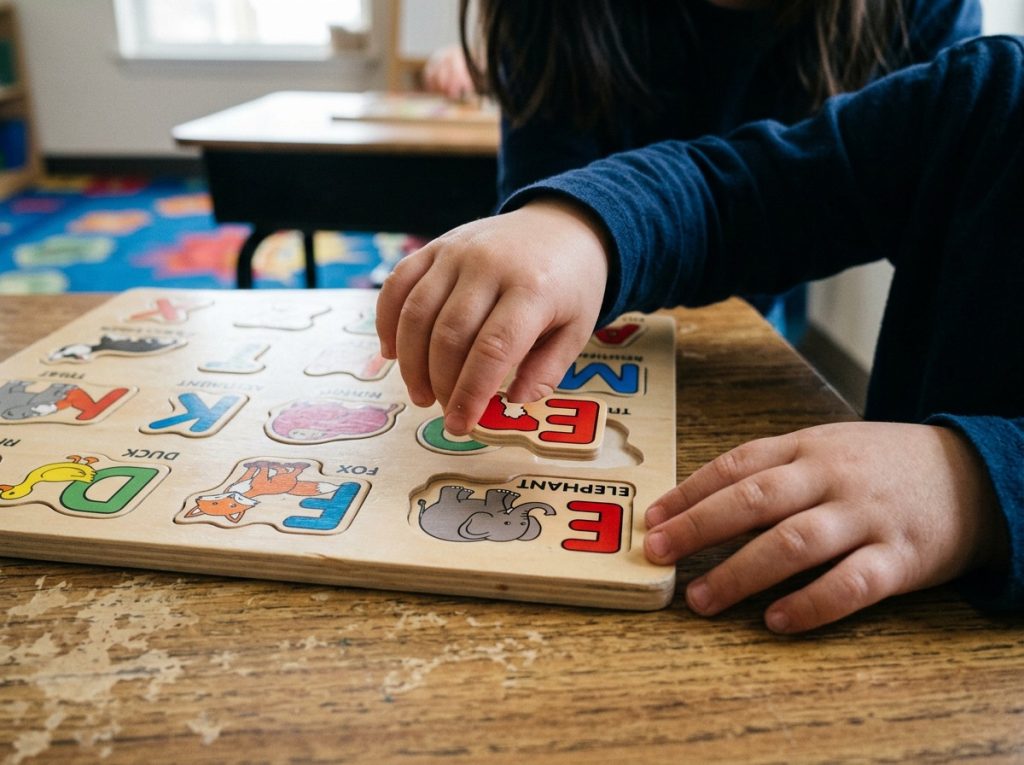
While sorting toys are primarily associated with categorical thinking, their spatial component — comparing sizes, matching shapes to slots, distinguishing mirror-image forms — develops the foundational spatial perception that supports all higher-order spatial operations. Programs that treat sorting toys as solely “math readiness” materials overlook their spatial development function.
Developmental Progression of Spatial Thinking Ages 3 to 6
Spatial reasoning develops through predictable stages, though individual timing varies based on exposure frequency, material variety, and neurological maturation.
| Age Range | Spatial Capacity | Observable Milestones | Toy Categories That Target This Stage |
|---|---|---|---|
| 3–3.5 years | Spatial perception | Matches identical shapes; sorts by size; completes 4–6 piece inset puzzles; stacks blocks vertically | Shape sorters, large-piece puzzles, stacking toys |
| 3.5–4.5 years | Emerging mental rotation | Completes puzzles requiring piece rotation; builds from 2D models; copies simple block patterns | Magnetic pattern blocks, tangrams, construction sets with visual guides |
| 4.5–5.5 years | Spatial visualization | Builds 3D structures from photos; creates symmetrical designs; solves multi-step maze paths | Complex building systems, advanced mazes, modular construction |
| 5.5–6 years | Integrated spatial thinking | Draws simple maps; explains spatial relationships verbally; predicts whether pieces will fit before trying | Advanced pattern blocks, tabletop strategy games, 3D construction kits |
Teachers should note that chronological age serves as a rough guide only. A four-year-old with extensive block-play experience may demonstrate spatial visualization skills typical of five-year-olds, while a five-year-old with limited manipulation exposure may perform at the three-year-old level. Observation-based assessment — rather than age-based assumptions — should drive material selection. Selecting spatial reasoning toys matched to observed developmental stage, not chronological age, ensures each child encounters appropriately challenging materials that sustain engagement.
Classroom Implementation: Integrating Spatial Reasoning Into Daily Routines
Effective spatial development requires intentional integration rather than isolated block-play periods. Three implementation strategies produce measurable outcomes.
Teacher Questioning Strategies
The language teachers use during spatial play determines whether children develop spatial vocabulary alongside motor skills. Research from the University of Chicago (Pruden and Levine, 2017) found that children whose teachers used spatial terms — corner, edge, middle, behind, between, rotate, flip — during block play showed significantly stronger spatial vocabulary and reasoning at age four compared to peers whose teachers used generic terms (put it there, move it over). When spatial reasoning toys are paired with deliberate teacher narration, children develop geometric vocabulary and manipulation skills simultaneously rather than in isolation. Teachers should narrate spatial properties during play rather than reserving geometric vocabulary for formal lessons.
Sustained Block Play Duration
Brief free-play periods of 10–15 minutes produce limited spatial gains. Research from the National Association for the Education of Young Children indicates that spatial reasoning benefits from sustained engagement — sessions of 25–35 minutes allow children to cycle through exploration, experimentation, revision, and mastery. Spatial reasoning toys deliver maximum developmental value when children have uninterrupted time to plan, build, test, and revise. Programs should structure schedules to accommodate extended manipulation periods rather than fragmenting play into short rotations.
Documentation and Formative Assessment
Teachers document spatial development by photographing children’s structures weekly, noting whether constructions increase in complexity (number of components, symmetry, three-dimensionality), and recording spatial vocabulary usage during play. These records directly inform rotation decisions and identify children who need additional spatial exposure.
Selecting Spatial Reasoning Toys: Quality Criteria for Educators and Buyers
Program directors and purchasing managers evaluating spatial reasoning toys for institutional use should assess materials against specific functional criteria.

Geometric precision. Quality spatial reasoning toys present geometrically accurate forms with clearly defined edges, correct angles, and proportions matching standard definitions. Poorly manufactured shape sorters featuring “squares” with rounded corners or “triangles” with unequal sides teach incorrect spatial concepts that require later correction. Solid wood construction maintains shape accuracy through years of handling that plastic alternatives may deform under.
Open-ended design capacity. Materials that support multiple assembly configurations — rather than single-solution puzzles — provide greater spatial training value per unit cost. A magnetic pattern blocks set that allows free design, guided model replication, and progressive tessellation challenges serves three learning purposes within one product.
Progressive complexity. Quality spatial reasoning toys offer built-in difficulty progression. The same material set should serve a three-year-old sorting by shape and a five-year-old creating symmetrical tessellation patterns. This progression extends classroom lifespan and justifies higher per-unit investment.
Safety and compliance documentation. Materials for children under three require CPC certification (US) and CE/EN71 compliance (EU). Even for 3+ products, per-SKU third-party test reports verify mechanical integrity and surface coating safety. Buyers should request per-SKU documentation rather than accepting catalog-level certificates.
Multi-child durability. Classroom materials withstand 200+ handling cycles weekly. Joining mechanisms — magnetic connections, interlocking tabs, threaded components — must maintain function after repeated assembly and disassembly. Surface finishes must resist chipping from drops and withstand cleaning chemicals without degradation.
Programs sourcing materials at scale can request OEM services with per-SKU CPC and CE certification packages, streamlining procurement compliance while ensuring consistent quality across classroom sets.
Common Misconceptions About Spatial Development
“Spatial Skills Are Innate and Fixed”
The Uttal et al. (2013) meta-analysis directly refutes this assumption. Across 206 studies, targeted spatial training produced effect sizes of 0.62 standard deviations — equivalent to moving a child from the 50th to the 73rd percentile. Spatial skills are among the most malleable cognitive capacities in early childhood, and material selection directly influences development.
Screen-Based Spatial Games Substitute for Physical Manipulation
Tablets and apps offering rotation and puzzle activities engage visual-spatial processing but lack the proprioceptive feedback that solidifies spatial learning. When a child physically picks up, rotates, and places a wooden block, tactile and kinesthetic signals reinforce the spatial concept in ways that touch-screen swiping cannot replicate. Physical materials remain irreplaceable for foundational spatial development.
“Gender Determines Spatial Potential”
Research consistently shows that observed gender differences in spatial skills reflect differential exposure rather than innate capacity. Studies controlling for block-play frequency find no significant gender differences in spatial reasoning outcomes. The Casey et al. (2008) intervention study demonstrated that targeted block play eliminates pre-existing gender gaps within six months.
Applicable Boundaries and Limitations
Spatial reasoning toys support but do not constitute a complete mathematics readiness program. Two limitations require attention.
First, the research connecting spatial skills to STEM outcomes, while robust in its correlational strength, does not establish that spatial training alone causes improved mathematics scores. Children who engage extensively with spatial reasoning toys also tend to have enriched home environments, involved caregivers, and broader educational support. Spatial programming should complement, not replace, number sense activities, literacy instruction, and social-emotional development.
Second, spatial development interacts with multiple cognitive systems — working memory, executive function, language acquisition. Addressing spatial skills in isolation, without attention to these connected systems, may produce incomplete results. Children with persistent spatial reasoning difficulties despite adequate material exposure may need evaluation for underlying visual processing or working memory factors.
A common misconception is that complex, multi-component construction sets produce better spatial outcomes than simpler materials. Research consistently shows that focused, well-designed manipulatives with clear geometric properties outperform elaborate kits with decorative components that dilute spatial practice. A basic set of accurately manufactured wooden blocks, properly rotated and supported by teacher narration, often yields stronger spatial gains than expensive electronic building systems.
How Spatial Reasoning Toys Prepare Children for Lifelong STEM Engagement
Spatial reasoning toys provide the cognitive foundation that enables preschoolers to transition from concrete manipulation to abstract mathematical and scientific thinking. Children who build, rotate, sort, and pattern their way through preschool enter formal mathematics with a spatial vocabulary and mental toolkit that accelerates geometry, measurement, and data analysis acquisition. The evidence is consistent — early investment in purposeful spatial play produces measurable dividends across STEM domains for years following preschool.
Programs implementing intentional spatial learning stations — with curated materials targeting specific spatial components, teacher narration using geometric vocabulary, sustained play duration, and observation-based progression — give children the strongest possible foundation for STEM readiness. For educators and program directors seeking classroom-ready materials with verified geometric precision and progressive design, exploring Vindstier’s construction and pattern block collections offers a practical starting point for building a developmentally sequenced spatial reasoning program.