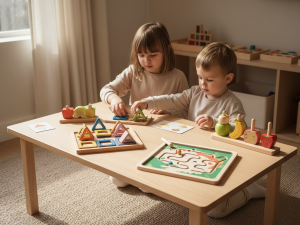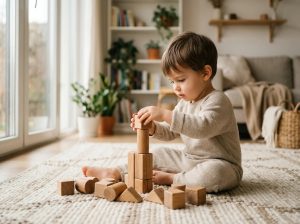
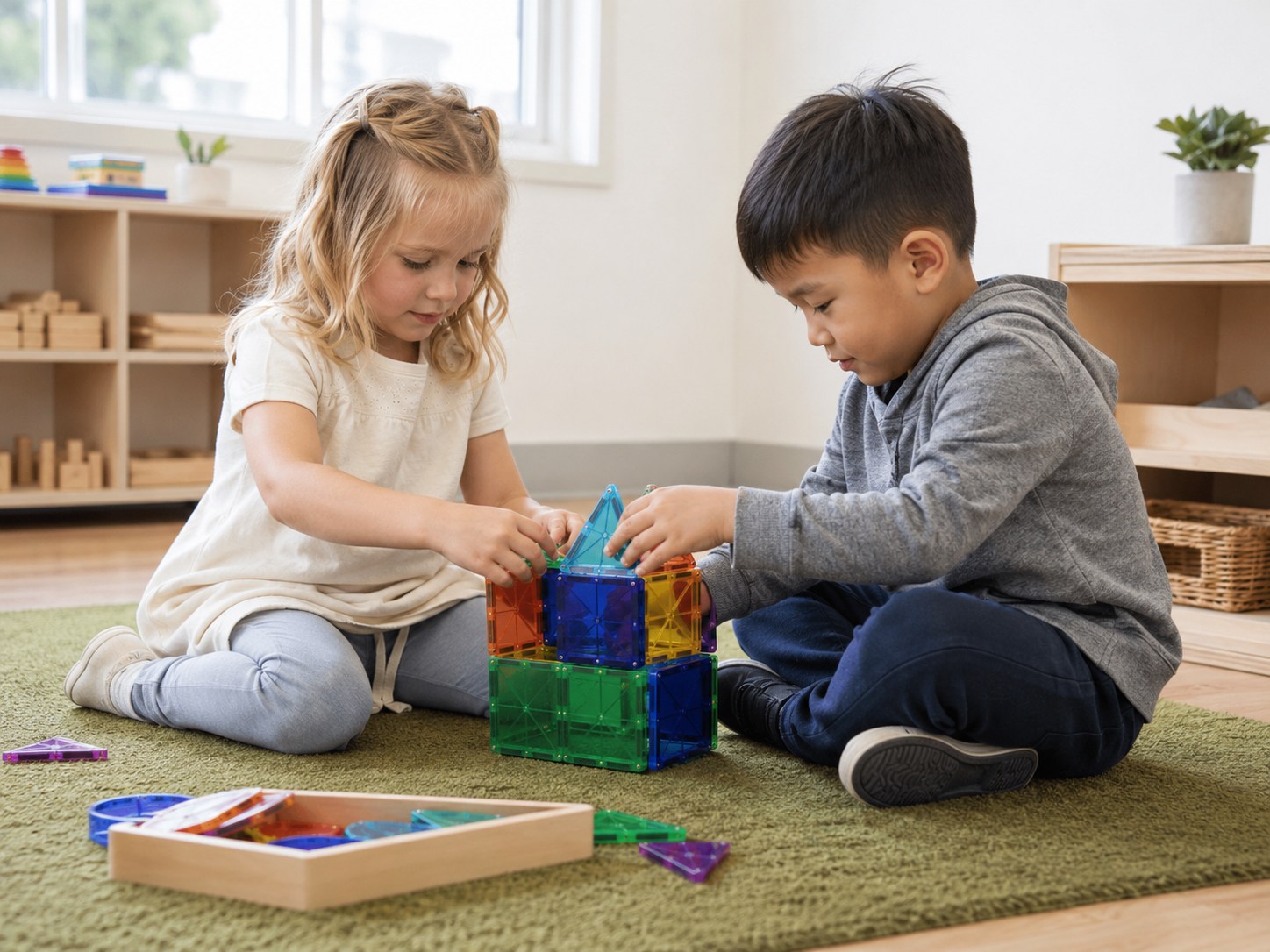
A teacher hands a child a worksheet, and the child completes it the way every other child in the room does. A teacher hands the same child a set of open-ended building blocks, and twenty minutes later she has built something no one else in the room thought of — a bridge, a robot, a house with a secret door. The worksheet tested what she already knew. The blocks revealed what she could imagine.
This is the gap many classrooms and households run into without naming it directly: children are surrounded by structured activities that reward correct answers, but they get far fewer chances to practice generating original ones. Over time, that imbalance shows up as hesitation — kids who wait to be told what to do rather than trying something new. Creative toys for kids exist to close that gap, giving children a low-pressure space to experiment, fail, adjust, and try again without a single “right” outcome hanging over them.
For teachers, parents, and school buyers, the real question isn’t whether creativity matters — most already agree it does. The harder question is which creative toys for kids actually build that capacity, and which ones just look creative on a shelf. This article looks at what separates genuinely development-driving creative toys for kids from the rest, how they function in real classrooms, and what schools and distributors should weigh before purchasing.
Why Imagination Needs More Than Free Time
There’s a common assumption that creativity develops naturally if children are simply given unstructured time. In practice, unstructured time without the right materials often produces boredom rather than invention. A child staring at a blank table doesn’t automatically start inventing; a child holding open-ended creative toys for kids — blocks, magnetic tiles, modular construction pieces, role-play sets — has something to push against, and pushing against material is where imagination actually starts.
This is the core mechanism behind creative toys for kids: they provide constraints loose enough to allow invention but concrete enough to give a child something to act on. A stack of uniform wooden blocks doesn’t tell a child what to build. A pretend-play kitchen set doesn’t dictate the story a child tells while using it. The toy supplies raw material; the child supplies the idea. That combination — material plus open interpretation — is what distinguishes genuinely creative toys for kids from toys that simply occupy time.
Schools that understand this distinction tend to move away from single-purpose toys (a toy that only does one thing, one way) toward multi-use, modular creative toys for kids that can be reconfigured across dozens of different play sessions without losing relevance.
This isn’t just a classroom impression — it’s been tested directly. A 2025 study published in the International Journal of Early Childhood assessed 203 children aged 4 to 7 and found that a child’s preference for open-ended toys was directly associated with stronger imagination scores, measured by both the number of details children added to their play and the originality of the scenarios they created. The researchers noted that a toy’s open-endedness — not its branding or feature count — was the variable that predicted richer imaginative play. For buyers comparing creative toys for kids, that’s a useful benchmark: the more a toy allows for reinterpretation, the more consistently it supports imaginative development.
What Innovation Actually Looks Like in Young Children
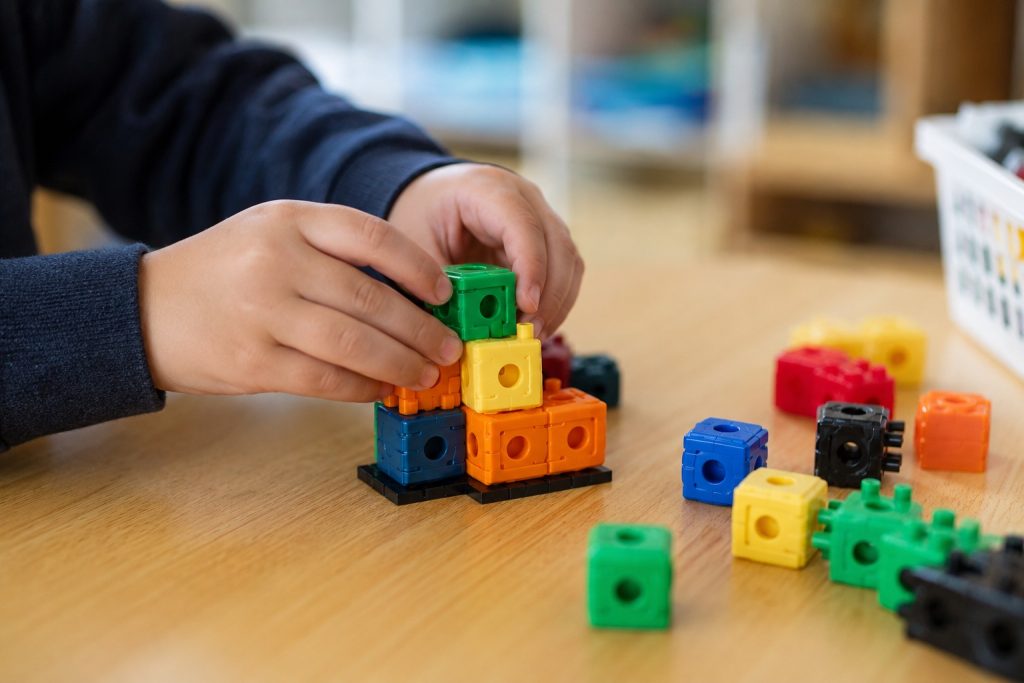
“Innovation” sounds like a word reserved for engineers and entrepreneurs, but at the classroom level it looks much smaller and more concrete: a child solving a problem in a way nobody showed them. That might mean stacking blocks at an angle to keep a tower from tipping, combining two unrelated toy sets into one new game, or narrating an entirely invented story during pretend play.
These small moments matter because they’re rehearsals for a skill children will need well beyond early childhood — the ability to approach an unfamiliar problem without a template. Hands-on learning tools and other creative toys for kids that reward experimentation give children thousands of small repetitions of this skill before they ever reach a formal academic setting where original thinking is expected but rarely explicitly taught.
Teachers who track this closely often notice a pattern: children who regularly use open-ended, developmentally appropriate creative toys for kids tend to approach unfamiliar tasks with less hesitation than peers who mostly work through single-answer activities. They’ve simply had more practice generating options instead of waiting for one.
Where Structured Toys Fall Short
Not every toy marketed as “educational” actually builds creative capacity, and not every toy on a shelf qualifies as a genuinely creative toy for kids. Many structured toys — puzzles with one correct configuration, toys with a single built-in function, character-based sets tied to a fixed storyline — are useful for other skills like fine motor coordination or sequencing, but they don’t ask much of a child’s imagination because the outcome is already decided.
This distinction matters for school buyers evaluating classroom materials, because a shelf full of “STEM toys” doesn’t automatically mean a classroom is stocked with real creative toys for kids. The relevant question is whether a toy allows multiple valid outcomes. A construction set that can be assembled a hundred different ways builds different cognitive muscles than a puzzle with exactly one solution — both have value, but only open-ended creative toys for kids develop imaginative and innovative thinking as their primary function.
The purchasing side of this is measurable too. According to Fortune Business Insights, the global educational toys market is projected to grow from roughly $76.96 billion in 2026 to $148.14 billion by 2034, an 8.53% CAGR — with the motor-skills and STEM-toy segments leading that expansion. Separate analysis from Mordor Intelligence puts STEM toys specifically on track for a 9.92% CAGR through 2031, outpacing the broader toy category. That growth isn’t happening because schools are buying more toys for the sake of it — it reflects institutions shifting spend toward creative toys for kids they can justify on developmental grounds, not novelty alone. For distributors, this points to sustained, above-average demand in the open-ended and STEM-adjacent segment specifically, rather than the toy category as a whole.
Case Study: Open-Ended Building Sets in a Preschool Classroom
Background A preschool classroom of four- and five-year-olds had relied primarily on themed, single-use toys — vehicles, character figures, and simple stacking sets — rather than genuine creative toys for kids. Teachers noticed that free-play time was often repetitive, with the same small set of activities recurring day after day.
Application Process The classroom introduced a set of modular, magnetic building pieces — a category of creative toys for kids designed for open-ended use — alongside loosely themed prompts (“build something that moves,” “build a place an animal could live”) rather than instructions with a single correct result. Teachers observed rather than directed, stepping in only to ask open questions (“what happens if you add another piece here?”) instead of correcting a child’s approach.
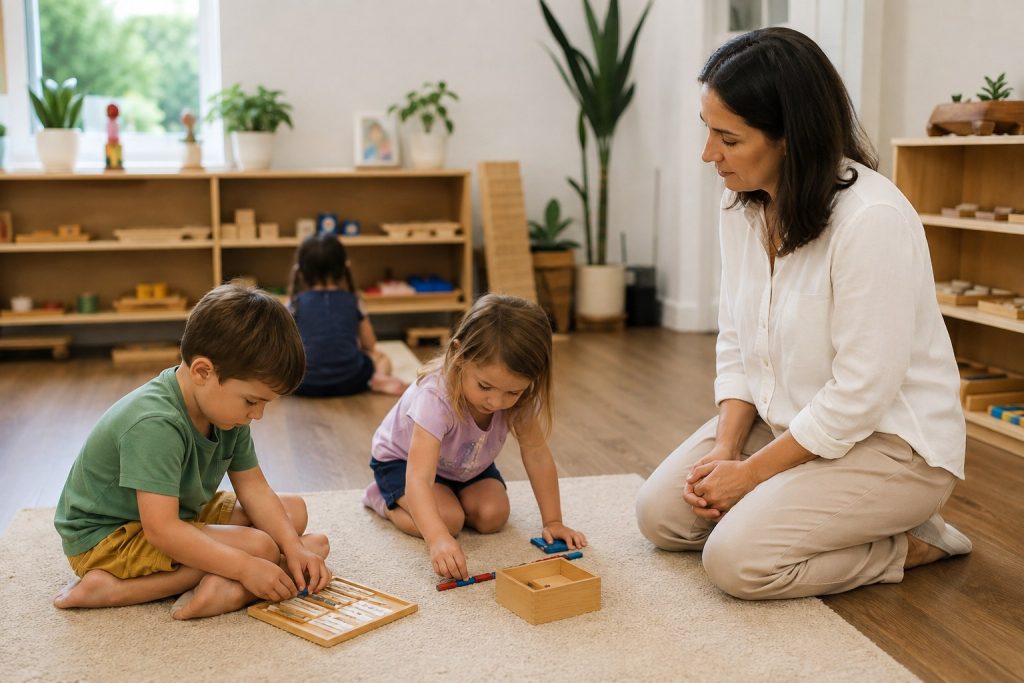
Problem Solved Within a few weeks, teachers reported a noticeable shift: children who had previously waited for adult direction before starting an activity began proposing their own builds unprompted. Group play increased, since children began combining ideas — one child’s base structure became the starting point for another child’s addition. The repetitive play pattern from single-use toys largely disappeared once open-ended creative toys for kids replaced them.
Practical Value For the children, the shift meant more independent problem-solving and stronger peer collaboration during play. For teachers, the toys required less redirection and produced more varied engagement across a single session. For the school, a single set of modular creative toys for kids replaced the need for multiple narrow-purpose items, reducing both storage demands and long-term replacement costs — a practical purchasing consideration alongside the developmental one.
How Vindstier Supports This Kind of Learning
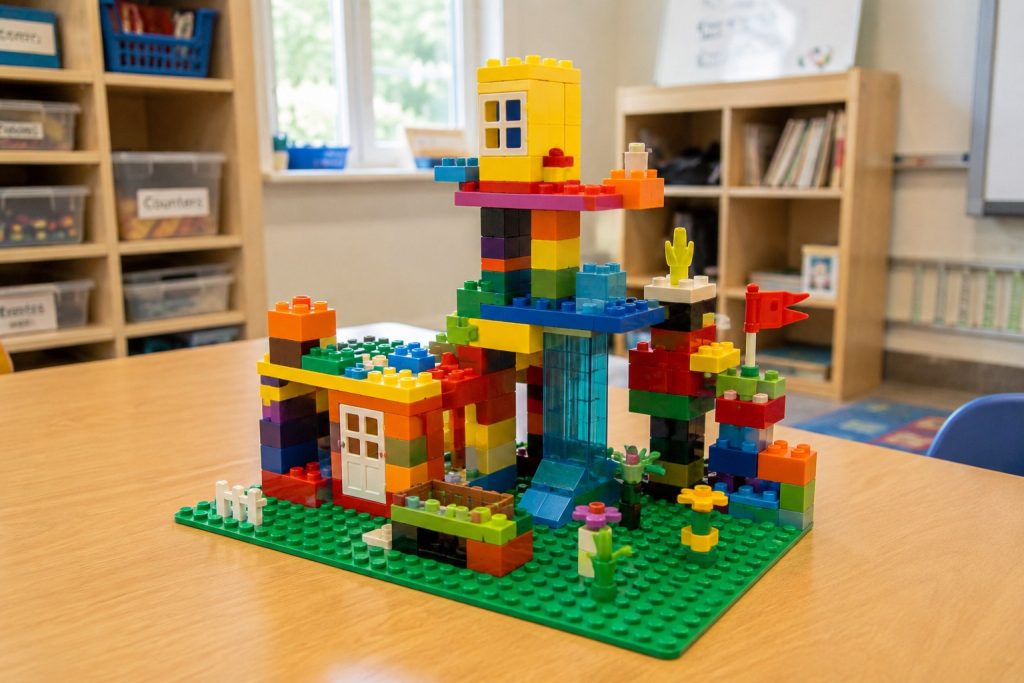
The pattern in the case study above is consistent with what Vindstier designs toward: open-ended, modular construction and role-play creative toys for kids built specifically so that no two play sessions produce the same result. Rather than fixed-outcome toys, Vindstier’s product lines are built around configurable pieces — magnetic building sets, modular construction kits, and open-ended role-play tools — designed so a single product supports dozens of different activities across a wide age range.
Educational value comes from the open-ended structure itself: children aren’t following a printed instruction sheet toward one correct build, so every session becomes a fresh opportunity to test an idea. Classroom value comes from durability and simplicity — teachers can introduce a new prompt in seconds without lengthy setup, and the materials hold up under repeated daily use across an entire school year. Business value for schools and distributors comes from the toy’s flexibility: a single product line of creative toys for kids can serve multiple age groups and multiple learning goals, reducing the number of separate SKUs a school or distributor needs to stock and replace. This is a meaningful differentiator from lower-cost, single-function alternatives that need constant replacing as children age out of their narrow use case or simply lose interest once the one intended outcome has been explored.
For distributors and educational buyers evaluating suppliers, this focus on open-ended, reconfigurable creative toys for kids — rather than single-use novelty — reflects a broader shift in how educational institutions are purchasing: fewer narrow-purpose items, more materials that can grow with a child and a classroom over time.
What Schools and Distributors Should Look For When Purchasing
Not all “creative” toys deliver on the promise. When evaluating classroom or retail-ready creative toys for kids, a few practical questions help separate genuinely development-driving tools from marketing language:
| Consideration | What to Look For |
|---|---|
| Outcome flexibility | Can the toy be used in multiple valid ways, or does it have one correct result? |
| Durability | Will it withstand daily use across a full school year, not just occasional play? |
| Age range | Does it stay relevant as a child’s skills develop, or is it outgrown quickly? |
| Storage and cost efficiency | Does one product replace the need for several narrow-purpose items? |
| Classroom usability | Can a teacher introduce it with minimal setup or instruction? |
These factors matter as much for a distributor building a catalog as for a school buying directly, since long-term reorder rates for creative toys for kids tend to track closely with how well a toy holds a child’s attention past the first few sessions.
For institutions sourcing at scale, the calculation shifts slightly. Districts and school groups shopping for bulk creative toys for schools are typically less concerned with a single product’s novelty and more concerned with consistency: will every unit in a large order perform the same way, and will the supplier still stock replacement pieces two or three years into a purchasing cycle. Early-education buyers searching specifically for open-ended STEM toys for preschools are usually filtering out anything that requires reading instructions or a fixed sequence of steps, since the youngest classrooms need materials a child can pick up with no adult setup at all. And for toy brands and wholesalers evaluating educational toys for distributors, the deciding factor is rarely the toy itself — it’s whether the manufacturer can support OEM/ODM customization, consistent unit quality across large production runs, and documentation that makes the product easy to position to school buyers downstream.
Conclusion
Imagination isn’t built through a single activity or a single toy — it’s built through repeated, low-pressure opportunities to try an idea and see what happens. Creative toys for kids that are genuinely open-ended give children exactly that: a chance to build, rebuild, and reimagine without being steered toward one predetermined answer. For teachers, that means more independent, engaged classrooms. For schools and distributors, it means fewer narrow-purpose products to replace and a clearer case for creative toys for kids designed to grow alongside the children using them. The toys that hold up to this standard aren’t the ones with the flashiest packaging — they’re the ones still generating new ideas on the hundredth play session, not just the first.