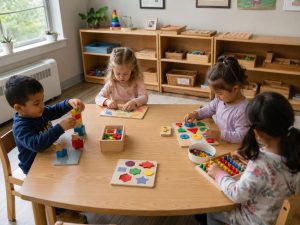
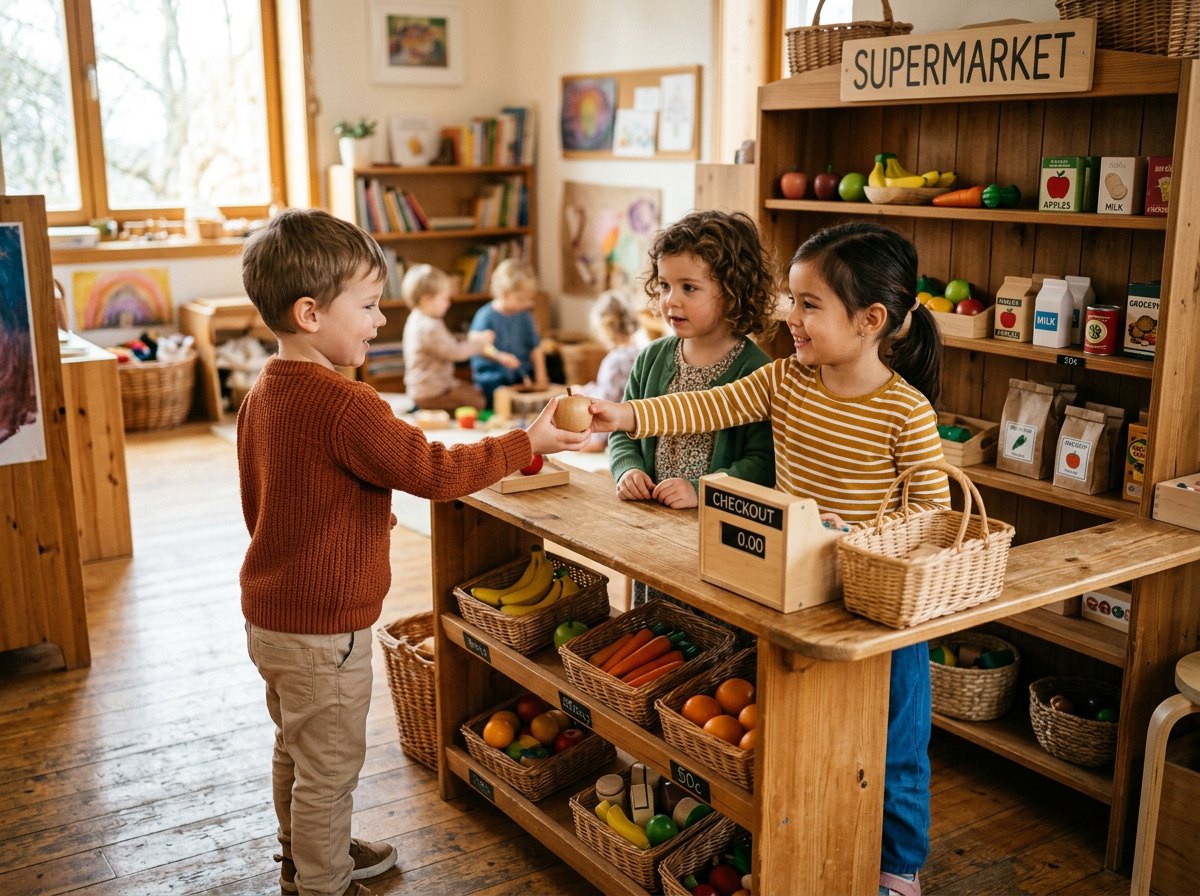
Circle time falls apart for the third morning in a row. Twenty minutes later, the same four-year-old runs a pretend restaurant for half an hour straight — taking orders, negotiating who cooks, reminding a friend that customers pay before they leave. Many adults read that contrast as a discipline problem. It points somewhere more useful: the child already sustains attention, follows rules, and produces complex sentences whenever a situation gives those skills a job to do. Pretend play toys create that situation on purpose, and the difference between a curated prop collection and a random costume box shows up in how children talk and how they steady themselves.
Why the Dramatic Play Corner Produces Longer Sentences
A shared pretend world runs on talk, and pretend play toys are the stage it runs on. To keep a restaurant, clinic, or construction site alive, children must announce role assignments, declare object substitutions (“this block is the phone”), and settle disputes without a referee. Language stops being a tool for describing the world and becomes a tool for organizing other people — a harder job than naming pictures on a worksheet.
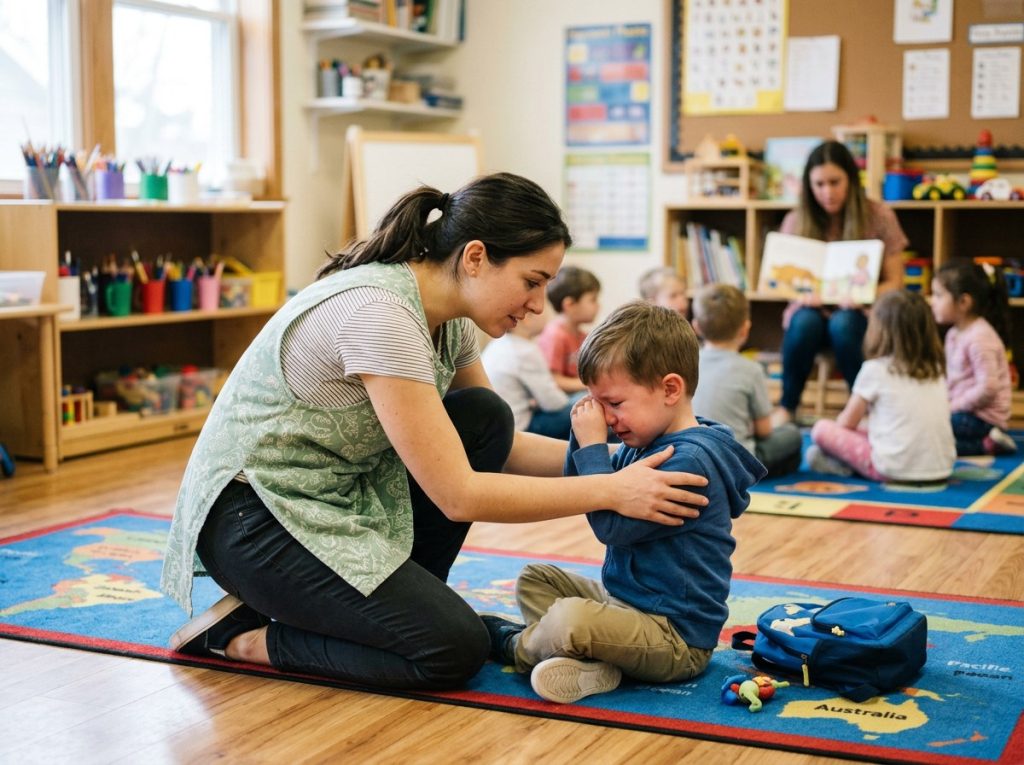
Peer play raises the bar further. Adults anticipate what a child wants; peers rarely do. A four-year-old who points and grunts at a parent learns quickly that a play partner needs full sentences, or the game collapses on the spot. That pressure explains why language measures keep clustering around dramatic play. Lewis and colleagues (2000, International Journal of Language & Communication Disorders) found that symbolic play levels tracked expressive and receptive language in young children. A longitudinal study by Stagnitti and Lewis (2015, Deakin University) went further: the complexity of children’s pretend play at ages four and five predicted semantic organization and narrative retelling skills up to five years later, into the elementary grades.
Vocabulary follows the props. A clinic center pulls in medical words; a grocery store pulls in quantity, money, and comparison language. Teachers who curate pretend play toys by theme are, in effect, selecting the vocabulary their class will use that month — the same logic behind language development toys that build vocabulary and narrative thinking.
Narrative skill rides along for free. Children who stretch one scenario across a morning — the restaurant runs out of pasta, a delivery arrives, the menu changes — are rehearsing story structure: setting, problem, resolution. Teachers capture that growth by writing down play stories and reading them back at circle time, which turns spoken play into an early bridge toward print.
The Hidden Rulebook: How Role Play Trains Self-Regulation
Every role carries rules. The cashier stays at the register; the dragon stays a dragon; the baby cries before being fed, never after. Lev Vygotsky observed in the 1930s that children in role play routinely hold themselves to standards above their everyday behavior, because dropping the rules means dropping the game. Self-control stops being an adult demand and becomes the price of admission. Role-defining pretend play toys make that rulebook visible: a register implies one job, a stethoscope implies another, and each job arrives with its own limits.
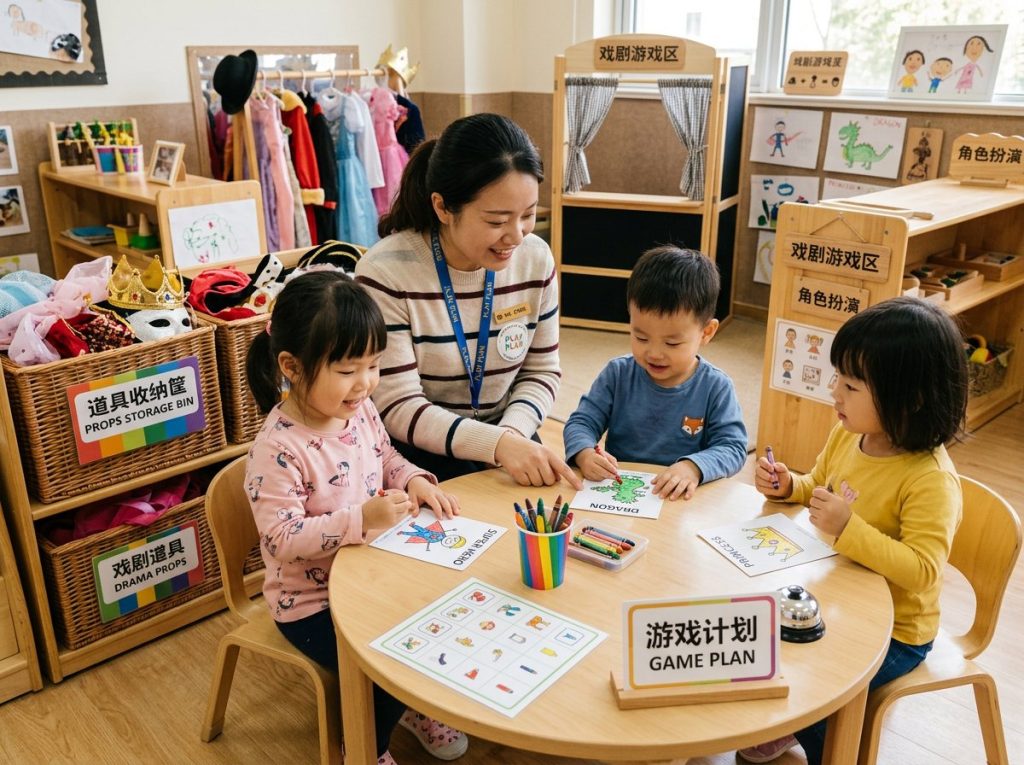
Modern curricula put the observation to work. In the Tools of the Mind program, built on Vygotskian theory, children plan their play in advance — drawing or stating their role before acting it out — and the plan works as an external memory aid that keeps the role steady. A randomized evaluation published in Science (Diamond et al., 2007) followed 147 preschoolers from low-income families and found that children in the play-based program outperformed peers in the district’s standard literacy curriculum on several measures of executive function — the suite of skills covering attention, working memory, and impulse control that Harvard’s Center on the Developing Child calls foundational for later learning.
Emotional control responds too. In a study published in Developmental Science (Goldstein and Lerner, 2018), preschoolers who played structured dramatic pretend play games over four weeks improved emotional control more than peers in other active-play programs, and children who started with the lowest regulation gained the most. The rehearsal itself is the mechanism: a child playing the worried patient or the strict doctor practices difficult feelings at a safe distance, with the option to stop at any moment.
For classrooms, the takeaway is concrete: role-rich pretend play toys put regulation practice where children will actually choose it. The corner is where the training happens; the calm afterwards is the residue, and executive function toys that build working memory and self-regulation extend the same practice into solo formats for quieter days.
What the Research Does and Does Not Show
Honest claims build more authority than inflated ones. Angeline Lillard and colleagues at the University of Virginia, in a 2013 monograph for the Society for Research in Child Development, reviewed more than 150 studies on pretend play and concluded that most of the evidence is correlational: children who play well tend to develop well, but few studies prove that play itself caused the gains. Any supplier promising that specific pretend play toys will raise a child’s intelligence deserves the skepticism that claim invites — no toy can honestly promise that, and manufacturers who avoid such language are the ones worth shortlisting.
The interventional evidence is narrower but more encouraging. A five-week guided fantasy-play program developed at the University of Washington (Thibodeau et al., 2016) produced measurable gains in working memory and attention shifting compared with control conditions. The reasonable reading for teachers and buyers: pretend play toys create one of the most efficient known contexts for practicing language and self-regulation, but they are tools, not mechanisms with guaranteed output. Programs get the returns by funding the practice — the props, the rotation calendar, and the teacher’s restraint — and by evaluating each purchase against how long it sustains that practice.
What Separates High-Value Pretend Play Toys From a Costume Box
Not everything in the dress-up bin pulls equal weight, and the pretend play toys market adds novelty items every season that promise imagination and deliver a single week of novelty. The difference between props used daily and props abandoned by Thursday comes down to traits a buyer can check before ordering:
| Trait | What to check | Why it matters |
| Symbolic openness | Does the prop suggest a role or dictate a script? | Open materials sustain weeks of new scenarios; single-script gadgets exhaust their story within days |
| Group scale | Can three to five children hold parallel roles? | The negotiation-heavy form of dramatic play needs room for a cast, not a solo hero |
| Rotation durability | Joints, coatings, and seams after months of daily use | Classroom sets pass through dozens of hands; fragile props quietly leave circulation |
| Cleanability | Sealed surfaces that tolerate daily wiping | Shared props in preschools and daycares need sanitizing between groups |
| Compliance | EN 71, ASTM F963, or CPC documentation per SKU | Institutional purchasing requires it; home buyers get the same assurance |
Two additions matter for institutional orders. Buy rotation sets rather than single units, because a center that loses one crate should not force a full re-order. And ask suppliers whether replacement parts exist — the answer separates manufacturers who understand classrooms from factories that only ship boxes. Whether a shelf serves one family or twelve classrooms, seasoned buyers treat pretend play toys as equipment rather than gifts, and equipment earns its cost over years.
Building a Dramatic Play Center Children Actually Use
Props alone do not activate the mechanisms above — even well-chosen pretend play toys need a setup that lets children steer. Centers that stay alive for months share a pattern:
- Rotate themes every two to three weeks — grocery store, veterinary clinic, workshop — because new themes pull new vocabulary and re-engage children who drifted away
- Open each session with a short play plan, where children say or draw their intended role — the planning routine credited in the Tools of the Mind evaluation, scaled down to one corner
- Keep props at child height and cap the cast at three to five roles, so negotiation stays possible
- Step back during play — the teacher sets the stage and observes, saving vocabulary extensions for circle time instead of directing scenes mid-play
Observation turns the corner into an assessment tool. Role persistence, negotiation moves, and vocabulary used in context are all visible during play, and directors can fold observation notes into family conferences as evidence of development — a return on investment that standardized checklists miss. In home settings, the same principles shrink to one bin and a weekly theme swap, so a small set of pretend play toys serves an entire rotation.
Where Sorting and Counting Props Earn Their Place
A grocery store center runs on produce, and this is where multi-purpose pretend play toys justify their shelf space. A wooden fruit sorting and stacking set stocks the shelves, then doubles as the day’s math work: children sort produce by color and type, fill orders by count, and trade items across the counter — quantity language embedded in the role play rather than drilled at a table. Sealed beech wood survives rotation cycles that thin plastic sets often crack through, wipes clean between groups, and covers dramatic play, sorting practice, and early counting in one purchase. Vindstier produces its set with per-SKU CE and CPC documentation, which matters equally to a home buyer checking safety and a program manager filing procurement records.

Where Pretend Play Toys Reach Their Limits
Two boundaries keep expectations honest. First, the developmental window: pretend play builds from around age two, peaks between three and six, then folds into rule-based games and collaborative projects in the early elementary years. A single set of pretend play toys will under-serve a toddler and bore a seven-year-old, so age range matters more in this category than in most. Second, the child-direction requirement: negotiation and self-made rules only activate in play that children steer, and the correlational evidence base described above is one reason to stay modest about outcomes.
The most common misuse follows from that second boundary: over-scripting. When an adult assigns every role, corrects every line, or leans on an electronic toy that narrates one fixed story, the negotiation layer disappears and the language gains leave with it. Patience belongs on the list too — some children join a center by watching first, and forcing early participation works against the goal the pretend play toys were bought to serve.
Choosing Pretend Play Toys That Hold Their Value
The through-line holds across every section above. Language grows through negotiation, and self-regulation grows through role rules; both depend on props and setups that leave the script in children’s hands. The evidence is more correlational than marketing suggests, yet the practice case — low-cost, naturally engaging, observable in real time — stands on its own. Buyers evaluating pretend play toys can hold to a short list: open-ended materials, capacity for a small cast, rotation-grade durability, cleanable surfaces, and verifiable safety files.
Applied consistently, that checklist turns a random pile of pretend play toys into a curriculum tool that survives years of rotation. Rotate themes, plan before play, and resist directing the scenes — then watch what children say when the game is theirs. Readers mapping a full program year can keep this guide and the linked skill-area articles as the reference set for each rotation cycle.