A preschooler who points instead of talking, melts down when asked to describe what happened at school, or cannot follow a two-step instruction is not simply “a late talker.” These behaviors often signal a gap between what a child understands and what they can articulate. Hart and Risley’s foundational research (1995) documented that children from language-rich professional households heard approximately 11 million words by age three, compared to roughly 3 million in less verbal environments — a gap that persisted and predicted reading comprehension years later. Language development toys provide the structured play contexts that narrow this gap by creating natural, repetitive opportunities for vocabulary use, narrative construction, and conversational turn-taking.
The Science of Play and Language Acquisition
The connection between play and language rests on a shared cognitive foundation: both symbolic play and language require the ability to use one thing to represent another. A block becomes a phone. A spoken word stands for an absent object. Vygotsky’s sociocultural theory positions pretend play as the leading activity of preschool development, arguing that symbolic transformations in play provide a developmental bridge to verbal symbols. Neuroimaging studies show overlapping neural activation between pretend play and language processing, suggesting shared cognitive architecture rather than mere correlation. This research helps explain why well-designed language development toys deliver measurable gains beyond what unstructured play alone can produce.
A longitudinal study by Creaghe, Quinn, and Kidd (2021, Infancy) tracked 54 parent-infant pairs from 18 to 24 months, comparing language interactions during symbolic play (pretend cooking, tea parties, doll play) versus functional play (puzzles, shape sorters, hammering toys). Symbolic play generated significantly more conversational turns — 42.13 versus 33.22 per session at 18 months, with a moderate-to-strong effect size (Cohen’s d = 0.667). Caregivers used more questions and fewer imperative commands during symbolic play, and higher rates of imperative language predicted significantly smaller vocabulary gains (p < .05) and lower grammatical complexity (p < .01) at 24 months. In turn, more conversational turns at 18 months predicted significantly stronger vocabulary production (p < .05) and better grammar scores (p < .05) at 24 months. These findings help explain why symbolic play materials form the core of effective language development toys for toddlers and young preschoolers.
The mechanism is clear. Symbolic play’s inherent ambiguity — what does this block represent? what happens next? — requires communication partners to negotiate meaning through talk, producing the conversational turns and varied vocabulary that drive language growth.
Why Toy Type Changes Language Outcomes
Not all play materials create equivalent language environments. A controlled experiment published in JAMA Pediatrics (Sosa, 2016) assigned 26 parent-infant pairs (infants aged 10-16 months) to three 15-minute conditions: electronic toys, traditional toys, and board books. Each pair completed sessions with each toy type in counterbalanced order across three days.

The differences were substantial. During play with traditional toys, parents produced 55.56 words per minute, compared to 39.62 during electronic toy play — a 40% reduction in language input. Content-specific vocabulary — words naming objects, colors, positions, and actions — fell from 4.09 to 1.89 words per minute with electronic toys.
Conversational turns dropped from 2.49 to 1.64 per minute. The pattern extended to children, who vocalized 3.74 times per minute with traditional toys versus 2.90 with electronic alternatives. Board books generated the richest language environment of the three conditions, but traditional toys performed comparably to books on conversational turns and child vocalizations. This is why selecting language development toys based on how they shape adult-child interaction matters more than choosing products marketed as “educational.”
The implication for selecting language development toys is direct. Toys that produce their own sounds and speech reduce the adult’s conversational role, which narrows the vocabulary children hear during play. Open-ended materials — blocks, puzzles, pretend play props — require adults to supply naming, narration, and direction verbally, generating richer language input as a natural byproduct of the play interaction.
How Language Development Toys Target Core Language Systems
Language development is not a single process. Receptive vocabulary, expressive vocabulary, narrative production, and grammatical complexity follow related but distinct developmental trajectories, and different categories of language development toys activate different systems. Selecting materials that match the specific language domain being targeted produces more reliable gains than assuming all play produces equivalent language growth.
Symbolic Play Materials and Conversational Richness
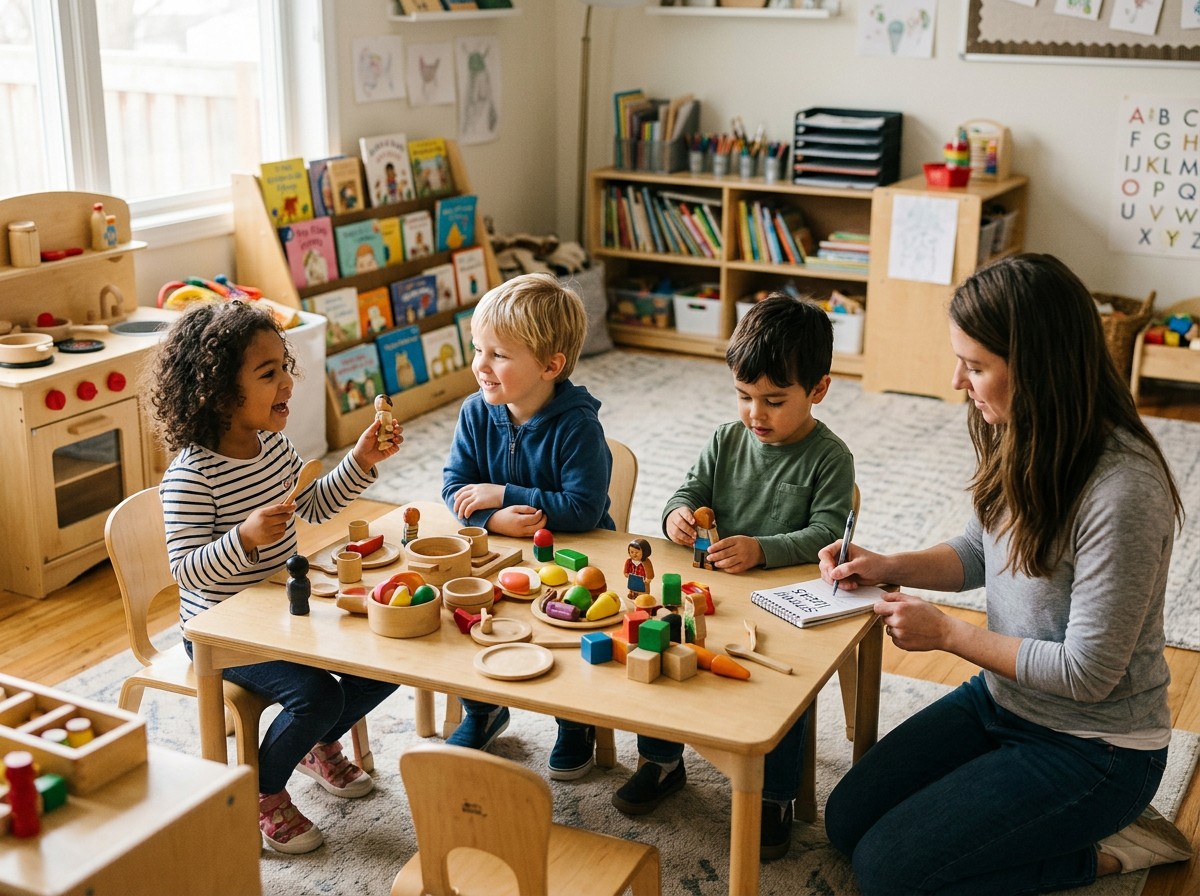
Pretend play materials — kitchen sets, dollhouses, play food, dress-up props — generate the conversational turn-taking that underpins expressive vocabulary growth. In the Creaghe et al. (2021) study, symbolic play conditions produced more caregiver questions (yes-no questions: d = 0.787; wh-questions: d = 0.544) and fewer imperative commands (d = −0.993) compared to functional play. When caregivers ask open-ended questions like “What is happening in the kitchen?” rather than instructing “Put the piece here,” children receive language that invites response — the kind of input that builds vocabulary and grammatical complexity simultaneously. These interactions also overlap with social emotional learning, where emotional vocabulary and perspective-taking develop through shared pretend scenarios. For this reason, pretend play sets are among the most high-impact language development toys for building expressive vocabulary and conversational skills.
Storytelling and Narrative Practice Tools
Narrative competence — the ability to produce coherent accounts with a beginning, middle, and end — is among the strongest predictors of later reading comprehension. Nicolopoulou et al. (2015, Early Childhood Research Quarterly) conducted a quasi-experiment with 216 low-income preschoolers across 13 classrooms, implementing Paley’s storytelling and story-acting practice (STSA). Children dictated stories to an adult scribe, then performed them collectively with peers.
After one school year, STSA children showed narrative comprehension gains significantly exceeding controls (Cohen’s d = .35; experimental gain M = 5.43 vs. control M = 3.15). Print and word awareness gains were larger still (d = .58; M = 2.35 vs. M = .71). A dose-response analysis confirmed that children who produced more stories showed greater narrative comprehension gains (b = .16, p = .002) and peer interaction improvements (b = .31, p = .001). Notably, standardized expressive vocabulary scores did not differ significantly between groups (p = .27) — the intervention targeted narrative and symbolic capacities more directly than isolated word knowledge, suggesting that materials must be matched to the specific language domain being developed. The narrative demands of storytelling also draw on working memory capacity, as children hold story elements in mind while sequencing events — meaning language and executive function develop as complementary processes.
Construction Materials and Thematic Language
Block play, often categorized as a spatial-reasoning activity, also drives language growth when structured thematically. Cai et al. (2022, Frontiers in Psychology) assigned 61 preschoolers (mean age 5.85 years) to either a 12-week theme-based block play intervention (“Journey to the Zoo,” “Robot Story,” “On the Road”) or unstructured free block play. The themed condition included interest arousal, collaborative construction, and story-sharing phases led by teachers.
Children in the themed condition gained 6.16 points on the reading and storytelling subscale versus 0.48 for free-play controls (Cohen’s d = 1.267 — a large effect). Total language assessment scores improved by 11.66 versus 2.48 points (d = 1.235). The intervention worked because thematic framing gave block play a narrative spine — children were building a zoo and telling its story — transforming a spatial activity into a language-rich one. Sorting toys used in group contexts similarly generate categorization language (color, shape, size, belongs, does not belong) when an adult narrates the sorting process. When paired with thematic framing, standard building sets become powerful language development toys that drive both spatial and verbal growth.
Vocabulary Growth Through Adult-Supported Play
The distinction between free play and adult-supported play matters for language outcomes. A study by Toub et al. (2018, Early Childhood Research Quarterly) involving 249 preschoolers from low-income backgrounds tested three conditions following shared book reading: free play with themed toys, adult-guided play, and adult-directed play. All three conditions produced significant vocabulary gains for taught words. However, children in adult-supported play conditions — both guided and directed — showed significantly greater gains than those in free play, on both receptive and expressive measures. Gains were maintained after a two-week delay.
A second study (N = 101) extended this finding by comparing play-based vocabulary review against picture-card review in a within-subjects design. Both methods produced gains, but play-based review yielded significantly greater expressive vocabulary growth. The researchers concluded that adult-supported play provides unique benefits for early vocabulary growth that extend beyond the value of repeated exposure — the play context itself appears to support deeper word learning through embodied, multi-sensory engagement.

This finding has practical implications. Language development toys deliver maximum value when an adult actively engages — narrating, questioning, expanding on the child’s utterances — rather than serving as background materials. The toy provides the context; the adult provides the language scaffolding that transforms exposure into acquisition. This is why the most effective language development toys work best when paired with intentional adult engagement, rather than being used as independent play items.
Developmental Progression of Language Through Play Ages 2 to 6
Language competencies emerge in a predictable but individually variable sequence. Environmental language exposure, peer interaction frequency, and developmental conditions all influence timing. Understanding this developmental sequence helps educators match language development toys to each child’s current skill level rather than using a one-size-fits-all approach.
| Age Range | Language Competency in Focus | Observable Milestones | Toy Categories That Support This Stage |
|---|---|---|---|
| 2–3 years old | Early vocabulary explosion | Labels familiar objects; uses 2-word phrases; follows simple instructions | Shape sorters with adult narration, simple pretend play props, board books with everyday objects |
| 3–4 years old | Grammatical complexity emerging | Uses 3-4 word sentences; asks why questions; begins storytelling | Dramatic play sets with multiple roles, simple construction sets with thematic play, matching games with verbal rules |
| 4–5 years old | Narrative production developing | Tells sequential stories; uses complex sentences; participates in group discussions | Story-building materials, themed construction sets, cooperative games with verbal rules |
| 5–6 years old | Pragmatic and narrative refinement | Adjusts language to listener; produces coherent narratives with temporal sequencing | Complex role-play with story arcs, storytelling and story-acting tools, group construction projects with shared narratives |
Teachers should observe children’s language during play directly rather than relying solely on age benchmarks. A four-year-old from a language-rich environment with regular adult-mediated play may produce narratives typical of five-year-olds, while a five-year-old with limited conversational exposure may perform at the three-year-old level.
Selecting Language Development Toys: Criteria for Classrooms
Program directors and purchasing managers evaluating language development toys for classroom or institutional use should assess materials against functional criteria rather than assuming that any toy labeled “educational” supports language growth.

Symbolic potential
Materials that can represent multiple meanings — a block that becomes a phone, a car, or a bridge — generate more language than single-function toys. The Creaghe et al. (2021) data showed that symbolic play materials produced 27% more conversational turns than functional alternatives. Open-endedness is the primary design feature that distinguishes language-supportive materials from those that occupy children silently, and it is the most important criterion when evaluating language development toys for classroom use.
Narrative affordance
Materials that support story construction — character figures, settings, props for dramatic play, construction sets with thematic scenarios — give children content to narrate. The Cai et al. (2022) study demonstrated that themed block play produced large-effect language gains (d = 1.267) precisely because thematic framing gave children a story to tell while building.
Durability for shared use
Classroom materials undergo hundreds of handling cycles weekly by multiple children. Interlocking mechanisms, hinges, and surface finishes must withstand collaborative — sometimes enthusiastic — handling. Wooden construction materials maintain structural integrity longer than plastic alternatives under institutional conditions, reducing replacement frequency and per-child cost over a product’s classroom lifespan.
Compliance documentation
Materials for children under three require CPC certification (US) and CE/EN71 compliance (EU). For products rated 3+, per-SKU third-party test reports verify mechanical integrity and surface coating safety. Buyers should request per-SKU documentation rather than accepting catalog-level certificates, as batch-level compliance gaps affect institutional procurement. Programs sourcing preschool classroom toys at scale can request OEM services with per-SKU CPC and CE certification packages, streamlining procurement while ensuring consistent quality across classroom sets.
Misconceptions and Limitations in Play-Based Language Development
“Any Toy Labeled Educational Supports Language”
The JAMA Pediatrics study directly contradicts this assumption. Electronic toys marketed as educational produced the poorest language environment of the three conditions tested — 40% fewer content-specific words than traditional toys. A common purchasing mistake is selecting toys with sound features assuming they teach language, when in practice they reduce the adult language input that drives vocabulary growth. Not all products labeled as language development toys actually deliver the conversational environment children need.
“Free Play Alone Produces Vocabulary Gains”
Toub et al. (2018) found that free play with themed toys produced vocabulary gains, but adult-supported play produced significantly larger gains on both receptive and expressive measures. Providing materials without active adult mediation yields inconsistent, smaller results. Language development toys deliver maximum value when paired with deliberate adult scaffolding — narrating, questioning, and expanding on children’s utterances.
Two limitations require attention. First, language development is multiply determined — it responds to family language exposure, hearing status, bilingualism, and developmental conditions, not solely to toy selection. Programs addressing language through materials alone, without attention to these broader factors, may see attenuated results.
Second, children with persistent language delays despite adequate play exposure may need evaluation by speech-language pathologists for underlying factors including articulation disorders, language processing differences, or hearing impairment. Play materials support development but do not constitute clinical intervention. Programs should connect families with appropriate specialists when language concerns persist.
Language Development Toys and the Path to Communication Competence
Language development toys provide the structured play contexts that enable preschoolers to build the vocabulary, narrative competence, and conversational skills that both academic success and social participation require. Children who practice storytelling, negotiate meaning through pretend play, and hear varied vocabulary during adult-supported play enter kindergarten with language tools that accelerate reading acquisition and classroom participation. The evidence is consistent — purposeful play, supported by intentional materials and engaged adults, produces measurable language gains that extend well beyond the play session itself.
Programs implementing language development through curated play materials — with dramatic play sets, storytelling tools, and themed construction kits paired with active teacher narration — give children the strongest foundation for communication competence. For educators and program directors seeking classroom-ready language development toys with verified compliance and language-supportive design, Vindstier’s curated range of educational and construction toys offers a practical starting point for building a developmentally sequenced language development program.