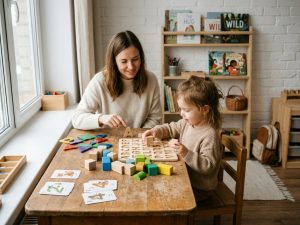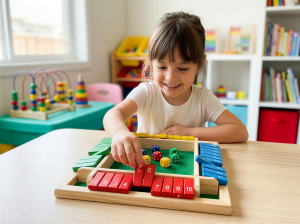
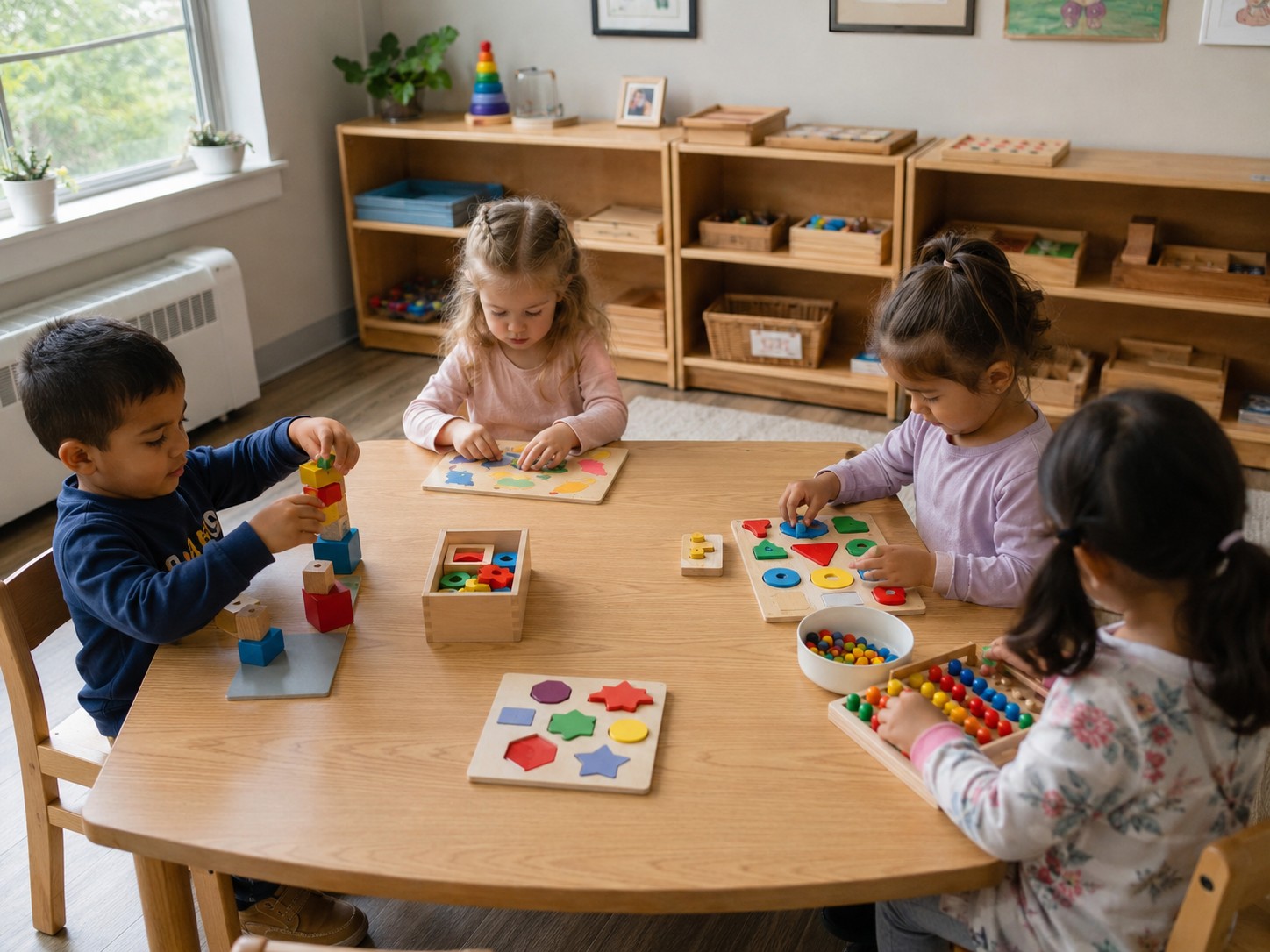
Most preschool classrooms have no shortage of toys. The real problem is that a significant portion of them stop being useful within weeks — pieces go missing, children lose interest, and teachers find they can’t build consistent learning activities around them. What looked educational in a catalog turns out to be decorative in practice.
The gap between “marketed as educational” and “actually useful in a classroom” costs schools more than most buyers realize. This guide breaks down which categories of classroom toys deliver measurable developmental value, how teachers use them effectively, and what the real cost of sourcing decisions looks like when you extend the calculation beyond purchase price.
What Early Childhood Research Actually Says About Learning Through Play
Before evaluating specific product categories, it helps to understand the developmental framework that separates effective classroom toys from decorative ones.
The National Association for the Education of Young Children (NAEYC) identifies hands-on, play-based learning as the primary mode through which children aged 3–6 build foundational cognitive skills. Their position statement on developmentally appropriate practice is explicit: abstract instruction without physical manipulation is developmentally mismatched for this age group. Children need to act on objects before they can form stable mental representations.
This is why a child who can recite numbers to twenty may still struggle to compare quantities. The verbal knowledge exists independently of the conceptual understanding. Physical materials — classroom toys that externalize thinking — are what create the bridge.
“Spatial skills at age three were a significant predictor of mathematics performance at age five, independent of general cognitive ability.”
— Verdine et al. (2014), Psychological Science
The implication for classroom purchasing decisions is direct: toys that develop spatial reasoning in early childhood aren’t enrichment. They’re foundational academic preparation.
“Structured play with physical materials builds the self-regulation, working memory, and cognitive flexibility that predict school readiness more reliably than early academic drills.”
— Center on the Developing Child, Harvard University
The right classroom toys are doing developmental work that no worksheet can replicate.
Core Categories of Preschool Classroom Toys That Deliver Real Learning Outcomes
Building and Construction Sets
Open-ended construction materials are among the most evidence-supported tools in early childhood classrooms. Blocks, interlocking bricks, and magnetic tile systems support spatial reasoning, cause-and-effect understanding, and early engineering thinking — simultaneously, and across a wide developmental range.
What distinguishes a strong classroom building set isn’t complexity — it’s recomposability. A child should be able to use the same set of pieces to build something fundamentally different each session. The learning happens in the iteration: building, observing failure, adjusting, rebuilding. Products that constrain children toward a single prescribed outcome exhaust their curriculum value quickly.
For teachers, construction sets are particularly valuable because they’re self-differentiating. A child working on basic stacking uses the same materials as one exploring structural balance or symmetry. One product serves the full developmental spectrum of a preschool classroom without requiring teachers to manage multiple parallel activities.
Institutional durability is the critical sourcing variable in this category. Classroom building sets are handled by twenty or more children daily, dropped repeatedly, stored loosely, and expected to function for multiple school years. Products with thin connectors, brittle joining mechanisms, or lightweight construction fail quickly under these conditions. Buyers should specifically ask suppliers about impact resistance standards and whether the product has been tested under repeated drop conditions — not just whether it meets general toy safety certifications.
Vindstier’s construction sets are designed with institutional classroom use as the baseline requirement, not an afterthought. Connector thickness, piece weight, and join tolerance are specified for multi-year classroom durability rather than single-household use.
Sorting and Matching Toys
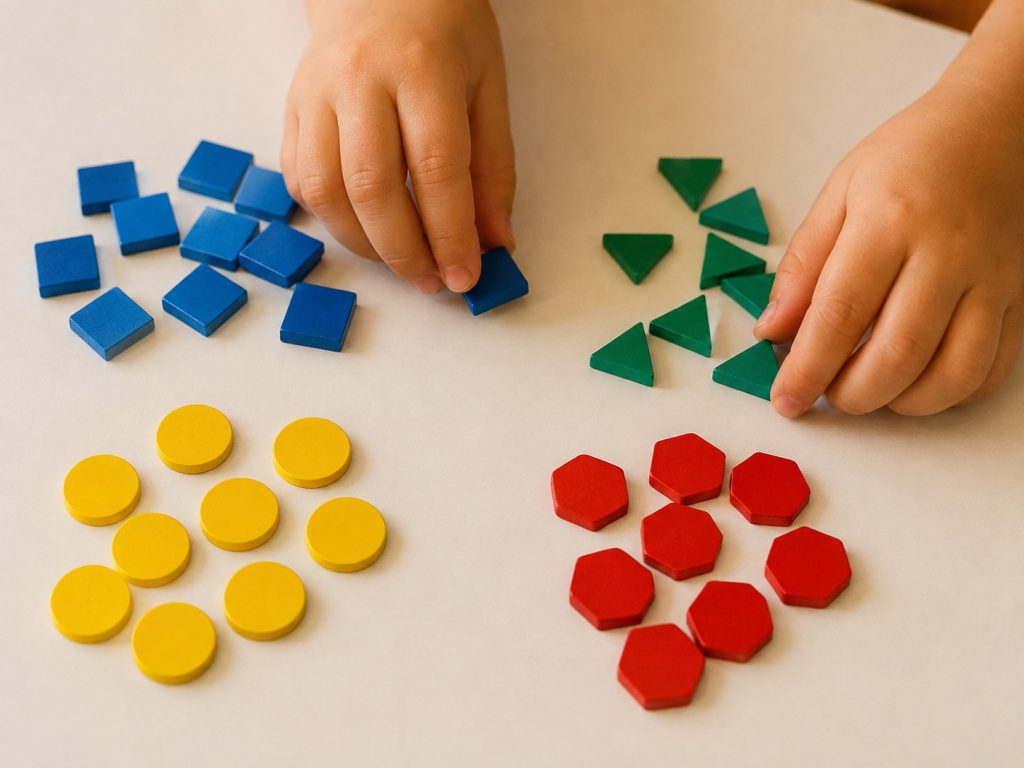
Classification — the ability to group objects by shared attributes — is a prerequisite for virtually every formal mathematics concept children encounter in primary school. Sorting and matching classroom toys develop this skill directly.
The developmental ceiling of a sorting toy is determined by how many distinct variables it supports. A product that sorts only by color is a single-lesson tool. A product that allows children to reorganize the same objects by color, size, shape, texture, or function across multiple sessions has a much longer instructional life.
NAEYC’s mathematics learning guidelines specifically highlight classification and patterning as core early math competencies for the preschool years. Products that address these competencies through multiple attribute dimensions align directly with what early childhood educators are required to teach.
In classroom practice, sorting materials work best when teachers use them across three distinct contexts: whole-group introduction, small-group guided activity, and independent exploration. A set that functions only in teacher-directed settings limits how much instructional value it generates per unit. The most effective sorting and matching classroom toys support all three without requiring different configurations.
Vindstier sorting sets are designed to support a minimum of four distinct sorting variables across the same product, covering the classification competencies outlined in NAEYC’s early mathematics framework for the full 3–6 age range.
Pretend Play and Role-Play Kits
Dramatic play is chronically undervalued in sourcing conversations because it doesn’t look like instruction. A child running a pretend market or preparing a kitchen scenario appears to be simply playing. Developmentally, they’re simultaneously practicing narrative sequencing, vocabulary acquisition, symbolic thinking, and social role negotiation.
“Children engaged in role-play scenarios with realistic props produced significantly more complex sentence structures and broader vocabulary than children in unstructured free play.”
— Center for Human Growth and Development, University of Michigan
For classroom buyers, this means the quality of the role-play kit’s scenario coherence is as important as material durability. A market set with realistic product replicas, functional accessories, and enough variety to support different narrative threads gives teachers a natural context for language activities. A generic collection of loosely related objects doesn’t provide the same scaffolding.
Evaluation criteria for this category should include scenario completeness (does the set support a coherent play narrative without teacher intervention?), piece count relative to group size, material hygiene (easy to clean between uses), and whether the scenario reflects cultural and contextual familiarity for the children using it.
Vindstier role-play kits are developed around scenario-coherent design principles — each set includes the props, accessories, and contextual variety needed to sustain independent dramatic play without requiring constant teacher facilitation.
Puzzles and Spatial Reasoning Tools
The Verdine et al. research has direct implications for how schools should approach puzzle and spatial reasoning purchasing. If spatial skills at age three predict mathematics outcomes at age five, then the quality of spatial reasoning tools in a preschool classroom is a measurable academic investment.
Standard shape-insert puzzles test recognition. Multi-piece puzzles, tangrams, pattern block sets, and geometric composition tools develop the more complex spatial skills — mental rotation, part-whole relationships, figure-ground discrimination — that the research links to later mathematical performance.
For teachers working with mixed developmental levels, the most useful puzzle sets are those that offer graduated difficulty within the same product line. A child progresses from simpler configurations to more complex ones without the teacher sourcing a different product. This reduces per-child cost and simplifies classroom material management.
When evaluating puzzle and spatial reasoning classroom toys at scale, buyers should assess: difficulty range within the set, piece durability under repeated handling, whether the activity can be reset easily for the next child, and whether the same materials support both teacher-guided and independent use.
Sensory and Fine Motor Development Toys
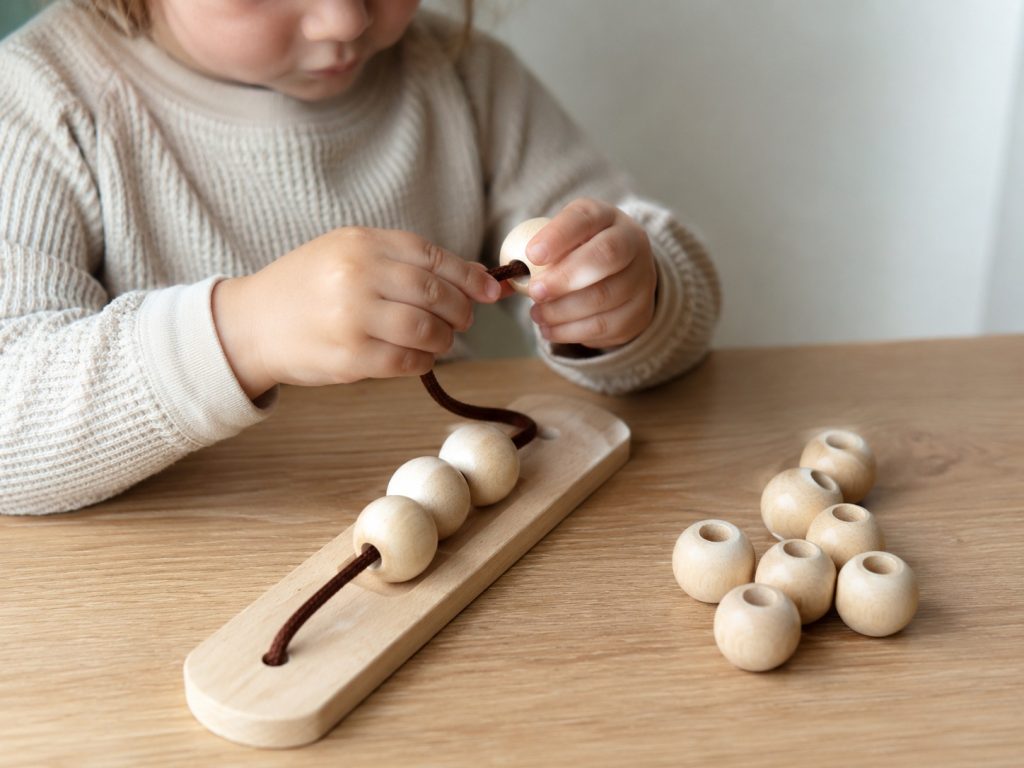
Fine motor development — hand strength, precision grip, hand-eye coordination — is a developmental prerequisite for writing, drawing, and many self-care skills. Threading sets, pegboards, lacing activities, precision stacking tools, and manipulative-based sensory materials all contribute to this foundation.
“Fine motor activities build focused attention, task persistence, and sequential planning — the regulatory behaviors that support formal learning readiness.”
— Center on the Developing Child, Harvard University
For school buyers, this category has specific safety and hygiene requirements that make sourcing decisions more complex than in other categories. Individual pieces need to be sized appropriately to eliminate choking risk while still providing a meaningful precision challenge. Materials need to be cleanable between users without degrading. And sets need enough pieces to support simultaneous use by multiple children without creating frustrating wait times.
Sourcing cheap fine motor sets creates compounding problems: pieces are lost quickly, thin materials degrade under sanitization, and inadequate piece counts mean the activity can only serve one or two children at a time. These are operational costs that don’t appear on the purchase invoice but show up in teacher time and replacement frequency.
Vindstier’s fine motor sets are designed for institutional sanitation standards, with piece counts calibrated for group classroom use and material specifications that maintain integrity through repeated cleaning cycles.
How Teachers Build Effective Lessons Around Classroom Toys
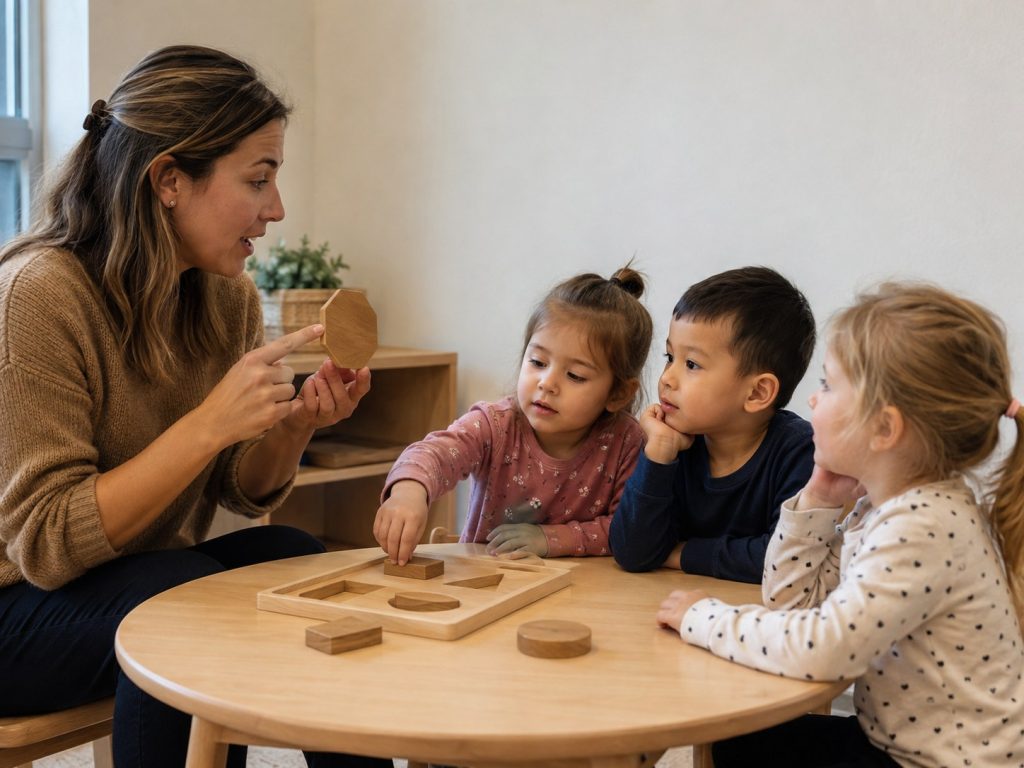
The developmental outcomes from classroom toys don’t happen automatically. They depend on how teachers structure the learning sequence.
Effective early childhood educators use classroom toys across three distinct pedagogical modes. In whole-group introduction, the teacher uses physical materials to demonstrate a concept — modeling classification rules with a sorting set, or showing balance principles with building blocks. In small-group guided play, groups of three to five children work with the same materials under teacher direction, and the teacher observes where understanding breaks down. In independent exploration, materials move to the activity corner for child-directed use, where informal assessment happens naturally.
A classroom toy that functions effectively across all three modes generates significantly more instructional value per unit than one designed only for independent play. When evaluating products, teachers and buyers should ask: can this be demonstrated to a group? Can I build a guided challenge around it? Will children engage with it independently? All three questions need affirmative answers for a product to justify classroom investment.
The Real Cost of Generic Classroom Toy Sets
The market for preschool classroom toys has a low-end concentration problem. Many products, similar quality, limited durability, shallow educational function. For buyers working with constrained budgets, the lower per-unit price of generic sets is genuinely attractive. But the total cost calculation looks different when you extend the timeframe.
| Cost Factor | Generic Set | Vindstier Quality Set |
|---|---|---|
| Unit purchase price | $40 | $120 |
| Replacement frequency | Twice per year | Once in 5 years |
| Total cost over 5 years | $200 | $120 |
| Educational function over 5 years | Degrading | Consistent |
| Indirect costs (teacher time, admin) | High | Low |
| 5-year cost advantage | — | 40% cheaper |
The quality product is 40% cheaper over its useful life — and delivers consistent educational function throughout, rather than degrading performance as the years progress.
Beyond direct replacement costs, there are indirect costs that don’t appear in procurement spreadsheets: teacher time spent managing broken or incomplete sets, the reduced educational value of a sorting set missing half its pieces, and the administration overhead of repeated small-purchase cycles. Schools that have moved to higher-quality classroom toy suppliers consistently report that the operational friction reduction justifies the higher unit cost independently of the direct cost comparison.
For institutional buyers making sourcing decisions across multiple classrooms, the calculation is straightforward: total cost of ownership over five years is the relevant metric, not purchase price per unit.
What Vindstier Brings to Institutional Classroom Toy Sourcing
The standards described throughout this article — developmental alignment, multi-variable educational function, institutional durability, scenario coherence — are the design criteria Vindstier applies to every product in its preschool range.
This means construction sets tested for classroom-intensity handling rather than single-household use. Sorting sets that support four or more distinct classification variables, covering the NAEYC mathematics competency framework across the full 3–6 age range. Role-play kits designed around scenario-coherent narratives that sustain independent dramatic play. Fine motor materials specified for institutional sanitation cycles without material degradation.
For brands, distributors, and educational product buyers looking to source classroom toys that schools will actually keep using — and that reduce the replacement frequency that makes cheap sourcing expensive over time — Vindstier welcomes detailed sourcing conversations. We’re equipped to discuss OEM and ODM requirements, certification documentation, and how our products align with specific curriculum frameworks your markets require.
Conclusion
The preschool years are when children build the spatial reasoning, classification ability, language foundation, and executive function that determine how prepared they are for formal learning. Classroom toys are the primary vehicle for that development — not as decoration, but as structured cognitive tools.
NAEYC’s developmental frameworks, spatial skills research from Psychological Science, and executive function work from Harvard’s Center on the Developing Child all point to the same conclusion: the quality of physical learning materials in a preschool classroom has measurable academic consequences. That makes sourcing decisions in this category more consequential than they often appear.
For teachers, the right classroom toys are the ones that work across whole-group, guided, and independent learning modes without requiring separate product configurations for each. For school buyers, the right classroom toys are the ones whose five-year total cost, durability, and educational function justify the investment beyond their initial price tag. For brands and distributors, the right sourcing partner is one who understands these criteria in depth — and builds to them.