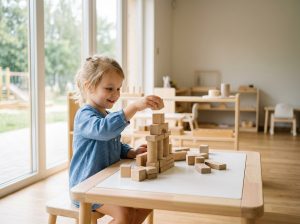
If you’ve ever watched a 3-year-old face a puzzle they can’t immediately solve, you know what happens next: some children push the pieces away in frustration, while others lean in closer, brow furrowed, utterly determined. That second response — that instinct to try again — is exactly what parents of preschoolers are hoping to nurture. The challenge is finding a toy that creates the right kind of productive struggle: hard enough to stretch a young mind, safe enough to hand over without a second thought, and engaging enough to hold a toddler’s attention past the first five minutes.
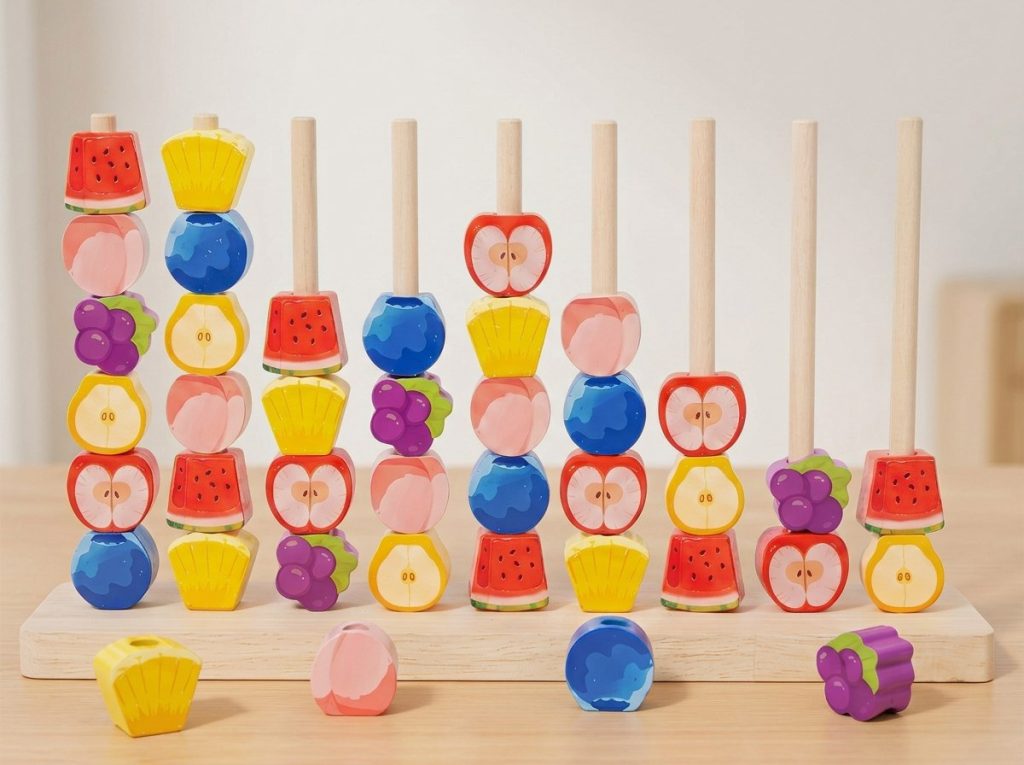
The Fruit Sorting Stacking Toy from Vindstier was designed around that precise challenge. It doesn’t rely on screens, sounds, or batteries. Instead, it places 7 columns of mixed fruit blocks and 2 spare posts in front of a child and asks a deceptively simple question: can you move all the fruits so each column holds only one type?
That question, and the dozens of micro-decisions required to answer it, is where real cognitive development begins.
The Tower of Hanoi Principle: Why This Fruit Sorting Stacking Toy Challenges Young Brains Differently
Most sorting toys for toddlers ask children to match a shape to a hole or place blocks by color. The Fruit Sorting Stacking Toy operates on an entirely different cognitive level. Its gameplay is modeled on the Tower of Hanoi — a classic logic puzzle used in mathematics education and cognitive science research — but reimagined with 7 fruit-themed columns and 2 spare posts that function as temporary holding stations.
Here’s what that looks like in practice: your child cannot simply lift a grape block and place it directly onto the grape column if another fruit is already stacked there. They must first move that fruit to a spare post, free up the target column, complete the transfer, then decide what to do with the displaced fruit next. Every single move creates a downstream consequence. That is sequential reasoning — and it is precisely the kind of thinking that underlies later skills in mathematics, coding logic, and structured problem-solving.
For a child aged 3+, this is not abstract. It is immediate and tactile: wooden block in hand, eyes scanning 9 total posts, brain working through what comes next. The developmental toys for children market is full of products that claim to build “critical thinking,” but few create the specific condition of constrained decision-making that the Tower of Hanoi structure provides. With this fruit sorting stacking toy, the constraint is built into the rules of the game itself.
Color and Pattern Recognition as the First Layer of Problem-Solving
Before a preschooler can begin sorting, they must first read the board. The Fruit Sorting Stacking Toy includes 7 distinct fruit types — apples, watermelons, grapes, and more — each rendered in bright, non-glare colors chosen specifically to be distinguishable without causing visual fatigue during extended play.
This matters more than it might seem. A child’s ability to classify — to look at a column of mixed blocks and identify which fruit goes where — is not a given at age 3. It is a skill that develops through repeated exposure and practice. The non-glare finish on each block means children can focus on the fruit pattern itself rather than squinting against reflective surfaces, which removes a subtle but real barrier to sustained engagement.
Color perception and fruit recognition in this context are not separate from problem-solving — they are its prerequisite. A child who cannot confidently distinguish the watermelon block from the grape block will struggle to plan their moves. The toy’s design treats visual discrimination as step one of the cognitive chain, not as a decorative feature. This alignment with early cognitive enlightenment goals makes it a strong fit for parents looking for Montessori toys 3+ years that build genuine foundational skills rather than surface-level pattern matching.
Fine Motor Execution: Where the Plan Meets the Hand
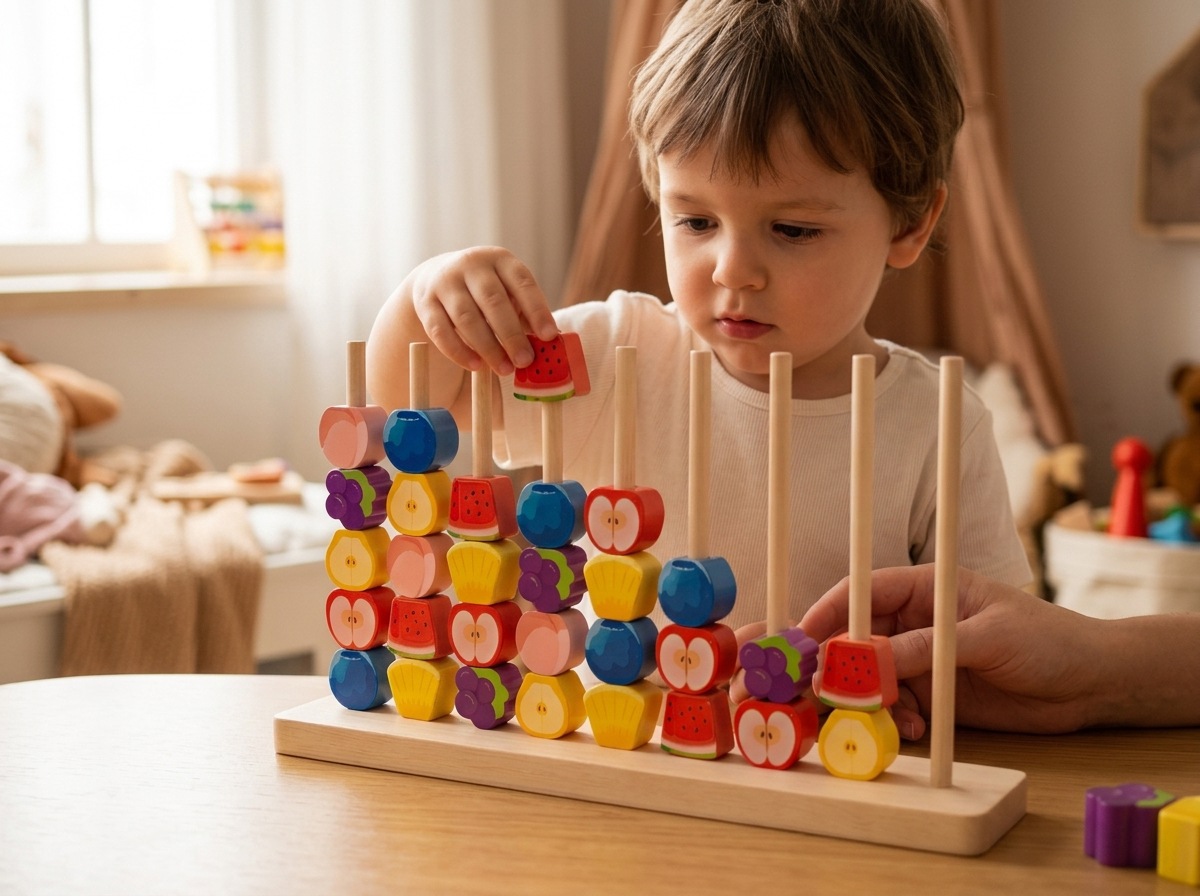
Planning a sequence of moves is one cognitive challenge. Executing it with small hands is another. The Fruit Sorting Stacking Toy requires children to grasp individual fruit blocks — sized and weighted for 3-year-old hands — and thread them accurately onto narrow wooden dowels. That threading action demands precise hand-eye coordination: the child must align the block’s central hole with the dowel tip, lower it smoothly, and release without knocking adjacent columns.
For preschoolers, this is not a trivial physical task. It strengthens the intrinsic hand muscles responsible for later pencil grip and scissor control. It trains the eye to guide the hand to a specific target point. And because each placement is consequential to the overall sorting strategy, children remain focused and patient in ways that open-ended stacking alone does not typically sustain.
Parents searching for STEM toys for preschoolers often focus on the cognitive dimension — rightly so — but the physical execution layer is where children learn that a good plan still requires careful action. A child who has mentally worked out the next three moves but fumbles the block onto the wrong post must adapt. That recovery process — re-evaluating, adjusting, continuing — is a micro-version of the problem-solving cycle that this fruit sorting stacking toy builds repeatedly across every play session.
How the 7-Column Structure Creates Escalating Difficulty
One of the less obvious design decisions in this fruit sorting stacking toy is the choice of 7 fruit columns rather than a simpler 3 or 4. This is not arbitrary. With only 2 spare posts available, the complexity of the sorting challenge scales significantly with each additional fruit type. A child working through a 7-column board must hold more visual information in working memory, plan further ahead, and manage a greater number of intermediate states.
This built-in escalation means the toy grows with a child’s developing ability. A 3-year-old encountering the toy for the first time might work on a simplified version — focusing on 3 or 4 columns while a parent helps manage the rest. A 4-year-old with several months of practice may attempt the full 7-column challenge independently. The same physical toy presents genuinely different cognitive demands at different developmental stages, which is the defining characteristic of strong open ended play toys.
For parents and educators aligned with Montessori principles, this self-scaffolding quality is significant. The child sets the level of challenge. The toy does not cap their potential by providing only one difficulty setting.
Material Safety Designed Around This Toy’s Specific Use Pattern
The safety profile of this fruit sorting stacking toy follows directly from how it is actually played. Children pick up blocks repeatedly, thread them onto dowels, remove them, and start again. That means every surface a child contacts — the block body, the dowel tip, the base plate edge — must be finished to a standard that tolerates repeated handling by small hands.
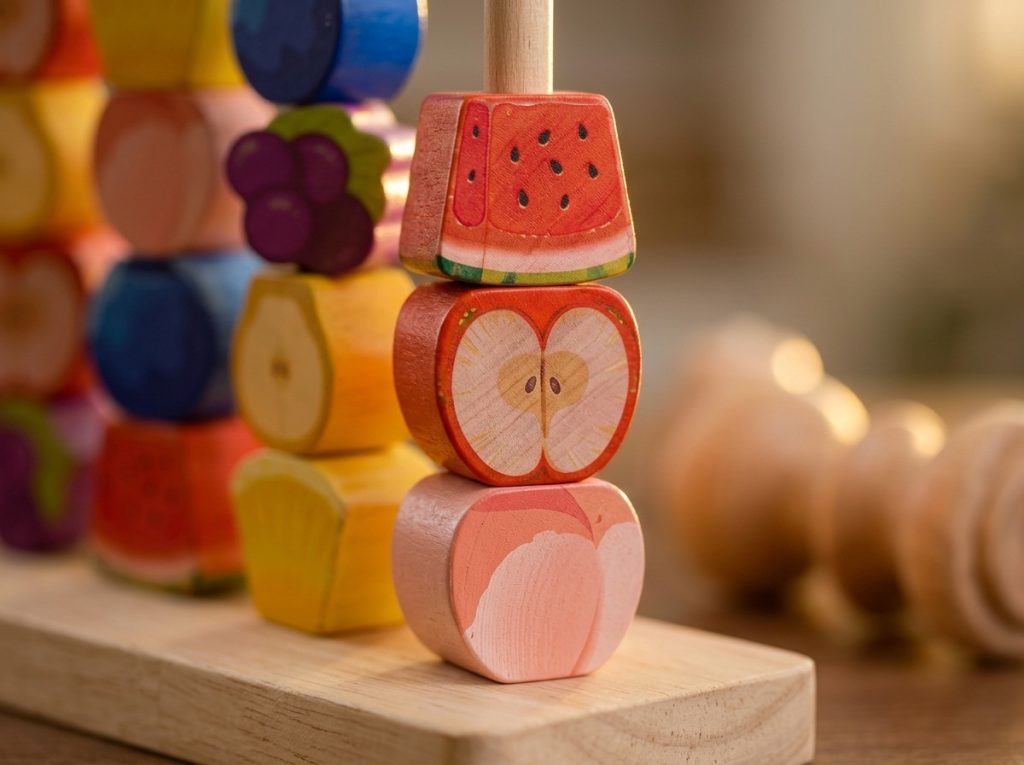
The toy is crafted from sturdy natural wood with laser-cut precision, which produces consistent block dimensions without the rough edges that hand-cut wood can leave. All edges undergo chamfering followed by 360° polishing, resulting in a fully rounded profile with no burr points. This is not a general claim about “smooth wood” — it is the specific result of a two-stage finishing process applied to every edge and corner that a child’s palm or fingertip might contact during normal play.
The toy meets both CE certification standards (required for the European market) and CPC compliance (required for the US market under CPSC regulations). For parents purchasing educational toys for 3 year olds, those two certifications together represent the most rigorous parallel safety validation available for children’s products — not because the brand says so, but because third-party testing bodies in two separate regulatory jurisdictions have verified the materials, structural integrity, and age-appropriateness of this specific product.
The Gift Dimension: Why Problem-Solving Toys Make Better Presents
Parents and gift-givers searching for stocking stuffers for 3+ years or birthday gifts for preschoolers face a common dilemma: toys that look impressive in the box often disappoint within a week, while truly developmental toys are sometimes difficult to explain to a child excited to play immediately.
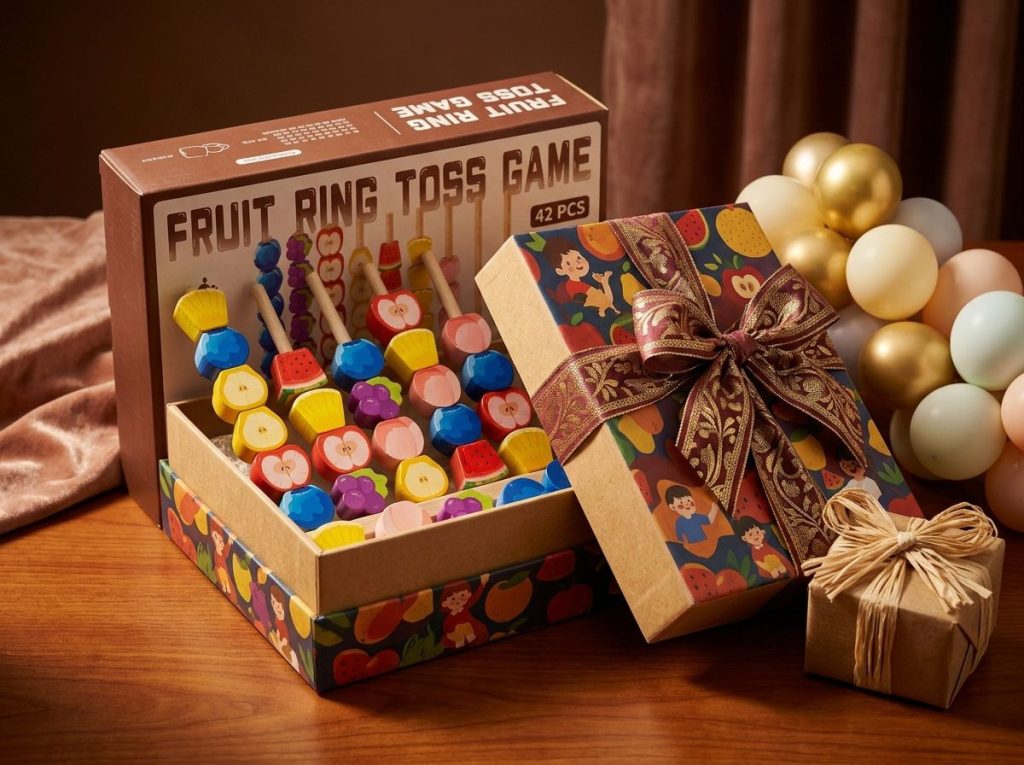
The Fruit Sorting Stacking Toy resolves this tension. Its colorful gift box packaging is designed to communicate the toy’s appeal visually — the bright fruit blocks, the wooden structure, the puzzle-game format — so the gift lands well at the moment of unwrapping. But unlike many brightly packaged toys, the engagement doesn’t peak at unboxing. The Tower of Hanoi structure means there is always a next challenge, always a more efficient solution to discover, always a reason to return to the board.
The parent-child interaction dimension matters here too. Because the sorting challenge is rule-based rather than open-ended, parents can participate meaningfully without taking over. A parent can prompt rather than direct: “Which fruit needs to move first? What happens if you put the grape here?” These questions reinforce exactly the same sequential reasoning the toy builds during solo play, making it one of the more genuinely collaborative developmental toys for children in this age category.
What Vindstier’s Design Philosophy Means for Buyers and Partners
Vindstier develops wooden educational toys for kids with a focus on play mechanics that map directly to cognitive development milestones. The Fruit Sorting Stacking Toy is not a brand extension of a generic stacking toy — it was built around the Tower of Hanoi logic structure from the ground up, which is why its developmental outcomes are specific rather than claimed.
For retailers and distributors exploring wooden toys wholesale or educational toys OEM ODM partnerships, the product’s dual CE and CPC certification removes a significant sourcing barrier. For private label buyers considering OEM wooden toys or private label educational toys programs, Vindstier’s manufacturing precision — laser-cut components, standardized finishing processes — supports consistent quality at scale.
The toy’s alignment with Montessori wooden toys principles, its credentials as eco-friendly wooden toys built from sustainably sourced natural wood, and its positioning within the STEM toys for preschoolers category give it clear shelf positioning across multiple retail verticals, from specialty educational toy stores to mainstream gift retail.
Conclusion
The problem with many toys marketed as “educational” is that the education is incidental — a label applied after the fact to a product designed primarily to entertain. The Fruit Sorting Stacking Toy works differently. Its 7-column, 2-spare-post structure creates a logic challenge that cannot be solved by guessing or by brute force. A child must plan, sequence, evaluate, and adapt. Those cognitive operations are not side effects of play — they are the play itself.
For parents of 3+ year olds who want a toy that develops real problem-solving capacity, the specific mechanics of this fruit sorting stacking toy — the constrained moves, the tactile wooden blocks, the fruit-pattern classification goal — deliver a developmental experience that generic stacking and sorting toys do not replicate.
If you’re looking for a toy that will still be on the shelf six months from now, still presenting new challenges, and still building the skills your child needs for school and beyond, the Fruit Sorting Stacking Toy belongs in that conversation.