

A kindergarten teacher sets out a bin of colorful blocks, expecting ten minutes of quiet independent play. The reality looks very different. Within seconds, three children argue over whose tower is taller. One child abandons the activity completely. None of the kids explore shapes, balance, or symmetry—the core concepts the lesson was designed to teach.
This scenario plays out in classrooms worldwide every day. Traditional blocks and puzzles keep little hands occupied. However, they rarely encourage open-ended reasoning, the core capability that early STEM learning relies on.
Magnetic building toys were created to fill this critical educational gap. They combine tactile, hands-on play with invisible magnetic physical forces. They turn simple construction play into intuitive lessons in geometry, spatial reasoning, and cause-and-effect logic—no worksheets required.
These educational toys deliver dual value for educators and school buyers. They hold young children’s attention far longer than standard toys. More importantly, they build foundational cognitive skills. Understanding what makes high-quality magnetic building toys educationally effective helps school teams make budget-friendly, high-impact purchasing decisions instead of investing in underperforming classroom supplies. For early childhood classrooms, magnetic building toys bridge the gap between playful engagement and intentional skill building in a way few other learning materials can.
Why Traditional Building Toys Fall Short
Classic wooden blocks and plastic interlocking bricks depend solely on gravity and friction to stay upright. They work for basic stacking practice, but they create clear limitations for young learners.
Unstable structures collapse before children can fully grasp structural concepts. Younger kids often feel frustrated when pieces fail to connect or stay in place. Most traditional building play only delivers surface-level learning. Stacking blocks mechanically does not help children understand core structural geometry or spatial logic.
Truly effective hands-on learning tools teach through physical experience, not adult explanation. This is the key advantage that magnetic building toys bring to early education. Magnetic pieces snap together instantly and hold stable from multiple angles. This simple mechanism lets kids build taller, more complex 3D structures, including bridges, domes, and geometric solids. Children test spatial relationships actively while building. The magnets stabilize structures, freeing children to focus on critical thinking and creative problem-solving.
How Magnetic Building Toys Build Real STEM Skills
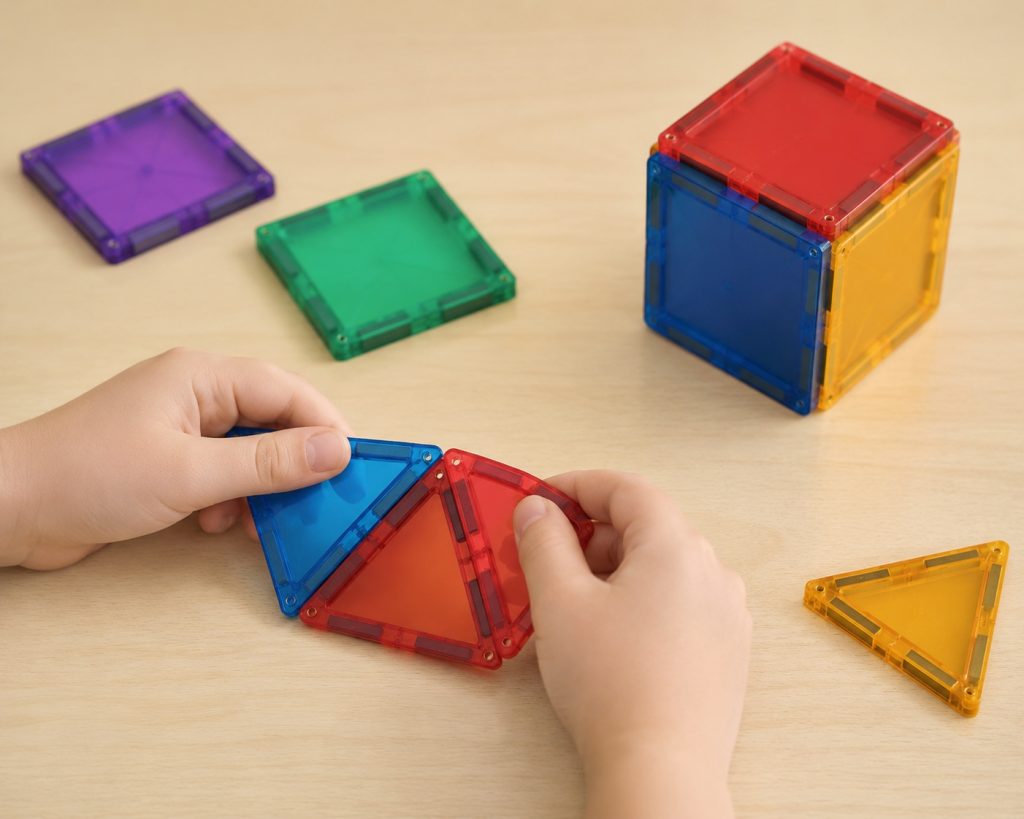
Leading early childhood education research confirms that concrete physical manipulation is the foundation of abstract mathematical thinking. Children develop stronger long-term math and spatial reasoning skills when they learn shapes through touch and construction before learning paper-based diagrams.
Magnetic tiles for kids turn this educational theory into daily classroom practice. When a child combines two triangles to form a square or assembles flat tiles into a cube, they complete a physical, hands-on geometry test. They independently verify which shapes fit together and why certain combinations work. This concrete-to-abstract learning process is widely recognized by early education researchers as a key predictor of later STEM academic success.
Beyond geometry mastery, STEM building toys support holistic child development. Aligning and pressing small magnetic pieces together refines fine motor control. The stable build environment also builds persistence and resilience. Unlike traditional blocks that require full reconstruction after a collapse, magnetic structures allow quick corrections and adjustments. For young learners, magnetic building toys turn passive skill instruction into active, memorable exploration.
This iterative build-test-adjust cycle teaches children that failure is fixable and normal in creative problem-solving. Classrooms that integrate magnetic construction play report improved collaborative skills as well. Multiple students can work on one large structure at the same time, practicing communication, negotiation, and teamwork—skills that static worksheets cannot cultivate. This hands-on, exploratory learning model is the core reason magnetic building toys become a long-lasting staple in early STEM classrooms.
Classroom Application: From Free Play to Structured Lessons

Background
A preschool serving children aged four to six previously relied on standard block sets for open play. Teachers needed separate, structured activities to teach shape recognition and symmetry, as standard blocks could not easily demonstrate core spatial concepts. Most supplementary resources, such as paper cutouts and printed worksheets, felt repetitive and boring for young children, leading to low student engagement and poor knowledge retention.
Application Process
The teaching team introduced a set of magnetic construction tiles for both free play and guided curriculum lessons. During unstructured free time, children explored independently, testing how different pieces connect and experimenting with basic builds without adult guidance.
During structured lessons, teachers used the same magnetic tile sets for interactive demonstrations. Educators built simple 2D flat shapes, then guided students to extend and lift the shapes into 3D solids. This visual, physical transformation let children directly observe the relationship between planar shapes and three-dimensional structures.
Problem Solved
This dual-use system resolved two core classroom challenges simultaneously. It provided a low-supervision creative outlet for free play periods. It also gave teachers a tangible demonstration tool for abstract spatial concepts that static images struggle to explain clearly. This flexibility is what makes magnetic building toys such a versatile addition to early education curriculums.
Practical Value
Consistent with early childhood learning principles, physical, interactive learning significantly improved student understanding of 2D-to-3D transformation. Teachers observed better knowledge retention compared to previous paper-based teaching methods. For school administrators, magnetic building toys unified two budget categories—free-play recreational materials and structured instructional aids—reducing redundant procurement costs.
Why the Right Materials and Design Matter
Not all magnetic construction toys suit formal classroom environments. Home-use magnetic building toys differ greatly from institutional-grade educational sets. Classroom toys must withstand daily heavy use: frequent dropping on hard floors, repeated assembly and disassembly, and handling by dozens of children across multiple school terms.
Low-quality products have weak magnets that lose adhesion quickly after months of repeated use. Thin, fragile plastic tiles crack easily under normal classroom activity. For institutional buyers, educational magnetic building toys must be evaluated as durable classroom equipment, not disposable consumer toys.
Vindstier designs professional magnetic building toys exclusively for group classroom settings. Every tile features reinforced edges and embedded high-performance magnets engineered for long-term daily use. Unlike lightweight home toy alternatives, these sets maintain stable magnet strength and structural integrity over years of repeated use.
The tiles feature kid-safe sizing and weighted balance for small preschool hands. They fully comply with classroom safety standards and eliminate choking hazards for younger learners. In daily teaching scenarios, high-precision magnetic alignment lets children complete builds independently. This preserves the core educational value of self-directed exploration and reduces reliance on adult assistance. For education distributors, this professional-grade durability and safety compliance creates clear market differentiation from generic low-cost imported magnetic toys.
Comparing Common Magnetic Building Toy Formats
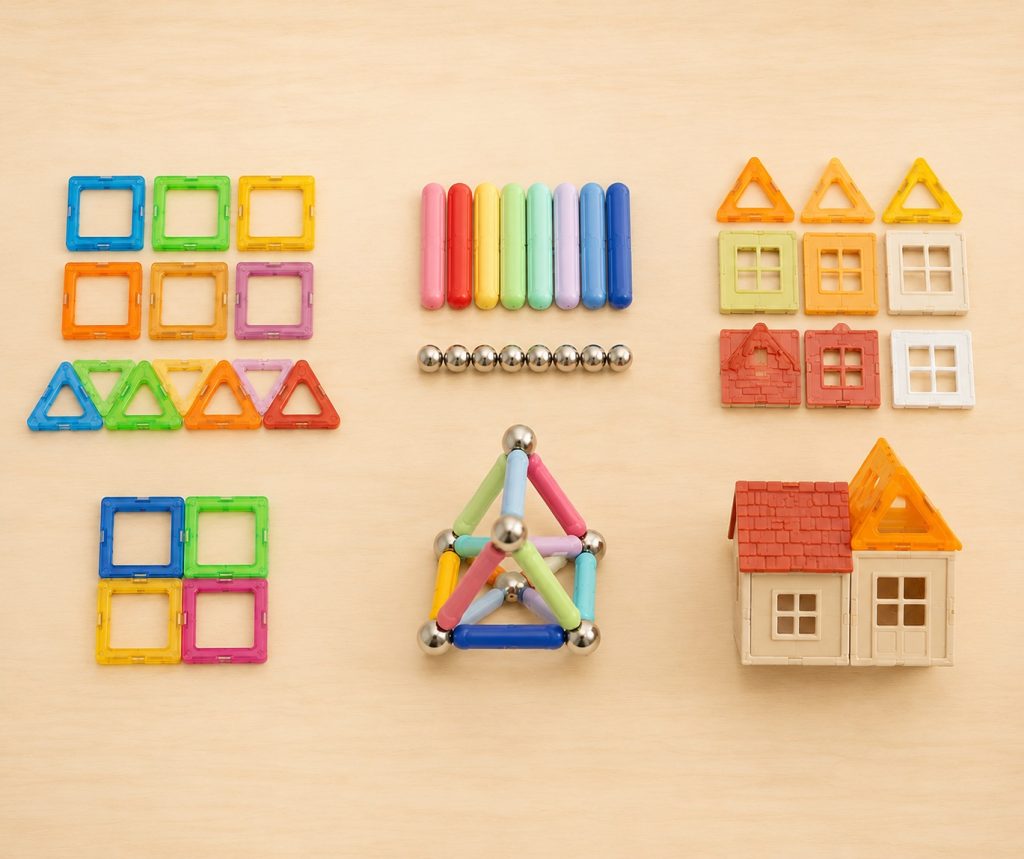
Different types of magnetic building toys serve unique educational purposes and age groups. Each format of magnetic building toys targets different developmental stages, allowing schools to scale their STEM resources as students grow. Most well-rounded STEM classroom corners combine multiple formats to support progressive skill development from preschool to early elementary grades.
| Format | Suitable Age Range | Skills Emphasized | Best Classroom Use | Potential Limitations |
|---|---|---|---|---|
| Flat geometric tiles | 3–8 years | Shape recognition, 2D-to-3D spatial reasoning, basic geometry comprehension | Guided STEM lessons, small-group collaborative building, shape transformation exercises | Limited structural height and load-bearing capacity; less effective for advanced structural engineering learning for older kids |
| Magnetic rods and spheres | 5–10 years | Structural engineering, balance and tension logic, advanced 3D spatial design | Independent STEM center exploration, engineering challenge activities, upper preschool and early elementary lessons | Small spherical parts require stricter supervision for younger preschoolers; steeper learning curve for beginner builders |
| Themed magnetic sets (vehicles, architecture) | 4–9 years | Narrative imaginative play, fine motor refinement, scenario-based problem-solving | Unstructured free play, classroom transition activities, creative enrichment sessions | Themed molds limit open-ended creative freedom compared to universal geometric tiles; lower pure STEM education focus |
What This Means for Schools and Toy Buyers
Classroom teachers prioritize simplicity and usability. The best educational magnetic building toys allow four-year-old children to build independently and withstand daily classroom wear and tear.
School procurement officers focus on long-term durability, safety certification, and cost efficiency. High-quality magnetic building toy sets serve multiple student cohorts for years, maximizing budget ROI. Toy brands and education distributors prioritize consistent manufacturing quality, stable magnet performance, and education-aligned design that meets classroom pedagogical needs.
Vindstier integrates educator feedback throughout the entire product development process. Instead of manufacturing generic toys first and adjusting for classrooms later, the brand designs every magnetic construction set around real preschool and early elementary teaching needs. This educator-first approach ensures every set of magnetic building toys delivers real classroom value, not just recreational fun.
Conclusion
Magnetic building toys outperform traditional blocks and paper worksheets in early STEM education for one key reason: they enable real-time, physical scientific experimentation. Children test shape matching, structural stability, and balance through hands-on building. They learn to build, observe failure, adjust their design, and rebuild.
This natural hands-on feedback loop embodies the student-centered learning that early childhood educators strive to foster. It occurs organically with qualified magnetic building toys, without rigid lesson plan enforcement.
For schools and educational buyers, the value of magnetic building toys in classrooms is well-established by educational research and long-term classroom practice. The key purchasing decision is not whether to adopt these tools, but selecting professionally designed, durable sets that deliver genuine STEM learning value and long-term classroom service life.