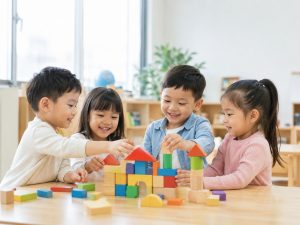
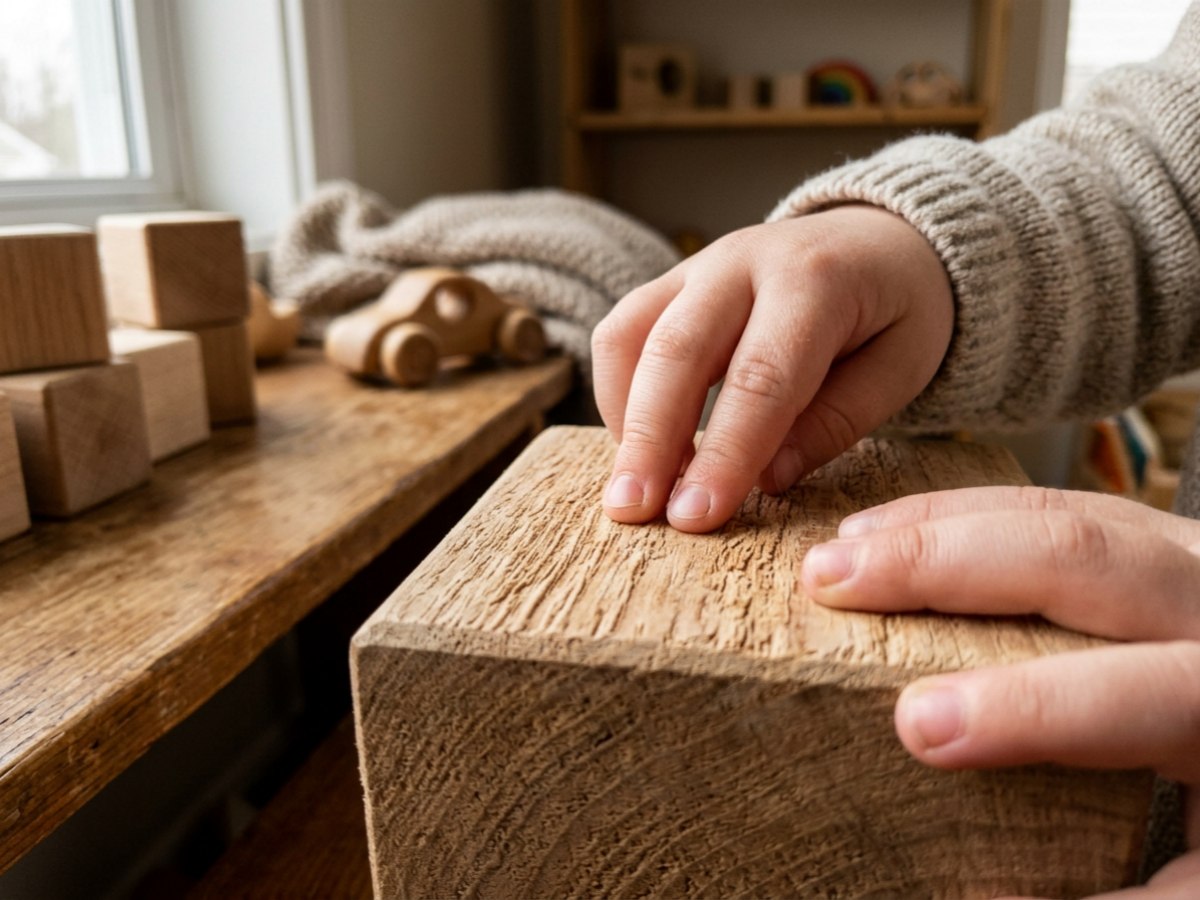
Parents searching for Wooden Toys for Preschoolers often focus on “educational value,” “safe play,” or “screen-free learning tools.” Yet in real preschool classrooms and Montessori environments, educators tend to evaluate something far more practical: how the toy behaves in a child’s hands after repeated daily use.
Texture matters.
Weight matters.
And for preschool children still developing grip strength, bilateral coordination, and motor planning skills, these physical properties directly shape how learning unfolds during play.
Unlike lightweight plastic alternatives, Wooden Toys for Preschoolers create consistent tactile resistance through natural wood grain structure, stable material density, and balanced weight distribution. Children are not simply holding objects—they are constantly adjusting finger pressure, wrist rotation, and grip stability while interacting with them.
Research from the American Occupational Therapy Association (AOTA) highlights that tactile-rich object interaction plays an important role in early motor development. A 2023 study published in Frontiers in Psychology further suggests that preschool children often demonstrate longer sustained engagement during open-ended tactile play compared to high-stimulation electronic toys.
In many classrooms, educators observe this before reading any research.
When children first encounter weighted wooden blocks, they often pause before building. Some test the weight repeatedly in their palms. Others tap the blocks on tables to compare vibration feedback.
What looks like simple play is actually early sensory processing in action.
Over the past few years, many preschool procurement teams have gradually reduced reliance on high-stimulation electronic toys and increased investment in open-ended play materials, especially tactile-based wooden learning tools.
Why Wooden Toys for Preschoolers Support Sensory Learning More Effectively
Texture is not a surface decoration in early childhood education.
It is a communication channel between hand and brain.
Wooden Toys for Preschoolers provide subtle variations in tactile feedback through grain patterns, density differences, and friction resistance. These sensory inputs become especially important during preschool years, when children are still building hand stability and coordinated movement control.
A smooth, uniform surface allows movement with minimal adjustment.
A textured wooden surface requires continuous recalibration of grip strength.
That difference quietly reshapes how children interact with objects.
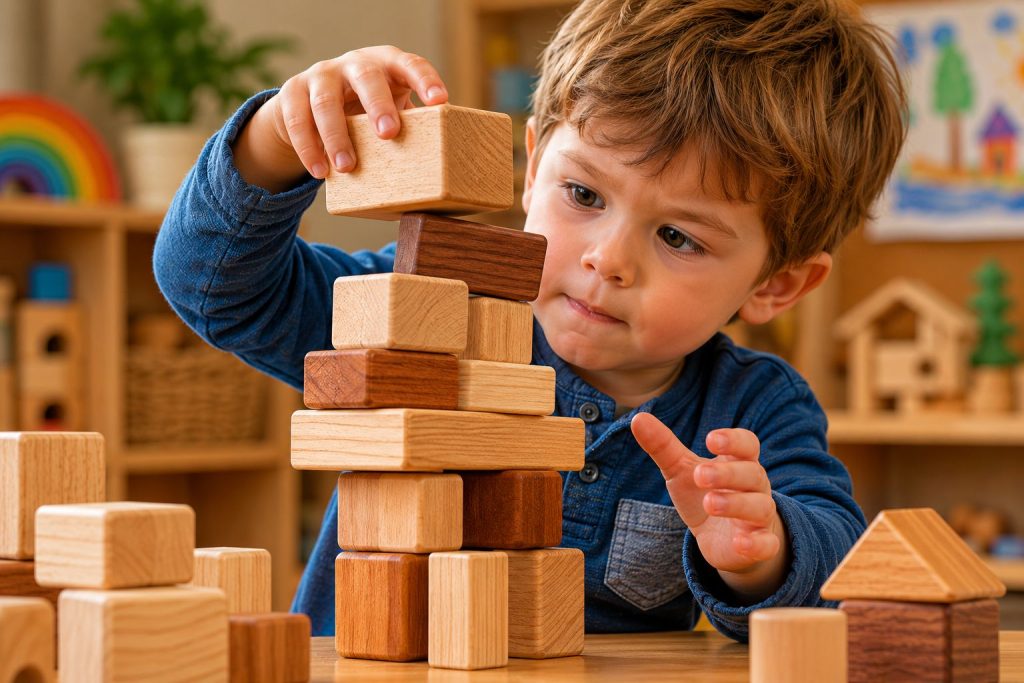
Why Preschool Wooden Learning Toys Encourage More Intentional Movement
Many preschool wooden learning toys use matte finishes instead of glossy coatings because surface friction directly influences how children adjust their grip.
For example:
- Beechwood grain creates subtle fingertip variation during rotation
- Matte sealing reduces slippage during stacking activities
- Rounded hardwood edges improve grip stability during repeated handling
- Balanced tactile resistance naturally slows down impulsive movement
In Montessori classrooms, tactile wooden toys are often placed in calm, low-stimulation areas because children tend to sustain attention longer without audio or visual interruption.
This process is rarely immediate.
Some children spend several minutes simply exploring material properties before starting structured play—rubbing surfaces, comparing shapes, and testing balance points.
Interestingly, this exploratory phase varies noticeably across developmental stages and classroom exposure levels.
Developmental psychology research from the University of Chicago has linked tactile exploration with stronger object memory formation in early childhood learning.
This is one reason sensory wooden blocks remain widely used in occupational therapy settings, Montessori classrooms, and early childhood development environments.
Why Weight Changes Behavior in Wooden Toys for Preschoolers
Weight directly influences how children move.
It also influences how long they stay engaged.
Heavier objects naturally slow down hand movement, encouraging more deliberate motor planning and reducing impulsive actions during play.
This is why many preschool sensory programs integrate weighted Wooden Toys for Preschoolers into daily activities.
How Weighted Wooden Blocks Support Fine Motor Development
Many classroom-grade weighted wooden blocks are made from dense hardwoods such as beech or maple because stable density improves stacking consistency.
Typical density levels for classroom hardwood blocks often range around 720–760 kg/m³. This range provides enough resistance for sensory feedback without limiting usability for preschool-aged children.
The behavioral impact becomes visible in real classroom environments:
| Physical Property | Developmental Effect |
| Stable hardwood weight | Supports bilateral coordination |
| Balanced center of gravity | Reduces repeated collapse frustration |
| Controlled lifting resistance | Strengthens grip development |
| Stable stacking behavior | Encourages spatial planning |
Educators often notice that children remain engaged longer when structures stay stable during collaborative building activities.
Conversely, lightweight blocks that shift easily or collapse frequently tend to interrupt focus and reset attention cycles.
Some preschool procurement teams even avoid hollow wooden blocks for this reason—because even when visually similar, internal weight inconsistency affects classroom performance significantly.
This detail is rarely highlighted in product descriptions but becomes obvious during repeated classroom use over time.
Research published in the Early Childhood Education Journal also suggests that higher-density construction materials are associated with longer sustained collaborative play.
The difference is not always dramatic in every instance.
But it is consistent enough to be recognized in long-term observation.
Why Montessori Wooden Toys for Preschoolers Remain Central in Sensory Classrooms
Many modern early childhood programs are re-evaluating high-stimulation learning environments.
Instead of increasing sound effects or digital interaction, more Montessori-based classrooms emphasize tactile engagement and slower, open-ended play.
This shift explains why Montessori Wooden Toys for Preschoolers continue to be widely adopted in sensory-focused learning environments.
Quiet Tactile Feedback Supports Longer Attention Cycles
Wood behaves differently from plastic during impact.
The sound is softer.
Vibration feedback is lower.
While these differences may seem subtle, experienced educators often report measurable changes in classroom behavior when sensory wooden toys replace plastic alternatives.
Common observations include:
- Longer uninterrupted building sessions
- Reduced object-throwing behavior
- Increased cooperative interaction
- Higher persistence in sorting tasks
- Smoother transitions into independent play
A 2023 study in Frontiers in Psychology also suggests that tactile-centered play environments may support sensory regulation in preschool-aged children.
While no single material determines learning outcomes, tactile wooden toys consistently encourage slower, more controlled interaction patterns.
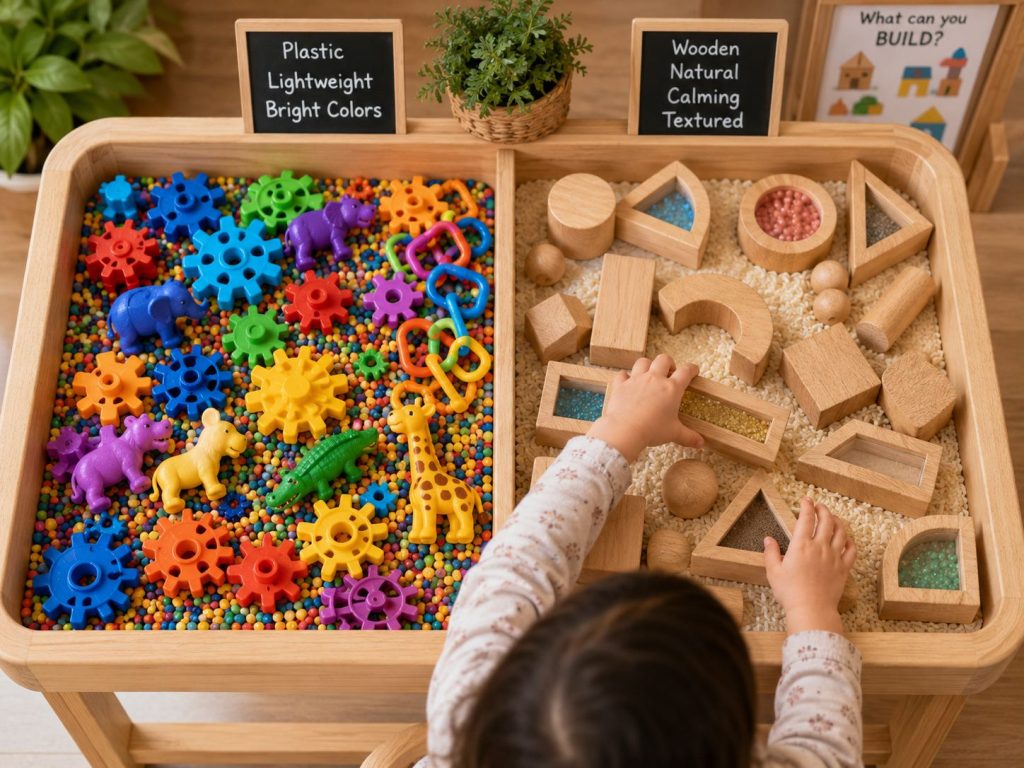
Why Lightweight Plastic Toys Often Reduce Sensory Feedback
Different materials produce fundamentally different learning experiences.
Plastic toys are often colorful, lightweight, and easy to clean. However, many low-density plastic designs provide limited tactile variation due to uniform surface and structural consistency.
In contrast, Wooden Toys for Preschoolers introduce multi-layered sensory input during play.
| Feature | Lightweight Plastic Toys | Wooden Toys |
| Grip resistance | Low | Stable tactile feedback |
| Weight consistency | Low | Naturally balanced |
| Surface texture | Uniform | Natural grain variation |
| Stacking behavior | Unstable | More predictable |
| Sensory engagement | Visual dominant | Multi-sensory tactile input |
Children naturally test physical feedback during play—comparing weight, tapping surfaces, and experimenting with pressure differences.
Sensory wooden blocks encourage this exploration because wood responds more realistically to applied force.
This feedback loop becomes part of the learning process itself.
Manufacturing Factors That Actually Influence Wooden Toys for Preschoolers
Many online descriptions treat wooden toys as a single category, but in real classroom environments, manufacturing precision directly affects long-term sensory consistency and usability.
Not all wooden toys deliver the same tactile experience.
Small Manufacturing Choices Create Significant Differences
High-quality Wooden Toys for Preschoolers often rely on strict production controls, including:
- Kiln-dried hardwood with 6%–8% moisture content to reduce deformation during repeated cleaning cycles
- 3–5 mm rounded edge finishing for safer grip rotation
- Water-based matte coatings to preserve natural wood texture
- Precision sanding that removes splinters while retaining micro-texture variation
- Tight dimensional tolerance control for stable stacking alignment
In real preschool environments, insufficiently dried wood may gradually shift in shape after repeated sanitation cycles. Even minor deformation can affect stacking stability during group activities.
This is why many classroom-grade wooden blocks prioritize kiln-dried hardwood over faster, lower-density alternatives.
Occupational therapists also often select high-density sensory wooden blocks because stable weight distribution supports controlled wrist movement training.
These differences are difficult to evaluate visually and usually become clear only after long-term classroom use.
Why Schools Continue to Invest in Wooden Toys for Preschoolers
Durability plays a critical role in early childhood education environments, especially where toys are used repeatedly throughout the day by many children.
Many schools and Montessori programs continue to invest in Wooden Toys for Preschoolers because solid hardwood maintains structural and sensory consistency under repeated handling, cleaning, and rotation cycles.
Over time, many procurement teams have also begun prioritizing low-stimulation, high-tactile-feedback learning materials rather than purely digital or electronic toys.
Common Evaluation Criteria in Preschool Procurement
| Factor | Why It Matters |
| Edge durability | Reduces long-term wear risks |
| Surface coating stability | Maintains tactile consistency |
| Weight stability | Ensures predictable classroom behavior |
| Cleaning resistance | Prevents surface degradation |
| Replacement cycle | Reduces long-term cost |
In long-term classroom rotation systems, weight stability also influences maintenance frequency and replacement planning.
Some environments increasingly prefer hardwood balancing toys because they retain structural consistency even under frequent use.
This value is not purely visual—it directly affects how children interact with materials over time.
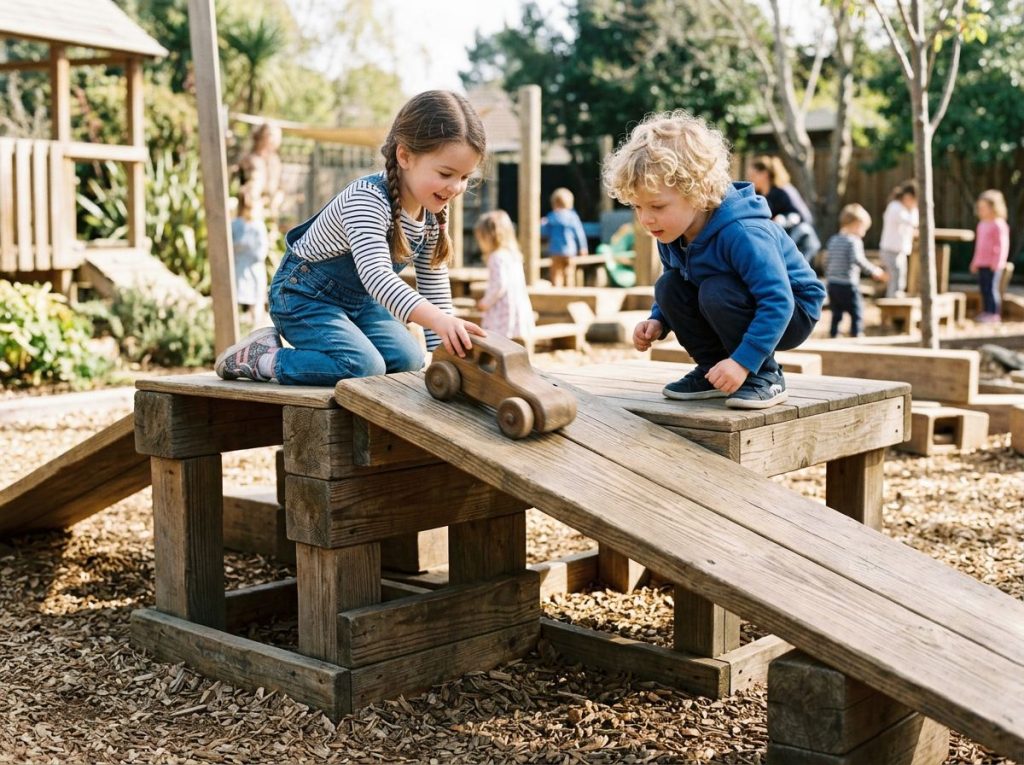
FAQs About Wooden Toys for Preschoolers
Why do Montessori classrooms prefer wooden toys?
Montessori environments emphasize low-stimulation, hands-on learning. Wooden toys naturally support this approach because they encourage children to focus on balance, weight, spatial reasoning, and repetitive hands-on exploration rather than sound or screen-based feedback.
What type of wood is best for preschool wooden toys?
Beech and maple are commonly used due to their stable density and durable surface structure. In classroom-grade applications, kiln-dried hardwood is often preferred to maintain shape consistency after repeated cleaning cycles.
How does weight affect attention span in preschool children?
Heavier wooden toys tend to slow down movement, encouraging more intentional actions. This often results in longer engagement during building activities, improved focus during collaborative play, and reduced impulsive handling behavior compared to lightweight materials.
Why do Wooden Toys for Preschoolers encourage open-ended play?
Open-ended play allows children to explore objects freely without predefined rules. Wooden toys naturally encourage exploration of weight, balance, texture, and spatial relationships, making them highly effective for sensory-driven learning experiences in early childhood education.
Conclusion
Texture and weight are not decorative attributes in early childhood toys.
They are core learning mechanisms that influence how children grasp, balance, coordinate, and explore their environment.
Wooden Toys for Preschoolers continue to be widely used in Montessori classrooms, sensory programs, and early childhood education settings because solid hardwood provides consistent tactile resistance, stable weight feedback, and natural surface variation that lightweight materials struggle to replicate.
As research and classroom observation increasingly align, a clear pattern emerges: children engage more intentionally when materials provide meaningful physical feedback.
For educators, parents, and procurement teams, the key consideration is no longer how many features a toy includes, but whether it actively engages a child’s hands, muscles, and sensory system in the learning process.
One movement.
One balance adjustment.
One moment of real tactile feedback.