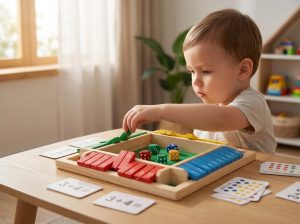
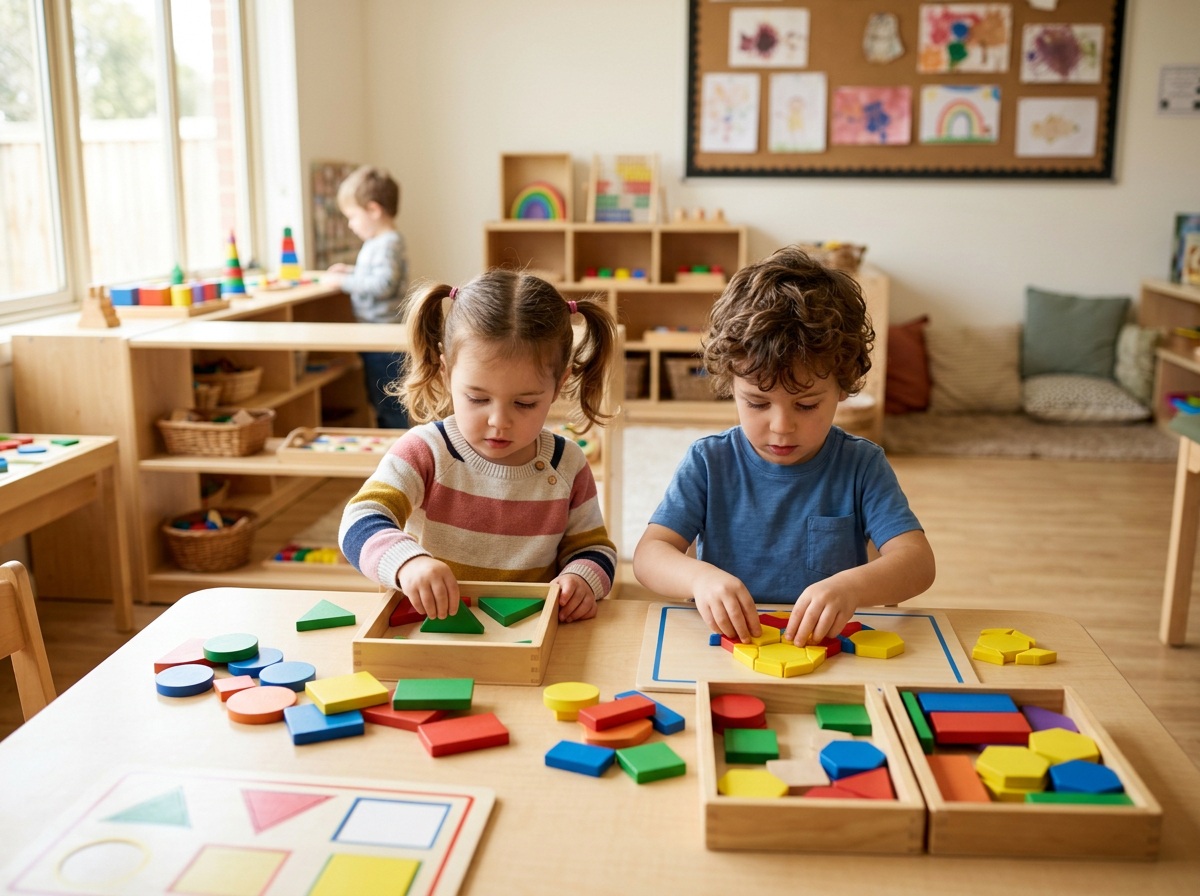
Preschool teachers preparing math centers discover that shape recognition activities generate frustration rather than engagement—children correctly identify circles during guided instruction but point to ovals, calling them “circles” during free play minutes later. Parents purchasing shape puzzles and flashcards report similar confusion: their three-year-old memorizes “triangle” when viewing the puzzle piece but fails to recognize triangular objects (pizza slices, roof peaks, sandwich halves) in daily environments.
Research from the National Council of Teachers of Mathematics indicates that geometric thinking develops through physical manipulation and spatial exploration rather than passive observation. Teaching shapes to preschoolers through hands-on activities and purposefully selected toys creates the multi-sensory, contextualized experiences necessary for children to recognize shape properties across varied presentations rather than memorizing isolated examples.
Why Shape Recognition Matters Beyond Simple Identification
Early geometry comprehension predicts later mathematics achievement more reliably than early number skills. Research published in Child Development (2021) documented that preschoolers demonstrating strong shape recognition and spatial manipulation abilities scored 40% higher on fifth-grade mathematics assessments compared to peers with equivalent early numeracy but weaker geometric skills.
Shape recognition develops spatial vocabulary (beside, inside, corner, edge) that children apply to navigation, construction, and visual analysis tasks. Understanding that triangles maintain identity despite orientation changes builds mental rotation abilities essential for map reading and scientific visualization.
The Transfer Problem: From Recognition to Application
Many preschoolers successfully complete shape-matching worksheets but fail to identify shapes in real-world contexts. Teaching shapes to preschoolers requires moving beyond isolated identification toward recognizing shape properties that persist across different sizes, orientations, colors, and contexts.
A child who identifies circles only when presented as red dots on flashcards lacks understanding that circles appear as wheels, plates, buttons, and coins. Effective approaches for teaching shapes to preschoolers emphasize property recognition over example memorization.
Traditional two-dimensional instruction particularly fails three-dimensional understanding. Real geometric competence requires experiencing shapes as both flat (2D) and solid (3D) forms through manipulation and construction.
Developmental Progression: Teaching Shapes to Preschoolers at Each Stage
Shape understanding develops through predictable stages, with activities aligned to current developmental levels rather than chronological age alone. Individual children progress at different rates based on experience, exposure, and developmental readiness.
| Development Stage | Typical Age Range | Shape Recognition Skills | Geometric Understanding | Appropriate Activities |
|---|---|---|---|---|
| Beginning | Ages 2-3 | Identifies circles and squares in standard orientation; matches identical shapes | Recognizes shapes as distinct objects; sorts by visual similarity | Simple shape sorting; matching identical shapes; tracing large outlines |
| Emerging | Ages 3-4 | Names circles, squares, triangles; recognizes shapes in varied orientations | Begins noticing properties (corners, straight/curved sides) | Shape hunts; building with shape blocks; creating patterns |
| Developing | Ages 4-5 | Identifies rectangles, ovals; distinguishes similar shapes | Describes properties (counting sides and corners); recognizes shapes as categories | Complex sorting by attributes; combining shapes; tangram puzzles |
| Advanced | Ages 5-6 | Recognizes hexagons, pentagons; identifies 3D shapes (sphere, cube, cylinder) | Understands shapes maintain identity across transformations; relates 2D and 3D shapes | Pattern block designs; 3D construction; describing relationships |
Preschoolers initially distinguish shapes through holistic visual recognition without analyzing specific properties. Children typically begin articulating shape properties around the emerging stage: triangles have three sides and three corners, rectangles have four sides with opposite sides equal length.
Teachers implementing strategies for teaching shapes to preschoolers support this transition by modeling property language (“This shape has four corners and four sides—it’s a square”) rather than only providing shape names. The shift from recognition to property understanding enables flexible shape identification regardless of orientation.
Five Effective Activities for Teaching Shapes to Preschoolers
Successful shape instruction embeds learning within engaging, hands-on experiences providing repeated exposure to shape properties across varied contexts.
Activity 1: Environmental Shape Hunts
Shape hunts transform classrooms, playgrounds, and homes into geometry laboratories where children identify shapes within familiar surroundings. Teachers implementing methods for teaching shapes to preschoolers assign specific challenges (“Find five rectangles in our classroom”) and children photograph, sketch, or collect items matching target shapes.
This activity builds shape recognition across varied contexts—rectangles appear as books, doors, windows, and tables, demonstrating that shape identity persists despite functional differences. The movement component maintains engagement while the discovery element creates intrinsic motivation.
Beginning learners hunt one shape at a time with teacher guidance. Advanced children hunt multiple shapes simultaneously or sort findings by additional properties.
Activity 2: Building and Construction With Shape-Based Toys
Building toys for preschoolers like wooden blocks, magnetic tiles, and pattern blocks provide three-dimensional manipulation developing spatial reasoning alongside shape recognition. Children building structures discover how shapes fit together: triangles combine to form diamonds, squares and triangles create houses, rectangles stack to build towers.
Construction activities reveal shape properties through direct physical experience. Preschoolers attempting to stack cylinders discover curved surfaces don’t support stable building, learning that flat faces enable vertical construction.
Teachers maximize learning by narrating shape properties during construction and asking prediction questions (“Which shapes do you think will fit in this space?”). For institutional buyers evaluating resources for teaching shapes to preschoolers, construction toys require sufficient quantity for multiple children (minimum 100 pieces for classrooms of 15-20 children) and durable materials withstanding repeated handling.

Activity 3: Shape Sorting and Classification Games
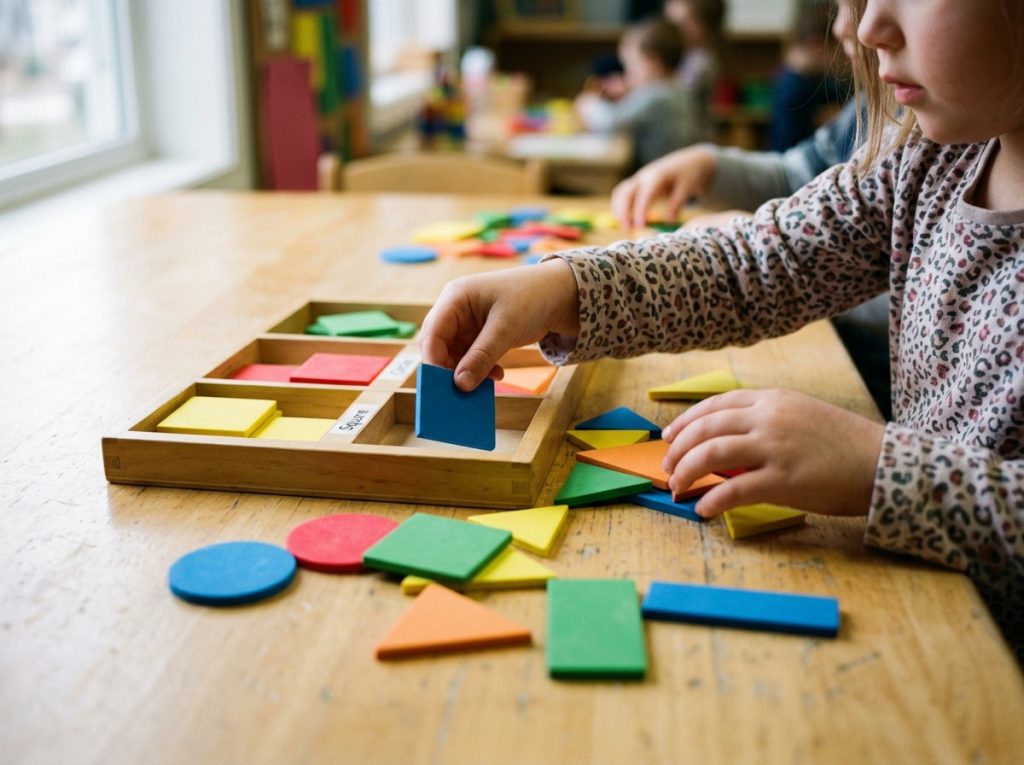
Sorting activities develop analytical thinking by requiring children to identify properties and group shapes by shared characteristics. Teachers provide mixed shape collections and challenge children to organize by attributes: number of sides, presence of curves, size, or combinations of properties.
This moves beyond simple identification toward property analysis. Sorting “shapes with straight sides only” versus “shapes with curves” requires examining edges rather than relying on memorized labels.
Beginners sort shapes into pre-labeled categories. Intermediate learners create their own sorting categories. Advanced children follow complex multi-property rules.
Activity 4: Shape Art and Creative Projects
Art activities using shapes as building blocks combine creativity with geometric learning. Children create pictures by arranging cut paper shapes (circles become wheels, triangles become roofs, rectangles become buildings) or paint using shape stamps and stencils.
This demonstrates shape versatility—the same triangle represents multiple objects depending on size, orientation, and combination. The creative freedom reduces performance pressure while providing shape identification practice.
Process-focused art emphasizes free exploration. Product-focused projects (“create a robot using only rectangles and circles”) add challenge by constraining shape choices.
Activity 5: Movement and Body-Based Shape Activities
Physical movement activities kinesthetically reinforce shape properties through body positioning. Children form shapes using their bodies (three children hold hands forming a triangle, four children create a square) or trace large floor shapes with their feet.
Movement integration addresses preschoolers’ physical activity needs while creating memorable experiences. The proprioceptive feedback from positioning bodies into shape configurations builds spatial understanding unavailable through visual observation alone.
Teachers guide activities through physical challenges (“Can you walk along this circle path?”) and reflection questions (“How did we know we made a square? Let’s count the corners”).
Selecting Toys and Materials for Teaching Shapes to Preschoolers
Effective materials for teaching shapes to preschoolers provide clear shape representation, varied manipulation opportunities, and durability for intensive classroom use.
Shape Clarity and Representation Quality
High-quality shape toys present geometrically accurate forms with clearly defined edges, distinct angles, and proportions matching standard geometric definitions. Poorly designed shape sorters sometimes feature “circles” that are slightly oval or “squares” with rounded corners, teaching incorrect concepts.
Three-dimensional shape toys (wooden blocks, geometric solids) provide advantages over flat alternatives by allowing children to explore shapes from multiple angles. A cube’s six square faces connect flat and solid geometry in ways pictures cannot demonstrate.
Durability and Multi-Child Use
Preschool shape manipulatives endure hundreds of handling cycles weekly. Solid wood construction outperforms hollow plastic alternatives, maintaining structural integrity and shape accuracy through years of use.
Painted shapes require durable finishes that don’t chip or peel. Size considerations balance ease of handling against choking safety—shapes with minimum 1-inch dimensions suit preschool age ranges while remaining safe.
Quantity Requirements for Group Activities
Minimum quantity standards suggest 8-10 pieces per child for open-ended building, or 3-4 pieces per child for teacher-guided sorting activities. Collections emphasizing 4-5 basic shapes (circles, squares, triangles, rectangles, hexagons) in multiple sizes provide better learning support than sets featuring 10+ shape types but limited quantities of each.
Assessing Shape Understanding: Observable Milestones
Progress in teaching shapes to preschoolers appears through children’s spontaneous shape vocabulary, accuracy in varied contexts, and property-based explanations.
Beginning stage: Children correctly name basic shapes when viewing standard presentations but struggle with orientation changes or real-world applications.
Emerging stage: Children identify shapes across varied presentations, begin noticing properties (“This one has pointy corners”), and recognize familiar shapes in environmental contexts.
Developing stage: Children describe shapes using property language (counting sides and corners), predict which shapes will fit together, and recognize relationships between shapes (two triangles make a square).
Advanced stage: Children spontaneously apply shape knowledge to creative construction, identify complex 3D shape properties, and explain shape relationships and transformations independently.
Teachers document progression through observational notes capturing spontaneous shape vocabulary during free play and accuracy during shape hunts or sorting activities.
Common Mistakes When Teaching Shapes to Preschoolers
Even thoughtfully designed approaches for teaching shapes to preschoolers face limitations and implementation errors that reduce effectiveness.
Limited shape vocabulary. Some programs focus exclusively on circles, squares, and triangles, neglecting rectangles, ovals, hexagons, and 3D shapes appropriate for preschool learning. This prevents children from developing comprehensive geometric foundations.
Two-dimensional teaching emphasis. Focusing exclusively on flat representations fails to develop spatial reasoning about three-dimensional forms. Preschoolers need experience with cubes, spheres, cylinders, and pyramids alongside flat shapes.
Passive learning methods. Worksheet completion and flashcard drills provide insufficient hands-on manipulation for preschool-age geometric thinking development. These tools offer occasional assessment value but cannot replace physical building, sorting, and environmental exploration.
Inconsistent vocabulary. Adults sometimes use imprecise language (calling all rectangles “boxes,” referring to ovals as “circles”) that confuses children about shape identity. Conscious attention to accurate geometric terminology supports clearer concept formation.
Conclusion
Teaching shapes to preschoolers through hands-on activities builds genuine geometric understanding extending beyond memorization to property recognition and spatial reasoning. Five effective activities embed shape learning: environmental shape hunts build recognition across real-world applications, construction with shape-based toys develops spatial understanding, sorting games strengthen property analysis, shape art demonstrates creative applications, and movement activities create kinesthetic reinforcement. Material selection prioritizes geometrically accurate representations, durable construction, and sufficient quantities supporting multi-child engagement. Progress relies on observable behaviors including spontaneous shape vocabulary and identification accuracy in varied contexts.