Every parent has been there. You set up a “math practice session,” and within three minutes your child is staring at the ceiling, tapping the table, or suddenly needing a glass of water. The problem isn’t the child — it’s that drills feel like work. The moment numbers appear on a worksheet, something switches off.
What changes the equation isn’t a better worksheet. It’s removing the worksheet entirely.
The Number Flip Dice Box was built around a deceptively simple idea: if kids are laughing, competing, and begging for one more round, they’re not “doing math” — they’re just playing. And somewhere inside that game, addition and subtraction are happening automatically.
What Actually Happens When You Play the Number Flip Dice Box
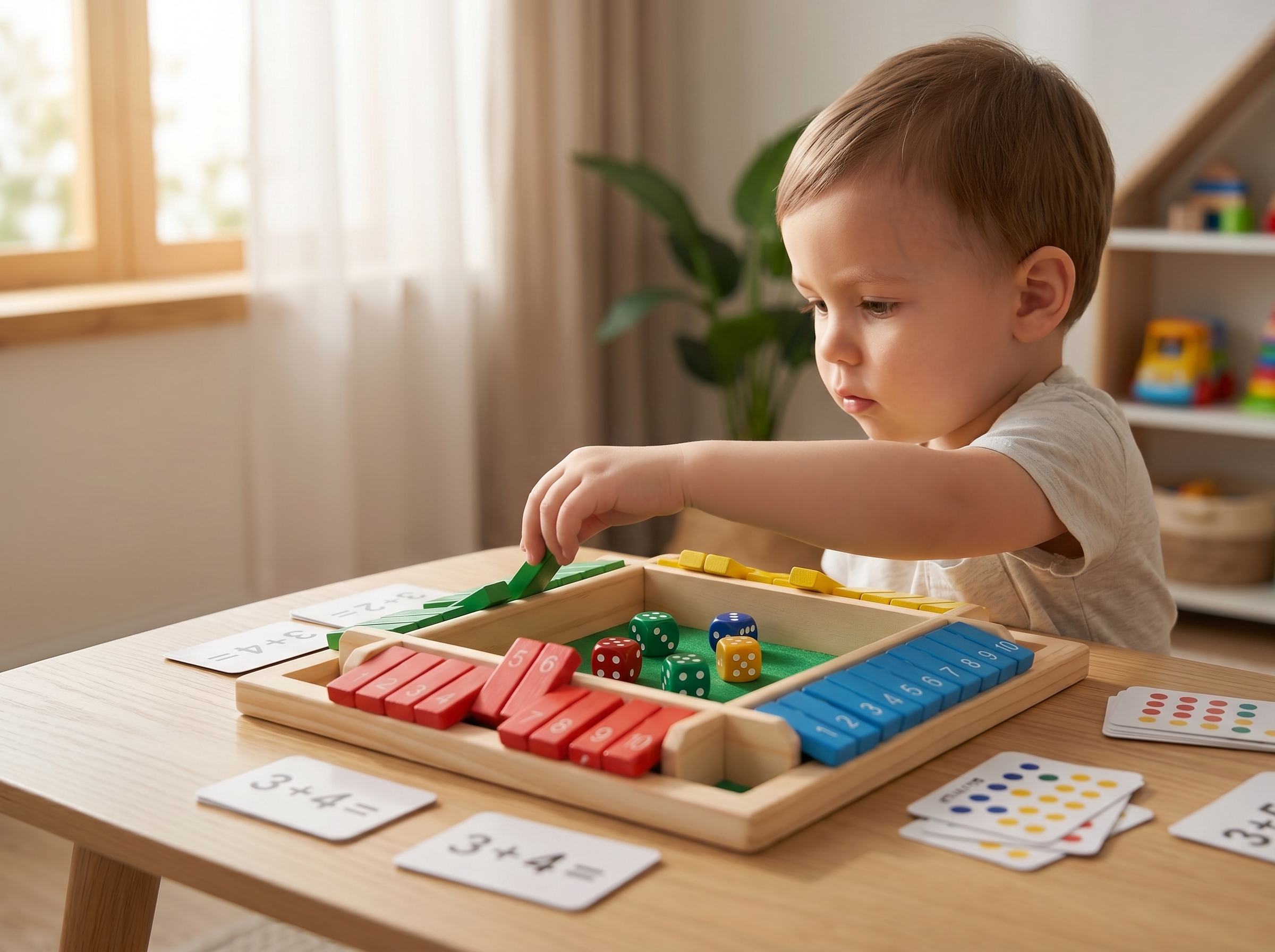
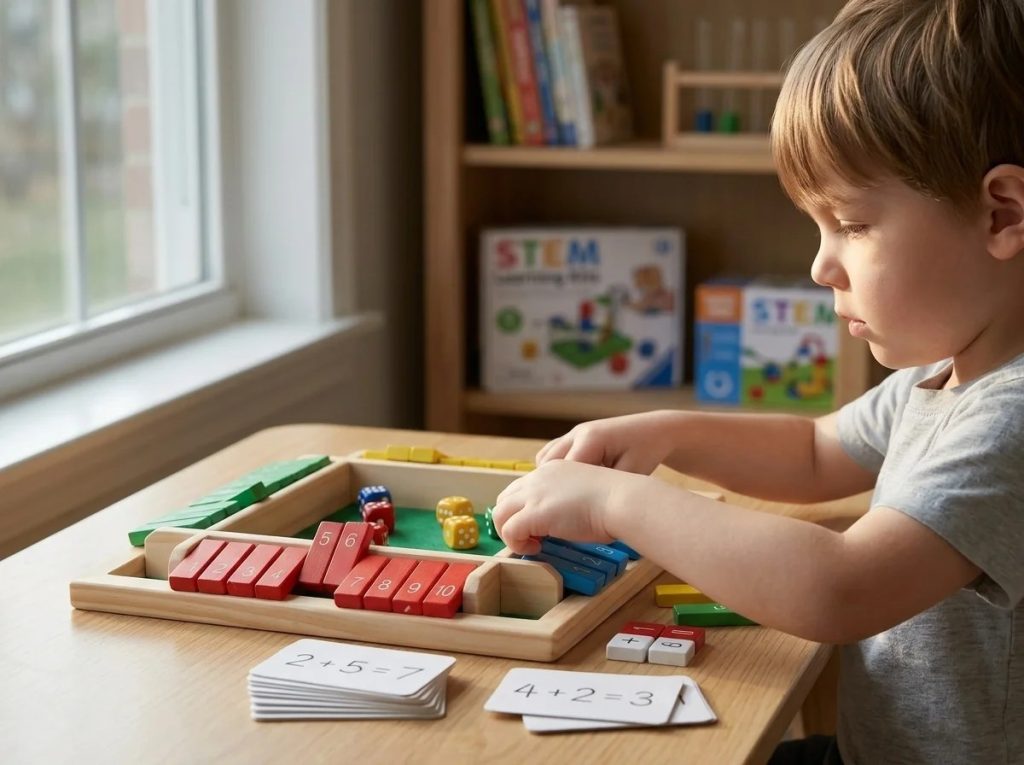
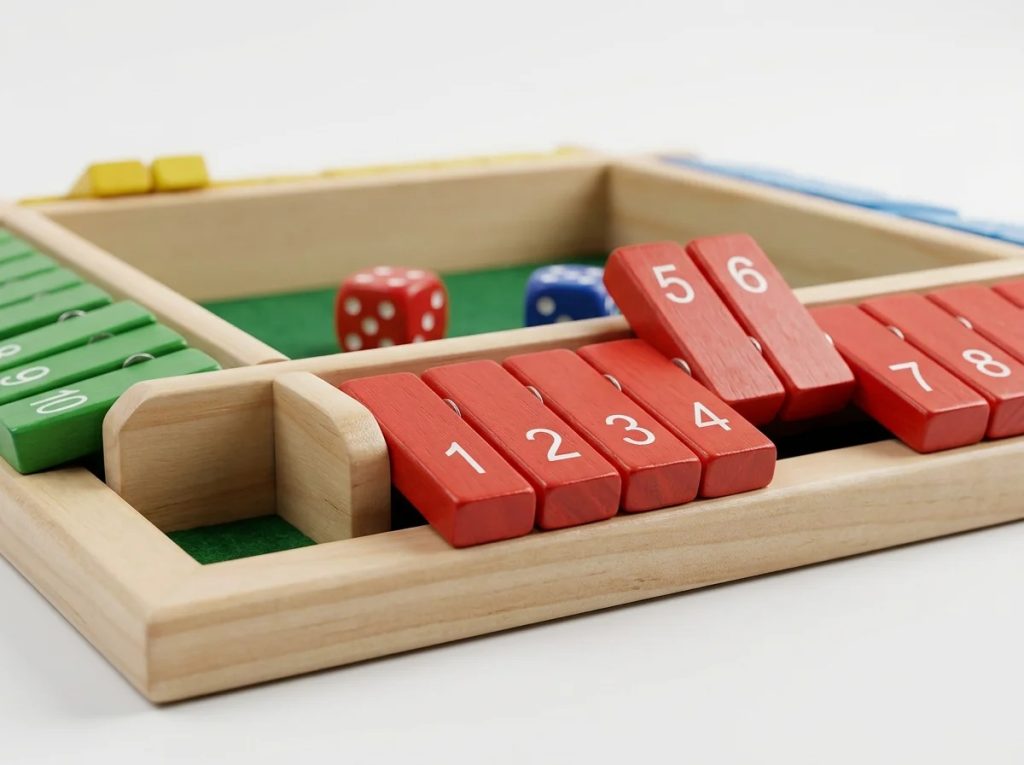
The setup takes about 30 seconds. Each of up to four players gets a wooden tray holding numbered tiles from 1 to 12, all standing upright. On your turn, you roll two dice, add the numbers showing, then flip down any combination of tiles that equals that sum. Roll a 9, and you might flip down 5+4, or 6+3, or even 9 alone — the choice is yours.
The goal is to flip all your tiles. If you can’t make a move, you stop, and whoever has the lowest total of remaining tiles wins.
Why the Rules Work for Kids as Young as 3
The beauty of this game is that it scales naturally. A three-year-old can flip single tiles and count the dots on the dice. A six-year-old starts hunting for combinations — “Can I flip 4 and 3 instead of 7?” That mental pivot, from counting to calculating, happens without any adult prompting it.
Research from the University of Chicago’s Department of Psychology found that children who practice arithmetic in game-based contexts show 30% faster recall of basic number facts compared to those using traditional drill methods. The Number Flip Dice Box creates exactly this environment: repeated addition under low pressure, disguised as competition.
The Moment Math Stops Feeling Like a Chore
There’s a specific moment parents describe — usually around the third or fourth round — when a child starts doing mental math before they even pick up the dice. They’re anticipating combinations. Strategizing. That’s not rote memorization. That’s number sense developing in real time.
The four-player format matters here too. When siblings or parents are at the table, the social stakes create a light urgency that no solo app can replicate. Nobody wants to be the one with tiles still standing.
Built for the Chaos of Real Family Life
The Noise Problem Nobody Talks About
Anyone who has played dice games in a restaurant booth or a hotel room at 9pm knows the problem immediately: dice are loud. They rattle, they skitter, they fall off tables. The Number Flip Dice Box addresses this with a green felt lining inside the wooden tray that absorbs the roll. The sound drops from a crack to a soft thud.
This isn’t a minor convenience. It’s the difference between a game that travels and one that stays in the closet. Road trips, waiting rooms, camping trips where the tent walls are thin — the Number Flip Dice Box works in all of them because it doesn’t announce itself to everyone within 20 feet.
A Base That Doesn’t Drift
The anti-slip base on each tray is one of those details you only notice when it’s absent. On a kitchen table, a restaurant booth, the backseat of a car — the tray stays put. Tiles don’t tip over between turns. The game doesn’t reset itself.
For a 3-year-old still developing fine motor control, this stability matters more than it might seem. A tray that spins or slides creates frustration that interrupts play. Smooth, rounded tile edges mean small fingers flip tiles cleanly rather than fumbling or pushing them sideways.
The Material Argument: Why Birch Wood Specifically
A lot of wooden toys claim to be “natural” without specifying what that means in practice. The Number Flip Dice Box is made from birch — not because birch is a marketing word, but because it has specific properties that matter for a toy handled by young children daily.
Birch has a tight, consistent grain that resists splintering under repeated impact. In a game where tiles are flipped, dice are rolled, and the whole tray occasionally gets carried by a toddler, that structural density means tiles don’t develop rough edges over time. The non-toxic paint used on the numbering is water-based and cured, not simply dried — it won’t chip or peel under the friction of small hands running across it repeatedly.
The CE and CPC certifications this product carries aren’t checkboxes. CE certification requires compliance with EU toy safety directive EN 71, which includes specific mechanical and physical tests for small components. CPC (Children’s Product Certificate) under U.S. CPSC standards requires third-party lab testing for lead content, phthalates, and flammability. Both were tested against the product as manufactured — not against a prototype or a similar material.
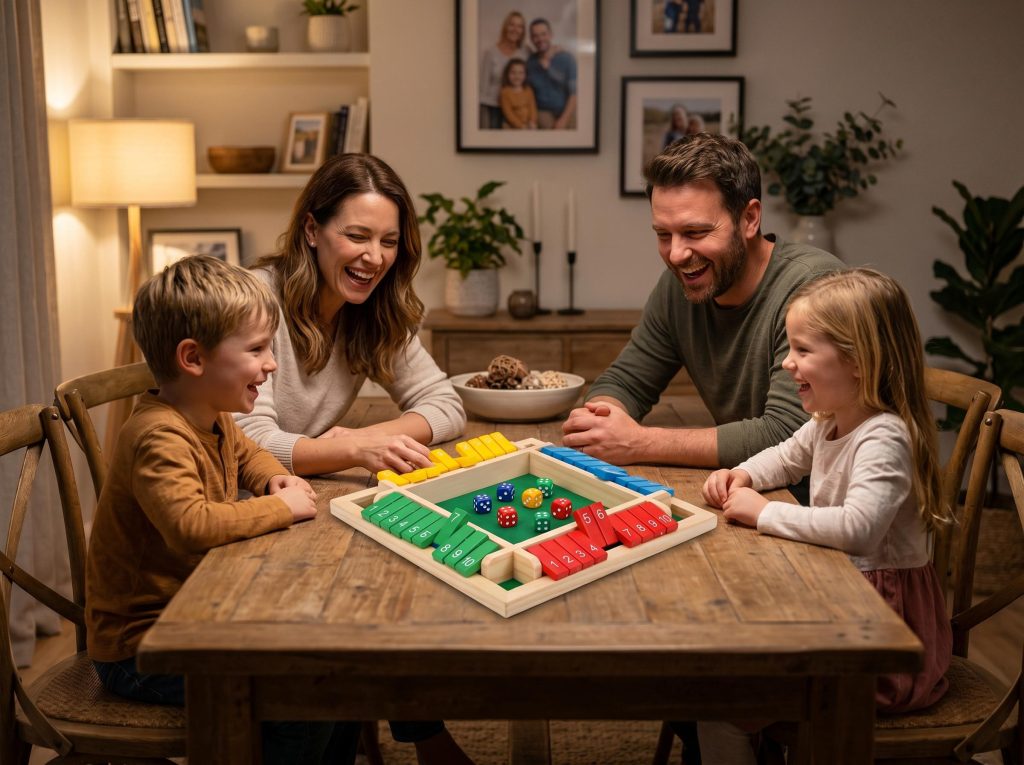
How the Number Flip Dice Box Fits Different Age Groups at the Same Table
One of the genuine challenges of family game nights is the age gap. Games either bore adults or frustrate young kids. The Number Flip Dice Box sidesteps this by letting each player operate at their own cognitive level simultaneously.
| Player Age | Typical Engagement | Skill Being Practiced |
| 3–4 years | Counting dice dots, flipping single tiles | Number recognition, 1-to-1 correspondence |
| 5–7 years | Finding tile combinations for each sum | Basic addition, strategic thinking |
| 8–12 years | Optimizing tile choices, calculating odds | Mental arithmetic, probability intuition |
| Adults | Full strategy, teaching younger players | Working memory, patience, game theory |
The game accommodates this range without requiring rule modifications or handicaps. Everyone plays the same game. The depth of engagement just shifts naturally by age.
Research from the Joan Ganz Cooney Center found that cross-generational play — when children play alongside adults rather than being supervised by them — improves both learning retention and social-emotional development. The Number Flip Dice Box is structured for exactly this dynamic: four players, same table, same rules.
Rethinking What “Educational” Means in a Toy
The phrase “educational toy” has been stretched to cover almost anything with a number or a letter on it. What it rarely describes is a toy that children request unprompted.
The Number Flip Dice Box earns the STEM label not through packaging language but through the cognitive sequence the game requires. Every turn involves:
- Reading two dice values simultaneously
- Computing a target sum
- Decomposing that sum into possible tile combinations
- Selecting the strategically optimal combination
- Executing the physical flip with fine motor precision
That sequence — perceive, calculate, decide, act — repeats 10 to 15 times per game, per player. In a 20-minute session, a child practices mental addition and decomposition more times than in a typical homework assignment, without any of the resistance that comes with homework.
Open-Ended Play Within a Structured Game
Unlike single-solution puzzles, the Number Flip Dice Box has no fixed “right move.” A roll of 8 can be answered with 8, or 7+1, or 6+2, or 5+3, or 4+3+1, or 5+2+1. This open-ended structure within defined rules is precisely what Montessori-aligned educators describe as guided discovery: the child finds their own path to the same destination.
This is why the Number Flip Dice Box sits comfortably alongside Montessori toys 3+ years and open ended play toys in educational frameworks — not because it was designed to a pedagogical checklist, but because the game mechanics naturally produce exploratory thinking.
Why the Number Flip Dice Box Works as a Gift
Gift-buying for children is harder than it looks. Toys get outgrown. Batteries die. Pieces get lost. The packaging looks great and the toy lasts two weeks.
The Number Flip Dice Box ships in gift-ready packaging, but the more relevant point is longevity. Because engagement scales with age, this isn’t a toy a child outgrows at 5. A 3-year-old counting dots and an 8-year-old calculating combinations are having fundamentally different experiences with the same object. That’s unusual, and it’s directly tied to the game’s open-ended math structure.
For holiday gifting — whether as stocking stuffers for 3+ years or a standalone birthday present — the consideration that matters most is whether the toy will still be wanted three months later. Competitive games with multiplayer formats tend to have longer active lifespans than single-player activities, because the appeal isn’t the toy itself but what happens between the players.
Conclusion
The Number Flip Dice Box doesn’t solve the problem of children resisting math by making math look friendlier. It solves it by making math invisible — wrapped inside a competitive, social, physical game that a 3-year-old and a grandparent can play at the same table.
The birch construction and felt-lined tray are design decisions that extend the game beyond the living room. The CE and CPC certifications mean the material safety has been independently verified, not self-declared. The tile mechanics create dozens of calculation repetitions per session without any of the friction that traditional practice generates.
If the test of a good educational toy is whether children ask to play it again without being prompted, the Number Flip Dice Box meets that bar in a way that most wooden toys for toddlers and stem toys for preschoolers do not — because it was designed as a game first, and an educational tool second.