
Thirty minutes into a six-hour drive, the playlist runs dry, snacks lose their appeal, and the inevitable chorus begins: “Are we there yet?” For families facing long-distance travel, the back seat becomes a pressure cooker of restless energy, sibling conflicts, and parental stress. Screens offer temporary relief but deliver diminishing returns—eye strain, motion sickness, and the post-screen emotional crashes that turn the final hour into a behavioral minefield.
The real challenge isn’t filling time; it’s sustaining genuine engagement without triggering the downsides of prolonged screen exposure. Children ages 3-7 need cognitively stimulating activities that work within the physical constraints of car seats, require minimal adult facilitation from the driver’s seat, and deliver sustained focus periods of 20-45 minutes. Road trip toys for kids that meet these criteria transform travel from endurance test into productive play time, protecting both child development and family dynamics during extended journeys.
Why Screen-Free Travel Entertainment Delivers Superior Developmental Outcomes
The American Academy of Pediatrics recommends limiting screen time to one hour daily for children ages 2-5, yet a typical family road trip easily doubles or triples this threshold. The convenience of tablets and portable devices masks three compounding costs that become apparent only after travel ends, making the case for quality road trip toys for kids increasingly compelling for health-conscious families.
Cognitive passivity during screen time prevents the active learning that builds problem-solving skills and creativity. Research from the University of Michigan found that passive screen consumption provides none of the neural benefits of hands-on manipulation—children watch content without the executive function engagement required for skill development. During the critical 3-7 age window when prefrontal cortex development accelerates, hours of passive viewing represent missed opportunities for cognitive growth that well-designed road trip toys for kids can effectively address.
Physical constraints compound the problem. Car seats restrict movement while screens demand sustained visual focus at close range, creating the perfect conditions for eye strain, headaches, and motion sickness. Pediatric ophthalmologists note that children under 8 have developing visual systems particularly vulnerable to the convergence stress of prolonged near-focus tasks in moving vehicles. The result: arrival at destinations with children experiencing physical discomfort alongside the behavioral dysregulation of excessive screen exposure.
Behavioral rebounds create the third hidden cost. The dopamine spikes from fast-paced screen content leave children in heightened arousal states when devices are removed. Parents report that children who spend 3-4 hours on tablets during travel exhibit increased irritability, difficulty transitioning to other activities, and resistance to non-screen play for 2-3 hours post-arrival—exactly when families need cooperation for check-ins, meal times, and settling into new environments.
Quality road trip toys for kids eliminate these cascading problems by delivering active engagement that builds skills rather than consuming attention. Open-ended manipulative toys activate fine motor development, spatial reasoning, and creative problem-solving—the same developmental domains that screen time bypasses. Children arrive at destinations cognitively satisfied rather than overstimulated, physically comfortable rather than strained, and ready to engage with new environments rather than demanding device continuation.
For extended family travel, childcare providers, and family entertainment businesses, this distinction carries significant implications. Programs that equip families with effective screen-free travel solutions differentiate their value proposition while supporting child development principles. Retailers and distributors serving family travel markets can position travel-appropriate educational toys as health-conscious alternatives rather than mere entertainment, tapping into parent concerns about screen dependency while delivering measurable behavioral benefits that distinguish premium road trip toys for kids from generic entertainment options.
Selection Criteria for Travel-Appropriate Educational Toys
Effective road trip toys for kids must satisfy constraints that eliminate most conventional toy categories. Understanding these requirements allows purchasers to build travel toy inventories that actually function in vehicle environments rather than creating frustration and cleanup burdens. The selection process for quality road trip toys for kids differs fundamentally from choosing toys for home playrooms due to unique vehicle constraints.
Spatial Footprint and Containment
Vehicle entertainment must operate within a 12×18 inch lap zone without requiring flat surfaces, spreading components, or vertical construction that collapses with movement. Toys that scatter small pieces across seats and floor wells create hazards, distraction for drivers, and retrieval interruptions that break engagement. Magnetic building sets, compact puzzle systems, and contained activity boards meet this threshold; loose blocks, traditional puzzles, and bead sets do not. This spatial constraint represents the primary filter when evaluating potential road trip toys for kids.
Single-Child Operation Without Adult Facilitation
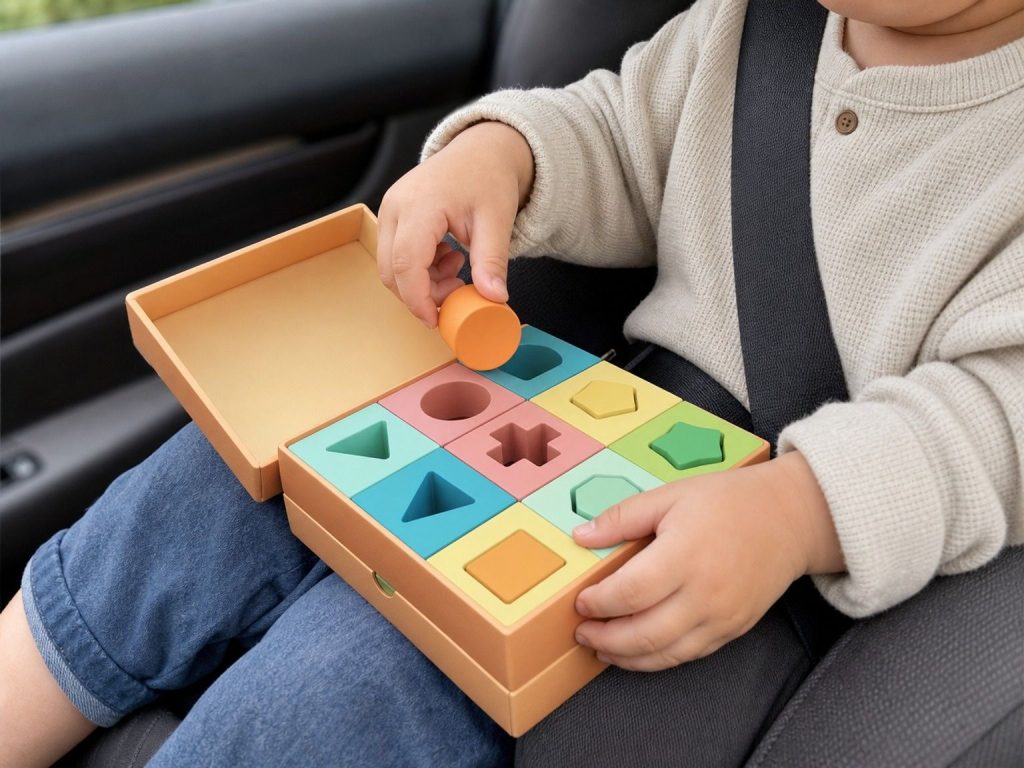
Driver safety requirements mean adults cannot provide hands-on guidance or conflict mediation during travel. Toys requiring initial setup, rule explanation, or multi-player cooperation fail unless children already possess mastery. Self-explanatory manipulative toys that invite immediate exploration without instruction—magnetic tiles, pattern blocks, quiet books—allow children to engage autonomously from moment one, which is essential for successful road trip toys for kids.
Sustained Engagement Duration
Children ages 3-5 require 20-30 minute engagement periods per toy; ages 6-7 need 30-45 minutes to justify the spatial allocation and management overhead. Toys falling below these thresholds force frequent activity switching that increases parent involvement and elevates vehicle chaos. Open-ended construction materials that support progressive complexity deliver longer engagement than single-solution puzzles or simple fidgets, making sustained engagement duration a critical benchmark for evaluating road trip toys for kids.
Sensory Appropriateness for Confined Spaces
Noise-generating toys create driver distraction and sibling conflict in enclosed vehicle cabins. Sound effects, musical components, and talking features that seem reasonable in home playrooms become overwhelming irritants during four-hour drives. Silent or whisper-quiet manipulation—building, drawing, tactile exploration—respects acoustic constraints while maintaining engagement value, distinguishing well-designed road trip toys for kids from products that fail in vehicle environments.
Durability Against Intensive Manipulation
Travel toys endure dropped pieces, sat-on components, and aggressive handling born of confined-space frustration. Cheap plastic construction that survives home play often fails under travel stress, creating mid-trip breakage that eliminates the toy from rotation and triggers child disappointment. Commercial-grade materials and enclosed component designs protect investment value across multiple trips, ensuring that road trip toys for kids deliver long-term value rather than single-use disappointment.
Safety Compliance for Unsupervised Use
Unlike home environments where adults maintain sight lines, vehicle travel involves periods when drivers cannot monitor back-seat activity. Toys must contain no small parts that create choking hazards for children under 3 (if younger siblings share space), no sharp edges that become weapons during sibling disputes, and no cords or strings that pose strangulation risks. ASTM F963 compliance provides baseline safety assurance, but travel-specific risks demand additional consideration beyond standard toy safety testing.
These six criteria create a demanding filter that eliminates 70-80% of conventional toy categories. Products that meet all requirements simultaneously represent premium value despite often-higher unit costs, because they actually function in the intended environment rather than disappointing during deployment. For purchasing decision-makers in family entertainment, childcare, or retail contexts, this selection framework explains why generic toy assortments fail travel applications while purpose-selected educational manipulatives succeed as reliable road trip toys for kids.
Categories of Road Trip Toys for Kids That Deliver Multi-Hour Engagement
Within the constrained universe of travel-appropriate options, four toy categories consistently deliver the combination of sustained engagement, developmental value, and operational practicality that justifies their inclusion in family travel kits. These categories represent the proven core of effective road trip toys for kids across diverse family contexts.

| Toy Category | Engagement Duration (Ages 3-5) | Engagement Duration (Ages 6-7) | Primary Skills Developed | Spatial Footprint | Key Selection Criteria |
|---|---|---|---|---|---|
| Magnetic Building Sets | 25-40 minutes | 35-55 minutes | Spatial reasoning, fine motor skills, creative problem-solving | Lap-sized (12×18″), self-contained | Tile thickness 1.5mm+, strong neodymium magnets, 40-60 piece travel sets |
| Pattern and Shape Manipulatives | 20-30 minutes | 30-45 minutes | Geometric understanding, visual-spatial processing, pattern recognition | Compact storage box 8×10″ | Chunky pieces 1.5″+, clear storage case, 30-50 pieces |
| Reusable Sticker Activity Books | 15-25 minutes | 20-35 minutes | Fine motor precision, scene composition, narrative thinking | Single book format 9×12″ | Static-cling or fabric-loop attachment, 20+ reusable stickers, themed scenes |
| Quiet Busy Books | 20-35 minutes | 25-40 minutes | Fine motor skills, problem-solving, independent exploration | Bound format 10×12″ | Felt or fabric construction, 8-12 activity pages, no loose pieces |
Magnetic Building Sets
Magnetic tiles and shapes occupy the premium tier of travel toys because they simultaneously address construction play, spatial learning, and open-ended creativity within fully contained systems. Unlike traditional building blocks that require flat surfaces and collapse with vehicle movement, magnetic components connect at any angle and maintain structural integrity through minor jostling, making them among the most reliable road trip toys for kids.
The developmental value centers on three-dimensional spatial reasoning—children plan structures mentally before execution, test engineering principles through trial and error, and receive immediate feedback about balance, symmetry, and geometric relationships. This active problem-solving keeps minds engaged far longer than passive entertainment while building foundational skills for math and science learning.
Travel-specific magnetic sets differ from home versions through intentional size reduction and component selection. Sets of 40-60 pieces provide sufficient variety for complex building without overwhelming lap space or storage capacity. Square and triangle tiles form the foundation; adding hexagons and rectangles increases creative possibility, but small specialty pieces (tiny windows, wheels) typically get lost during travel. Priority should favor basic geometric shapes at larger sizes (3-4 inch tiles) over elaborate sets with miniature accessories, making them ideal road trip toys for kids who need sustained, independent engagement.
Pattern and Shape Manipulatives
Wooden or plastic pattern blocks, tangrams, and geometric puzzles deliver similar spatial-cognitive benefits through two-dimensional challenges. Children replicate provided patterns, create original designs, or explore geometric relationships through free play. The self-correcting nature of shape fitting provides independent feedback loops—children immediately see when pieces don’t align, adjust their approach, and retry without adult intervention, characteristics that define effective road trip toys for kids.
Travel viability depends entirely on containment systems. Loose blocks in bags scatter on first sharp turn; blocks in segmented trays with clear lids maintain organization and allow children to access pieces without spilling. The best systems include pattern cards stored within the same container, eliminating the need to track separate instruction booklets that disappear into seat crevices.
Reusable Sticker Activity Books
Static-cling or fabric-loop sticker systems allow children to compose scenes repeatedly without the one-time-use limitation of traditional sticker books. Themed sets—farm scenes, space stations, underwater worlds—invite storytelling and imaginative play alongside the fine motor practice of precise sticker placement.
The engagement curve differs from construction toys: initial play periods of 15-25 minutes, followed by returns throughout long trips as children reimagine scenes or create new narratives. This makes sticker books excellent rotation pieces that maintain novelty across multi-day trips. Quality indicators include thick, durable backing boards that withstand repeated use and stickers large enough for preschool hands to manipulate (1.5 inches minimum) but detailed enough to interest early elementary ages.
Quiet Busy Books
Fabric or felt activity books with built-in challenges—buckles to fasten, zippers to manipulate, laces to thread, shapes to match through tactile exploration—engage children through diverse fine motor challenges across multiple pages. Each page presents a different skill focus, allowing children to spend 2-4 minutes per activity before advancing, building up to 20-35 minute total engagement periods.
The multi-activity structure matches well with younger children’s shorter attention spans, providing natural transition points that feel like progression rather than distraction. For families with children spanning the 3-6 age range, busy books accommodate mixed developmental levels better than single-focus toys—younger siblings practice basic skills on simple pages while older children tackle more complex challenges.
These four categories form the core of effective road trip toys for kids, each delivering distinct engagement patterns and skill development focuses. Building travel kits from multiple categories rather than concentrating on single types provides variation that sustains interest across multi-hour or multi-day journeys while keeping total toy volume manageable within vehicle storage constraints. Families who strategically combine these categories report significantly reduced screen time requests and improved arrival behavior compared to those relying on improvised entertainment or single-category road trip toys for kids.
Implementation Strategies That Maximize Engagement and Minimize Vehicle Chaos
Owning appropriate toys solves only part of the travel entertainment equation. Deployment strategies determine whether road trip toys for kids deliver their potential value or become sources of frustration, conflict, and driver distraction. Implementation design matters as much as product selection.
Rotation Introduction Rather Than Full Access
Presenting all available toys simultaneously overwhelms children with choice, creates competition for space, and eliminates novelty for later trip segments. Introducing one toy per 45-60 minute segment maintains freshness while allowing children to fully explore each option before transitioning. This staged approach transforms a four-hour drive into distinct “chapters” with clear activity boundaries that help children mentally segment long journeys.
Parents can enhance this structure by linking toy transitions to geographic milestones rather than time intervals: “When we cross the river, you’ll get the next activity.” This creates anticipation and helps children develop geographic awareness alongside receiving new entertainment. This rotation strategy maximizes the engagement value of road trip toys for kids across extended travel periods.
Pre-Trip Familiarization Without Full Exploration
Children engage more readily with toys they recognize but haven’t exhausted. Introducing new travel toys 2-3 days before departure allows children to understand basic operations without depleting novelty. A 10-minute preview exploration at home means children can operate toys independently during travel rather than requiring driver-distracted explanations during the trip.
This preview period also allows parents to assess whether toys meet engagement expectations before committing them to limited vehicle storage space. Toys that fail to capture interest at home rarely improve in the more constrained vehicle environment, making preview testing an essential step in selecting effective road trip toys for kids.
Individual Child Kits Rather Than Shared Resources
Sibling conflict over toy access peaks during confined-space travel when escape and separation aren’t options. Providing each child with distinct toy sets—color-coded bags or containers—eliminates “that’s mine” disputes and establishes clear ownership boundaries. While this approach increases total toy volume and investment, the behavioral management benefits far outweigh costs for families with multiple children.
Color coding extends beyond bags to the toys themselves: one child receives magnetic tiles in warm colors (red, orange, yellow), another receives cool colors (blue, green, purple). This makes ownership instantly visible without reading names or negotiating trades, and creates opportunities for planned sharing: “After the next rest stop, you can trade color sets if you both want to.” Individual ownership systems transform potential conflict sources into cooperative opportunities with properly selected road trip toys for kids.
Strategic Placement for Driver Accessibility
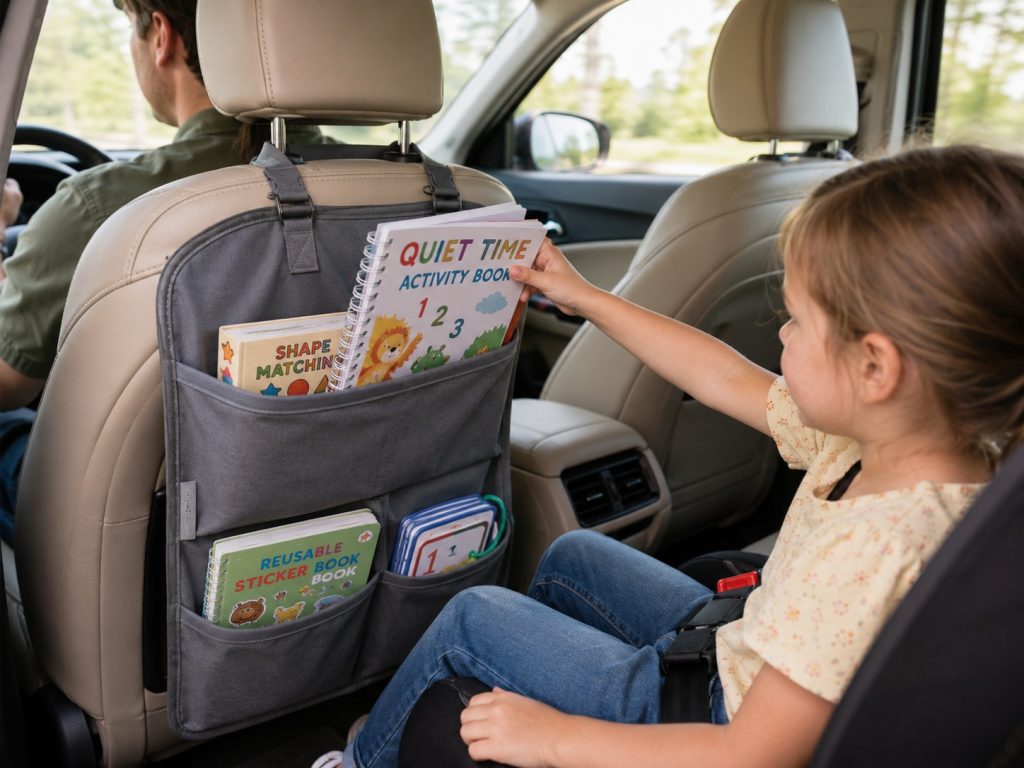
Road trip toys for kids should live in locations that allow parents to retrieve and distribute them without unbuckling, reaching across bodies, or requiring stops. Seatback organizers, center console compartments, and passenger-seat floor areas work; trunk storage and rear cargo areas don’t. Each toy should have designated storage that children can identify: “Your magnetic tiles live in the blue bag in the seatback pocket.”
This systematic organization prevents the “where did we put…” searches that disrupt travel flow and elevate parent stress. It also teaches children organizational systems that transfer to home environments, delivering life skills alongside entertainment value. Strategic storage placement represents a critical but often-overlooked factor in successful deployment of road trip toys for kids.
Quiet-Time Buffers and Activity-Free Intervals
Continuous stimulation creates its own form of exhaustion. Building 15-20 minute quiet periods between activities—times for looking out windows, listening to music, or simply daydreaming—allows cognitive rest that makes subsequent activities more engaging. These buffers work particularly well around planned stops: quiet time for 20 minutes before a rest area gives children mental space to transition, makes them more cooperative during the stop, and creates receptiveness for new activities when travel resumes.
For purchasing stakeholders and family service providers, these implementation strategies represent the “instruction manual” that transforms product ownership into successful outcomes. Retailers can differentiate by providing travel toy kits pre-organized with rotation guides and storage systems rather than selling individual toys. Childcare centers can coach families on deployment strategies as part of travel preparation services. The value isn’t just in the physical products but in the systems that make those products function effectively within the specific constraints of vehicle travel, ensuring that road trip toys for kids deliver their full developmental and behavioral potential.
Magnetic Building Tiles as Premium Travel Entertainment Infrastructure
Among the categories of effective road trip toys for kids, magnetic building sets occupy a distinct position through their combination of maximum engagement duration, highest developmental value, and most successful self-contained operation within vehicle constraints. Understanding why these materials outperform alternatives clarifies their premium position in travel entertainment investments for families seeking reliable road trip toys for kids.
The magnetic connection mechanism creates construction stability impossible with traditional stacking toys. Vehicle vibrations, sudden stops, and minor jostling—movements that topple block towers and scatter puzzle pieces—leave magnetic structures intact. Children can build continuously for 30-45 minutes without the frustration cycles that come from repeatedly rebuilding collapsed constructions, allowing them to pursue increasingly complex designs rather than restarting basic attempts.
Three-dimensional spatial learning happens through direct manipulation rather than observation. Children test structural concepts through hands-on experimentation: discovering that triangle tiles create rigid frameworks, that alternating magnetic polarities prevent connection, that larger bases support taller structures. This trial-and-error process builds spatial reasoning and basic engineering principles without requiring instruction, making magnetic tiles perfectly suited for the unsupervised play that vehicle travel demands.
Age scalability protects investment value across expanding developmental ranges. The same tile set serves 3-year-olds exploring basic stacking and color sorting, 5-year-olds building representational structures (houses, vehicles), and 7-year-olds engineering complex geometric designs. This 4-5 year usability span exceeds most toy categories, particularly important for families planning multiple children or organizations serving mixed-age groups.
Travel-optimized sets balance piece quantity against storage constraints. Sets of 40-60 pieces provide sufficient variety for complex building without overwhelming lap space or requiring large storage containers. Standard geometric shapes—squares, triangles, rectangles—deliver more building versatility than elaborate sets with wheels, figures, and specialty pieces that get lost in seat crevices. Tiles in the 3-inch size range balance structural stability with compact storage better than larger 4-5 inch tiles that limit the number of pieces children can actively deploy in confined spaces.
The Vindstier magnetic building system addresses travel-specific requirements through design features that extend durability and usability in vehicle environments. The 1.5mm tile thickness prevents the warping that occurs with thinner tiles subjected to temperature variations in parked vehicles. Riveted magnet housings eliminate the separation failures that strand magnets in seat gaps when glued tiles come apart. The tile edges use rounded profiles that prevent the scratching and pinching injuries that sharp-edged budget tiles create during the aggressive handling common to confined-space play.
Storage integration matters as much as tile quality. Vindstier travel sets include custom-fitted storage cases with individual tile slots rather than dump-and-bag systems. Slotted storage eliminates the noise of loose tiles rattling during travel, allows children to independently return pieces without adult help, and makes missing-piece identification immediate rather than requiring full counts. The case dimensions (12x8x3 inches) fit standard seatback pockets and under-seat storage without consuming excessive space.
Color selection in travel sets prioritizes visual appeal without overwhelming cognitive load. Six distinct hues provide sufficient variety for creative expression while keeping sets simpler than 12-color home versions that include too many pieces for effective vehicle deployment. Translucent tiles maintain the light-play engagement that extends interest while avoiding the opacity that reduces construction visibility.
Measuring Travel Toy Success Through Observable Child Behavior
Investment in quality road trip toys for kids generates returns only when those toys actually sustain engagement and positive behavior during travel. Observable metrics allow families and organizations to distinguish effective tools from disappointing purchases, optimizing future selections based on demonstrated performance rather than marketing claims. Evaluating road trip toys for kids through behavioral outcomes ensures families invest in solutions that actually work rather than products that merely promise results.
Sustained Independent Engagement Duration
The primary success indicator measures how long children remain focused on toys without requesting adult help, switching activities, or displaying boredom signals. For children ages 3-5, sustained engagement periods of 20-30 minutes indicate appropriate challenge levels; for ages 6-7, 30-45 minutes represents successful toy selection. Toys consistently falling below these thresholds may offer insufficient complexity, unclear operation, or poor vehicle adaptability regardless of how well they function in home environments, suggesting they don’t meet the standards for effective road trip toys for kids.
Voluntary Return Engagement Across Multiple Days
Children naturally gravitate toward genuinely engaging toys across multi-day trips, requesting favorites from previous days rather than seeking constant novelty. Toys that children ask for by name on day two or three of extended journeys demonstrate deep engagement rather than temporary distraction. This metric reveals which specific toys deliver the highest value, allowing families to prioritize those items for future trips while eliminating options that seemed promising but failed to sustain interest.
Absence of Frustration Behaviors
Well-designed travel toys challenge without overwhelming. Children should display focused concentration, occasional satisfaction expressions when achieving goals, and problem-solving persistence after initial failures. Red flags include throwing pieces, refusing to continue after short periods, requesting adult assistance repeatedly, or displaying visible frustration. These behaviors indicate toys that exceed children’s current capabilities or that operate poorly within vehicle constraints despite appropriate difficulty levels, signaling that these products don’t function as reliable road trip toys for kids.
Sibling Cooperation Versus Conflict
In multi-child vehicles, toy success correlates with reduced conflict over access and resources. Toys prompting sharing, parallel play, or collaborative building indicate designs that support social play even in competitive sibling dynamics. Conversely, toys generating repeated disputes, possession battles, or “that’s mine” conflicts suggest insufficient quantities, inherently competitive structures, or designs that work better for solo play than shared spaces.
Post-Travel Toy Requests
The ultimate success metric appears after trips end: children requesting their travel toys during home play, asking to bring specific items on subsequent trips, or showing sustained interest in toy categories they first explored during vehicle travel. This transfer of engagement from travel contexts to home environments indicates toys that genuinely captured interest rather than merely filling time when no alternatives existed, confirming their status as truly effective road trip toys for kids.
Parental Stress Reduction
For adult stakeholders, successful road trip toys for kids deliver measurable reductions in driver distraction, stops for behavioral management, and arrival stress levels. Parents should notice fewer interruptions, decreased need for conflict mediation, and children’s smoother transitions to post-travel activities. If travel toy investments fail to reduce these parent-experienced stress factors, the toys aren’t delivering their core value proposition regardless of how engaged children appear, indicating a fundamental mismatch in the selection of road trip toys for kids.
Boundaries and Common Implementation Failures
Even optimal toy selections face limitations that families and organizations must acknowledge for realistic expectations and successful deployment. Understanding these boundaries prevents unrealistic expectations and guides appropriate selection of road trip toys for kids for specific family contexts.
Screen-free travel entertainment cannot fully replicate the passive ease of device-based content. Quality road trip toys for kids require higher initial engagement effort from children—active manipulation, creative thinking, problem-solving persistence—compared to passive video consumption. During the first 15-20 minutes of new toy introduction, some children display resistance, requesting screens instead of exploring alternatives. This initial hurdle requires parental consistency; giving in to screen requests at first resistance undermines the entire screen-free approach by teaching children that complaint generates device access.
Attention spans during late-day or overnight travel drop below normal ranges. Children who sustain 30-minute engagement periods during morning travel may manage only 10-15 minutes with identical toys during evening hours when fatigue accumulates. This isn’t toy failure—it’s biological reality. Travel plans should account for reduced engagement capacity during late-day segments, possibly accepting screen use during final hours rather than fighting declining attention with increasingly frustrated toy interactions.
Age gaps within vehicles create inevitable toy mismatches. A magnetic building set perfectly suited for a 6-year-old may contain small pieces creating choking hazards for a 2-year-old sibling, while toys appropriate for toddlers bore older children within minutes. Families spanning wide age ranges cannot find single-toy solutions; they need parallel systems that accommodate developmental differences without creating excessive storage demands, requiring strategic selection of multiple age-appropriate road trip toys for kids.
Common implementation mistakes undermine even quality toys. Introducing all toys simultaneously eliminates rotation benefits and creates overwhelm. Failing to preview toys before travel means children struggle with operation during drives rather than playing confidently. Storing toys in inaccessible locations forces parents to unbuckle or stop for retrieval, defeating the hands-free convenience that travel toys should provide. Skipping quiet-time buffers creates stimulation fatigue that manifests as irritability and resistance to continued play.
Purchase decisions carry predictable pitfalls. Selecting toys based on home play performance ignores the constraints that make vehicle environments fundamentally different from home playrooms. Prioritizing cheapest options yields breakage and frustration that exceeds any initial cost savings. Buying elaborate specialty items rather than versatile open-ended materials reduces the creative flexibility that sustains engagement across multiple uses. Over-purchasing creates storage burdens and decision paralysis; under-purchasing leaves gaps during extended journeys when families need reliable road trip toys for kids to maintain engagement and prevent behavioral deterioration.
Conclusion
Long-distance family travel presents inherent challenges that screens temporarily mask but ultimately worsen through developmental costs, physical discomfort, and behavioral rebounds. Strategic investment in screen-free road trip toys for kids transforms these challenges into opportunities for skill-building, creative engagement, and positive family dynamics during extended journeys. The most effective solutions meet stringent criteria around spatial constraints, autonomous operation, sustained engagement, and developmental value—requirements that eliminate most conventional toys while highlighting specific categories that excel in vehicle environments.
Success depends equally on toy quality and deployment strategy. Magnetic building sets, pattern manipulatives, reusable sticker systems, and quiet busy books form the core toolkit, each delivering distinct engagement patterns across developmental stages. Implementation approaches around rotation timing, pre-trip familiarization, individual ownership systems, and strategic storage determine whether road trip toys for kids fulfill their potential or disappoint despite appropriate selection.
For families, the infrastructure approach evaluates travel entertainment not by individual toy costs but by total system effectiveness across multiple trips and developmental years. Quality road trip toys for kids deliver cost-per-hour engagement value that far exceeds budget alternatives through extended durability, multi-age usability, and reduced parent stress during the 20-40% of annual family trips involving vehicle travel exceeding three hours. For retailers, childcare organizations, and family service providers, positioning travel-appropriate educational toys as health-conscious screen alternatives addresses parent concerns while delivering measurable behavioral benefits that distinguish premium offerings from generic toy assortments that fail vehicle environments despite working adequately at home. The growing market for reliable road trip toys for kids reflects broader parental shifts toward screen-conscious parenting and developmental prioritization during all aspects of family life, including travel.