Ten minutes into game time, the scene repeats itself in classrooms everywhere: one child has flipped the board, another has walked off with the dice, and an adult spends the session refereeing instead of playing. The problem is rarely patience. In most cases, the game itself was never built for how young children actually play. Board games for preschoolers sit in an awkward middle ground in many catalogs — too simple to hold attention past a week, or too complex to survive a group of four-year-olds without constant adult intervention.
Choosing well is a skill rather than a matter of taste, and the stakes rise as the market grows. Shelves now carry dozens of board games for preschoolers, from rebranded classics to miniature versions of family titles, and the gap between a well-matched game and a poorly matched one shows up within a single session. This guide breaks the selection process into criteria any teacher, parent, or program buyer can apply before the next purchase.
Why Board Games for Preschoolers Earn Their Shelf Space
The strongest case for board games for preschoolers comes from number research. In a randomized trial across ten Head Start centers, rated by the What Works Clearinghouse as meeting evidence standards without reservations, Ramani and Siegler (2008, Child Development) had preschoolers play a linear number board game for four sessions of 15–20 minutes over two weeks. Children who played the number version outperformed peers who played an identical color-based version on counting, numeral identification, magnitude comparison, and number line estimation. The gains were still measurable nine weeks later, with follow-up effect sizes between 0.55 and 0.80 — a substantial result for roughly one hour of total play.

A companion study sharpened the finding. Siegler and Ramani (2009, Journal of Educational Psychology) compared linear and circular boards directly: children playing the linear format built more accurate mental number lines and learned arithmetic facts faster afterward. The physical layout of the board, not just the dice, drives part of the learning. Home experience points in the same direction — within the same research program, preschoolers’ board game experience correlated with all four numeracy measures, while screen game experience correlated with almost none.
Beyond mathematics, the turn-taking loop itself functions as self-regulation practice. Waiting for a turn, following a shared rule, and accepting an unfavorable roll are all low-stakes rehearsals of impulse control, and they complement the independent routines that counting toys that build number sense establish during solo play. For program directors and distributors, this evidence matters commercially: board games for preschoolers are one of the rare toy categories where a modest wholesale price point sits on top of documented, citable learning outcomes.
Match the Rules Load to the Child, Not the Age Label
Age markings on packaging reflect safety testing minimums, not developmental ceilings. A box labeled “3+” describes the youngest safe user, not the right player. Teachers who run successful game corners evaluate board games for preschoolers by rules load instead:
- Ages 3 to 4 handle one action rule at a time — roll, move, flip. Sessions hold attention for 5–10 minutes, and any reading requirement disqualifies the game immediately.
- Ages 4 to 5 manage two to three stacked rules: taking turns plus a simple consequence, such as losing a piece or flipping a tile. Ten to fifteen minutes stays realistic.
- Ages 5 to 6 can layer light strategy and early arithmetic, and a 15–20 minute session keeps the challenge without pushing past stamina.
The same logic works when adults review a catalog or a showroom shelf. A practical test replaces the age label: a game matches the child when the child can explain one rule back after watching a single demonstration. If the demonstration needs repeating, the game — not the child — is the wrong fit.
Five Criteria Teachers Apply When Evaluating Preschool Board Games
Experienced buyers run a consistent checklist when they evaluate board games for preschoolers, extending how teachers choose educational toys for classrooms into the tabletop aisle, whether a shelf serves one family or twelve classrooms:
| Criterion | What to check | Why it matters |
| Session length | 10–20 minutes printed or tested | Games that drag past stamina end in conflict, not learning |
| Piece count and size | Fewer, chunkier components | Fewer pieces to lose or argue over; oversized parts avoid choking hazards |
| Rule layering | Rules that can be dropped for younger players | One box serves mixed ages and extends product life |
| Durability | Drop-tested wood or thick board, reinforced hinges | Classroom copies endure far more play cycles than home copies |
| Cleanability and documentation | Wipeable surfaces; EN71 (EU) and ASTM F963 (US) test files, per-SKU CPC for the US market | Non-negotiable for preschool procurement and customs clearance |
The last row separates serious suppliers from casual ones. A manufacturer that supplies per-SKU certification packages — rather than a generic factory letter — removes weeks of compliance work from a buyer’s schedule, and that difference shows up in reorder rates. Buyers who sample several board games for preschoolers before committing to a range also catch weaknesses that product photos hide: thin boards that warp, tiles with sharp edges, rule sheets written for reading-age players.
Where a Classroom Shelf and a Family Cupboard Diverge
Teachers need board games for preschoolers that a child can set up independently, because a game that requires an adult at every step will never leave the cabinet. Storage design, box weight, and self-explanatory layouts decide whether tabletop play happens daily or never. Rotation across small groups adds another requirement: several affordable sets beat one premium set.
Families optimize differently. Replay value dominates, because a home copy faces the same two children for years instead of a new group each term. A two-player mode matters when siblings or one parent participate, and difficulty that scales with the child delays the shelf-of-forgotten-boxes problem.
Buyers building an assortment should read both profiles together. The strongest ranges of board games for preschoolers cover the entry formats families gift, the number formats teachers rotate, and the cooperative formats mixed-age groups share. A catalog that serves only the classroom loses the gift market; one that serves only families loses institutional reorders.
How to Introduce a New Game So It Actually Gets Played
Selection is half the work; the first two weeks of play decide whether a game earns a permanent slot or gathers dust. Teachers who get lasting value from their board games for preschoolers tend to follow the same sequence:
- Play it adult-first. One full run-through by an adult exposes rule gaps and piece problems before children meet them.
- Demo at circle time with half the rules. Introduce the core loop only, then add the second rule in a later session.
- Pair an experienced player with a new one. Peer explanation sticks better than a second adult demonstration.
- Cap the first sessions at ten minutes. End while attention is still positive, and the game gets requested again.
- Rotate the game out after two weeks. Absence restores novelty; a game that returns after a break plays like a new arrival.
The sequence costs no money and no extra materials. It simply treats board games for preschoolers the way a good teacher treats a new book — as something that needs a proper introduction before independent use.
A Shortlist Approach That Applies the Framework
Running the selection framework over board games for preschoolers shows how quickly the field narrows.
For age 3: sorting and stacking formats
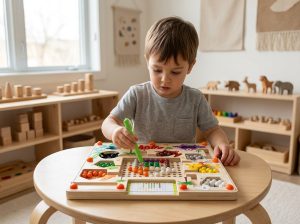
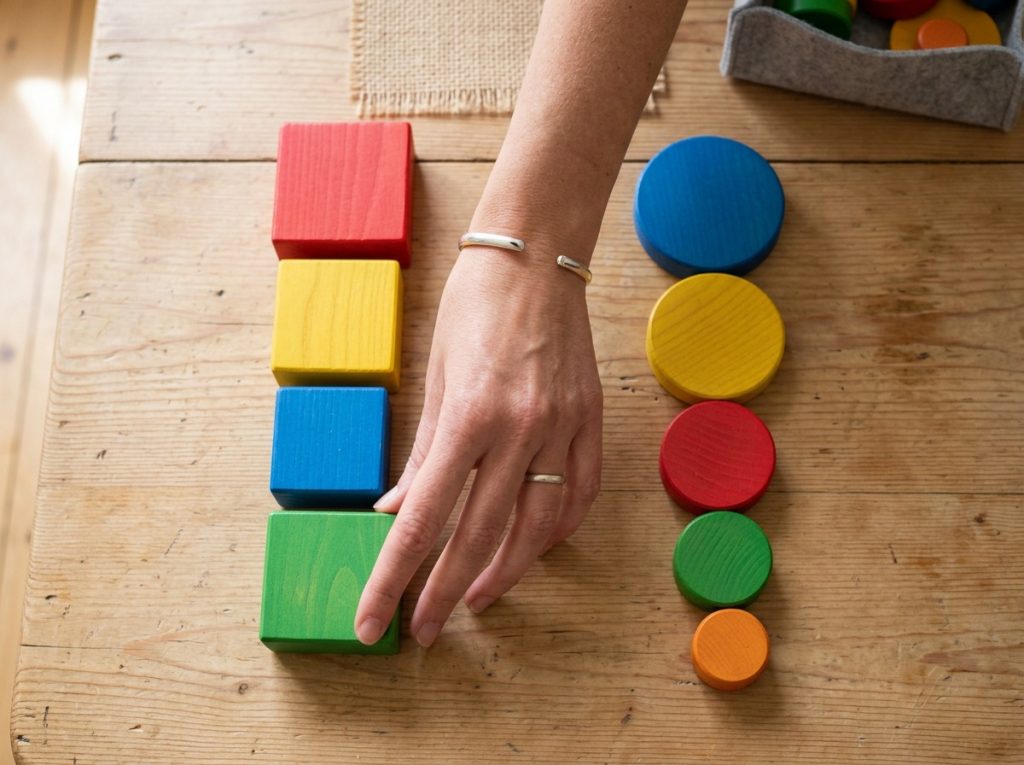
The healthiest entry point is a game whose core loop is sorting objects by color or size — one visible action, immediate feedback, no winning or losing. A fruit-themed sorting and stacking set fits the role: children classify by color and stack by size, and turns structure themselves around the pieces. It plays like a first board game without any reading or counting requirement.
For ages 4 to 6: number-flip formats
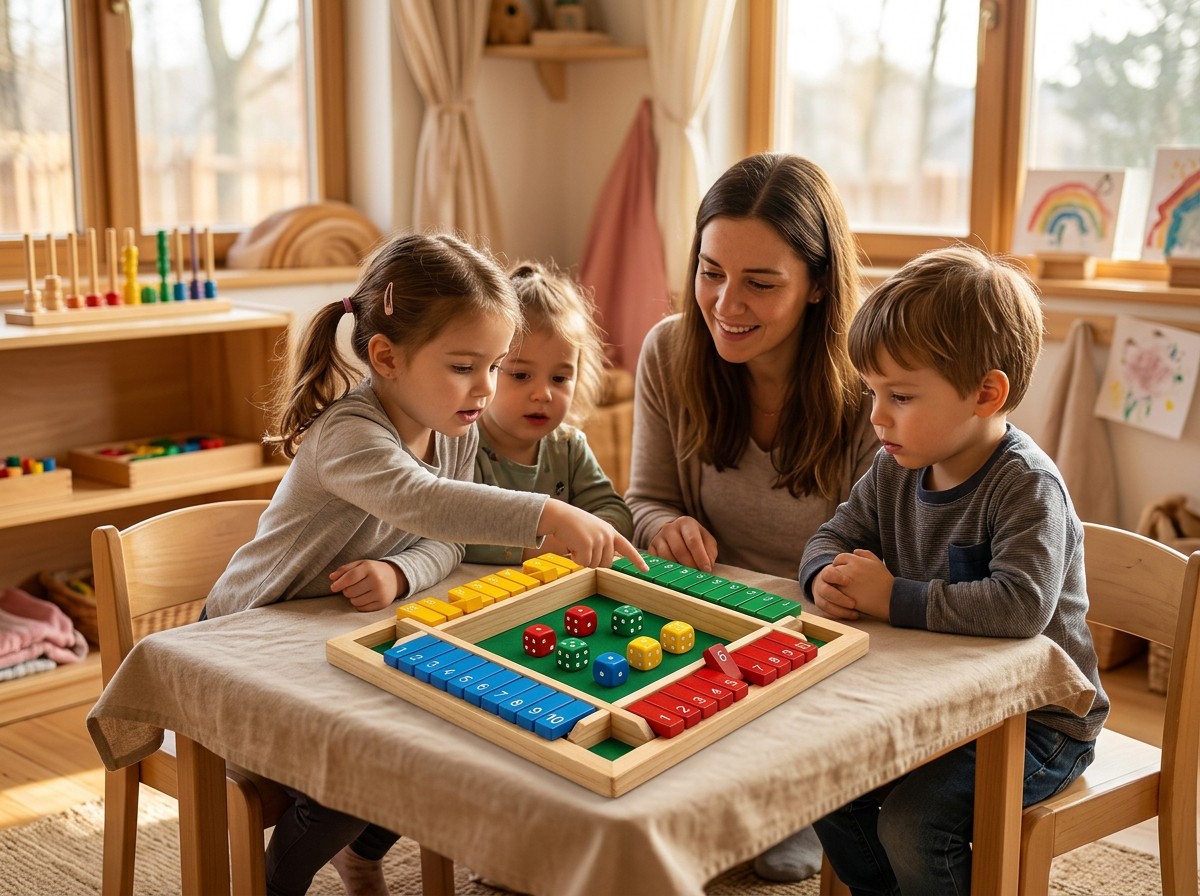
The research on linear number boards points directly to number-flip games in the Shut the Box tradition. A wooden number flip dice box family game fits the evidence well: a child rolls, counts, and flips the matching tile — one action rule with arithmetic that deepens as the child grows, from numeral recognition to quick addition. Solid wood construction and tiles without loose small parts handle classroom rotation, which the durability row demands.

For mixed ages: cooperative pattern formats
Magnetic pattern block sets cover the gap where siblings or mixed-age groups need one shared activity. Children work a shared board in parallel, trading turns without a zero-sum winner, which sidesteps the losing-tantrum stage entirely while building geometry vocabulary.
None of these formats needs a screen, batteries, or an app — three failure points that consistently shorten a game’s classroom lifespan.
Where the Framework Reaches Its Limits
Two boundaries deserve honesty. First, the documented mathematics gains come specifically from linear number-board play with adult structure. A box marketed as educational does not inherit that evidence by association; format and adult involvement carry the effect, and most board games for preschoolers have never been tested in any trial. Second, the landmark studies ran as experimenter-led sessions, not as free cabinet access. Placing a game on a shelf and walking away reproduces the setup, not the outcome — an adult needs to sustain the counting aloud and the turn loop in early sessions.
The most common misuse is competitive framing too early. Asking three-year-olds to accept losing, in public, before their emotional regulation can support it converts a learning tool into a conflict generator. Cooperative framing — playing toward a shared total, or dropping win conditions entirely — keeps the rule practice without the tears. Buying a single copy for an entire class creates the same failure from another direction: four children and one board produce waiting, and waiting produces noise.
Choosing Board Games for Preschoolers: The Short Version
The framework compresses into one sentence: match the rules load to the child, demand a 10–20 minute session, insist on durable cleanable pieces with real certification files, and let the format — number lines, sorting loops, cooperative patterns — carry the learning. Applied consistently, this method turns a random pile of board games for preschoolers into a curated set that survives both circle time and family game night.
For programs, retailers, and brand teams, the next step is tactile. Sample the shortlist, drop the boxes, flip the tiles, and read the certification files per SKU. Vindstier’s wholesale catalog covers the three formats above with per-SKU CE and CPC documentation, and samples ship in low minimum quantities — request the catalog and evaluate the range before committing shelf space.