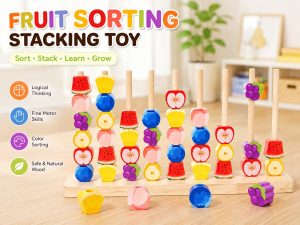

The supply catalogs arrive at the start of every school year, and so does the decision fatigue. A primary school teacher tasked with refreshing her classroom resources might evaluate dozens of educational toys before settling on a handful that actually get used consistently. The selection isn’t arbitrary — experienced teachers apply a working set of criteria, refined through years of watching certain tools transform lessons and others collect dust on supply room shelves.
What those criteria are, how they shift across age groups and subject areas, and what institutional requirements schools cannot afford to overlook — that’s what this article addresses directly.
Educational Toys vs. Teaching Manipulatives: Why the Distinction Matters
These two terms are frequently used interchangeably, but in professional educational contexts, they describe distinct product categories with different evaluation standards and procurement logic.
Educational toys are broadly designed to support developmental learning through play. They span building sets, puzzles, role-play kits, and sensory materials, serving both home and classroom environments. Their goals are typically developmental: fine motor skills, spatial reasoning, social interaction, and early language acquisition.
Teaching manipulatives are classroom-specific instructional tools designed to represent abstract concepts in physical, hands-on form. Base-ten blocks, fraction tiles, algebra tiles, and geometric solids exist specifically to bridge the gap between concrete experience and symbolic understanding within curriculum-aligned lessons.
“Concrete objects are not just visual aids. They are the cognitive bridge between experience and abstraction. Without that bridge, symbolic learning floats without foundation.”
— Jerome Bruner, Toward a Theory of Instruction, 1966
This distinction carries direct implications for purchasing decisions. A school procuring educational toys for a preschool play center is applying entirely different criteria than a curriculum coordinator sourcing math manipulatives for a Grade 3 numeracy program. Conflating the two leads to misaligned purchases — toys ordered where structured instructional tools were needed, or rigid manipulatives placed in contexts that required open-ended play materials.
The evaluation framework below addresses both, with clear distinctions where the criteria diverge.
The Non-Negotiables: Safety and Compliance Before Evaluation
Before assessing educational value, teachers and procurement officers must confirm that any educational toy or classroom learning tool meets the institutional safety standards applicable to their market.
| Certification | Market | What It Covers |
|---|---|---|
| ASTM F963 | United States | Physical, mechanical, chemical, and flammability safety for toys |
| CE EN71 | European Union | Chemical safety (EN71-3), flammability (EN71-2), and mechanical hazards |
| AS/NZS 8124 | Australia / New Zealand | Toy safety aligned with ISO 8124 framework |
| GB 6675 | China | National standard covering chemical, mechanical, and flammability risk |
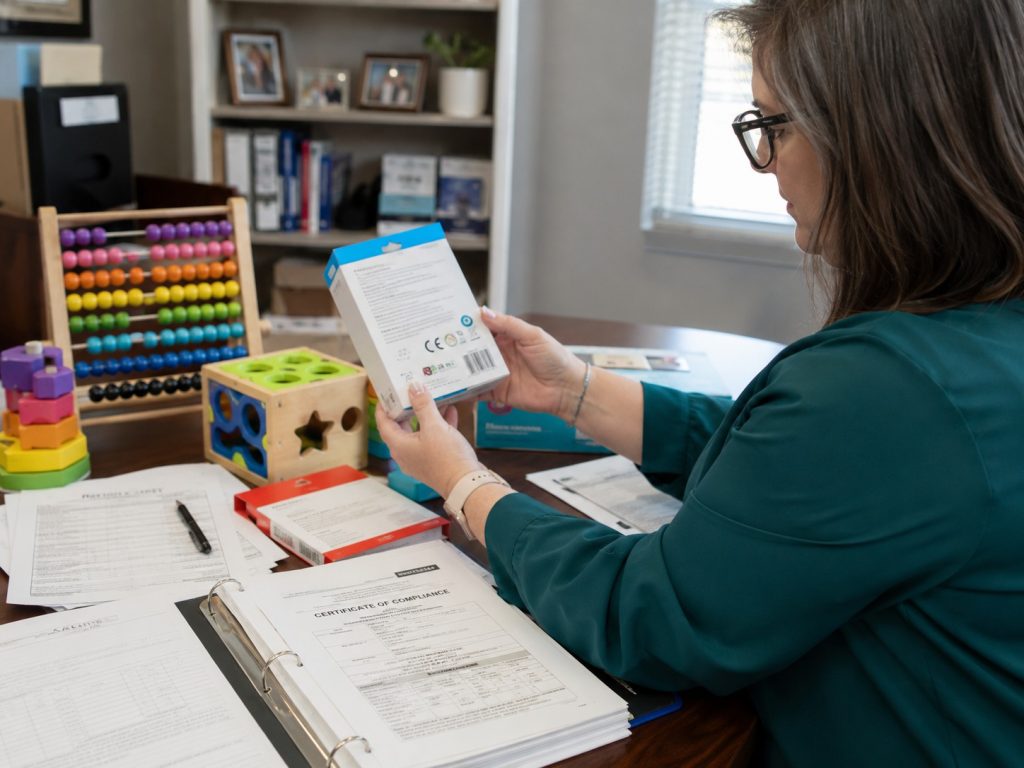
Schools handling public procurement carry institutional liability for materials used with students. Products without verified certification should not advance to educational evaluation, regardless of how compelling the learning concept appears. This is a compliance threshold, not a quality judgment.
Two additional dimensions are frequently overlooked in procurement conversations:
Non-toxic materials and surface finishes. Young children handle educational toys repeatedly — and in early childhood settings, mouthing is common. Water-based, non-toxic coatings are a baseline requirement for any product used with children under age eight, not an upgrade specification.
Special education adaptability. Classrooms serving students with sensory processing differences, fine motor challenges, or cognitive disabilities need educational toys that accommodate modified use. Oversized grip components, high-contrast color differentiation, and tactile variation are functional requirements in these contexts, not optional design features.
Suppliers who present certification documentation proactively — rather than requiring procurement officers to request it — remove a significant administrative barrier that often delays or terminates institutional purchasing decisions.
Core Criteria: How Teachers Evaluate Educational Toys
Once compliance is confirmed, teachers apply a consistent set of criteria that determine whether an educational toy earns a place in regular classroom rotation — or gets returned to the supply room.
Curriculum Alignment: The First Filter
Teachers don’t browse educational toys the way consumers shop retail. They start with a learning objective. A second-grade teacher working on place value needs a tool that maps to her current unit specifically — not a generally “math-related” product.
The National Association for the Education of Young Children (NAEYC) framework emphasizes that developmentally appropriate practice requires materials that match both the child’s developmental level and the specific instructional goal simultaneously. A product that addresses only one of those dimensions is a compromise.
For suppliers, this has a practical implication: educational toys presented with grade-level references, learning standard alignment, and subject-specific positioning are evaluated more seriously than those described only by age range or broad developmental benefit. “Supports early numeracy” is a marketing description. “Designed for place value instruction at Grades 1–3, aligned with Common Core 1.NBT” is a purchasing specification.
Differentiation Capacity: Does It Work Across the Full Classroom?
A typical primary classroom includes students performing two or more grade levels above and below the curriculum target. Educational toys that function only within a narrow skill band create a classroom management problem — the teacher ends up running parallel activities, which fragments instruction and multiplies workload.
The most durable classroom tools support vertical differentiation: the same physical product functions at different levels of complexity simultaneously. A set of fraction tiles can support a student working on basic partitioning while another explores equivalent fractions. Magnetic building sets serve spatial reasoning at an introductory level and structural engineering principles at an advanced level. The practical teacher test is direct: Can I use this with my strongest and my most struggling students in the same session, without losing either group?
Setup Time and Ease of Deployment
Classroom time is not flexible. A 45-minute lesson cannot absorb 10 minutes of distributing, explaining, and recovering materials. Teachers who’ve had that experience become genuinely cautious about introducing new educational toys, even when the learning value is apparent.
The best classroom resource is one a teacher can deploy confidently, repeatedly, and quickly — without the tool itself becoming an additional management challenge.
Products with components that stay connected, color-coding that requires no verbal setup explanation, and storage configurations designed for fast distribution and retrieval are more likely to see consistent use after the first week. Setup friction is one of the primary reasons well-designed educational toys fail to establish regular classroom rotation — not because the learning value isn’t there, but because the deployment cost exceeds the available time.
Visible Learning: Does the Student See What They’re Understanding?
Jerome Bruner’s Concrete-Pictorial-Abstract (CPA) model — widely embedded in Singapore Math instruction and applied primary mathematics curricula globally — argues that lasting conceptual understanding begins with physical, manipulable objects before moving to pictorial representation and finally to symbolic notation. Educational toys that create this concrete experience aren’t supplementary; they’re foundational.
Products that are self-correcting — where an incorrect combination doesn’t physically fit, where a balance doesn’t align — reduce the teacher’s explanation load and allow students to work more independently. A student who discovers their own error through the tool learns more durably than one whose error is corrected externally.
Versatility Across Activity Modes
Teachers structure classrooms around multiple formats: whole-class instruction, small-group rotations, partner work, and independent practice. Educational toys that function effectively across all four modes deliver significantly more value per dollar than those limited to a single setting — and that versatility translates directly into stronger justification when budget approval requires administrative sign-off.
Long-Term Durability Under Institutional Conditions
Consumer durability and classroom durability are not the same standard. An educational toy handled by 25 students daily, packed into shared storage bins, transported between rooms, and occasionally cleaned faces conditions that most consumer product testing doesn’t replicate.
Experienced teachers and school buyers ask a specific question: What does this product look and perform like 18 months into institutional use? Color fade, broken connectors, and missing pieces aren’t only aesthetic concerns — they render sets educationally non-functional when key components are undifferentiated or absent.
Evaluation by Age Group and Subject Area
Evaluation priorities don’t apply uniformly. The table below outlines how assessment criteria shift across age groups:
| Age Group | Primary Evaluation Focus | Key Product Features Needed | Example Product Types |
|---|---|---|---|
| Pre-K / Kindergarten (3–5) | Sensory engagement, fine motor, early language | Large grip, high contrast, non-toxic, open-ended play | Sorting sets, sensory bins, large building blocks, simple puzzles |
| Early Primary (6–8) | Curriculum alignment, concrete concept building | Self-correcting design, classroom pack sizing, fast reset | Counting manipulatives, phonics tiles, pattern blocks |
| Upper Primary (9–11) | Abstract concept bridging, collaborative use | Multiple difficulty levels, durability, versatile formats | Fraction tiles, base-ten blocks, geometry sets |
| Middle School (12–14) | Conceptual modeling, cross-subject application | Precision, minimal moving parts, professional finish | Algebra tiles, measurement tools, STEM construction kits |
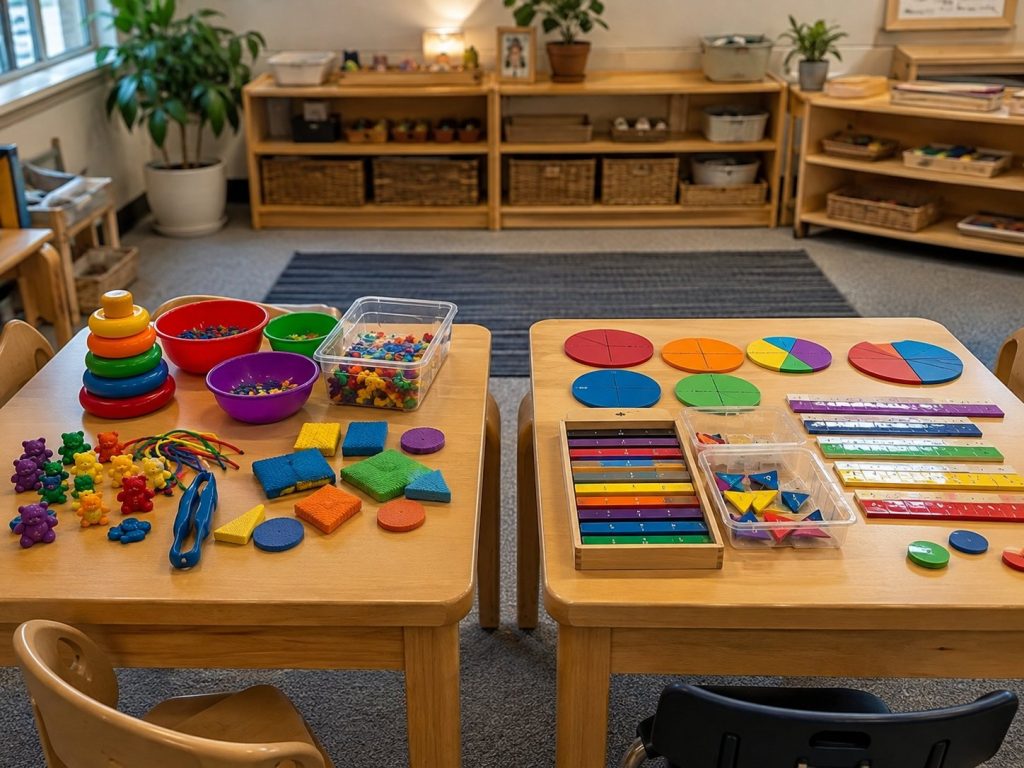
Subject area shifts priorities with equal significance:
| Subject | What Teachers Prioritize | A Common Gap in Available Products |
|---|---|---|
| Mathematics | Mathematically accurate concept representation, self-correction | Visually appealing products that are conceptually imprecise |
| Language Arts | Phonemic flexibility, multi-word application, legibility | Narrow vocabulary range, letter sets not aligned to phonics sequences |
| STEM / Science | Structural integrity, repeatable experimentation, material safety | Consumer-grade build quality unsuited for repeated structured classroom use |
| Special Education | Sensory adaptability, modified grip, clear visual differentiation | Mainstream educational toys not designed for sensory or motor accommodation |
How the Purchasing Process Works at the School Level
Understanding the decision pathway is as important as understanding the evaluation criteria. In most schools, procuring educational toys involves multiple stakeholders with distinct priorities — and a product needs to satisfy more than one of them.
A classroom teacher identifies a specific instructional gap. She researches options through peer recommendations, professional development networks, or education trade publications. She may use discretionary classroom budget to trial a small quantity before recommending a broader purchase.
A teacher’s trial order is rarely just a trial. It functions as the evaluation that drives the school-wide recommendation that follows — if the product performs.
The recommendation moves to a department head or curriculum coordinator, who evaluates it against broader instructional goals and cost-per-classroom metrics. For significant purchases, a procurement officer applies vendor qualification and budget criteria. The product must persuade two distinct audiences: the teacher assessing educational merit, and the institutional buyer assessing systemic value. Suppliers who provide documentation addressing both levels — learning outcome evidence and activity guides for teachers, volume pricing, certification records, and warranty terms for buyers — consistently advance further in this process.
A Practical Classroom Educational Toy Evaluation Checklist
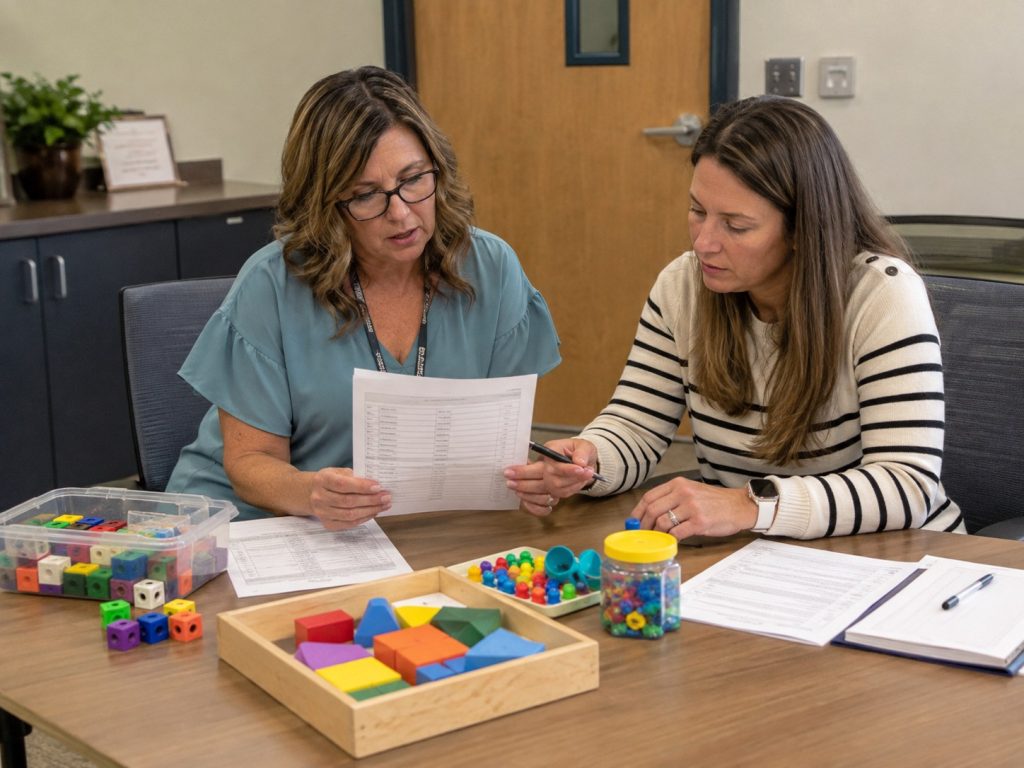
The criteria above translate into a working tool. The checklist below is designed for classroom teachers and procurement coordinators evaluating educational toys for institutional purchase.
Safety & Compliance
- Relevant certification confirmed (ASTM F963 / CE EN71 / market equivalent)
- Non-toxic materials verified for the applicable age group
- No small-part choking hazard for age group intended
- Accommodates students with sensory or motor differences if applicable to the class
Curriculum & Learning Value
- Directly connected to a specific learning objective or curriculum standard
- Supports both lower-performing and higher-performing students in the same session
- Creates visible, self-directed learning feedback
- Builds toward abstract understanding, not only activity completion
Classroom Usability
- Can be distributed and retrieved in under 3 minutes
- Requires no verbal setup explanation after first use
- Functional in at least three activity formats (whole class, small group, independent)
- Storage solution included or clearly specified by supplier
Durability & Institutional Fit
- Materials rated for high-frequency handling
- Color differentiation, markings, and connectors remain functional after 12+ months of institutional use
- Replacement parts or full set reorder available from supplier
- Classroom pack sizing available — not only individual or retail units
Supplier Qualification (Institutional Orders)
- Certification documentation provided proactively
- Volume pricing and minimum order quantities clearly stated
- After-sale communication and warranty process confirmed
- Sample or pilot order option available before bulk commitment
Conclusion
The process by which teachers choose educational toys for classrooms is structured, consistent, and shaped by pressures that aren’t visible from the outside — curriculum requirements, classroom logistics, safety obligations, budget accountability, and the accumulated memory of purchases that underperformed.
The distinction between educational toys and teaching manipulatives matters for procurement clarity. Safety certifications are an entry threshold, not a differentiator. Age group and subject area reshape every evaluation criterion. And the most reliable measure of product quality isn’t a specification sheet — it’s observable classroom performance across a full school year.
For schools refining their procurement framework, the checklist above provides a repeatable starting point. For suppliers and manufacturers serving the institutional market, every item on that list represents a question that the product — and the sales process supporting it — needs to answer before a teacher signs off on a school-wide recommendation.