The board game shelf tells the same story in almost every preschool classroom. One child celebrates, three children cry, and a teacher spends the rest of circle time repairing the fallout instead of teaching. The trigger is rarely the game itself — it is the win-or-lose structure that asks four-year-olds to regulate emotions they are still years away from mastering.
Cooperative games for preschoolers remove that structure. Every player works toward one shared goal, the group wins together or loses together, and turn-taking becomes something to protect rather than something to endure.
This guide covers what changes in play, what current research supports, and how teachers and buyers can select cooperative games for preschoolers that hold a whole group’s attention.
Why Win-or-Lose Structures Fall Apart at Ages Three to Five
Losing gracefully is a genuine skill, and preschoolers have not developed it yet. Between ages three and five, emotional regulation still depends on adult co-regulation, and a public loss in front of peers overwhelms that support system. The result is predictable: tears, thrown pieces, and children who refuse to join the next round.
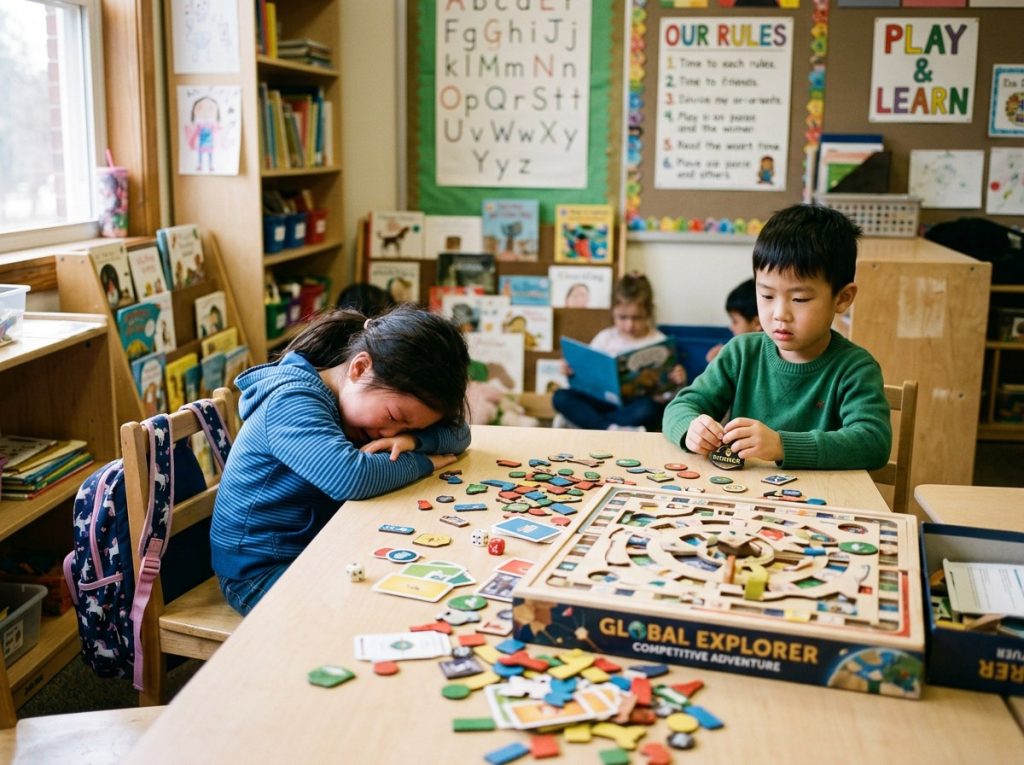
The classroom cost compounds. One competitive game can produce several conflicts that each need adult attention, which is why many teachers quietly retire competitive titles during the preschool years. Cooperative games for preschoolers solve this management problem as much as the emotional one — nobody stands alone in defeat, and the adult’s role shifts from referee to facilitator.
The longer developmental arc matters just as much. The routines children rehearse inside game time — negotiating roles, waiting for an agreed turn, helping a struggling teammate — anchor the same skills that research on how social emotional learning toys build empathy and cooperation identifies as preschool social foundations. Cooperative games for preschoolers simply give those routines a container with stakes low enough for daily practice.
What Makes Cooperative Games for Preschoolers Different
A genuinely cooperative game is not a standard board game with kind words printed on the box. Four design features do the real work.
The goal is shared. Players pursue one objective together — rescue the animal, finish the mural, move everyone home before nightfall. No child’s gain is another child’s loss.
Helping is legal. Rules encourage players to advise, remind, and assist each other between turns. Turn-taking stays, but support replaces sabotage.
The outcome is collective. The whole group wins or loses as one, which removes the audience effect of a public defeat and keeps emotional stakes manageable.
Communication is the mechanism. The game requires talking — requesting a card, planning the next move, warning about a risk — so verbal negotiation becomes the engine of play rather than a byproduct of it.
One boundary keeps the label honest. A game where one child tells everyone else what to do is not cooperation — it is direction with a friendly scoreboard. Genuine cooperative games for preschoolers make the shared goal impossible to reach without every player’s contribution, which is what forces the negotiation.
Together, these mechanics explain why cooperative games for preschoolers hold attention differently. A child who would drift away from a game they are losing stays engaged while the group is still in the fight, and a child who dominates learns that winning alone is not possible. That is also why cooperative games for preschoolers read as calmer from the outside — the energy goes into the problem instead of the scoreboard.
What Research Actually Shows About Shared-Goal Play
The evidence on cooperative games for preschoolers is more specific — and more honest — than most marketing copy suggests. Three findings matter for classrooms and for buyers evaluating materials.
A team at Leipzig University and the Max Planck Institute for Evolutionary Anthropology observed 96 four- and five-year-olds who played the same game cooperatively, competitively, or alone (PLoS ONE, 2019). After competitive play, children shared less with an uninvolved peer than after cooperative play.
The cooperative structure protected generosity; the competitive structure measurably reduced it. For a classroom, that difference lands in the minutes after the game ends — the time when teachers need sharing behavior most.
A six-week Swedish study of 65 children aged four to six compared cooperative and competitive board games played in groups of four (Scandinavian Journal of Psychology, 2021). Both versions produced similar levels of cooperative and prosocial behavior, but children reported enjoying the cooperative games more.
Enjoyment is not a soft outcome in early education: it predicts repeated play, and repeated play is where social routines actually form. A game children ask for again gets the repetition that a technically excellent but ignored title never will.
Earlier behavioral research pointed the same direction. In a study of 70 preschoolers, cooperative game sessions were followed by more cooperative behavior and less aggression, with effects carrying into free play (Journal of Applied Behavior Analysis, 1994). That early work also carries a caution — the strongest effects cluster in the short window after play, and no game session rewrites a child’s baseline social skills on its own.
Read together, the research supports a measured claim: cooperative games for preschoolers reliably lower the emotional temperature of game time, and the enjoyment advantage is clear, while broader character claims deserve skepticism.
How to Choose Cooperative Games for Preschoolers
Selecting cooperative games for preschoolers narrows the field, and that is an advantage: fewer titles meet the standard, and the ones that do stay in rotation for years. Five checks separate the durable picks from the shelf clutter.
- One shared goal that genuinely requires every player. If one skilled child could finish the game alone, the design fails the core test.
- Rules explainable in under two minutes, no reading required. Icon-driven boards beat text cards at this age.
- Play length of 10 to 15 minutes. Sessions that stretch past attention spans collapse back into management problems.
- Materials that survive group use. Large pieces, washable surfaces, and no small loose parts for mixed-age groups.
- Difficulty that scales. The same title should serve a three-year-old and a six-year-old at different challenge levels.
Buyers sourcing for classrooms, daycares, or wholesale programs can run these checks alongside the general framework for choosing board games for preschoolers — age fit, safety marks, and group-size flexibility remain non-negotiable in either format. Cooperative mechanics simply add a layer: the question is what a game teaches and what social structure it builds while doing so.
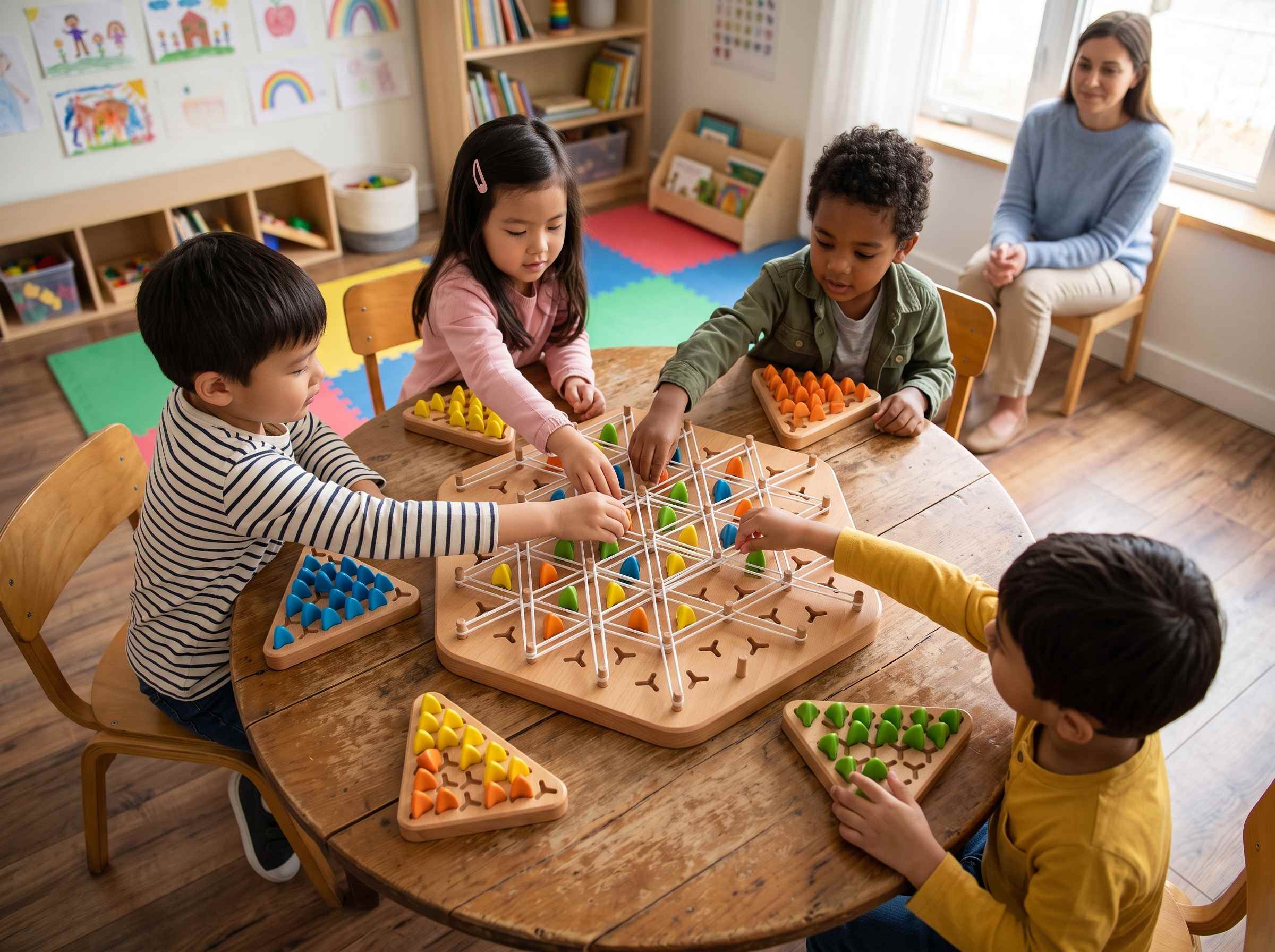
Group size deserves a deliberate decision rather than a default. The sweet spot for cooperative games for preschoolers sits at two to four players, large enough for real negotiation but small enough that every child gets a meaningful turn within attention span. Larger groups work when the material scales — team challenges with blocks or shared construction tasks absorb five or six children better than any board can.
Running a Cooperative Game Session That Works
The session routine
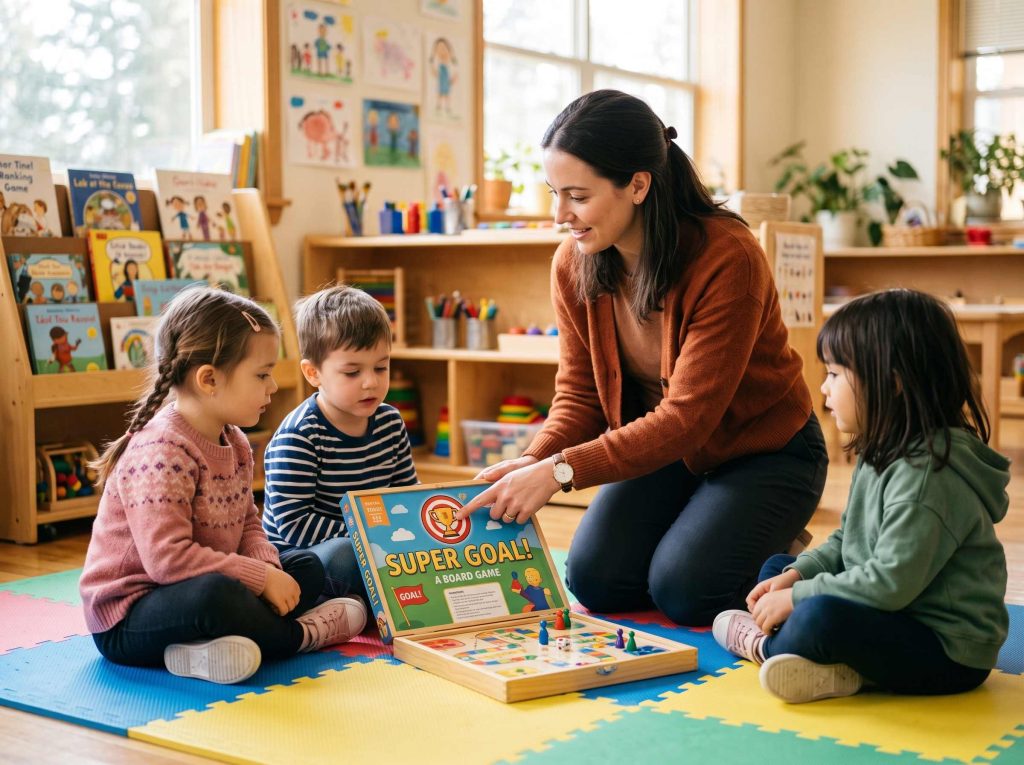
Introducing cooperative games for preschoolers follows a repeatable shape that experienced teachers refine within a week or two.
- Name the shared goal before opening the board. Children who can state the goal in their own words enforce the rules better than any adult.
- Assign rotating roles — card keeper, piece mover, card announcer. Roles distribute ownership and reduce grabbing disputes.
- Debrief on process, not outcome. Two minutes on what the team did that helped teaches more than any result.
In practice, cooperative games for preschoolers succeed when adults narrate the helping rather than the winning. Teachers who say things like “Maya suggested the move that saved the game” make cooperation visible and repeatable. Prompts that point at group progress, such as asking what the team needs next, outperform praise aimed at individuals, which quietly rebuilds the comparison dynamic the game removed.
What to expect at three, four, and five
Cooperative games for preschoolers meet children at very different developmental stages. Three-year-olds play parallel-assist: they stay on their own moves but will hand over a needed piece when asked. Four-year-olds manage prompted turn-taking and simple joint planning with adult reminders.
Five-year-olds negotiate strategy aloud, divide roles deliberately, and start coaching struggling teammates without adult direction. Expecting a three-year-old to run strategy talk sets both the child and the game up to fail; matching the challenge tier to the group keeps sessions productive.
Turning Familiar Materials Into Team Challenges
Most programs do not need a new shelf of titles to start tomorrow. Everyday materials convert into cooperative games for preschoolers with a rule change: one tower built together from all the blocks, a cleanup relay where the group races the clock rather than each other, a shared drawing that passes between painters every minute.
The strongest conversions use materials with a built-in challenge ladder. Vindstier’s wooden number blocks that work as a math tool, balance game, and building set pair a proportional height-equals-value design with 15 double-sided challenge cards spanning 30 tasks across five difficulty tiers. The highest tier is a free-balance task — build the tallest stable structure from a named set of blocks.
Reframed as a team brief for two children, one structure, shared planning, the task turns a solo logic exercise into negotiation, compromise, and joint victory. Because the tiers scale from number recognition to free engineering, a three-year-old and a six-year-old can work the same material side by side. The same conversion logic applies to pattern blocks and magnetic tiles: one shared canvas, one constraint, and a rule that every piece placement needs agreement.
Durability carries the same weight in group formats as in any classroom purchase. Solid wood and printed cards survive hundreds of rotations — a practical point for programs and distributors who calculate cost per use rather than sticker price.

Limitations and Common Misconceptions
Two boundaries deserve plain language. First, cooperative games for preschoolers relocate conflict rather than erase it: disputes over who goes first, who holds which piece, and whose plan the team follows still arrive — just without the win-or-lose detonation attached. Second, transfer is modest and routine-dependent. Measurable gains cluster in the hours after play, and only consistent scheduling with adult scaffolding turns single sessions into stable habits.
The most common misconception is treating cooperative structure as the only defensible format. Competitive play has documented value for school-age children learning to lose gracefully, and the Swedish six-week study found competitive board games harmless to prosocial behavior at these ages. The case for cooperative games for preschoolers rests on emotional load, classroom management, and enjoyment — strong reasons, without needing to moralize the alternative.
The Long-Run Value of Cooperative Games for Preschoolers
What accumulates across a school year is not a personality change but a repertoire. Children who spend a year inside shared-goal play have practiced negotiating roles, waiting for turns they agreed to, rescuing a struggling teammate, and losing as a group without anyone standing alone in defeat. Those are rehearsal conditions for the collaboration that school demands in every subject soon after.
The research is honest that effects build through repetition rather than arriving in a single session — and repetition is exactly what the enjoyment data promises cooperative games for preschoolers will keep getting. A game the whole group asks to replay is a tool that keeps teaching itself.