
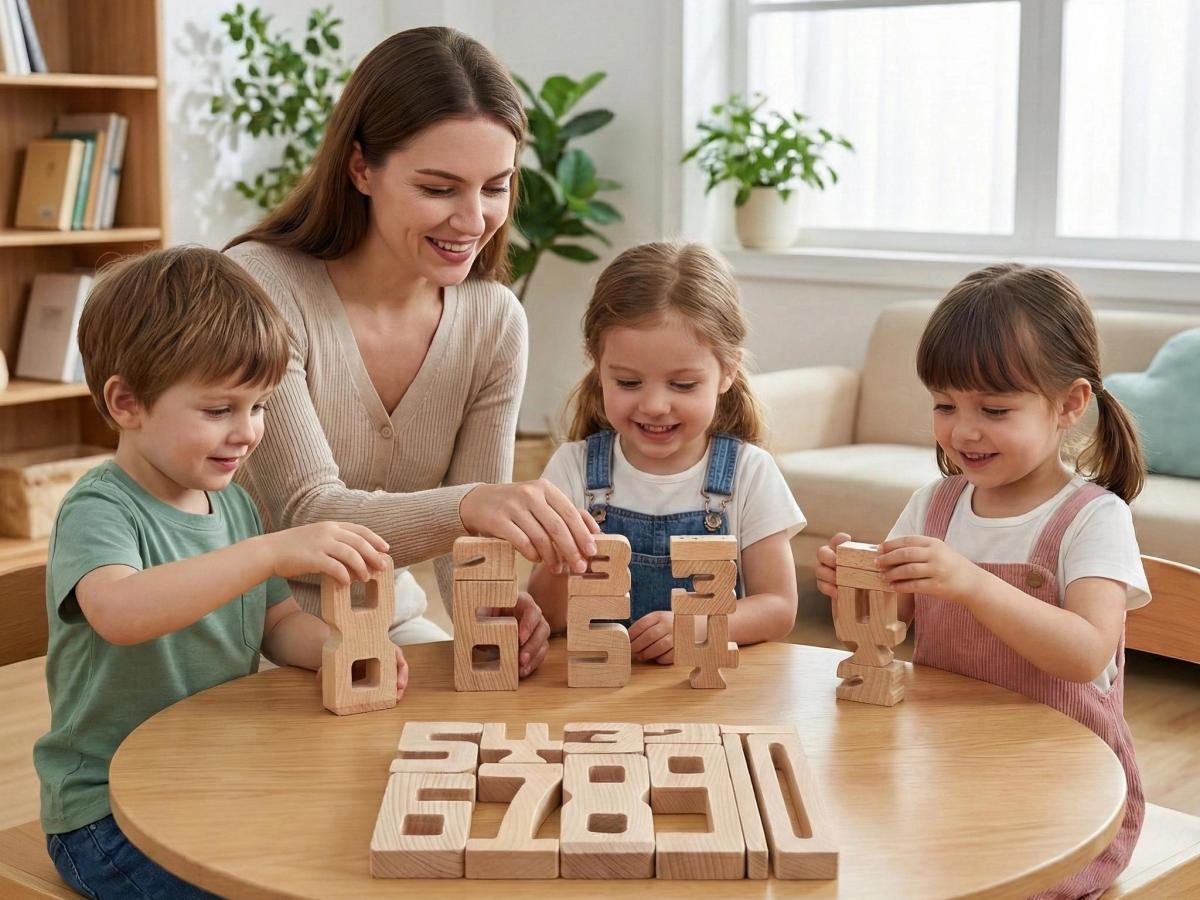
You’ve been there. A toy that looked amazing in the product photos sits untouched in the corner by week two. Meanwhile, your child is more interested in the cardboard box it came in.
The real problem isn’t your kid’s attention span — it’s that most toys only do one thing. Once that one thing stops being novel, the toy is done.
Vindstier Wooden Number Blocks were built around a different premise: what if one set of blocks could teach math, train balance, and fuel open-ended building — simultaneously, and progressively? In this guide, we’ll explore why wooden number blocks are essential for early childhood development.
Here’s exactly how it works across all three dimensions.
Part 1: Using Wooden Number Blocks as a Visual Math Tool
Most number toys show a child the numeral “7” and expect the concept to stick through repetition. Flashcards. Printed foam mats. Apps that say “seven!” in a cheerful voice.
None of them let a child feel what seven actually means relative to three.
Vindstier’s wooden number blocks are physically proportional: the block representing 7 is literally taller than the block representing 3. When a child places a “2” block and a “5” block side by side against a “7” block and watches the heights align perfectly, they’re not memorizing — they’re experiencing the equation2 + 5 = 7as a physical reality.
This is the core of the “Height = Value” design — and it’s why this specific toy functions as a genuine Montessori math tool rather than just a math-themed toy.
What this unlocks for a 3–4 year old:
- Number sequencing (arranging blocks from shortest to tallest)
- Visual comparison (“which number is bigger?”)
- Intuitive addition (stacking two blocks to match a taller one)
What this unlocks for a 5–6 year old:
- Multi-block addition (
1 + 2 + 4 = 7— does it balance against the “7” block?) - Early subtraction (removing a block from a stack and identifying what’s left)
- Number composition (how many different ways can you build a height of 10?)
No worksheet required. The blocks are the curriculum.
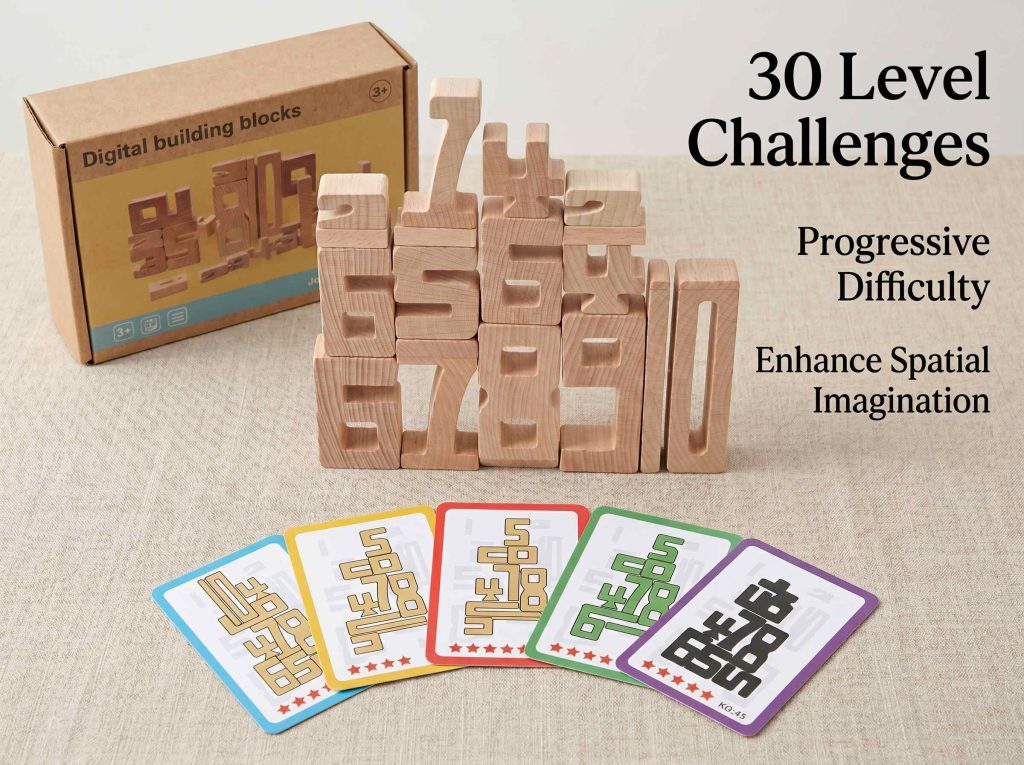
Part 2: 30-Level Logic Challenges with Wooden Number Blocks
Here’s the parent frustration no one talks about enough: educational toys that are too easy get ignored, and ones that are too hard cause meltdowns.
The 15 double-sided challenge cards solve this by breaking 30 distinct tasks into 5 structured difficulty tiers.
Level 1–6: Pure number recognition. Can your child find the “4” block and place it in the right spot on the card?
Level 7–12: Simple stacking sequences. The card shows a specific arrangement — your child has to reproduce it using the correct blocks in the correct order.
Level 13–18: Balance challenges begin. Arrangements that require precise block placement to maintain structural equilibrium. This is where the “Height = Value” design intersects with physics — a taller block is also heavier, which changes the balance dynamics. These wooden number blocks combine physics with math, as taller blocks are also heavier.
Level 19–24: Multi-block architecture. The card shows complex structures requiring 4–6 blocks placed in specific configurations. Spatial reasoning, planning, and fine motor control all come into play.
Level 25–30: Free-balance challenges. No fixed template — the card sets a constraint (e.g., “use blocks 3, 5, and 7 to build the tallest stable structure”) and your child has to engineer a solution.
The result: a child who masters Level 6 has a clear, engaging path to Level 7. There’s no point at which the toy is “beaten.” This is why the same set remains genuinely challenging for a 3-year-old and a 6-year-old — they’re just playing at different levels of the same progression.
Part 3: Creative Open-Ended Play with Wooden Number Blocks
Once the challenge cards are set aside, the blocks become raw building material.
But unlike generic wooden blocks (which are all the same size and shape), Vindstier’s number blocks introduce a variable the child has to account for: each block has a different height, and those heights follow a rule the child already understands.
This changes how open-ended play works:
- A child building a “staircase” has to think about which blocks to use and in what order — it’s not arbitrary, it’s mathematical
- A child trying to build the tallest possible tower has to consider weight distribution, because the taller blocks (higher numbers) are heavier
- A child playing “pretend city” might use the “1” blocks as people and the “10” block as a building — and notice that ten “1” blocks stacked are the same height as one “10” block
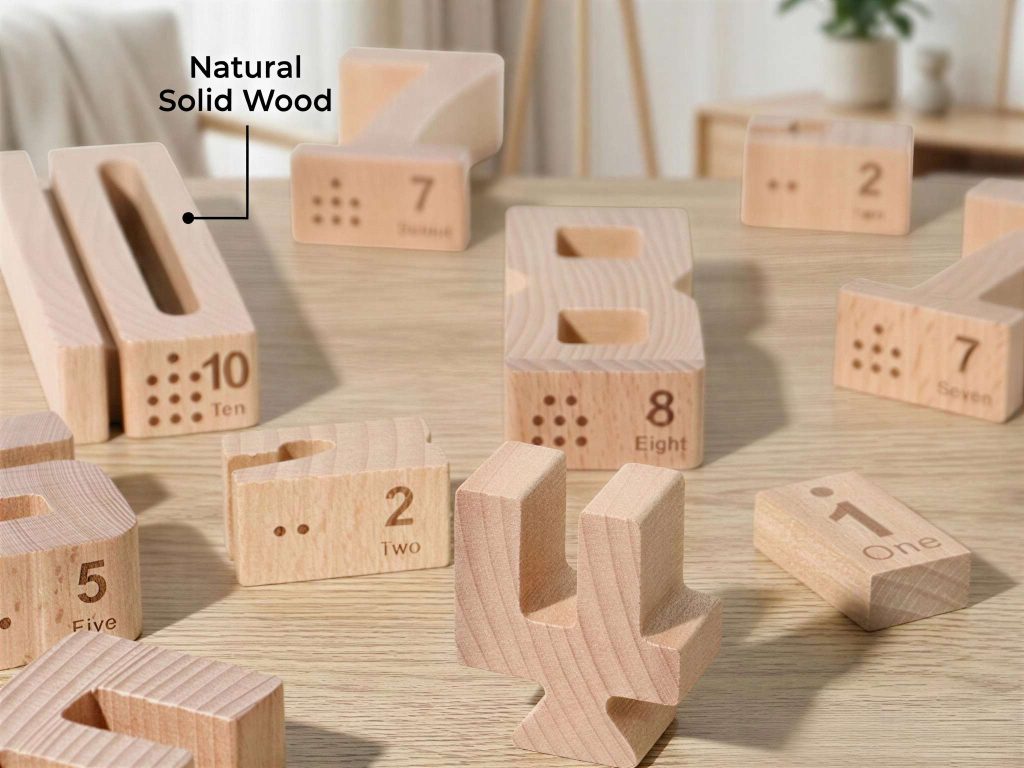
The bottom dot indicators add another layer. The raised dot patterns on the underside of each block (matching the block’s number value) aren’t just for structured counting activities. During free play, they become tactile information — a child can identify which block they’re holding without looking at it, which changes how they interact with the set during imaginative play.
This is what “open-ended play” actually means in practice: not a toy with no rules, but a toy whose rules are deep enough to generate endless new scenarios.
Why Safety Matters for High-Quality Wooden Number Blocks
Here’s where certification matters — but not in the way most product descriptions explain it.
Wooden number blocks are handled constantly and intensively. A child playing through the Level 15–20 challenge cards might pick up, place, and reposition each block dozens of times in a single session. The edges take wear. They also get mouthed by younger siblings.
Every edge on Vindstier’s number blocks goes through a multi-step sanding and polishing process specifically designed to eliminate burrs — the micro-splinters that standard sanding often leaves behind. The CE and CPC certifications (the required standards for the EU and US markets respectively) test for exactly this: edge sharpness, surface finish, and material safety under extended contact.
The solid natural wood construction also matters here in a way that MDF alternatives don’t: solid wood doesn’t chip into fragments the way compressed fiberboard can when a block is dropped on a hard floor repeatedly. Over months of intensive play, the material integrity holds.
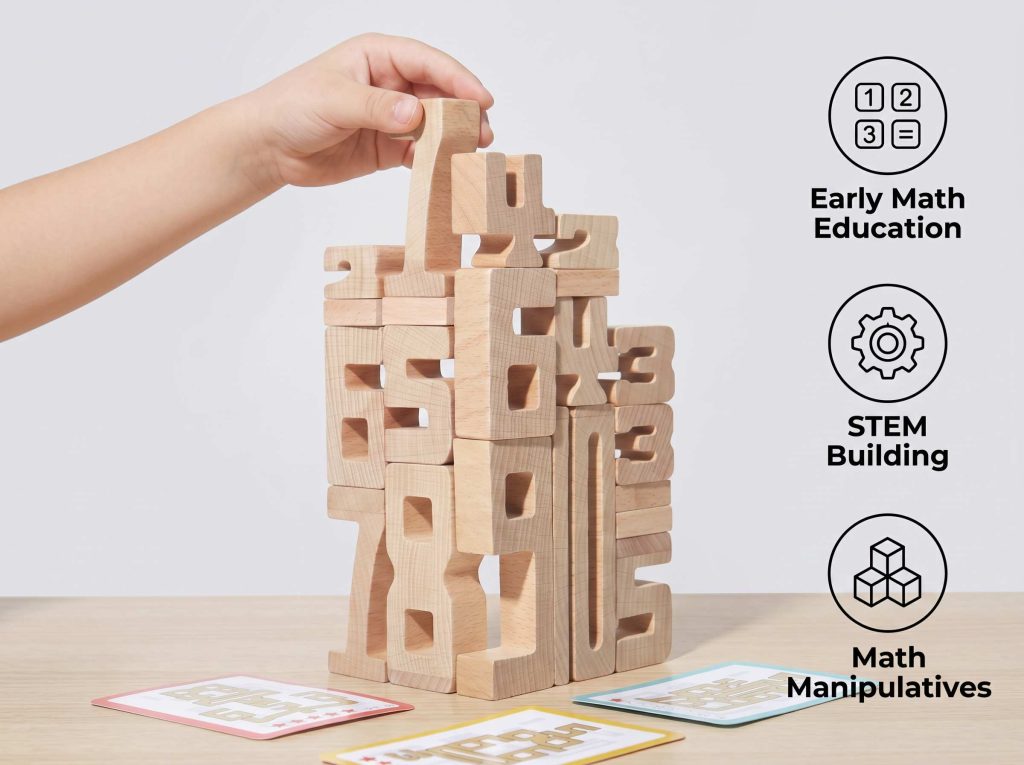
Who Should Choose These Wooden Number Blocks?
If you’re a parent shopping for a 3-year-old’s birthday and want something that won’t collect dust: the Level 1–6 challenge cards provide immediate, achievable engagement from day one. The set doesn’t require your child to be “ready for math” — the math understanding emerges from the play itself.
If you’re homeschooling and building a Montessori-aligned math environment: the height-proportional design directly supports the number rod and bead chain work in the Primary curriculum. These blocks function as a more compact, less expensive, and more durable alternative to traditional Montessori number materials.
If you’re a preschool or kindergarten teacher: the 30-level card system maps cleanly onto early math objectives across EYFS, Common Core Kindergarten, and Montessori Primary levels. The self-correcting nature of the balance challenges means children can work independently at the math center without constant teacher supervision.
If you’re looking for a holiday or birthday gift that won’t feel like homework: the blocks ship in a vibrant, retail-quality box that needs no additional wrapping. The visual appeal of the set is immediate — the colorful, height-varied blocks read as “fun” before a child ever reads the word “educational” on the box.
The Bottom Line: Why Our Wooden Number Blocks Grow With Your Child
Most toys that get labeled “3-in-1” just mean they come with accessories.
Vindstier Wooden Number Blocks are three genuinely distinct play modalities in one set — a structured math curriculum tool, a 30-level progressive logic game, and an open-ended building set — unified by a single design principle: height equals value.
That one principle is why the same blocks that teach a 3-year-old what “5” means can still challenge a 6-year-old to engineer a stable 10-block structure. The toy doesn’t get simpler as the child grows — the child grows into the toy.