The Real Problem: Your Child Knows the ABC Song — But Can’t Recognize the Letters
Most parents discover the same frustrating gap around age 3–4: their child can sing the alphabet perfectly, but freeze when asked “which one is the letter B?”
That’s not a failure of intelligence. It’s a failure of format.
Flashcards are passive. Alphabet apps reward tapping, not thinking. Foam letter mats get stepped on and forgotten. None of these formats connect the shape of a letter to an action a child controls — and that connection is exactly what makes recognition stick.
The Vindstier Magnetic Parking Game was designed to close that gap — not through repetition, but through play that makes letters impossible to ignore.
What Actually Happens When a Child Plays
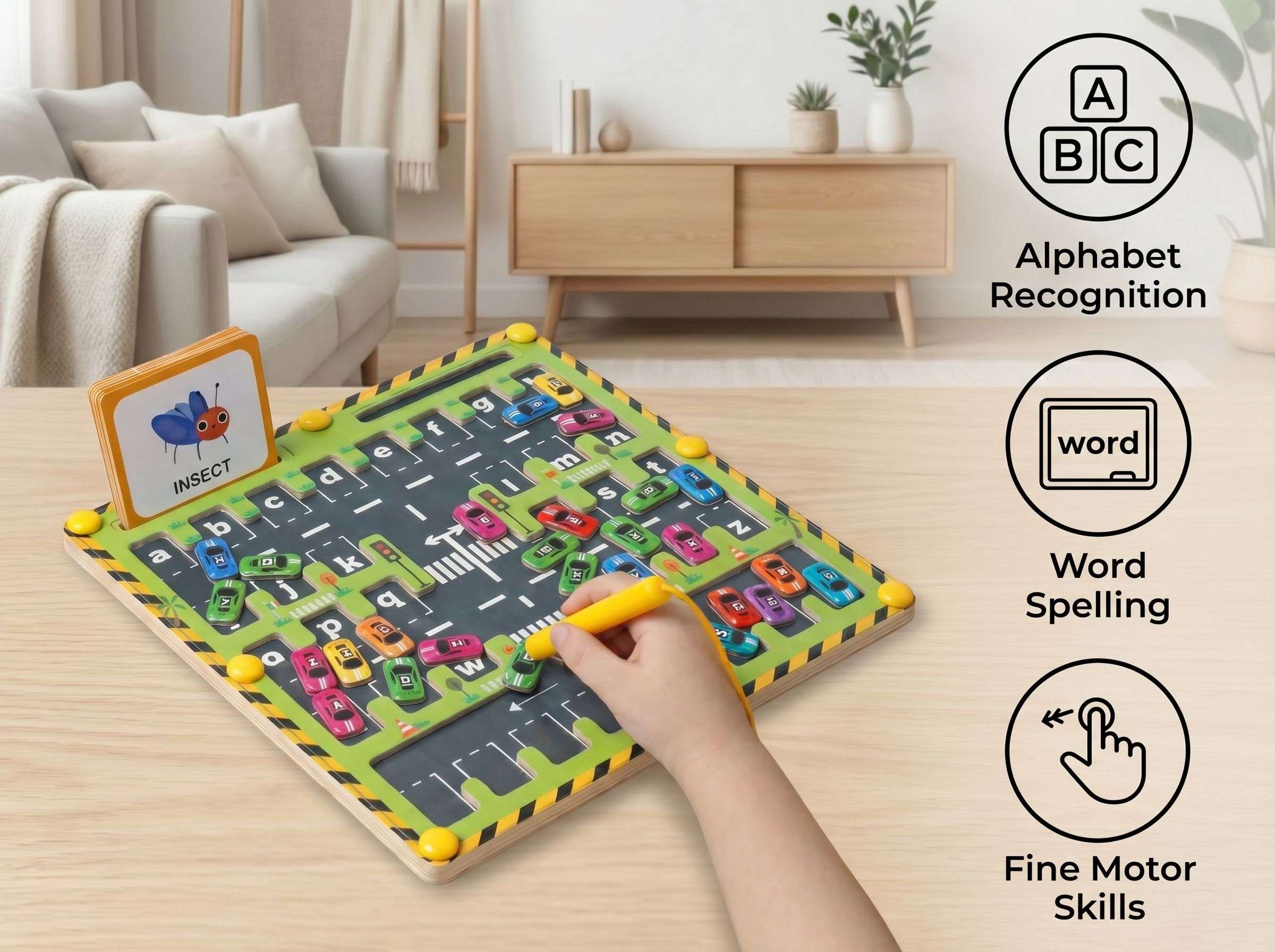
Here’s the core mechanic: your child picks up a magnetic wand, uses it to drag one of 26 colored letter cars across the board, and guides it into the matching lettered parking space.
That’s it. But let’s break down what’s happening cognitively in that single action:
- Letter identification: The child must read the letter on the car
- Visual matching: They scan the board to find the corresponding space
- Motor execution: They use the wand to drag — not push, not carry — the car across the board
- Color confirmation: Each car and space is color-coded, adding a second layer of recognition
This isn’t “learning the ABCs.” This is using the ABCs to complete a goal the child set for themselves. The letter becomes a tool, not a test.
And because the magnetic wand is calibrated to attract only one car at a time, a 3-year-old with still-developing hand control can successfully complete the action — which means they experience the win, not the frustration.
Why the “Drag” Motion Matters More Than You’d Think
There’s a reason Montessori educators spend so much time on activities involving precise hand control: the same pincer grip and directional wrist movement used to drag a magnetic car across a board is the same movement used to form letters with a pencil.
The Magnetic Parking Game’s “drag and drop” mechanic — guiding a car from starting position to a specific lettered space — isn’t just fun. It’s rehearsal.
For children aged 3–7, this window is critical. The fine motor pathways being built now directly determine how easily handwriting comes later. Most toy categories miss this entirely. Wooden puzzles build grip but not directionality. Digital games build letter recognition but zero motor skill. The Magnetic Parking Game builds both simultaneously, in a format that feels like a parking adventure, not a worksheet.
The 26-Car System: Why Every Letter Gets Equal Attention
One persistent problem with alphabet learning tools: vowels get overrepresented, and uncommon letters like Q, X, and Z get ignored.
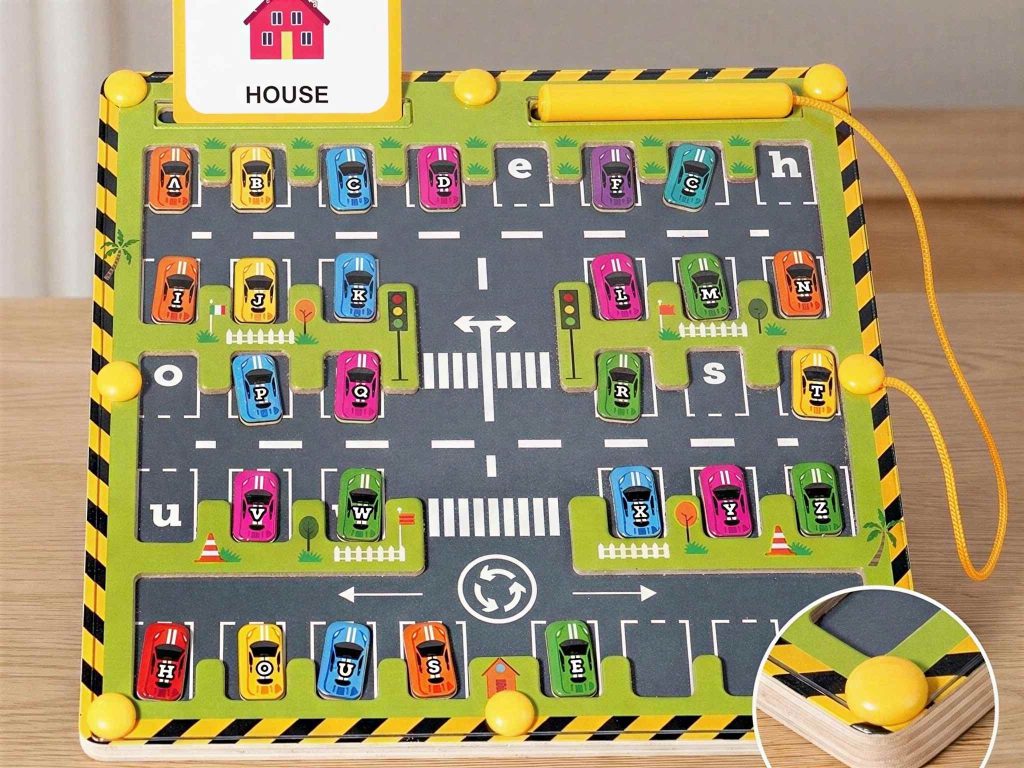
The Magnetic Parking Game includes all 26 letter cars — A through Z — each with its own color-coded car and matching parking space. There’s no “focus on the easy ones first” built into the design. Every round, the child is working with whatever cars they pick up, which means natural randomization ensures all 26 letters get played across sessions.
This matters because letter blindspots are real. Children who’ve only seen “A, B, C” in large type on classroom walls often can’t identify lowercase or stylized versions. The car-and-space matching format in the Magnetic Parking Game requires identification of the letter form itself — not just pattern memory.
The Flashcard Set: Where Vocabulary Enters the Game
Included with the Magnetic Parking Game are 12 double-sided flashcards — 24 early vocabulary words in total.
The integration is intentional: after a child parks the letter “A” car, they can flip to the “A” flashcard and connect the letter to a word. This is the bridge between letter recognition and early reading — the phonics connection that turns an alphabet into a language.
For parents working on pre-reading skills, the 24-word vocabulary set covers foundational early childhood words, giving you structured content to work through across multiple play sessions. It’s not supplementary — it’s the second phase of the same learning loop the parking game starts.
Built for the Moments Learning Actually Happens
Parents of toddlers know that “learning time” rarely happens at a desk. It happens in the back seat. In the waiting room. On the airplane. On the kitchen floor while you’re trying to make dinner.
The Magnetic Parking Game is built for these moments specifically:
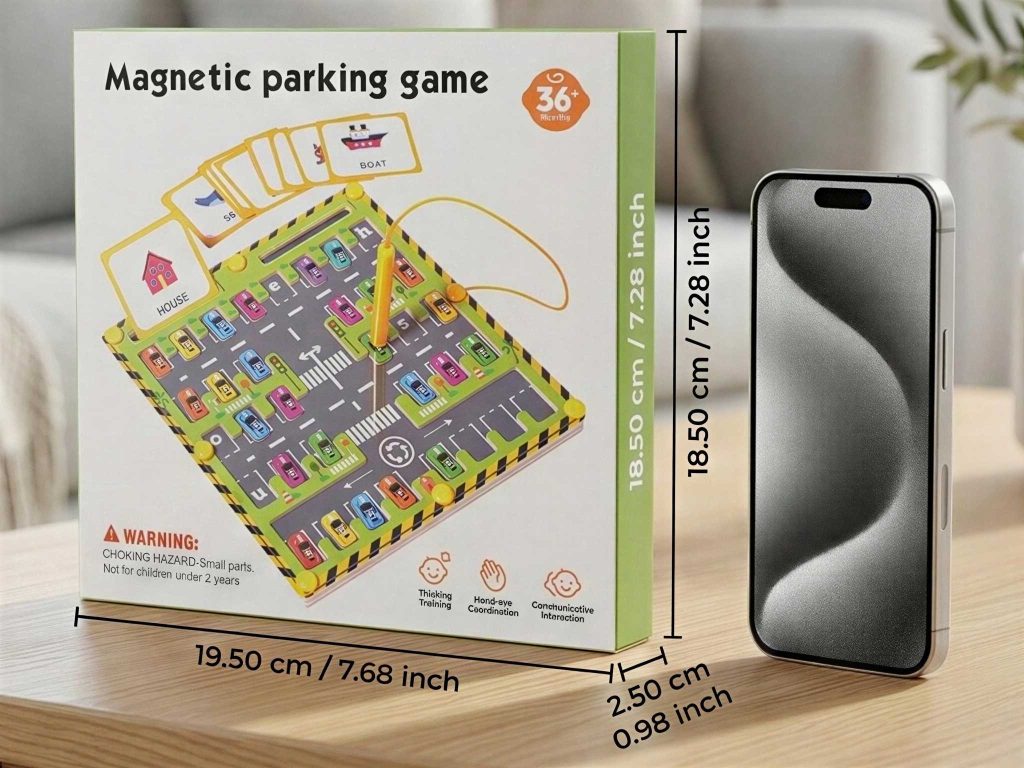
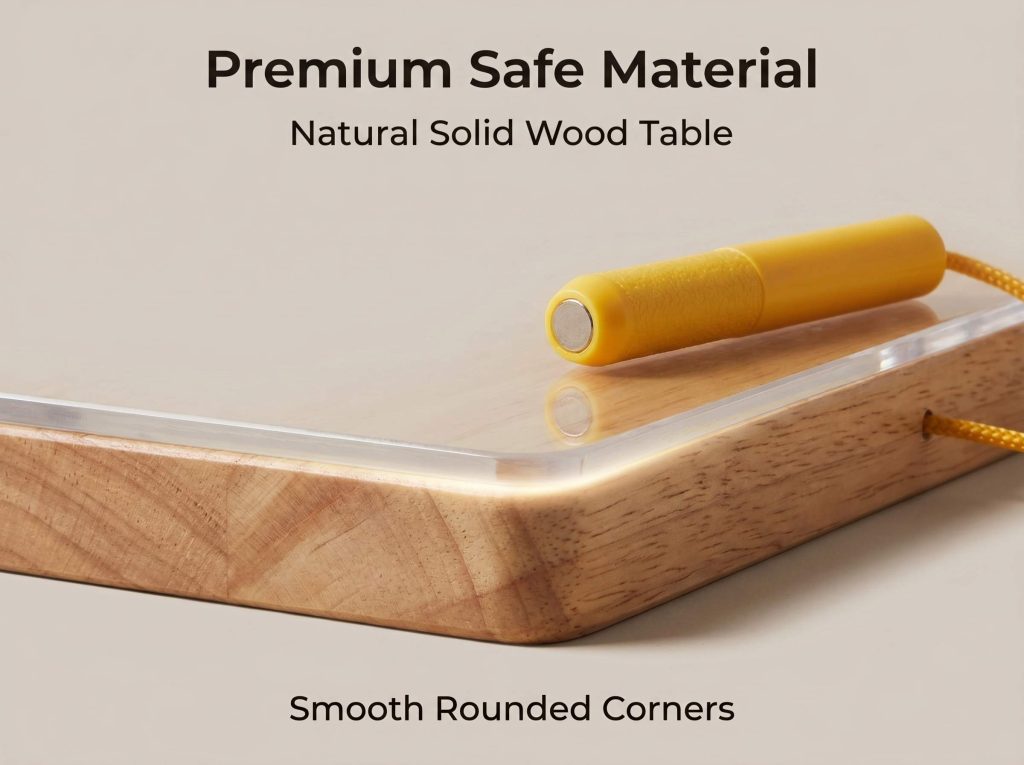
- All 26 cars are permanently sealed under the acrylic lid — there’s no “the pieces fell everywhere” scenario, because the pieces can’t leave the board
- The built-in pen slot means the wand is always part of the toy, never lost
- The compact wooden board format means the whole setup fits on a tray table or car seat
This isn’t a toy that requires setup, supervision, or cleanup. A 4-year-old can take it out, play independently for 20 minutes, and put it back — which is exactly the kind of self-sufficient engagement that makes it genuinely useful for parents, not just theoretically educational.
The sealed acrylic design also means no small parts can be accessed by younger siblings. For families where a 3-year-old and a 1-year-old share the same space, this matters in a way that “CE and CPC certified” doesn’t fully communicate: there is literally no way for the cars to become a choking hazard during play, because they never leave the board.
What Makes This Different from Every Other Alphabet Toy
Let’s be direct about the comparison most parents are making:
Foam letter mats: Great for floor play, no fine motor development, letters are incidental to the activity.
Magnetic refrigerator letters: High accessibility, but passive — the child places letters, not guides them with intention.
Alphabet learning apps: Strong on letter recognition, zero on motor skill, and require a screen.
Traditional wooden alphabet puzzles: Good grip development, but letters are isolated — no system, no narrative, no replayability.
The Magnetic Parking Game is the only format in this category that combines:
- 26-letter systematic coverage
- Active motor skill development via magnetic wand drag mechanics
- Color recognition as a parallel learning layer
- 24-word vocabulary extension via flashcards
- Fully self-contained, mess-proof portable design
No single one of those features is unique in isolation. The combination — in one sealed wooden board a 3-year-old can use independently — is what makes it distinct.
Who This Is Actually For
The Magnetic Parking Game works best for children aged 3–7 who are:
- At the pre-reading stage: knows some letters but can’t yet reliably identify all 26
- Resistant to “sit down and learn” formats: responds better to play with clear goals
- Developing fine motor skills: benefits from structured wand-control practice
- Frequently traveling or in situations requiring independent, mess-free activity
It’s also an unusually strong gift option for this age group — because unlike most educational toys, it’s immediately obvious to a 3-year-old what to do. There’s no instruction period. You pick up the wand, you find the matching space, you park the car. The learning is invisible. The game is obvious.
The Bottom Line
If your child can sing the ABC song but hesitates when you point to a letter and ask “what’s that?” — the gap isn’t ability, it’s format.
The Vindstier Magnetic Parking Game doesn’t teach letters by showing them repeatedly. It teaches letters by making children use them to complete something they actually want to do. Park the car. Match the letter. Do it again.
Twenty-six cars. Twenty-four vocabulary words. One magnetic wand. No setup, no cleanup, no lost pieces.
That’s how you close the gap between knowing the song and reading the page.