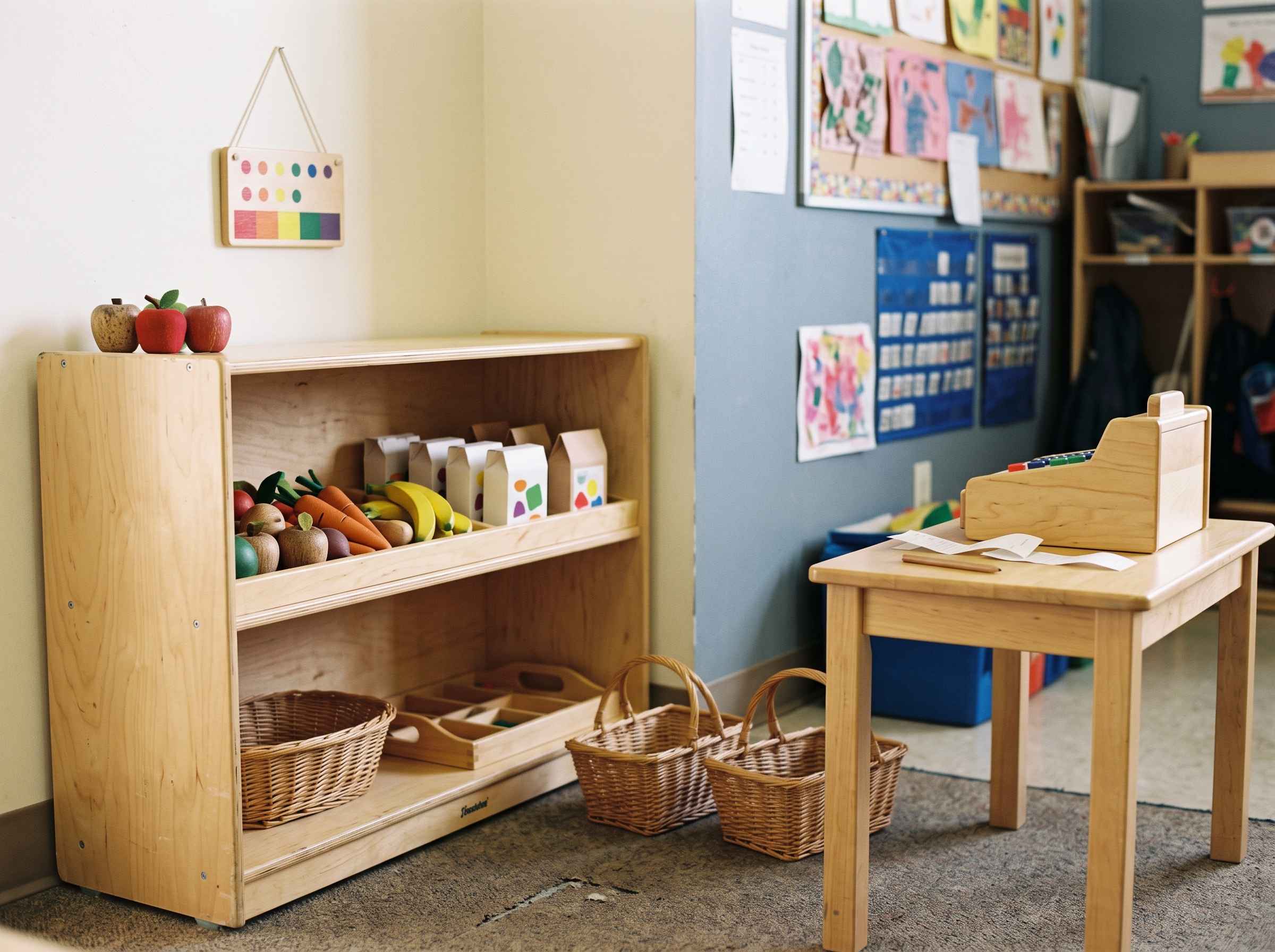
The grocery corner went up on a Friday: a shelf unit, a cardboard register, plastic food pieces, and a hand-lettered sign. By November, the register was held together with tape, half the food had migrated to the block shelf, and the corner sat empty while six children queued for the easel. A dramatic play center can fail quietly, and many classrooms never diagnose why.
The failure is not just visual. A play kitchen, dress-up storage, and themed props can represent a significant investment for an early childhood program. The corner also competes with the art table, reading nook, and block area for limited floor space. What matters is not how attractive the setup looks on opening day, but whether children continue choosing it weeks later.
This guide walks through the decisions that separate a dramatic play center children return to from one they quickly abandon. It covers the research, the failure patterns, space planning, themes and props, durable materials, and the teacher’s role.
What the Research Actually Shows About Pretend Play
The evidence behind pretend play is more specific than toy catalogs suggest, and the distinctions matter when deciding what belongs in a dramatic play center. A companion guide to pretend play toys covers toy selection, language, and self-regulation. This guide focuses on the environment and classroom practices that help collaborative play develop.
What Research Suggests About Emotional Control
A randomized trial in Developmental Science compared dramatic pretend play games with other guided activities, including block play and storytime, in 97 four-year-olds from low-income families. The dramatic-play group improved on emotional self-control, but not across all the social-emotional outcomes measured (Goldstein and Lerner, 2018).
The finding carries limits worth repeating: one intervention, one sample, and selected outcomes rather than every form of classroom pretend play.
For teachers, the practical implication is to build in opportunities to negotiate roles, follow shared rules, wait for turns, and manage emotions during interactions. These experiences sit closer to the study’s findings than filling a corner with costumes.
The Language Claims Deserve a Sober Read
A 2026 systematic review of sociodramatic play in early childhood education examined 27 studies reported across 35 papers, focusing on educator-supported collective pretend play among children aged three to seven.
The review described generally positive outcomes across studies, while also reporting areas without improvement. It highlighted teacher skills, appropriate scaffolding, and the ability to sustain child-led interaction as decisive.
The distinction matters because a child wearing a costume is not necessarily doing the collaborative play the review examined. Sociodramatic play involves recognizable roles, interaction between participants, an unfolding storyline, and a shared imaginary situation.
Language-rich props help create those conditions: menus, order forms, appointment cards, and shopping lists give children reasons to ask, explain, negotiate, and inform. Treat them as opportunities for language use, not guarantees of measurable gains.
The Causal Fine Print
A major 2013 review of the evidence linking pretend play to cognitive, social, and emotional development concluded that pretend play had not been established as a uniquely necessary cause of broad developmental gains. For several outcomes, the evidence could not separate causal effects from associations with other factors (Lillard et al., 2013, SRCD Monographs).
The balanced position: collaborative pretend play offers real practice in communication, emotional control, and problem-solving, but effects depend on the children, the activity, and adult support.
Executive-function skills — working memory, inhibitory control, cognitive flexibility — also develop through experience and interaction, as Harvard University’s Guide to Executive Function explains.
A dramatic play center should therefore be designed around useful interactions, not the assumption that elaborate themes or more props automatically produce better outcomes.
Why Dramatic Play Centers Sit Empty
Inactive corners share a few avoidable problems, and naming them makes a setup easier to fix without buying new materials.
The Overstuffed Shelf Problem
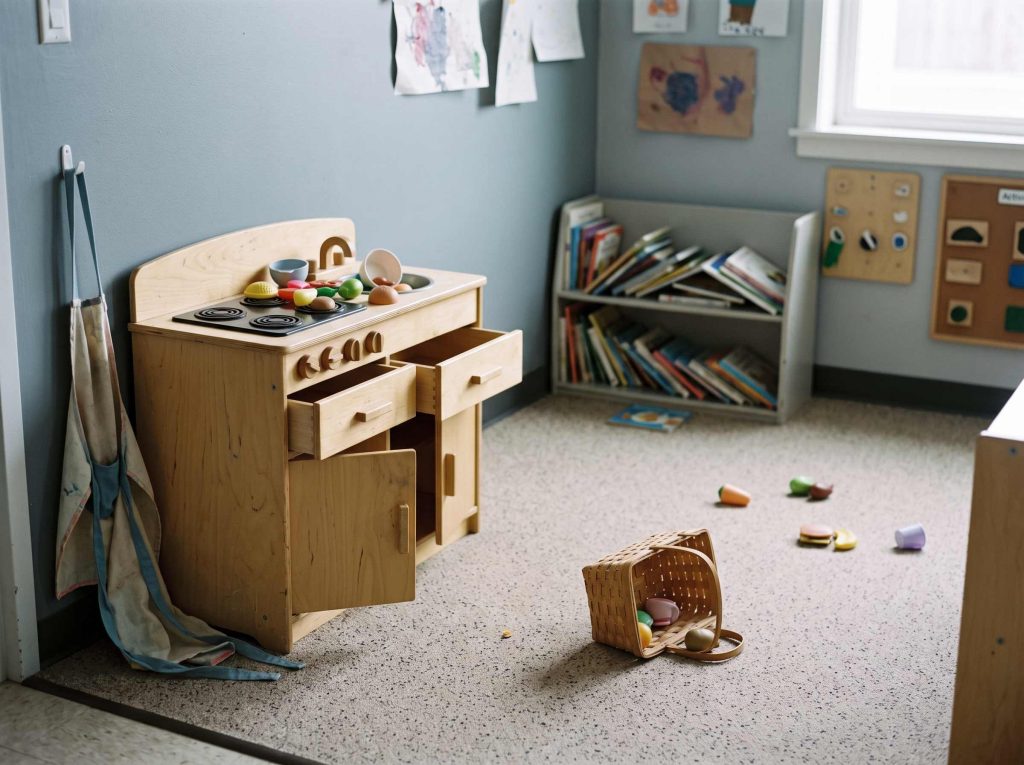
Classrooms often equate quality with quantity. A veterinary clinic filled with dozens of accessories may create initial excitement, but excessive choice makes the scene harder to organize. Returning every item to its place can also become a burden.
A smaller collection of chosen props keeps roles clear and cleanup manageable. A toy animal, a clipboard, appointment cards, a simple examination tool, and a carrier can already suggest several activities, with every item earning its place.
Props Without Roles
A basket of dress-up clothes provides materials, but it does not necessarily provide a scenario.
Collaborative dramatic play is easier to sustain when children have reasons to interact: a grocery store needs shoppers and cashiers, a clinic needs someone to bring an animal and someone to examine it, and a restaurant needs people to cook, take orders, and serve.
Props that support these roles keep the scene moving: name badges, appointment cards, order pads, and simple forms give children a reason to communicate, not just handle objects.
The Empty Chair and the Hijacked Plot
Two opposite adult habits can stall a dramatic play center.
An adult who never engages may leave children without the support needed to resolve conflicts or extend a struggling scenario. An adult who directs every action can turn play into a scripted activity in which children follow instructions rather than develop ideas.
A more useful approach is to participate when needed, sometimes through a role inside the scenario, while leaving children room to make decisions and negotiate direction.
Designing the Space: Zones, Size, and Traffic
A dramatic play center is a small stage, and its layout influences how children enter, interact, and move between activities. Three planning decisions are especially important.
Location and Boundaries
A corner bordered by two walls is easier to organize than an island in the middle of a room, because walls provide natural boundaries and support shelving without extra partitions.
A pretend play center beside a quiet reading area borrows its calm, while a position beside a busy block area inherits distracting traffic and noise.
Use low shelving and defined boundaries where possible, so adults keep sight lines while children still feel the zone is a distinct place where an imaginary situation can develop.
Capacity and Traffic Flow
No single capacity rule fits every dramatic play center; the right group size depends on floor space, furniture, age range, and the complexity of the scenario.
For a compact setup, begin with a manageable number of roles and watch whether children can move, reach props, and interact without repeated interruptions. If children spend more time waiting than playing, reduce simultaneous participants or rethink the layout. Keep entrances clear of the room’s main walkway.
The Semi-Enclosed Rule
Full enclosure makes supervision difficult, while complete exposure leaves the play area without a clear identity.
A semi-enclosed layout is the workable compromise: low shelving, a fabric canopy edge, or a defined rug marks a recognizable zone without blocking visibility, and one clear entrance shows children where the scenario begins.
The boundary should stay flexible: children may need blocks or baskets from neighboring areas to extend the play, and letting materials move between zones supports more complex scenarios than a fixed prop set.
Dramatic Play Themes That Hold Children’s Interest
Theme selection matters, but the way a theme is introduced, supported, and eventually rotated matters just as much. A successful dramatic play center gives children enough structure to begin while letting the scenario change as their ideas develop.
Turning Dramatic Play Ideas Into Theme Anchors
Four familiar themes provide a practical starting point for a preschool dramatic play center.
| Theme | Possible roles | Functional print materials |
| Grocery store | Shopper, cashier, shelf stocker | Price lists, receipts, shopping lists |
| Veterinary clinic | Veterinarian, assistant, receptionist, pet owner | Appointment cards, animal charts, care notes |
| Restaurant | Chef, server, cashier, diners | Menus, order pads, table numbers |
| Post office | Clerk, sorter, sender, courier | Address labels, stamps, package slips |
These themes work because they give children recognizable roles and reasons to interact. The print materials are functional rather than decorative: a shopping list guides the search for items, a menu carries an order, and an address label decides where a package belongs.
Children do not need conventional reading or accurate writing to use them; pictures, symbols, and early mark-making all support participation.
The same print-rich approach connects to the principles in How Language Development Toys Build Vocabulary and Narrative Thinking in Preschoolers.
Rotation Cadence: Consistent, Not Rigid
Frequent theme changes create novelty, but they can also interrupt developing storylines. Children often need repeated opportunities to revisit a setting, negotiate roles, and find new possibilities before their play grows more complex.
The companion pretend play toys guide uses a two-to-three-week rotation as a practical starting point — a planning rhythm, not a universal rule. Watch how children use the center and adjust when a theme needs more time or engagement has clearly declined.
During the first sessions, children may simply handle the props and learn the basic roles; as the scenario becomes familiar, they begin introducing problems and extending the storyline. Those developments are worth watching before any rotation decision.
Keep a Core, Rotate a Layer
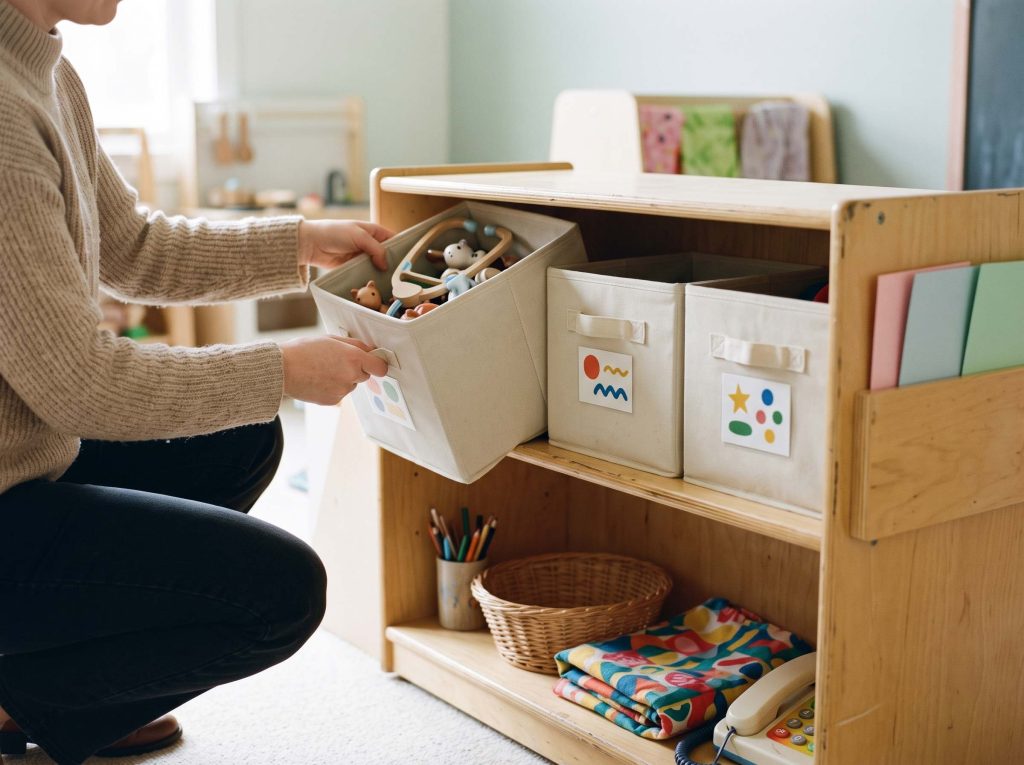
A dramatic play center does not need rebuilding from scratch at every theme change. Keep a small core of reusable materials — baskets, writing tools, storage containers, a play phone, a simple fabric backdrop.
Then rotate the theme-specific layer: a grocery store uses shopping lists and price labels, while a veterinary clinic uses appointment cards and animal-care records.
This approach reduces replacement costs, and familiar materials free children to focus on the new scenario.
Choosing Props: Fewer Pieces, More Meaning
Props influence whether a dramatic play center becomes a place for sustained interaction or a collection of objects children briefly handle and abandon.
Real Objects, Replicas, and Safety
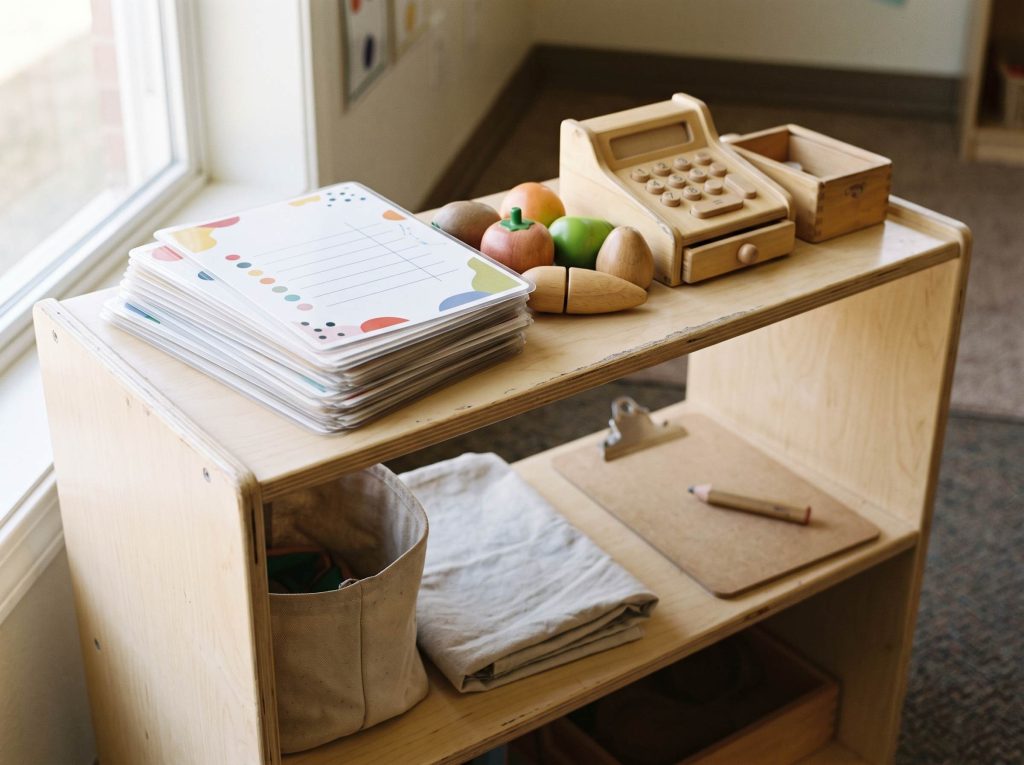
Familiar everyday objects suggest clear actions: a kitchen-safe ladle invites scooping, a working calculator supports pretend transactions, a wooden spoon suggests stirring, and a cloth bag invites packing.
Toy replicas can be equally useful when designed for children’s hands, repeated use, and the needs of the scenario. The right choice depends on safety, durability, and the actions the prop should support.
Before adding a real object, consider size, weight, edges, cleanliness, and intended users: no sharp edges, no small parts that pose a choking risk for the age group, and surfaces the classroom’s cleaning routine can handle.
Print Props Children Actually Use
Print props support early literacy when they serve a clear purpose in the play.
Provide two formats: pre-printed materials for children who need reading support, and blank versions for children who want to write or invent their own information.
Menus, shopping lists, appointment cards, and order pads belong where children naturally need them — a menu near the restaurant table, appointment cards at the clinic desk, not on a display wall.
Durability also matters: laminated or wipeable materials outlast unprotected paper when spills and regular cleaning are likely, so match the finish to the classroom’s cleaning routine.
Open-Ended Pieces Bridge the Block Shelf
Open-ended materials such as wooden crates, fabric squares, baskets, and other loose parts help children extend a scenario beyond its original props.
A grocery store might borrow blocks to build shelving; a post office might use baskets to sort packages along a delivery route. Because these materials serve many purposes, children adapt the environment to new ideas instead of stopping at the edges of a fixed toy set.
Letting materials move between zones also connects the dramatic play center with construction, sorting, and other classroom play.
Materials and Budgets That Survive Daily Use
A themed corner is an ongoing materials investment, not a one-time purchase: props pass through many hands, move between areas, and are cleaned frequently, so durability and maintenance belong in the purchasing decision.
Durability and Cleaning Considerations
Material choice alone does not determine how long a toy lasts; construction quality, joint design, surface finish, handling, storage, and cleaning methods all shape product lifespan.
When comparing wooden and plastic materials, evaluate the actual product rather than assuming one material always outperforms the other. Well-made products of either material can serve a classroom, depending on design and intended purpose.
For shared materials, look for stated age guidance, smooth well-finished surfaces, secure components, and cleaning instructions that fit the program’s routine. Textiles should suit the expected laundering frequency, and print should withstand its intended handling.
A useful purchasing comparison looks beyond the initial price: replacement parts, repairability, cleanability, storage, and cross-theme reuse all influence long-term cost.
What a Program Order Actually Sources
A dramatic play center may combine several material categories: wooden pieces, molded components, printed menus and appointment cards, fabric storage, and other props. For a school, retailer, or educational brand ordering across products, the challenge is ensuring that specifications and documentation match the items purchased.
Vindstier supplies educational toys across multiple categories and supports OEM/ODM projects; published company information describes an ISO 9001 quality-management system, FSC-certified sourcing, SKU-specific CE and CPC documentation, and a 7–14 day prototyping timeline. Buyers should confirm the applicable documents, certification scope, and timeline for their products and destination market.
A program piloting one classroom can evaluate layout and materials before equipping more rooms. If the setup works, the reorder should match the original products in dimensions, finish, function, and documentation — a supplier and quality-control question as much as a purchasing one.
The Teacher’s Role in a Dramatic Play Center
The 2026 review named teacher competencies — scaffolding, role adoption, supporting child-led problem-solving — as decisive implementation variables. They translate into two practical habits: support the scene when needed, and gradually hand responsibility for it back to the children.
In-Role Scaffolding
A teacher can join the play as a character with a simple problem — a customer who cannot find a product, a pet owner struggling to describe an animal’s symptoms.
This gives the teacher a natural reason to model vocabulary, ask questions, or help children consider solutions, then return the initiative to the children.
A useful rule: make a brief contribution, leave space for children to respond, and move the scenario forward without supplying every idea.
Fading the Adult Out
As children grow familiar with the setting and roles, the teacher can reduce direct involvement while continuing to observe.
Some groups need regular support to negotiate turns or organize a storyline; others become independent quickly. The pace should follow the children’s needs, not a rigid schedule.
The aim is not a perfectly scripted scene. It is a corner where children increasingly initiate ideas, manage roles, solve simple problems, and sustain shared play with appropriate support.
A Dramatic Play Center That Earns Its Floor Space
A dramatic play center should be evaluated by how children use it, not by how it looks; classroom observation reveals whether the setup supports meaningful play.
Four useful indicators are:
- Independent choice: Children choose the center without needing the teacher to direct them there.
- Sustained engagement: Play develops beyond brief handling of the props.
- Role flexibility: Children exchange roles, negotiate responsibilities, and introduce new ideas.
- Functional materials: Print props and other resources show signs of use rather than remaining untouched as decoration.
These indicators are observation prompts, not standardized measures; read them alongside the children’s age, interests, and group dynamics.
When a Child Opts Out
Not every child wants an active role in dramatic play, and non-participation does not mean the center has failed.
Some children prefer watching before joining; others start with a parallel task — organizing shelves, sorting materials, preparing items for the next customer — or visit occasionally rather than daily.
These entry points make participation more comfortable. Forcing a reluctant child into a leading role creates resistance, not confidence, so keep different ways to engage available.
Three Misuses to Avoid
The novelty trap: Changing themes too frequently prevents children from developing complex storylines. Rotate with a purpose, and watch how the current setting is being used.
The performance trap: Directing children through a fixed script for visitors replaces child-led sociodramatic play with theater. Demonstrations may have a classroom place, but they should not become the center’s main purpose.
The reward trap: Opening the corner only as a reward for good behavior excludes the children who may benefit most from practicing negotiation and emotional control. A dramatic play center belongs to the learning environment, not to a prize system.
The First Three Weeks
A short implementation period helps teachers establish the center without overplanning every detail.
Week one: Open the setting. Offer a manageable collection of props, show how materials are used and returned, and observe which roles children choose and which they ignore.
Week two: Support the storyline. Hold the theme in place, add prompts where needed, and join briefly in a supporting role — modeling functional print or helping children negotiate responsibilities.
Week three: Observe and adjust. Watch for children developing their own ideas, sharing roles, and using props with growing independence, then decide whether the theme continues or a new scenario better matches the group’s interests.
Before expanding the setup to more classrooms, a short checklist keeps the design honest:
- Every prop has a clear purpose or supports open-ended use.
- The theme stays long enough for children to revisit and deepen it, with a two-to-three-week rotation as a starting point rather than a rigid deadline.
- Print materials sit where children can use them naturally.
- Children have opportunities to change roles and contribute ideas.
- The layout supports access, movement, cleanup, and appropriate supervision.
A dramatic play center earns its floor space when children find reasons to return: a thoughtful layout, curated props, functional print, and responsive adult support create the conditions for richer collaborative play.
Start with one manageable theme, watch how children use the space, and adjust from what happens in the classroom. A dramatic play center succeeds not by being the most elaborate corner, but by becoming a place children can use, adapt, and make their own.