
A preschooler who grabs a toy from a peer, dissolves into tears when a game takes an unexpected turn, or stands frozen when another child cries is not simply misbehaving. These behaviors signal underdeveloped social emotional skills — the capacities to recognize emotions, regulate impulses, cooperate with others, and make caring decisions in social situations. The Collaborative for Academic, Social, and Emotional Learning identifies ages three to six as the most critical window for developing these competencies, and research consistently shows that children who build these skills early enter school better prepared for both academics and peer relationships. Social emotional learning toys provide the structured play experiences that translate abstract emotional concepts into practiced behaviors, making them a core component of high-quality early childhood SEL programs.
The Science of Social Emotional Learning in Early Childhood
Social emotional learning is not a single skill but a set of interrelated competencies that develop along distinct timelines. The CASEL framework, developed by the Collaborative for Academic, Social, and Emotional Learning and used by educators and researchers worldwide, identifies five core competence areas: self-awareness, self-management, social awareness, relationship skills, and responsible decision-making. Each area follows its own developmental trajectory and responds to different types of play experiences. Educators use this framework to select social emotional learning toys that target specific competency gaps rather than relying on unstructured play alone.
Self-Awareness and Self-Management
Self-awareness involves recognizing one’s own emotions, thoughts, and values — understanding that feeling frustrated is different from acting on that frustration. Self-management builds on this foundation, encompassing impulse control, stress tolerance, and goal-directed behavior — capacities that overlap substantially with executive function toys. In preschool, these capacities emerge as children begin labeling emotions verbally, using words instead of physical responses, and persisting through difficulty during challenging tasks. Social emotional learning toys that require waiting for turns, following multi-step rules, or managing disappointment when a structure collapses directly exercise self-management capacities.
Social Awareness, Relationship Skills, and Responsible Decision-Making
Social awareness enables children to recognize and empathize with others’ emotions — noticing when a peer is upset, understanding that sharing creates happiness. Relationship skills cover listening, cooperation, and conflict resolution. Responsible decision-making integrates these capacities: considering how actions affect others and choosing behaviors accordingly. Cooperative play materials, where children must negotiate roles, share resources, and enforce rules together, activate all three competencies simultaneously.
Why Social Emotional Learning Predicts Academic and Social Outcomes
The evidence linking social emotional skills to academic and life outcomes is substantial. A landmark meta-analysis by Durlak et al. (2011, Child Development) analyzed 213 school-based SEL programs involving 270,034 students from kindergarten through high school. Compared to controls, children participating in SEL programs showed significantly improved social and emotional skills (effect size = 0.57), increased positive social behavior (0.24), and decreased conduct problems (0.22). Academic achievement also improved, with an effect size of 0.27 — translating to approximately an 11 percentile-point gain relative to non-participating peers.
The practical implication is clear. Children who develop emotional vocabulary, self-regulation, and cooperative skills through play enter formal schooling with cognitive and social tools that accelerate learning across every domain. A child who can name frustration, ask for help instead of acting out, and cooperate during group activities is positioned to learn more effectively than a peer who cannot — regardless of raw cognitive ability.
How Social Emotional Learning Toys Target Core Competencies
Different toy categories activate different social emotional competencies. Understanding this mapping helps educators and parents select materials that address specific developmental gaps rather than assuming all play produces equivalent emotional growth.
Cooperative Board Games and Turn-Taking Materials
Games requiring players to wait for turns, follow shared rules, and respond to others’ moves directly train self-management and relationship skills. When children play a cooperative board game where the group wins or loses together, they practice perspective-taking, emotional regulation during setbacks, and collective goal-setting — all within a structured, repeatable format that adults can scaffold. These structured group experiences make cooperative board games some of the most practical social emotional learning toys for classroom use.
Role-Play and Dramatic Play Materials
Dramatic play materials — kitchen sets, doctor kits, dollhouses — are among the most researched social emotional learning toys in developmental psychology. When children adopt roles, negotiate scenarios, and respond to each other’s imagined emotions, they exercise social awareness, empathy, and responsible decision-making. The complexity of the play scenario — whether children sustain roles, incorporate peers’ ideas, and resolve in-character conflicts — determines the depth of social emotional practice. Dramatic play sets are versatile social emotional learning toys that grow with children as their social skills expand.
Construction and Sorting Materials for Group Use
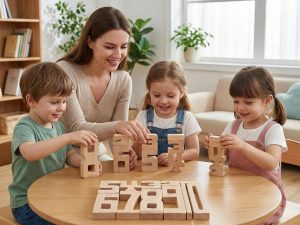
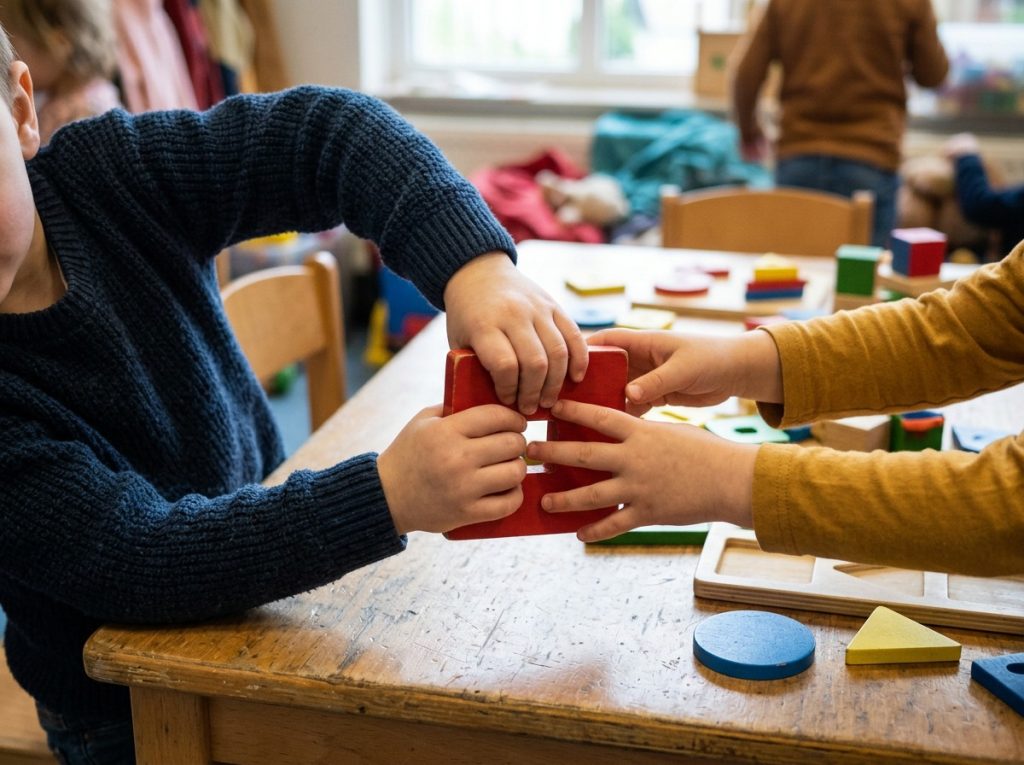
Sorting toys and construction sets used in small-group formats build relationship skills through resource negotiation. When three children share a limited set of blocks, they must request, wait, trade, and sometimes compromise — micro-interactions that build cooperative habits. The cognitive demands of sorting or building pair with social demands of coordination, producing dual-domain development in a single play session. When used in small groups, these materials double as social emotional learning toys that build cooperation alongside cognitive skills.
Cooperative Play and Empathy: What Research Shows
The link between cooperative play and social emotional development rests on both theoretical and empirical foundations. Vygotsky’s sociocultural theory positions dramatic play as the primary context in which preschoolers internalize self-regulation through social interaction with peers.
A foundational study by Elias and Berk (2002, Early Childhood Research Quarterly) tracked 51 preschoolers across a school year and found that complex sociodramatic play — play involving sustained roles, shared narratives, and rule negotiation — predicted significant gains in self-regulation during classroom clean-up periods. Solitary dramatic play, by contrast, was negatively correlated with self-regulation improvement. The effect was especially strong for children rated as highly impulsive, suggesting that sociodramatic experiences may serve as a corrective pathway for children most behind in self-regulatory development.

More recent evidence reinforces this finding. A controlled intervention by Jaggy et al. (2023, Early Childhood Research Quarterly) assigned 211 children across 27 Swiss playgroups to one of three conditions: play tutoring, provision of role-play materials, or control. Children in the play tutoring condition — where educators actively scaffolded social pretend play quality — showed the strongest gains in behavioral social skills and positive peer relationships. Notably, the study found that merely providing materials without educator scaffolding did not produce equivalent gains, underscoring that adult mediation is a critical ingredient.
A separate controlled intervention published in Acta Psychologica (2023) worked with 180 children aged five to six across 24 classrooms. After an 11-week program combining structured emotion instruction with teacher-scaffolded pretend play, children’s emotional understanding scores rose 12.0 percentage points versus 8.0 for controls — a statistically significant difference (F(1, 178) = 4.33, p = .039). More strikingly, aggressive reactions in social conflict scenarios decreased significantly in the intervention group (z = −2.68, p = .007, r = −0.51), while the control group showed no significant change. Ten of twelve teachers rated the program as very useful for addressing children’s behavior problems.
Developmental Progression of Social Emotional Skills Ages 3 to 6
Social emotional competencies emerge in a predictable but individually variable sequence. Environmental enrichment, language exposure, and peer interaction frequency all influence timing.
| Age Range | Competency in Focus | Observable Milestones | Toy Categories That Target This Stage |
|---|---|---|---|
| Around 3 years old | Basic self-awareness | Labels basic emotions (happy, sad, angry); begins parallel play; accepts brief turns | Simple turn-taking games, emotion-matching cards, single-role dramatic play |
| 3–4 years old | Self-management emerging | Uses words to express frustration; waits 2–3 minutes for a turn; engages in associative play | Cooperative board games, shared construction sets, multi-role dramatic play |
| Around 4 years old | Social awareness expanding | Recognizes peers’ emotions; offers comfort; sustains cooperative play for 20+ minutes | Group sorting with rules, dramatic play with assigned roles, storytelling games |
| 4–5 years old | Integrated SEL | Negotiates conflicts verbally; explains feelings; makes caring choices independently | Complex cooperative games, role-play with moral dilemmas, group construction projects |
Teachers should observe children’s peer interactions directly rather than relying solely on age benchmarks. A four-year-old from a language-rich home with regular cooperative play experience may demonstrate empathy typical of five-year-olds, while a five-year-old with limited peer interaction may perform at the three-year-old level. This staged framework helps educators choose social emotional learning toys matched to each child’s current social and emotional development level.
Selecting Social Emotional Learning Toys: Criteria for Educators and Buyers
When evaluating social emotional learning toys for classroom or institutional use, program directors and purchasing managers should assess materials against specific functional criteria rather than assuming that any toy labeled “educational” supports emotional development.

Cooperative structure
Materials designed for 2-4 children produce greater social emotional gains than single-player alternatives, even when the cognitive task is equivalent. Games where the group succeeds or fails together — rather than competitive formats where one child wins — build relationship skills and reduce the emotional volatility that competitive play can trigger in young children.
Sustained engagement potential
Social emotional skills consolidate through repetition. Materials that support 20-35 minutes of sustained play — through progressive complexity, expandable scenarios, or modular components — provide the duration that emotional practice requires. Brief play of 10-15 minutes produces limited gains, as the Gibb et al., 2021, Frontiers in Psychology demonstrated for related self-regulation capacities.
Durability for shared use
Classroom materials undergo 200+ handling cycles weekly by multiple children. Interlocking mechanisms, hinges, and surface finishes must withstand collaborative — sometimes enthusiastic — handling. Wooden building blocks maintain structural integrity longer than plastic alternatives under institutional conditions, reducing replacement frequency and per-child cost over a product’s classroom lifespan.
Compliance documentation
Materials for children under three require CPC certification (US) and CE/EN71 compliance (EU). For products rated 3+, per-SKU third-party test reports verify mechanical integrity and surface coating safety. Buyers should request per-SKU documentation rather than accepting catalog-level certificates, as batch-level compliance gaps affect institutional procurement. Programs sourcing preschool classroom toys at scale can request OEM services with per-SKU CPC and CE certification packages, streamlining procurement while ensuring consistent quality across classroom sets.
Misconceptions and Limitations in Social Emotional Learning Through Play
“Free Play Automatically Develops Social Emotional Skills”
Unstructured play develops some social emotional capacities through natural peer dynamics, but the gains are inconsistent and significantly smaller than those produced by structured, teacher-scaffolded play. The Jaggy et al. (2023) study found that merely providing role-play materials without educator scaffolding did not produce significant gains — active adult mediation was the differentiating factor. Social emotional learning toys deliver maximum value when paired with deliberate teacher scaffolding rather than offered as independent activity.
“Competitive Games Build Social Skills”
Competitive formats often trigger the emotional dysregulation they aim to prevent, particularly for children with weak self-management. Cooperative games — where the group wins or loses together — produce stronger relationship skills and reduce the emotional volatility that competitive play can reinforce. A common purchasing mistake is selecting elaborate competitive games assuming that social interaction automatically produces social learning.
Two limitations require attention. First, social emotional development is multiply determined — it responds to family attachment quality, language exposure, peer group stability, and caregiver mental health, not solely to toy selection. Programs addressing SEL through materials alone, without attention to these broader factors, may see attenuated results.
Second, children with persistent social-emotional difficulties despite adequate play exposure may need evaluation for underlying factors — including communication disorders, autism spectrum differences, or trauma effects. These materials support development but do not constitute clinical intervention. Programs should connect families with appropriate specialists when concerns persist.
Social Emotional Learning Toys and the Path to School Readiness
Social emotional learning toys provide the developmental scaffolding that enables preschoolers to build the empathy, self-regulation, and cooperation that both classroom success and lifelong relationships require. Children who practice waiting, negotiating, and recognizing emotions through structured play enter kindergarten with social emotional tools that accelerate learning and reduce behavioral disruptions. The evidence is consistent — purposeful play, supported by intentional materials and teacher scaffolding, produces measurable social emotional gains that persist into elementary school.
Programs implementing social emotional development through curated play materials — with cooperative games, dramatic play sets, and teacher narration — give children the strongest foundation for classroom and social success. For educators and program directors seeking classroom-ready social emotional learning toys with verified compliance and progressive design, Vindstier’s curated range of educational and construction toys offers a practical foundation for building a developmentally sequenced SEL program.