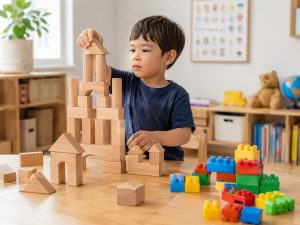

Walk into most preschool classrooms and you’ll find the same scene: a shelf of toys that gets rotated every semester, a budget that disappears faster than anyone planned, and teachers spending more time managing chaos than facilitating discovery. The problem isn’t a lack of toys. It’s a lack of the right preschool classroom toys — materials that do real educational work without requiring a specialist to deploy them.
Early childhood programs face growing pressure to demonstrate developmental outcomes while keeping per-child costs manageable. Preschool classroom toys are no longer just background furniture. They’re the core delivery mechanism for everything from fine motor development to early numeracy. Choosing them well is a curriculum decision as much as a purchasing one.
This guide is written for people making that decision seriously: school buyers weighing lifecycle costs, teachers evaluating what actually works during a 25-minute center rotation, and distributors who need to articulate product value beyond the spec sheet.
Why the toy selection problem is harder than it looks
The standard approach to equipping a preschool classroom hasn’t changed much in two decades: pick from a catalog, stay within budget, replace what breaks. It’s a reasonable process that consistently produces mediocre results.
The core issue is that most toy procurement decisions are made at one or two removes from actual classroom use. A buyer evaluates price, safety certifications, and durability ratings. A curriculum coordinator may add a developmental framework. But neither person is the one watching a four-year-old lose interest in a puzzle after forty seconds, or noticing that the same building set produces twenty minutes of sustained engagement when kids are given a specific challenge prompt.
The gap between “developmentally appropriate” as a category label and “actually drives learning outcomes” as an observable result is where most classroom toy budgets get quietly wasted.
Research from the American Journal of Play (2014, Stuart Brown et al.) consistently showed that the quality of a child’s engagement — not the number of toys present — is the primary predictor of cognitive and social development outcomes. More recently, NAEYC’s 2022 updated developmentally appropriate practice framework reinforced this, explicitly linking sustained play-based engagement with measurable gains in self-regulation, language acquisition, and early mathematical thinking. High-quality engagement requires toys that are open-ended enough to allow invention, structured enough to scaffold skill-building, and durable enough to survive repeated rough use.
Most products on the market satisfy one or two of those conditions. Few satisfy all three.
What makes high-quality preschool classroom toys stand out
The markers that distinguish genuinely effective preschool classroom toys from average ones aren’t always obvious from a product listing. They show up in how children interact with the object over time.

Multi-modal engagement
A toy that engages only one sense or one type of action tends to have a short cycle of interest. Toys that combine tactile, visual, and problem-solving elements — think construction sets with sensory textures, or sorting games that introduce early math vocabulary — sustain attention longer and create more natural opportunities for teacher-guided language development. Open-ended preschool toys that operate across multiple modes consistently outperform single-function alternatives in observed engagement duration. This is one of the clearest distinguishing traits of high-quality preschool classroom toys.
Scalable challenge
High-quality early childhood learning materials work differently for a 2.5-year-old and a 5-year-old. This isn’t about having multiple difficulty settings. It’s about the toy having enough inherent complexity that children at different developmental stages find their own level of challenge. This matters enormously for mixed-age preschool environments, which are increasingly common, and for programs that need to stretch every budget dollar across multiple years rather than replacing materials annually.
Low-threshold facilitation
A toy that requires a teacher to explain setup before every use creates friction in center-based learning. The most effective classroom toys can be introduced once, with a brief prompt, and then function semi-independently — freeing the teacher to observe, document, and intervene where it actually counts. This is a dimension that rarely shows up in product reviews but has an outsized effect on real classroom flow. This everyday efficiency gain is a core reason well-designed preschool classroom toys justify a higher upfront investment.
Physical durability
The total cost of a toy set that survives three years of daily preschool use is fundamentally different from one that needs replacing annually, even if the per-unit purchase price is lower. Materials that chip, paint that flakes, and small parts that separate are not just durability failures — they’re safety issues that pull teachers out of teaching mode. For procurement decision-makers, this directly reduces the three-year total cost of ownership; for classroom teachers, it eliminates the administrative friction of damage reporting and emergency material substitution.
A practical selection threshold: products that meet three or more of these criteria are worth including in a procurement shortlist. Those that meet all four are high-priority candidates. Products that satisfy only one or two criteria — regardless of how low the unit price is — should not anchor a core classroom materials budget.
Building a classroom toy inventory that actually works

Most classrooms benefit from organizing preschool classroom toys in functional layers rather than by narrow product category.
The foundation layer
Open-ended construction and manipulation materials — unit blocks, magnetic tiles, stacking and nesting sets — are the workhorses. They support spatial reasoning, cause-and-effect understanding, and collaborative play simultaneously. A well-maintained set of unit blocks has documented cross-curricular value across math, physics, language, and social-emotional development, which is why experienced early childhood educators tend to protect this budget line above almost any other.
The skill-development layer
This layer targets specific developmental milestones: puzzles calibrated to fine motor skills development stages, fine motor skills manipulatives for hand-eye coordination, early numeracy manipulatives. These preschool classroom toys work best when matched to the actual developmental range of the specific classroom, not just labeled “ages 3–5.” A group of predominantly three-year-olds needs different puzzle complexity than a pre-K cohort in its second program year.
The dramatic play layer
Dress-up materials, role-play sets, and community helper props are frequently underfunded relative to their developmental impact. Peer interaction during dramatic play is one of the primary settings where children develop theory of mind, emotional regulation, and early negotiation skills. Daycare learning materials budgets that treat this layer as optional tend to show gaps in social-emotional outcome data. This category of preschool classroom toys consistently delivers outsized social-emotional value relative to its cost.
The sensory and science exploration layer
Sensory bins, nature exploration kits, and simple cause-and-effect science materials round out a well-equipped environment. These require more teacher scaffolding but produce high-value moments for language development and early scientific thinking when facilitated well.
How to evaluate what you already have — and what to replace first

Before adding new preschool classroom toys, it’s worth auditing what’s currently in the room against a clear behavioral standard. This saves budget and surfaces actual gaps rather than perceived ones.
The most useful audit questions are behavioral, not categorical. Which toys consistently attract sustained engagement — ten minutes or more — without teacher intervention? Which materials are children returning to across a semester, not just novelty-testing and abandoning? Which toys have you seen used in ways you didn’t anticipate, which is usually the strongest signal of genuine open-ended value?
To make this actionable: run a one-semester audit by having classroom teachers record toy usage data across three consecutive school days each term. Track three specific metrics — single-session duration, weekly repeat usage frequency, and instances of unanticipated or self-invented play. Materials that score consistently low across all three are replacement candidates regardless of their physical condition or original cost.
Toys that pass all three tests should be protected and, where possible, supplemented with compatible additional pieces rather than swapped out entirely. This approach to early learning toys selection turns observation data into procurement logic, rather than relying on catalog browsing or intuition alone.
How to tell if it’s working
When evaluating whether preschool classroom toys are delivering a return on investment, a few observable signs are most reliable for both teachers and program administrators.
Sustained independent engagement — children returning to a material across multiple sessions without prompting — is the clearest signal. So is peer collaboration: two or more children working together on a shared goal, negotiating roles and approaches as they go.
Teacher-prompted extension is a secondary signal. When a material reliably generates teachable moments the teacher can step into naturally — a child asking why something fell, or noticing a repeating pattern — the material is doing curriculum work, not just occupancy work.
What doesn’t indicate success: children engaging with a material briefly during initial novelty, or using it only when directed. Both patterns suggest the material isn’t generating intrinsic engagement, which limits its educational value regardless of what the packaging claims.
Real limits worth acknowledging
No selection of preschool classroom toys resolves classroom management problems that are fundamentally about adult-to-child ratios or physical space constraints. In undersized rooms or understaffed environments, even well-chosen materials will underperform because the conditions for self-directed learning aren’t present.
Materials also don’t substitute for teacher facilitation skill. Fine motor skills manipulatives and open-ended construction sets in the hands of a teacher who knows how to ask the right question at the right moment produce dramatically better outcomes than the same toys left without guidance. Professional development investment is genuinely complementary to materials investment — not optional.
Finally, developmental appropriateness is local. A material that works excellently in a well-resourced suburban preschool may need significant adaptation for a multilingual classroom, a program serving children with developmental delays, or an under-resourced setting without reliable storage systems. Buyers serving diverse program types should build this variability into their selection criteria from the start.
Conclusion
The preschool materials market isn’t short on products. It’s short on products that earn their place in the room past the first week. Effective preschool classroom toys share a consistent profile: they sustain engagement without constant teacher intervention, scale across developmental stages, and hold up under the physical reality of institutional daily use.
Getting the selection right isn’t a one-time purchase decision — it’s an ongoing process of observation, audit, and deliberate replacement. Programs that treat toy selection as a curriculum function rather than a procurement task tend to build inventories that compound in value over time, rather than depreciate into a shelf of things nobody reaches for.
The standard for a good classroom toy is straightforward: does it do real educational work, reliably, in the hands of a real teacher with a real group of children? Everything else is secondary.