
A four-year-old who cannot wait for a turn, follow a two-step instruction without losing the first step, or switch from building to cleanup without distress is not simply behaving badly. These patterns signal underdeveloped executive function — the cognitive control system managing attention, impulses, and flexible thinking. Research from the Center on the Developing Child at Harvard University identifies executive function as one of the strongest predictors of lifelong academic, social, and economic outcomes, with the most rapid development occurring between ages three and five. The question for educators and parents is not whether children will mature, but whether their environment offers executive function toys and play experiences that strengthen these capacities during the brain’s most plastic developmental window.
The Science of Executive Function in Early Childhood
Executive function is not a single trait but a set of interrelated cognitive processes that develop along distinct timelines. The model most widely used in developmental psychology, proposed by Miyake et al. (2000, Journal of Experimental Psychology), identifies three core components: working memory, inhibitory control, and cognitive flexibility. Each component follows its own developmental trajectory and responds to different types of play experiences.
Working Memory
Working memory allows children to hold and manipulate information — remembering a two-step instruction, keeping a sequence of turns in mind, or tracking which blocks have already been placed. It expands rapidly between ages three and six, with capacity roughly doubling during this period. Executive function toys that require children to reproduce block models from memory, follow multi-step building sequences, or remember rules during gameplay directly exercise this capacity.
Inhibitory Control
Inhibitory control — the ability to suppress impulses, wait for turns, and resist distractions — underlies both behavioral self-regulation and focused attention. The classic marshmallow study (Mischel and Ebbesen, 1970) demonstrated that preschoolers who could delay gratification showed stronger academic and social outcomes decades later. Rule-based executive function toys where children must stop on cue, wait for a signal, or inhibit a dominant response train inhibitory control through repeated practice under increasing cognitive load.
Cognitive Flexibility
Cognitive flexibility enables children to switch between tasks, adapt to new rules, and consider alternative perspectives. It develops later than working memory and inhibitory control, typically becoming measurable between ages four and five. Executive function toys that involve sorting by shifting rules — first by color, then by shape — or dramatic play with role-switching, or open-ended construction where designs change mid-build, all strengthen cognitive flexibility through deliberate context-switching.
Why Executive Function Predicts School Readiness
Longitudinal studies consistently identify executive function as a stronger predictor of kindergarten readiness and early academic success than IQ or early literacy. A child entering school with strong inhibitory control can sit, attend, and follow classroom routines. Strong working memory supports multi-step directions and early mathematics. Cognitive flexibility enables the transitions — from recess to math, from individual work to group discussion — that structured schooling demands.

The Tools of the Mind curriculum, developed by Bodrova and Leong based on Vygotskian principles, provides the most studied classroom evidence. Children in Tools of the Mind classrooms, which embed executive function development into every play activity through planned dramatic play and peer-mediated learning, demonstrated significantly stronger executive function scores compared to peers in standard preschool programs (Diamond et al., 2007, Science). The program’s core insight: executive function does not develop through isolated exercises but through the structure of play itself.
How Executive Function Toys Target Specific Capacities
Different toy categories activate different executive function components. Understanding this mapping helps educators select materials that address specific developmental gaps rather than assuming all play produces equivalent cognitive benefits.
Rule-Based Games: Inhibitory Control
Games with stop-signal mechanics — where children must inhibit a prepotent response — directly train inhibitory control. The Building Brains and Futures study (Gibb et al., 2021, Frontiers in Psychology) implemented ten play-based games with 98 preschoolers across four sites, including Simon Says, Red Light/Green Light, and Musical Freeze. After eight weeks, children’s inhibitory control scores improved by 22.6 percentage points on a Stroop-like assessment, while block-building errors — which require both fine motor precision and response inhibition — decreased by 66.7%.
Multi-Step Construction: Working Memory
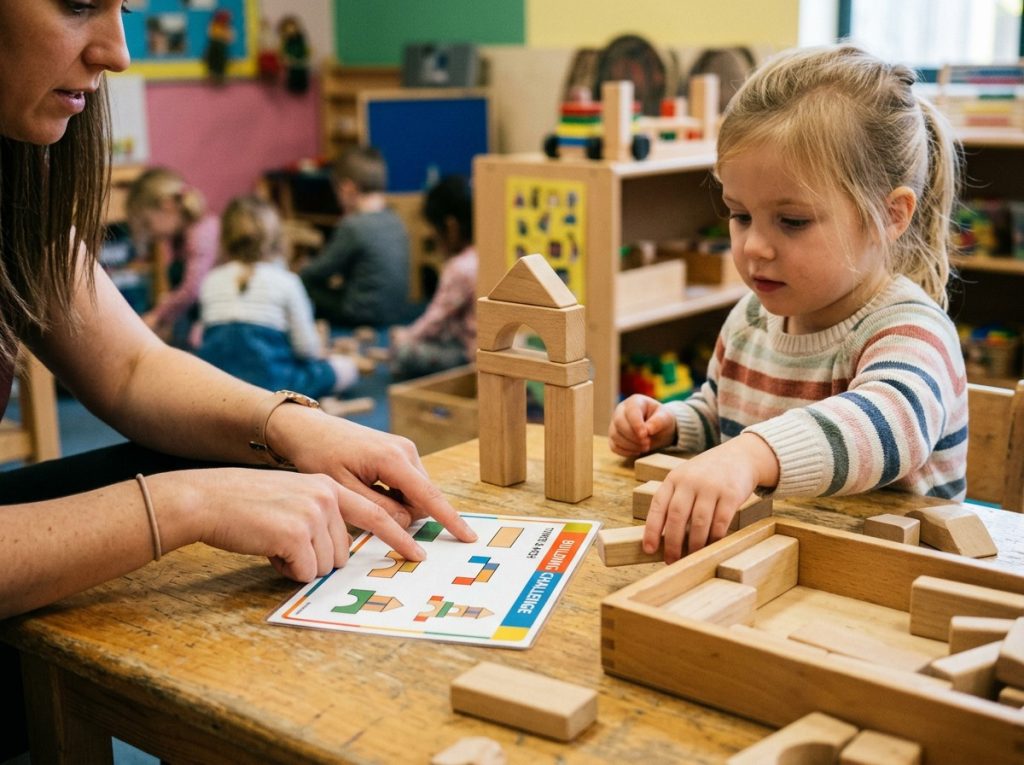
Maze toys and multi-piece construction sets require children to hold mental plans, track placed components, and sequence steps. When a child reproduces a block model from a photograph, they engage working memory by maintaining the target image while selecting and positioning each piece. The same Building Brains study found that block-building completion times decreased by 34% after the intervention, reflecting improved planning efficiency alongside motor gains.
Dramatic and Sorting Play: Cognitive Flexibility
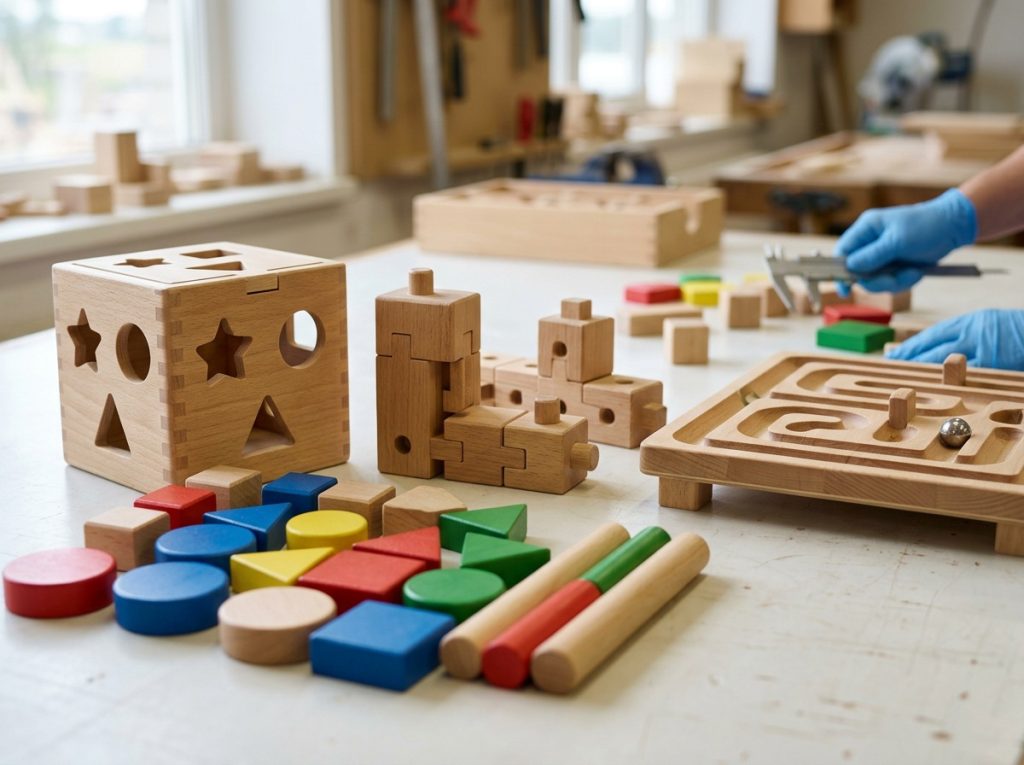
Sorting toys that require rule-shifting — sorting first by one attribute, then by another — train cognitive flexibility through deliberate context-switching. Dramatic play materials where children adopt and switch roles exercise the same capacity through social rather than material means. Executive function toys that embed flexible rule structures produce broader cognitive transfer than fixed-solution alternatives.
Developmental Progression of Executive Function Ages 3 to 6
Executive function capacities emerge in a predictable sequence, though individual timing varies with environmental enrichment, language exposure, and neurological maturation.
| Age Range | EF Component in Focus | Observable Milestones | Toy Categories That Target This Stage |
|---|---|---|---|
| 3-3.5 years | Basic inhibitory control | Waits briefly for turns; stops on single cue; follows one-step instructions with prompts | Simple turn-taking games, shape sorters, single-rule activities |
| 3.5-4.5 years | Working memory expansion | Follows two-step instructions; reproduces 4-6 block structures from models; remembers 2-3 game rules | Maze toys, guided construction sets, memory-matching games |
| 4.5-5.5 years | Emerging cognitive flexibility | Switches sorting rules on cue; adapts to new game rules; sustains dramatic play roles for 20+ minutes | Multi-rule sorting games, complex construction, role-play kits |
| 5.5-6 years | Integrated EF | Plans multi-step projects; explains strategies verbally; monitors own errors and self-corrects | Strategy games, advanced logic puzzles, open-ended construction |
Teachers should observe children’s self-regulation behaviors directly rather than relying on age-based assumptions. A four-year-old from a language-rich home with regular game-play experience may demonstrate cognitive flexibility typical of five-year-olds, while a five-year-old with limited structured play exposure may perform at the three-year-old level.
Classroom Implementation: Designing Play for Executive Function Growth
Effective executive function development requires intentional play design rather than unstructured free choice. Two implementation strategies consistently produce measurable gains.
Sustained Play Duration
Brief play periods of 10-15 minutes produce limited executive function gains. The Building Brains and Futures study implemented games lasting approximately five minutes each, but required daily repetition across eight weeks. Sustained engagement — whether through extended single-play sessions of 25-35 minutes or daily short-session repetition over weeks — provides the repetition that consolidates neural pathways underlying self-regulation.
Teacher Scaffolding Strategies
The language teachers use during play determines whether children develop self-regulation alongside content skills. When teachers narrate cognitive processes — pausing to think before placing a piece, checking the model again before adding more blocks — they externalize the internal dialogue that children eventually internalize as self-talk. This scaffolding, a core Vygotskian principle, transforms play from a purely physical activity into a cognitive training exercise. The Harvard Center on the Developing Child describes this process as scaffolding through structured play, where adult mediation converts everyday activities into executive function practice.
Selecting Executive Function Toys: Criteria for Educators and Buyers
Program directors and purchasing managers evaluating executive function toys for classroom or institutional use should assess materials against specific functional criteria.
Rule complexity progression. Quality executive function toys offer graduated rule complexity. A sorting set that begins with single-attribute sorting and progresses to multi-attribute, rule-switching tasks serves children across two developmental years. This progression extends classroom lifespan and justifies higher per-unit investment.
Multi-player design. Executive function develops most robustly through social play that requires turn-taking, rule enforcement by peers, and perspective-taking. Materials designed for 2-4 children produce greater gains than single-player alternatives, even when the cognitive task is equivalent.
Durability for high-frequency use. Classroom materials undergo 200+ handling cycles weekly. Hinges, magnetic connections, and interlocking mechanisms must maintain function after repeated use. Solid wood construction maintains structural integrity longer than plastic alternatives under institutional use conditions.
Compliance documentation. Materials for children under three require CPC certification (US) and CE/EN71 compliance (EU). For 3+ products, per-SKU third-party test reports verify mechanical integrity and surface coating safety. Buyers should request per-SKU documentation rather than accepting catalog-level certificates, as batch-level compliance gaps affect institutional procurement.
Programs sourcing executive function toys at scale can request OEM services with per-SKU CPC and CE certification packages, streamlining procurement compliance while ensuring consistent quality across classroom sets.
Misconceptions and Limitations in Executive Function Development
“Executive Function Cannot Be Trained Before Age Five”
The Gibb et al. (2021) study demonstrated significant executive function improvements in children as young as three, with block-building errors decreasing 66.7% and inhibitory control improving 22.6 percentage points over eight weeks. The malleability window opens earlier than many educators assume — the critical factor is material and activity design, not chronological age alone.
“Free Play Automatically Develops Executive Function”
Unstructured play develops some executive function capacities through natural social dynamics, but the gains are inconsistent and significantly smaller than those produced by structured, teacher-scaffolded play. The Tools of the Mind and Building Brains programs both rely on intentional adult mediation — not free play — to produce their documented effects. Executive function toys deliver maximum value when paired with deliberate adult scaffolding rather than offered as independent activity.
Two limitations require attention. First, executive function development is multiply determined — it responds to sleep quality, nutrition, stress levels, language exposure, and caregiver responsiveness, not only to toy selection. Programs addressing executive function through materials alone, without attention to these broader factors, may see attenuated results.
Second, children with persistent self-regulation difficulties despite adequate play exposure may need evaluation for underlying developmental factors — including attention disorders, sensory processing differences, or trauma effects. Executive function toys support development but do not constitute clinical intervention.
A common purchasing mistake is selecting elaborate, multi-component kits assuming that complexity produces better cognitive outcomes. Research consistently shows that focused, well-designed materials with clear rule structures outperform elaborate sets with decorative features that dilute the cognitive challenge. A set of wooden building blocks with a model-replication guide often yields stronger executive function gains than expensive electronic systems.
Executive Function Toys and the Foundation for School Readiness
Executive function toys provide the developmental scaffolding that enables preschoolers to build the self-regulation, working memory, and cognitive flexibility that formal schooling demands. Children who practice waiting, switching rules, and sustaining attention through structured play enter kindergarten with cognitive tools that accelerate learning across every academic domain. The evidence is consistent — purposeful play, supported by intentional materials and teacher scaffolding, produces measurable executive function gains that persist into elementary school.
Programs that embed executive function development into curated play routines — combining rule-based games, multi-step construction, and targeted teacher narration — give children the strongest foundation for classroom success. For educators and program directors seeking classroom-ready materials with verified safety compliance and progressive design, Vindstier’s curated range of educational and construction toys offers a practical foundation for building a developmentally sequenced executive function program.