Many fraction lessons begin with the same quiet confusion.
A teacher writes “1/2 = 2/4” on the board. One student answers confidently before the explanation even finishes. Another quietly stares at the worksheet, still unsure whether 0.5 belongs with 1/2 or 1/4. A few minutes later, someone at the back table has already lost focus completely.
For many elementary teachers, this is the moment when traditional fraction instruction starts slipping away.
The problem is rarely simple memorization. Most children can eventually repeat fraction rules. The harder part is helping them genuinely understand how different mathematical relationships connect.
That challenge explains why more educators are turning toward Magnetic Fraction Teaching Aids during interactive lessons and collaborative math activities.
Search interest for terms like visual fraction models, hands-on fraction activities, fraction manipulatives for classrooms, and elementary fraction learning tools has steadily increased as schools continue moving toward more tactile learning environments.
According to the National Council of Teachers of Mathematics (NCTM), students develop stronger conceptual understanding when mathematical ideas are explored visually and physically rather than taught only symbolically. In classroom settings, this often means children understand fraction relationships more naturally once they can physically compare values instead of simply reading them on paper.
Not every classroom fraction kit supports that process equally well, however.
Interactive group lessons demand materials that can handle constant movement, repeated discussion, and different learning speeds all at once.
Why Magnetic Fraction Teaching Aids Keep Students More Engaged During Group Lessons
One challenge many teachers quietly face is keeping an entire group mentally involved throughout a fraction lesson.
Worksheets often create uneven participation. Some students finish quickly and become restless. Others stop contributing once confusion appears. During longer explanations, attention tends to fade faster than teachers would like.
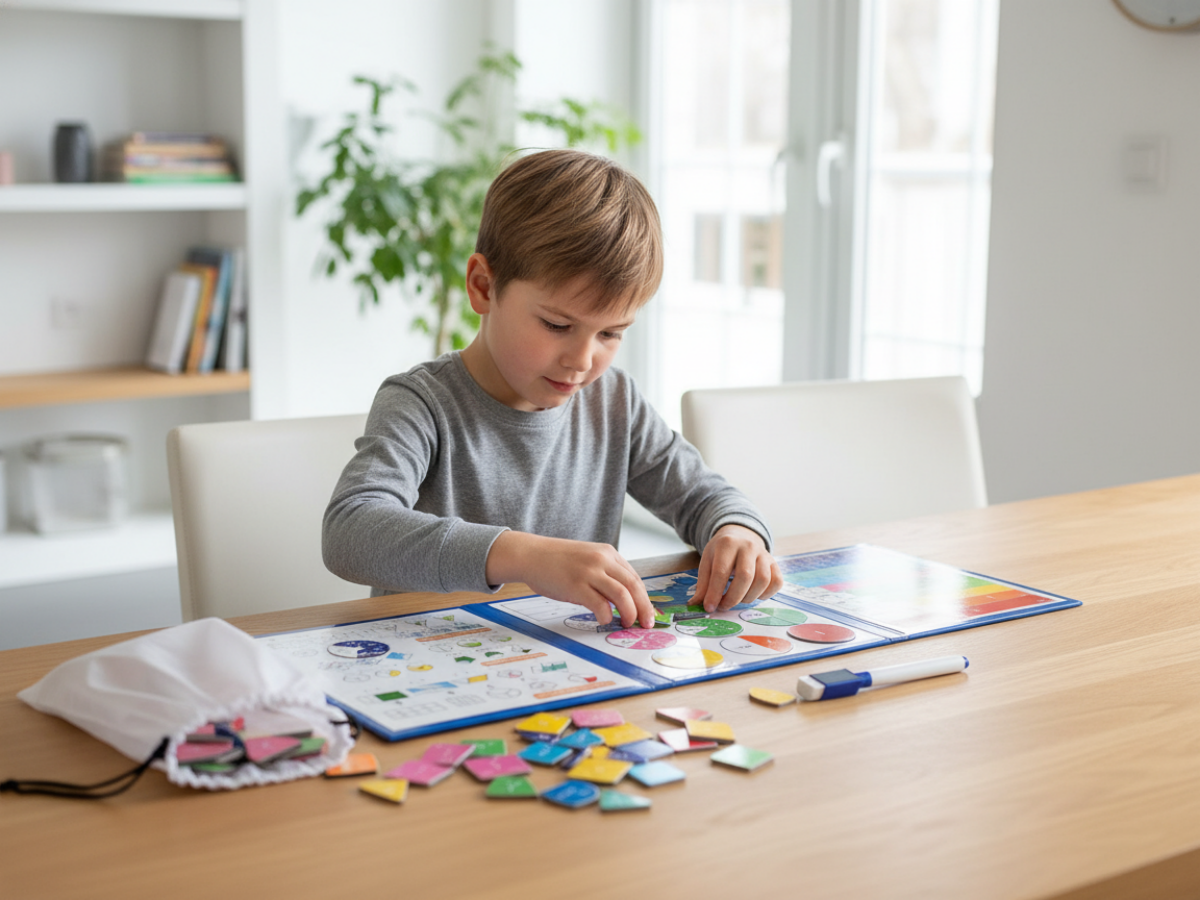
Magnetic Fraction Teaching Aids change that classroom dynamic because students are physically involved in building relationships instead of simply observing them.
A child places two 1/4 pieces beside a 1/2 section and suddenly pauses after noticing the lengths match perfectly. Another student experiments with smaller combinations and realizes several arrangements can still equal one whole.
The interesting part is what happens next.
Instead of waiting for the teacher to confirm every answer, students begin discussing the relationships themselves.
In many classrooms, conversations become more active once children can point directly at visual fraction models rather than trying to explain abstract numbers verbally. The lesson feels less like memorization and more like problem-solving together.
Different Learning Speeds Become Easier to Support
Some students understand equivalent fractions almost immediately. Others need repeated visual comparison before the relationship finally becomes clear.
This difference becomes especially noticeable during lessons involving:
- fraction addition
- decimal conversion
- equivalent fractions
- percentage relationships
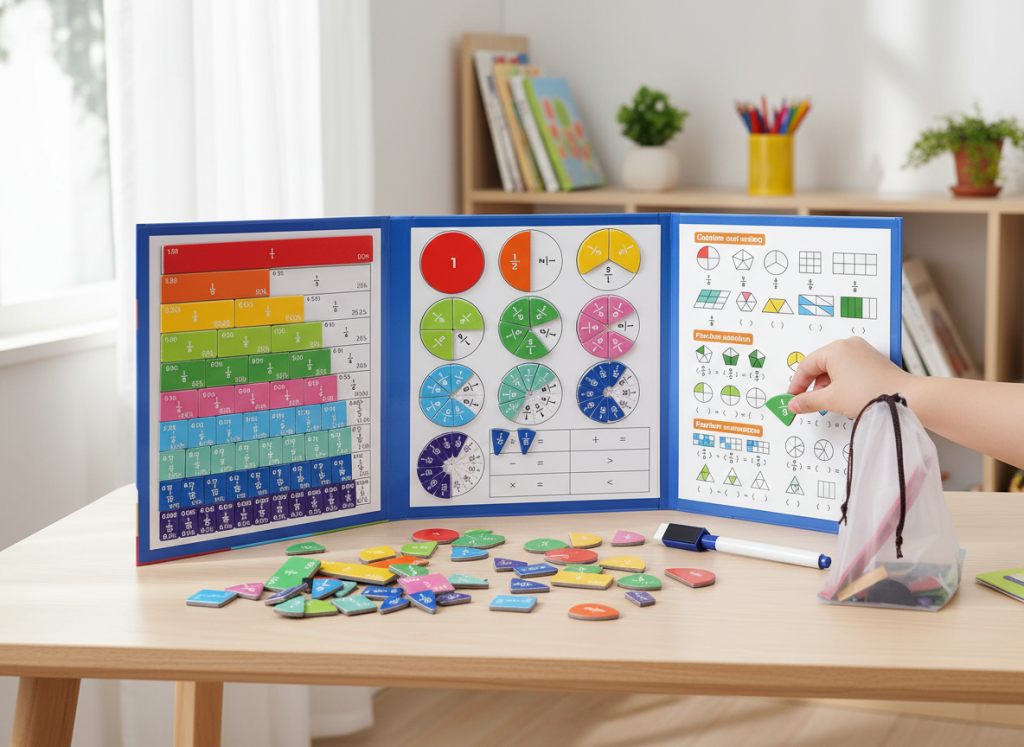
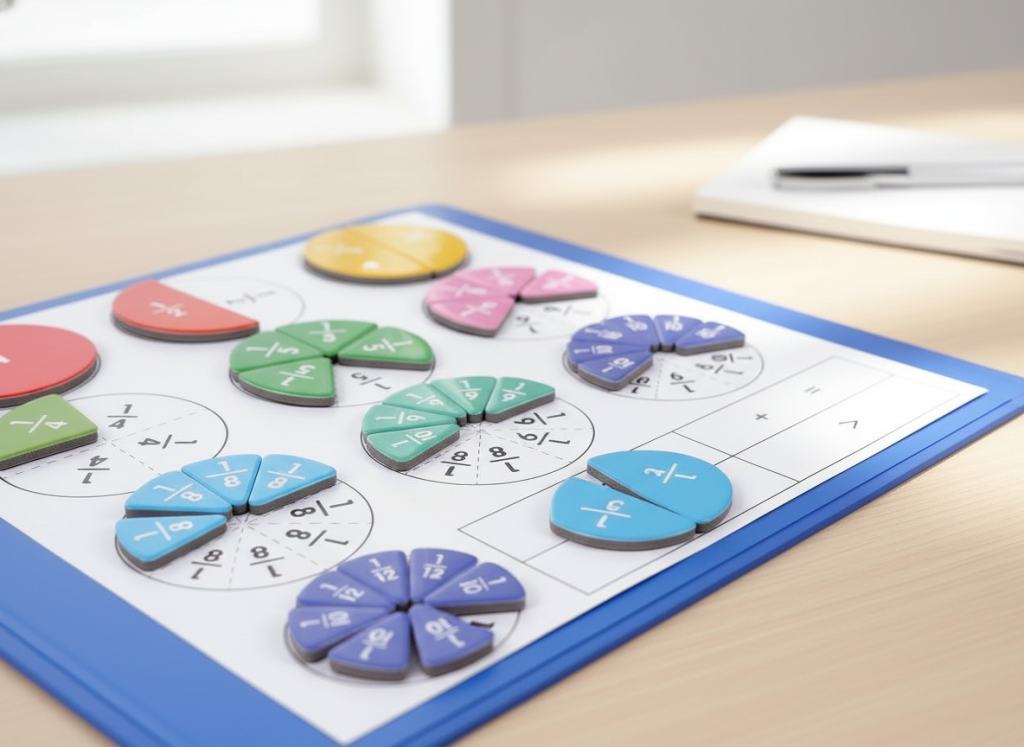
Magnetic Fraction Teaching Aids help reduce that gap because fractions, decimals, and percentages appear together in one visual system instead of being introduced as disconnected concepts.
Rather than mentally translating symbols, students compare relationships directly in front of them.
During small-group instruction, it also becomes easier to notice how differently children respond to learning environments. Some students who struggle during lecture-heavy activities stay engaged much longer once movement and manipulation become part of the process.
The Tri-Fold Design Teachers Notice During Busy Math Lessons
Many fraction boards currently available still rely on fairly limited workspace layouts.
Inside active classrooms, however, organization affects participation more than most people expect.
When multiple students try to manipulate fraction pieces within a small shared area, activities can quickly become crowded. Demonstrations overlap. Pieces slide into each other. Some students begin watching instead of participating simply because interacting with the materials becomes inconvenient.
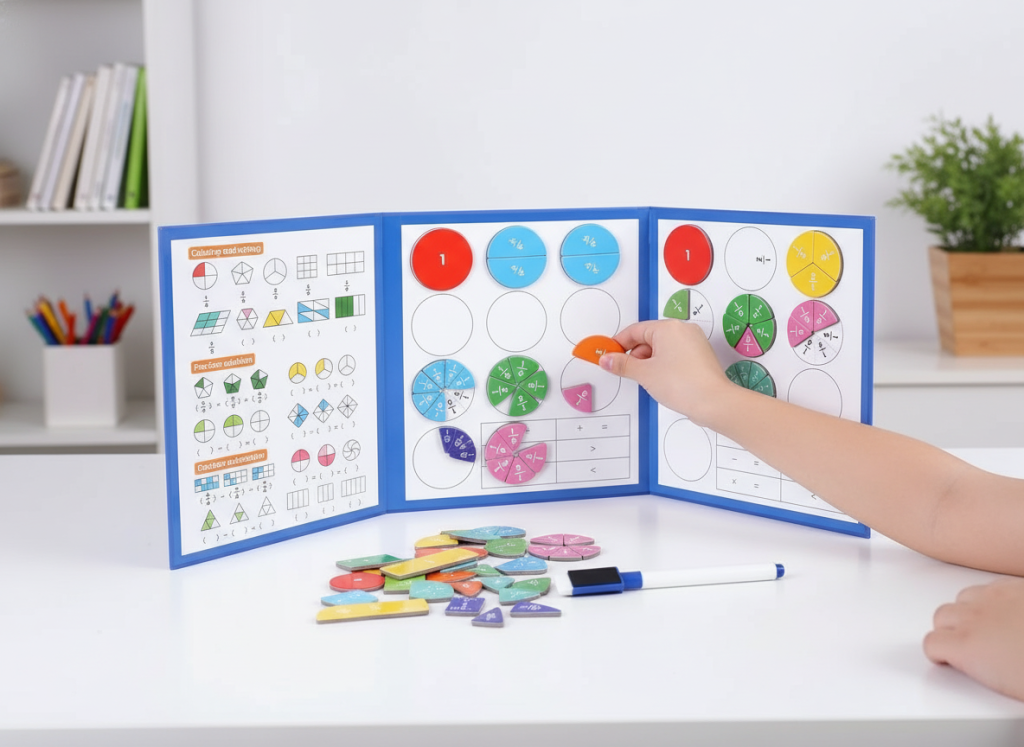
The tri-fold structure creates a more flexible learning setup during collaborative lessons.
Teachers often separate activities naturally across different sections of the board — one side for equivalent fractions, another for decimal comparison, while the center area becomes a shared workspace for solving equations together.
The difference may sound small at first, but during busy guided math rotations, additional workspace helps lessons feel calmer and easier to manage.
And in elementary classrooms, smoother transitions matter.
Keeping Fraction Materials Organized Becomes Simpler
Teachers spend a surprising amount of time managing classroom materials.
Fraction pieces disappear under desks. Smaller manipulatives become mixed into unrelated bins. Thin paper cards bend after repeated use.
The foldable structure helps reduce some of those daily frustrations because the learning surface and storage system stay connected together rather than separated into multiple containers.
Teachers moving between tutoring sessions, homeschool spaces, or classroom groups usually notice the convenience fairly quickly once setup and cleanup become less disruptive.
The Problem With Thin Paper Fraction Kits
Many lower-cost fraction manipulatives appear perfectly usable at the beginning.
The issues usually appear later.
After repeated classroom use, thinner materials often begin peeling at the edges or shifting during demonstrations. Once manipulatives stop staying in place consistently, even simple group activities become harder to manage.
This is one reason many teachers gradually move toward sturdier Magnetic Fraction Teaching Aids designed for repeated classroom handling.
Instead of constantly repositioning materials, students can stay focused on comparing relationships and testing combinations.
In busy elementary environments, small interruptions tend to affect concentration more than expected.
Stable Demonstrations Help Lessons Flow More Naturally
During group instruction, teachers often build fraction examples directly in front of students while explaining relationships step by step.
When pieces move too easily or detach during demonstrations, attention shifts away from the math itself.
More stable manipulatives help lessons progress more smoothly because students can continue observing the relationship instead of waiting for materials to be reset repeatedly.
Not every activity works perfectly the first time, of course. Some students still rush through combinations too quickly in the beginning. But once comparisons stay visible long enough for discussion, conversations usually become more thoughtful.
Magnetic Fraction Teaching Aids Help Students Connect Fractions, Decimals, and Percentages
Many students do not struggle with fractions alone.
They struggle with switching between representations.
A child may recognize 50% confidently, hesitate when seeing 0.5, and then become uncertain again once the same relationship appears as 1/2.
This disconnect is extremely common in upper elementary math instruction.
Magnetic Fraction Teaching Aids help bridge those relationships visually because equivalent values remain visible side by side instead of appearing separately across different worksheets or exercises.
One classroom activity demonstrates this particularly well.
Students were asked to create several different combinations equal to one whole. Some immediately reached for larger fraction sections, while others experimented with smaller pieces instead. Before long, students began debating which combinations worked fastest and why completely different arrangements could still represent the same total value.
Moments like this are difficult to recreate through worksheets alone because the learning develops through observation, conversation, and experimentation happening simultaneously.
Why Physical Fraction Models Feel Less Intimidating for Some Learners
For many teachers, the goal is not simply helping students arrive at the correct answer.
It is watching the moment when fractions stop feeling intimidating.
Some children process mathematical relationships more confidently once they can physically rearrange and compare values themselves. Instead of relying entirely on verbal explanation, they begin testing ideas independently through movement and observation.
And for hesitant learners, that shift can completely change how they approach future math lessons.
Why Many Teachers Still Prefer Magnetic Fraction Teaching Aids Over Digital Math Apps
Digital learning platforms certainly make fraction practice more accessible.
But in many classrooms, teachers notice that touchscreen activities often encourage speed rather than careful comparison. Students move quickly through exercises without spending much time reflecting on proportional relationships.
Physical fraction learning systems naturally slow the process down.
Students pause before placing pieces. They reconsider combinations. They compare sizes visually while discussing strategies with classmates around the board.
That slower pace often produces deeper mathematical discussion.
A RAND education survey similarly found that many elementary educators continue prioritizing classroom math manipulatives because tactile interaction supports stronger engagement during foundational math instruction.
Magnetic Fraction Teaching Aids allow teachers to move naturally between visual demonstration, collaborative exploration, equation practice, and independent experimentation without constantly switching between separate learning tools.
For busy classrooms, that flexibility becomes increasingly valuable over time.
Conclusion
Fraction lessons become far more meaningful once students can physically explore mathematical relationships instead of memorizing disconnected symbols.
That is one reason many educators increasingly prefer Magnetic Fraction Teaching Aids during collaborative group instruction and interactive elementary math lessons.
The combination of visual comparison, organized workspace, reusable learning surfaces, and hands-on interaction supports the realities of modern classrooms far better than traditional paper-based fraction activities alone.
Teachers are not simply searching for entertaining math games.
They need classroom tools that help students stay engaged, reduce unnecessary interruptions, encourage discussion, and make difficult concepts easier to understand together.
Inside real classroom environments, thoughtfully designed Magnetic Fraction Teaching Aids often make that process noticeably smoother for both teachers and students alike.