
A preschooler picks up a crayon, makes a few uneven lines, and proudly announces, “Look what I made!” To an adult, those marks might look like random scribbles. But behind every swirl and line, a child is practicing movements that will eventually help them write letters, numbers, and words.
Pre-writing skills for preschoolers develop long before formal handwriting lessons begin. They involve hand strength, finger control, posture, visual coordination, and the ability to guide a drawing tool across a surface.
The good news? Children can build these foundations through ordinary play. Squeezing playdough, stacking blocks, drawing with chalk, and sorting colorful objects all give little hands opportunities to practice important movements.
Understanding how these skills develop helps parents and teachers encourage early writing readiness without turning preschool playtime into a handwriting lesson.
Why Pre-Writing Skills Come Before Learning Letters
Writing requires several abilities to work together. A child needs enough stability to sit comfortably, control their arm and wrist, coordinate their eyes with their hands, and make small, intentional movements with their fingers.
These abilities develop gradually and influence one another. Children do not need to master every motor skill before exploring letters, but playful movement and drawing experiences can make early writing tasks more comfortable.
From Scribbles to Recognizable Shapes
Early drawing often begins with broad, uncontrolled marks. Over time, children start making more deliberate lines and shapes.
A typical progression includes:
- Exploratory scribbling: Children experiment with how crayons, markers, and other tools leave marks.
- Controlled lines: Movements become more intentional, including attempts at vertical and horizontal strokes.
- Circles and simple shapes: Children begin copying familiar forms and combining lines.
- More complex shapes: Crosses, squares, diagonal strokes, and other patterns gradually become easier.
- Early letters: Children experiment with letter-like forms and begin writing recognizable letters.
These skills do not develop on an identical schedule for every child. Some children enjoy drawing early, while others prefer building, climbing, or manipulating toys.
The goal is not to rush through the stages. It is to give children varied opportunities to explore movement, marks, and shapes.
What Does Handwriting Readiness Actually Mean?
Being ready to explore writing does not mean a three-year-old must produce a perfectly formed alphabet.
Instead, look for growing abilities such as:
- Holding and manipulating drawing tools with increasing control.
- Making intentional lines, curves, and simple shapes.
- Using both hands together during activities.
- Coordinating what the eyes see with what the hand does.
- Staying comfortable and engaged during short drawing activities.
According to the CDC’s developmental milestones for 3-year-olds, most children can draw a circle after watching an adult demonstrate it. By age four, the CDC identifies holding a crayon or pencil between the fingers and thumb, rather than in a fist, as another developmental milestone.
These are useful reference points, not rigid deadlines. Development should be considered as a whole rather than judged by one drawing or pencil grip.
The Fine Motor Foundations Behind Early Writing
Handwriting may appear to be a finger activity, but successful pencil control also depends on the arm, shoulder, and trunk.
These body systems work together to help children produce smaller, more precise movements.
Shoulder, Core, and Wrist Stability
When a child sits at a table to draw, the core helps maintain an upright position while the shoulder and arm support the hand.
Everyday movement provides opportunities to practice this coordination.
Activities such as crawling, climbing, pushing toys, carrying lightweight objects, and playing on the floor encourage children to use the larger muscle groups involved in postural control.
Drawing on a wall-mounted board or easel also changes how the arm and wrist work.
If a child regularly slumps, frequently changes position, or seems uncomfortable while drawing, consider the seating arrangement, work surface, and activity length before assuming the child needs more handwriting practice.
Hand Strength and Finger Control
Children use the small muscles of their hands throughout the day.
Opening containers, pressing buttons, pulling apart dough, and picking up objects all involve grasping, releasing, and controlling force.
Two particularly useful abilities are:
Pincer grasp: Using the thumb and index finger to pick up or manipulate objects.
Finger isolation: Moving one finger more independently from the others, as when pointing, pressing a button, or tapping a specific spot.
These abilities support everyday independence as well as the fine motor control involved in drawing and writing.
Sorting games, stacking toys, and other hands-on activities provide opportunities to explore these movements. For a closer look at how toy design relates to visual coordination, see our guide to hand-eye coordination toys for preschool development.
A child who enjoys squeezing, pinching, sorting, and manipulating objects is gaining experience using their hands in different ways.

How Pencil Grasp Develops
Young children commonly experiment with several ways of holding crayons.
Early on, a child may wrap the whole hand around a crayon. Later, they may use a finger-down grasp before developing more refined finger control.
With experience, many children adopt a three-finger grasp or another comfortable, functional way of holding a writing tool.
A mature tripod grasp should not be forced before a child is ready.
Different functional pencil grasps can support effective handwriting. Comfort, movement control, and endurance matter more than making every child’s fingers look exactly the same.
Offer crayons, markers, chalk, and pencils in different sizes, and observe which tools allow the child to draw with less effort.
Visual-Motor Integration: Helping Eyes and Hands Work Together
Imagine asking a child to copy a circle from a picture.
First, the child must recognize the shape. Then they must plan a movement and guide their hand to produce something similar.
This process is called visual-motor integration, or VMI.
It helps children connect visual information with physical movement and plays a role in drawing, copying shapes, and handwriting.
Why Copying Shapes Matters
Copying a simple shape requires more than recognizing it.
A child must judge direction, size, spacing, and how different movements connect.
Research supports a relationship between visual-motor integration and handwriting. A 2024 meta-analysis published in Learning and Individual Differences examined 29 studies involving 47 unique samples and identified a moderate association between these abilities.
That does not mean practicing shapes automatically improves handwriting. It does suggest that coordinating visual information with hand movement is an important part of the broader writing process.
Parents can encourage this coordination through simple experiences:
- Building patterns with blocks.
- Copying lines or shapes drawn by an adult.
- Completing age-appropriate puzzles.
- Arranging objects to match a picture.
- Drawing roads, circles, and connecting lines.
The activities do not need to look like schoolwork to offer meaningful practice.
Try Drawing on a Vertical Surface
A wall-mounted drawing board, easel, or large sheet of paper attached securely to a wall creates a different drawing experience from working at a desk.
Children can make larger movements, reach across the surface, and experiment with lines while standing.
In a 2018 study published in the American Journal of Occupational Therapy, Portnoy and colleagues compared preschool children’s shape-copying performance on horizontal and vertical surfaces.

The study included 22 typically developing children and 13 children with mild disabilities. Participants made faster and smoother movements when copying shapes on a vertical surface, without reduced copying accuracy.
These findings support trying vertical drawing as one useful option, although the small study does not establish that it is superior for every child.
For home practice, draw a large circle on an easel and invite your child to add rays to turn it into a sun. Or create a winding road and ask them to draw a car’s path.
Keep the focus on exploration rather than precision.
5 Everyday Pre-Writing Activities for Preschoolers
Some of the most useful early writing experiences begin with materials already found in a home or preschool classroom.
The activities below encourage children to explore grasping, hand coordination, controlled movement, and mark-making without requiring formal handwriting worksheets.
1. Playdough Squeezing, Rolling, and Pinching
What you’ll need: Age-appropriate playdough and a clean play surface.
Invite your child to squeeze a ball of dough, roll it into a long snake, flatten it with their palms, and pinch small sections into different shapes.
Try making pretend cookies, winding roads, or simple letters from rolled pieces of dough.
What this activity practices:
- Hand and finger movements.
- Grasping and releasing.
- Coordinated use of both hands.
- Adjusting pressure during manipulation.
Make it more engaging: Turn the activity into a pretend bakery. Let your child make dough cookies while you pretend to take customer orders.
Playdough offers a playful way to use the hands against gentle resistance. Children can experiment with different movements without the added demands of holding a pencil.
The CDC also recommends playdough activities involving squishing, pressing, and pinching as ways to encourage the hand and finger movements used in everyday tasks.
2. Sorting Colorful Objects With Tongs
What you’ll need: Child-friendly tongs, two small containers, and large, age-appropriate sorting objects.
Place the objects in one container and invite your child to transfer them into the other using the tongs.
Start with larger items that are easier to grasp. Once the movement becomes more comfortable, introduce a color-sorting challenge or vary the distance between containers.
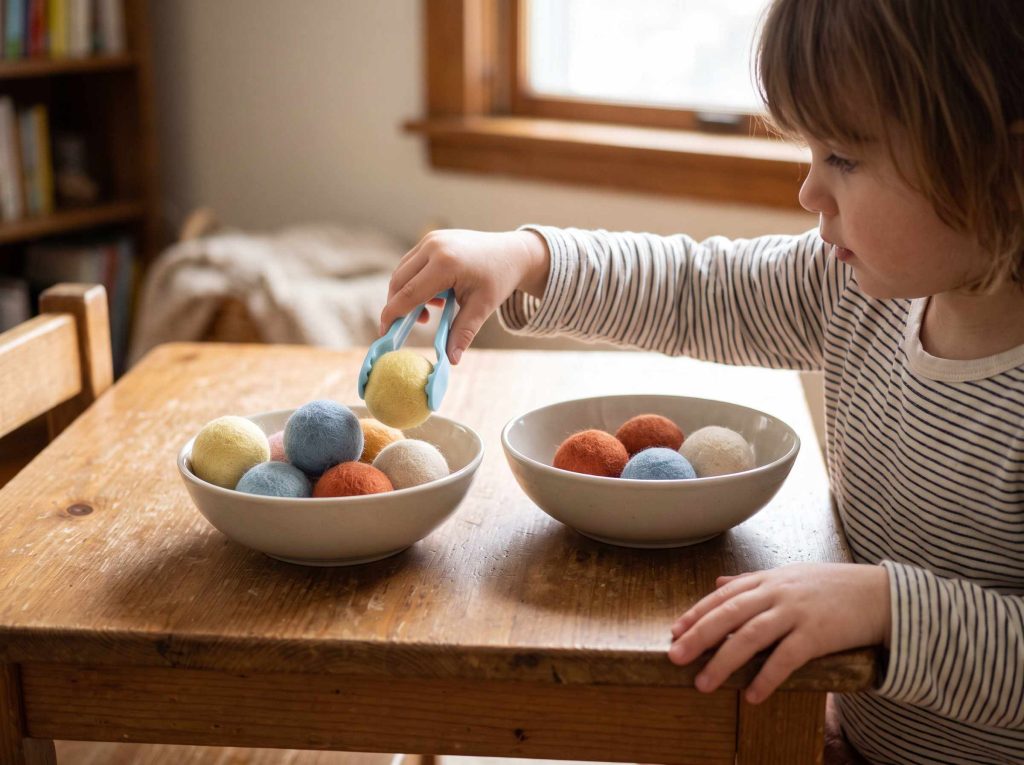
What this activity practices:
- Controlled grasping.
- Hand-eye coordination.
- Releasing objects intentionally.
- Adjusting the amount of force used.
Make it more engaging: Pretend the objects are colorful ingredients for a restaurant. Your child can prepare an imaginary order by selecting the correct colors.
Sorting activities can also be adapted as children’s skills develop. Younger preschoolers might match one color at a time, while older children experiment with patterns or multiple sorting rules.
If you’re looking for more ways to introduce classification through play, explore how sorting toys are used in Montessori learning environments.
For a different hands-on sorting challenge, Vindstier’s Fruit Sorting Stacking Toy invites children to grasp fruit-shaped pieces, align them with posts, and organize them by type. These movements provide opportunities to practice careful placement while children explore colors and patterns.
Always choose materials and toys appropriate for the child’s age. Small loose objects may present a choking hazard, especially for children who still put items in their mouths.
3. Threading and Lacing Games
What you’ll need: An age-appropriate lacing toy, large-hole threading board, or large threading pieces with a suitable cord.
Show your child how to guide the cord through a hole or thread one piece at a time.
Begin with a simple arrangement and let them work at their own pace.
As coordination improves, introduce patterns such as alternating colors or following a basic sequence.
What this activity practices:
- Coordinating both hands.
- Visual tracking.
- Controlled finger movements.
- Motor planning and sequencing.
Make it more engaging: Let your child create a pretend necklace, decorate a cardboard animal, or design a colorful pattern.
Lacing activities encourage one hand to stabilize an object while the other performs a more precise movement.
For younger children, choose products designed for their age rather than small beads or detachable components. Inspect cords and individual pieces for age suitability and follow the manufacturer’s instructions.
4. Drawing Roads, Shapes, and Silly Pictures
What you’ll need: Large paper, washable crayons, sidewalk chalk, or washable markers.
Instead of asking your child to trace letters repeatedly, begin with open-ended drawing.
Make a long road for toy cars, draw rain falling from clouds, or create a simple face that needs eyes, a mouth, and hair.
Invite your child to add lines, circles, and curves wherever they belong in the picture.
What this activity practices:
- Intentional mark-making.
- Visual-motor coordination.
- Controlling movement direction.
- Experimenting with drawing tools.
Make it more engaging: Take turns adding to a shared picture. You draw a house, your child adds windows, and together you create the surrounding neighborhood.
Large drawing surfaces allow children to explore movement before they are expected to produce small, precise marks.
Children who enjoy following paths may also like magnetic maze activities. In Vindstier’s guide to the Fun Dinosaur Maze and fine motor development, children use a magnetic stylus to guide beads along routes, introducing opportunities for visual tracking and controlled directional movement.
A maze is not a replacement for drawing, but it can offer another playful way to explore coordinated hand movements.
5. Sensory Tray Shape Drawing
What you’ll need: A shallow tray and a thin layer of age-appropriate sensory material.
Demonstrate how to use one finger to make a straight line, a circle, or a wavy path.
Smooth the surface and let your child try.
You can also draw simple shapes and invite your child to guess what they represent.
What this activity practices:
- Finger isolation.
- Movement planning.
- Visual-motor coordination.
- Exploring lines and shapes without a pencil.
Make it more engaging: Turn the tray into a treasure map. Draw a winding path and ask your child to follow it with one finger.
Sensory activities can be adapted to different interests, materials, and levels of coordination.
For additional setup ideas and age-appropriate material considerations, read our guide to sensory bins for toddlers.
Use materials appropriate for your child’s developmental stage, supervise sensory play, and avoid loose substances that could be inhaled or swallowed.
The goal of these activities is not to produce perfect shapes. It is to make hand movements familiar, enjoyable, and gradually more controlled.
Pre-Writing Skills by Age: What to Expect
Children develop early drawing and handwriting abilities at different rates.
The following guide describes common areas of exploration rather than a strict developmental checklist.
| Age | Common Skills and Play Opportunities |
|---|---|
| 2–3 years | Exploring scribbling, making broad marks, trying simple lines, and manipulating larger objects. |
| 3–4 years | Copying circles and simple strokes, using playdough, threading suitable objects, and experimenting with drawing tools. |
| 4–5 years | Practicing crosses and other shapes, improving controlled grasping, drawing recognizable pictures, and exploring early letter forms. |
| 5–6 years | Attempting more complex shapes, writing some recognizable letters, and developing greater control during drawing and handwriting. |
Developmental milestones are guides, not requirements that every child reaches on their birthday.
For example, the CDC’s developmental milestones for 5-year-olds include writing some letters in their name. This does not mean every five-year-old should already produce neatly formed words or sentences.
A child may confidently build complex block structures while still finding drawing difficult. Another may love making pictures but avoid threading activities.
Both patterns can reflect individual differences.
When planning preschool fine motor activities, consider what the child can do comfortably and what interests them, rather than relying on age alone.
Pencil Grip and Posture Without Pressure
As children begin drawing more intentionally, adults often focus on how the pencil is held.
A comfortable grasp matters, but repeated correction is not always the most helpful approach.
When Should Pencil Grip Become a Concern?
An unusual grasp is not automatically a problem, particularly in younger preschoolers.
Pay closer attention when a child consistently experiences:
- Pain or discomfort while drawing.
- Excessive finger tension or very tight gripping.
- Rapid fatigue during brief drawing activities.
- Difficulty controlling a crayon despite varied opportunities to practice.
- Persistent avoidance of drawing because the activity feels physically difficult.
These signs do not establish a diagnosis, but they may justify discussing the child’s development with a pediatrician or pediatric occupational therapist.
A child’s overall function matters more than whether the grasp matches a particular picture.
Choosing Comfortable Drawing Tools
Small adjustments can make mark-making more enjoyable.
Try offering:
- Chunky crayons: Easier for some beginners to grasp and manipulate.
- Short crayons: May encourage more finger involvement for children ready to use them.
- Triangular pencils: Can provide helpful finger placement cues.
- Sidewalk chalk: Encourages larger movements and outdoor drawing.
- Washable markers: Offer another drawing experience that may feel easier for some children.
No single tool works best for everyone.
Watch whether the child can move comfortably and make intentional marks. Switch tools when one seems difficult or frustrating.
Setting Up a Comfortable Drawing Space
A well-arranged workspace can reduce unnecessary effort.
For seated drawing, try to provide stable foot support, a comfortable table height, and enough space for the child’s arms to move.
Let the child position the paper at a comfortable angle. Many children naturally turn the page slightly when drawing.
A standing easel can offer variety, while floor drawing with large paper may suit children who enjoy using broader arm movements.
The best setup is one that allows the child to participate comfortably.
How to Observe Writing Readiness Over Time
Early writing development rarely moves forward in a perfectly straight line.
A child might draw several controlled circles one day and return to enthusiastic scribbling the next.
Rather than evaluating every drawing, observe patterns over several weeks.
Look Beyond Recognizable Letters
A drawing can provide clues about developing movement control.
Notice whether your child is beginning to:
- Make marks intentionally rather than only through broad movement.
- Change direction while drawing.
- Copy a familiar shape after watching someone demonstrate it.
- Adjust the pressure used on paper.
- Coordinate the supporting hand with the drawing hand.
These observations help adults choose activities that match the child’s present abilities.
They are not measures of intelligence or academic potential.
Adjust the Activity Before Correcting the Child
When a child seems uninterested in drawing, consider the experience itself.
Perhaps the crayon is uncomfortable. The paper might be too small, the activity too long, or the requested shape too difficult.
Try a different surface, a shorter session, or a playful drawing prompt.
A child who dislikes tracing letters might happily draw roads for toy cars or make enormous circles outside with sidewalk chalk.
Both experiences allow practice with controlled movements, but one may feel much more inviting.
Track Small Changes Over Weeks
If you want to observe progress, choose one familiar activity and repeat it occasionally under similar conditions.
For example, invite your child to draw freely with the same crayons once a week.
Notice changes in the types of marks, comfort with the tool, and willingness to explore different movements.
Avoid turning the observation into a test.
The purpose is to understand which activities help your child participate confidently, not to measure daily performance.
If a child loses a previously acquired skill or you have ongoing developmental concerns, consult their healthcare provider rather than waiting for the next observation.
What Research Tells Us About Early Handwriting Development
Research connects early handwriting with fine motor coordination, visual-motor integration, and self-regulation.
However, these relationships are more nuanced than the idea that stronger hands automatically produce better writers.
Visual-Motor Integration and Handwriting
A 2024 meta-analysis by Lu, Leung, and Fan identified a moderate relationship between handwriting and visual-motor integration.
The strength of the relationship varied with factors including age, writing system, and participant characteristics.
This supports the importance of visual-motor coordination while reminding us that handwriting depends on more than a single ability.
Activities involving copying, building, arranging, and drawing may provide useful practice, but no one game guarantees future handwriting performance.
Fine Motor Skills and Self-Regulation Work Together
In a 2021 study published in Early Childhood Research Quarterly, Chandler and colleagues examined fine motor skills, self-regulation, and writing in two samples of Head Start children aged three to five.
The samples included 333 children assessed near the beginning of the preschool year and 405 near the end.
The researchers found that self-regulation influenced the relationship between fine motor skills and writing differently depending on the difficulty of the task and the child’s skill levels.
This suggests that children’s ability to manage attention and behavior can matter alongside physical coordination.
In practical terms, an enjoyable, manageable activity may be more productive than repeatedly asking a tired or frustrated child to complete a difficult task.
Handwriting Quality and Later Spelling
Pritchard, Malone, and Hulme followed 569 children aged five to six and examined how early handwriting abilities related to growth in spelling and reading.
Their research on early handwriting and spelling development found that handwriting quality, but not general fine motor skill, accounted for unique differences in spelling growth. The same pattern did not emerge for reading growth.
The study highlights the value of handwriting as a developing skill in its own right.
It does not show that any particular preschool toy or fine motor activity will directly improve spelling.
What the Evidence Cannot Promise
Studies can identify relationships between skills without establishing that one specific activity causes a particular academic outcome.
Children also differ in their developmental histories, learning environments, opportunities to practice, and support needs.
A balanced approach recognizes that movement, play, attention, and early literacy experiences all contribute to development.
Rather than looking for a single activity that promises better handwriting, offer children a variety of appropriate experiences that support coordination and confidence.
Common Pre-Writing Misconceptions
Myth 1: Preschoolers Need Daily Letter Worksheets
Worksheets can be appropriate for some children, especially those who enjoy them, but they are not the only way to prepare for handwriting.
Large-scale drawing, playdough, lacing, construction play, and other hands-on activities offer different opportunities to use developing motor skills.
The National Association for the Education of Young Children (NAEYC) also encourages families to pair children’s early writing with drawing and meaningful everyday experiences.
Myth 2: Every Child Must Use a Perfect Tripod Grip
A comfortable, functional pencil grasp is more important than forcing every child into one exact position.
If a grasp causes discomfort or significantly limits control, professional guidance may help identify suitable adjustments.
Myth 3: A Child Who Can Trace Letters Is Fully Ready to Write
Tracing provides a visual path to follow.
Drawing or writing independently also involves remembering a shape, planning movements, and deciding where to place the marks.
Both can be useful activities, but they place different demands on the child.
Myth 4: Learning the Alphabet Means a Child Is Ready to Write It
Recognizing or naming letters is different from physically producing them.
A child may know the alphabet well while still developing the coordination needed to form letters comfortably.
Early literacy knowledge and motor readiness can grow together without developing at the same rate.
A Simple Weekly Rhythm for Pre-Writing Practice
Parents do not need a formal handwriting curriculum to create meaningful opportunities for early writing development.
A flexible weekly routine can combine movement, manipulation, and creative drawing.
| Day | Play Activity | Main Practice Focus |
|---|---|---|
| Monday | Playdough bakery | Hand movements and finger control |
| Tuesday | Drawing on an easel | Arm movement and visual-motor coordination |
| Wednesday | Large-piece sorting with tongs | Grasping and controlled release |
| Thursday | Lacing or threading game | Coordinated use of both hands |
| Friday | Sidewalk chalk roads | Mark-making and movement direction |
| Saturday | Block building and pattern copying | Visual-spatial coordination |
| Sunday | Free drawing or sensory tray play | Exploration and creative movement |
Keep sessions short enough to remain enjoyable. Some children may prefer several minutes of focused play, while others may stay engaged much longer.
There is no need to complete every activity on schedule.
Let your child’s interests, energy, and comfort guide how much time you spend.
For teachers looking to incorporate similar activities into a structured preschool environment, our Montessori practical life activities guide explores how everyday tasks can become part of a hands-on classroom routine.
FAQs
Should a 3-Year-Old Be Able to Write Letters?
Not necessarily. At age three, children are still developing many of the skills involved in drawing and handwriting.
Making lines, drawing circles, manipulating objects, and experimenting with crayons are all valuable activities.
The CDC includes copying a circle after a demonstration among its age-three milestones. Formal letter writing is not required for a child to benefit from early writing experiences.
What Are the Best Pre-Writing Activities for Preschoolers?
Useful options include playdough, large-scale drawing, age-appropriate lacing games, sorting activities, building blocks, and sensory shape drawing.
The best choice depends on the child’s developmental abilities, interests, and comfort.
Variety can give children opportunities to practice different movements instead of repeating a single exercise.
How Can I Help a Preschooler Who Doesn’t Like Holding a Pencil?
Start with activities that do not require a pencil, such as playdough, block building, chalk drawing, or painting with a brush.
Try different writing tools and surfaces, and keep the activity playful.
If your child consistently avoids drawing because of pain, discomfort, or significant difficulty, discuss the concern with their pediatrician.
Does Playing With Fine Motor Toys Improve Handwriting?
Fine motor toys and activities can offer opportunities to practice grasping, coordinating both hands, and controlling movements.
However, improved performance with a toy does not automatically translate into better handwriting.
Handwriting also involves visual coordination, letter knowledge, movement planning, and opportunities to practice making marks.
Pre-Writing Skills Are a Foundation, Not a Race
Children do not need to write earlier than their peers to develop a healthy relationship with learning.
Before a pencil produces a recognizable word, a child has already spent years experimenting with reaching, grasping, building, drawing, and coordinating movement.
These everyday experiences help create the foundation for more controlled mark-making and eventual handwriting.
For parents and teachers, the most useful approach is to provide interesting materials, encourage active play, observe progress without constant correction, and make room for individual differences.
A bowl of playdough, a box of blocks, or a few pieces of sidewalk chalk can offer meaningful opportunities to explore early writing movements.
The goal of pre-writing skills for preschoolers is not to produce perfect letters as soon as possible. It is to help children develop the comfort, control, and confidence to enjoy learning how to write.