When schools and educational programs invest in play materials, the question isn’t simply “which toys are better.” The real question is: what kind of thinking do these materials actually develop — and does that align with what children need in the classroom and beyond?
This distinction matters more than most buyers realize. Two classrooms can both claim to support creative play, yet produce entirely different outcomes depending on whether children are working with open-ended toys or structured traditional toys. Understanding the difference — and knowing when each serves its purpose — is what separates intentional curriculum design from guessing.
What Actually Separates Open-Ended Toys from Traditional Ones
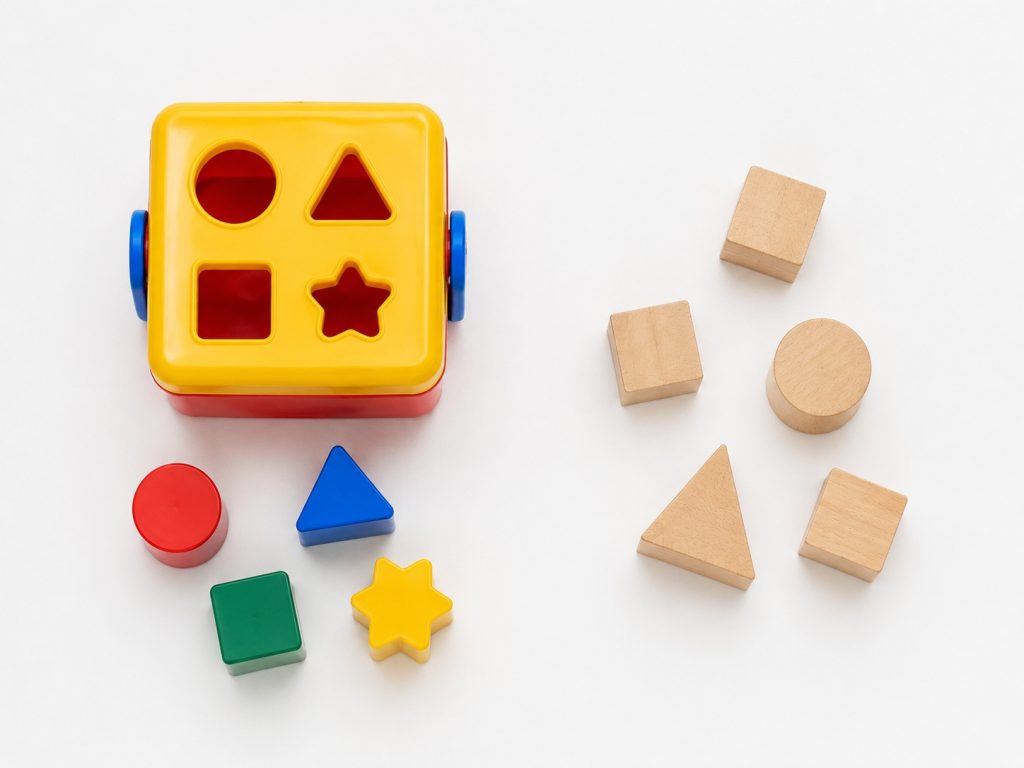
Traditional toys are designed around a specific outcome. A puzzle has one correct solution. A shape sorter accepts each piece in exactly one way. A battery-operated train follows a fixed track. These products teach specific concepts effectively — sequencing, color recognition, cause and effect — but the interaction ends when the task is complete.
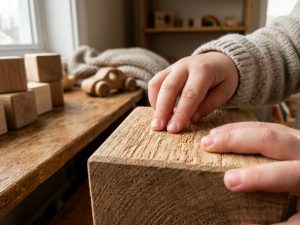
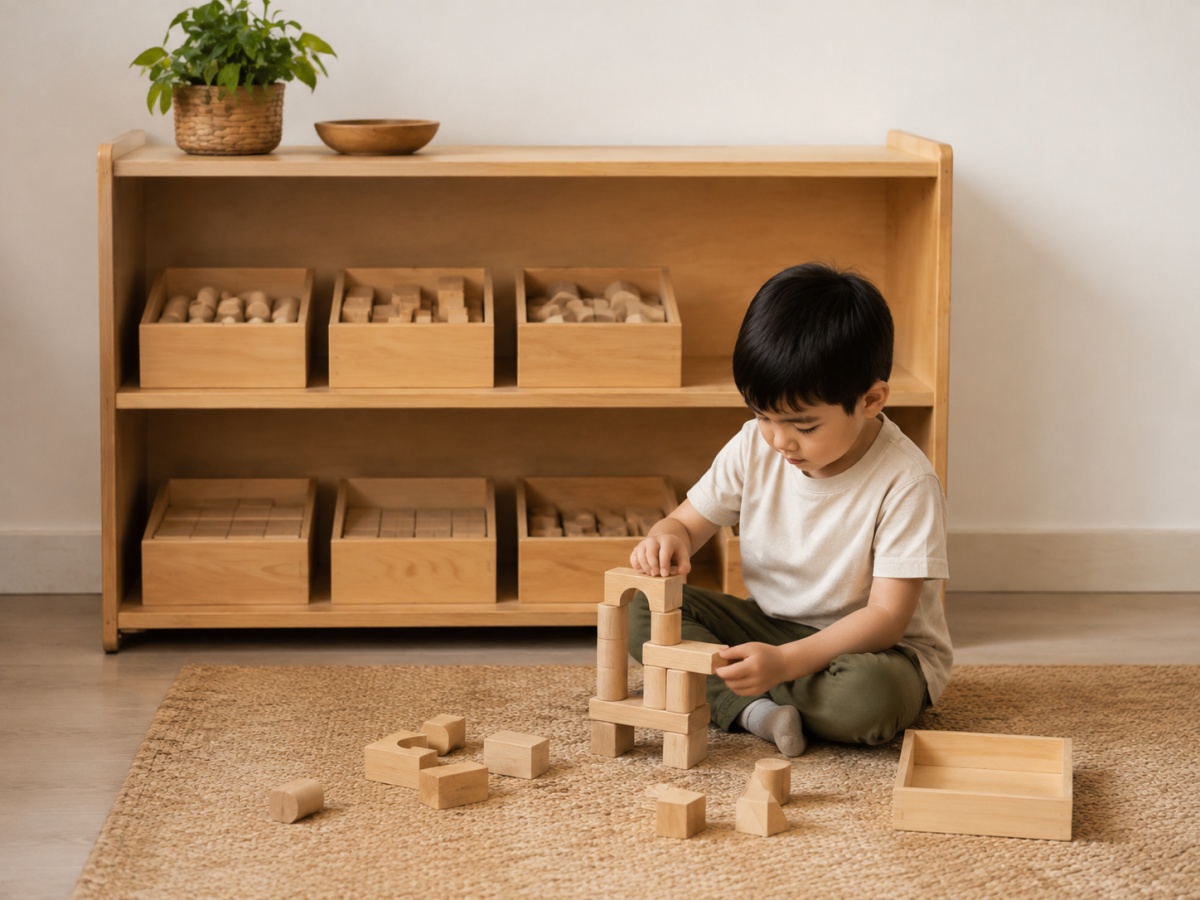
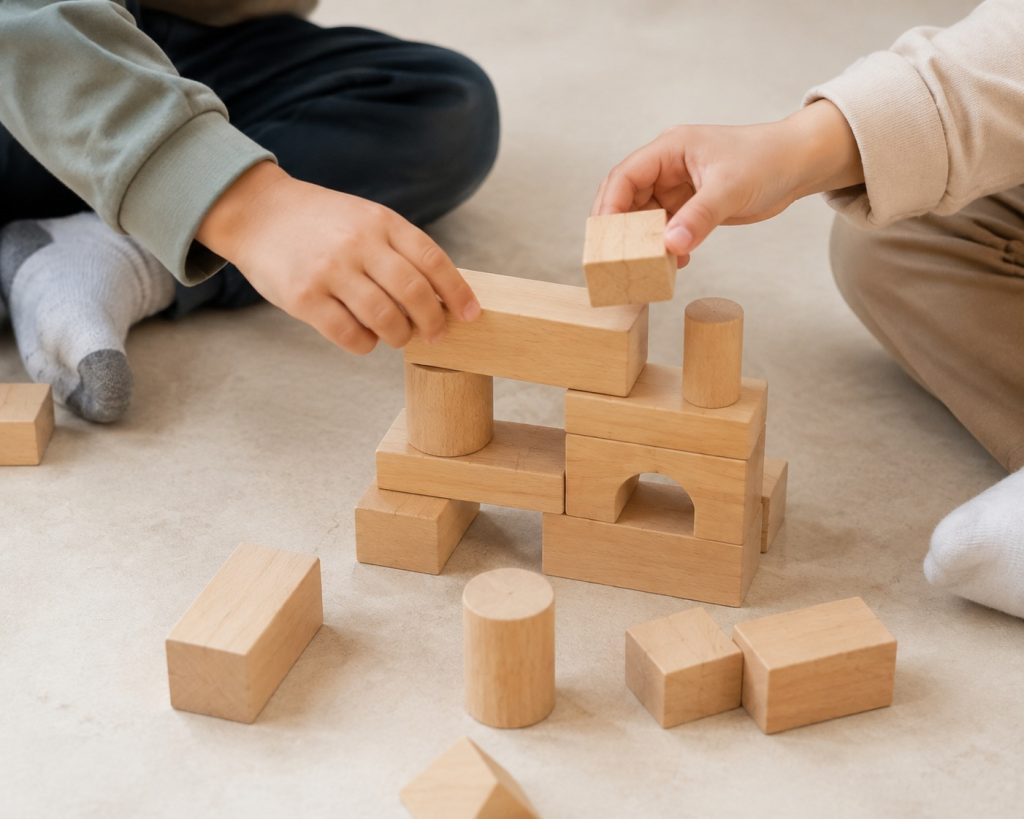
Open-ended toys don’t have a “finished” state. A set of wooden blocks can become a house, a bridge, a city, a pretend kitchen, or an abstract sculpture depending on who’s using it and what story they’re building. The same set of loose parts looks completely different in the hands of a three-year-old building towers versus a seven-year-old constructing a map of their neighborhood.
This isn’t just a philosophical distinction. It has direct implications for how long a material stays useful in a learning environment, how many developmental domains it can support simultaneously, and how well it serves a mixed-ability classroom.
The defining characteristic of open-ended play materials is that they respond to the child’s imagination rather than directing it. The child leads; the material follows.
Key Differences at a Glance
| Dimension | Open-Ended Toys | Traditional Toys |
|---|---|---|
| Play outcome | Child-defined, unlimited | Designer-defined, fixed |
| Replay value | High — engagement deepens over time | Lower — once mastered, interest drops |
| Age range | Broad — scales with development | Narrow — tied to specific stage |
| Cognitive focus | Divergent thinking, executive function | Convergent thinking, targeted skills |
| Classroom usability | Group play, mixed-ability settings | Targeted skill instruction |
| Procurement lifespan | 3–5+ years typical | 1–2 years typical |
| Curriculum alignment | Multi-domain simultaneously | Single-domain, precise |
| Best use case | Self-directed learning, imaginative play | Concept reinforcement, skill drills |
For procurement teams building a materials budget, this table captures the core trade-off: traditional toys offer precision; open-ended toys offer longevity and breadth. Most well-designed early learning environments need both, in proportions that reflect the curriculum’s overall goals.
Why Creativity Isn’t the Only Metric — But It’s the Right Starting Point
“Creativity” gets used loosely in early childhood education. It’s worth being specific about what open-ended toys actually develop and why that matters for learning outcomes.
The Executive Function Connection
When children engage with materials that don’t have prescribed uses, several cognitive processes activate at once. They must generate a goal (what am I building?), plan a process (how do I get there?), evaluate as they work (is this working?), and adapt when it doesn’t (what should I change?). This is executive function in action — and it develops through repeated practice, not instruction.
Divergent vs. Convergent Thinking
Divergent thinking — the ability to generate multiple solutions from a single starting point — is consistently linked to creative problem-solving in academic and professional contexts. Traditional toys, by their structure, often train convergent thinking: finding the one correct answer. Both are valuable, but early childhood is the developmental window most sensitive to divergent thinking practice, and it’s the one most easily missed if learning environments rely too heavily on structured materials.
For teachers, this has practical meaning. A child who has spent years finding the “right” answer to a toy’s built-in question may struggle when asked an open question in class. A child who has spent years deciding what a pile of materials should become is practicing exactly the cognitive flexibility that shows up as intellectual confidence later.
Where Traditional Toys Still Have Real Value
Open-ended toys are not categorically superior. This is an important point for curriculum designers and buyers.
Traditional toys serve specific instructional purposes with high efficiency. When a teacher needs to reinforce a concrete concept — ordinal numbers, color matching, fine motor precision — a well-designed structured toy does that faster and more clearly than a basket of loose parts. The child receives direct feedback. Progress is visible. The learning objective is unambiguous.
In therapeutic or special education settings, predictable cause-and-effect toys can provide sensory regulation and confidence building in ways that open-ended materials sometimes can’t, especially for children who need a clear framework before they can explore freely.
The most effective early learning environments don’t choose between the two. They understand the function of each and deploy them accordingly. Open-ended materials anchor imaginative, self-directed play. Structured materials support targeted skill instruction. The ratio and rotation of these materials is itself a curriculum decision.
How Open-Ended Toys Function Across Age Groups and Developmental Stages
One of the practical advantages that matters significantly for school and institutional buyers is developmental longevity. A traditional toy typically has a defined age range because its learning purpose is tied to a specific developmental stage. Once a child masters the task, the toy loses its value.
Why Open-Ended Toys Scale With the Child
Open-ended toys don’t age out the same way. A set of natural wooden pieces serves a two-year-old doing simple stacking and a six-year-old constructing elaborate narratives. The same magnetic tiles a kindergartner uses to make flat patterns becomes, by second grade, the tool for exploring symmetry, area, and architectural stability. The material doesn’t change; the developmental complexity of the engagement does.
For classroom settings, this has clear procurement value. Materials that remain usable across a two-to-three-year age span deliver better long-term return on investment than single-purpose toys that cycle out annually. For schools managing mixed-age groups or multi-grade classrooms, this scalability is especially significant.
What Experienced Teachers Notice Over Time
Teachers in Reggio Emilia-inspired and play-based programs often note that the richest play emerges not from newer toys but from familiar materials children have had time to master. Open-ended toys reward repeated use in a way structured toys rarely can. A classroom set of quality open-ended materials — chosen with developmental range in mind — often outlasts the children who first used it, passing value across cohorts rather than expiring with a single school year.
This is one of the reasons Vindstier designs open-ended toy sets with multi-age usability as a baseline requirement, not a feature. For distributors and school buyers working across grade bands, that design philosophy translates directly into procurement flexibility.
The Role of Material Quality in Open-Ended Play
Not all open-ended toys deliver equal results, and this is where product selection becomes a genuine professional decision rather than a commodity purchase.
Why Quality Determines Play Depth
Low-quality open-ended materials often fail in classroom use not because the concept is wrong, but because the execution undermines play. Pieces that don’t stack securely interrupt the building process. Materials that splinter or discolor quickly become hazards rather than tools. Sets with too few pieces or inconsistent sizing limit the complexity of what children can construct.
The physical quality of open-ended materials directly affects the depth of play they enable. A child who is compensating for poorly made pieces — balancing unstable blocks, sorting mismatched shapes — is not using cognitive energy for imaginative construction. They’re managing a flawed tool.
What Education-Grade Standards Actually Mean
For institutional buyers, this translates into a straightforward evaluation framework. Open-ended toys for classroom use need to meet higher durability standards than home use toys because they face daily handling by multiple users. They need to offer enough pieces and variety to support group play, not just individual use. And they need to be made from materials that can be cleaned, maintained, and safely used across years of classroom life.
This is where the difference between consumer-grade and education-grade open-ended materials becomes commercially significant. Vindstier’s manufacturing process applies education-grade standards to material sourcing, surface finishing, and structural tolerances — specifically because classroom use imposes demands that consumer product testing doesn’t fully account for. For brands and distributors sourcing for the educational channel, that distinction affects both product performance and liability exposure.
A Practical Example: Loose Parts in Early Childhood Settings
Consider how open-ended materials function in a real classroom environment — not as an abstract principle, but as a teaching tool with specific pedagogical logic.

How a Single Material Set Develops Over Five Weeks
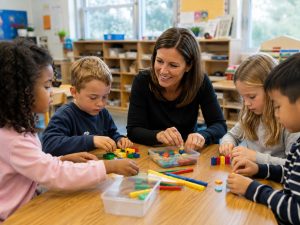
A teacher working with four and five-year-olds introduces a collection of natural loose parts: wooden discs, river stones, pinecones, wool balls, and small metal rings. No instructions are given. Children are invited to use the materials however they choose.
Over the first week, most children sort and arrange by color or size — early mathematical thinking. By the third week, groups are building landscapes, maps, and pretend food for a restaurant narrative. By the fifth week, the same materials appear in a complex collaborative project where children have designated roles and are making collective decisions about the layout.
What the Teacher Is Actually Observing
What the teacher is observing across those weeks isn’t play for its own sake. It’s the development of classification, spatial reasoning, narrative sequencing, cooperative negotiation, and symbolic representation — across multiple developmental domains, simultaneously, without a single worksheet.
The materials didn’t teach this. They created conditions where children could teach themselves through engagement. That’s the functional distinction between open-ended and traditional toys at its most concrete — and it’s the kind of outcome that justifies the investment in quality materials rather than the cheapest available option.
What Buyers Should Consider When Sourcing Open-Ended Toys
For educational product buyers, distributors, and school procurement teams, the decision between open-ended and traditional toys rarely comes down to philosophy. It comes down to application: who is using these materials, in what environment, with what learning goals?
Safety Certification and Material Composition
Material composition and safety certification matters more in open-ended toys because children interact with them in unscripted ways. The range of how a material might be used is broader than with structured toys, which means safety standards need to account for more scenarios. Buyers should verify that certifications cover actual classroom use conditions, not just standard consumer testing protocols.
Set Completeness and Group Play Scalability
Set completeness and scalability determines whether the product actually supports the classroom use cases it’s marketed for. Small sets designed for home use often don’t provide enough material for group play or large motor engagement in a classroom setting. When evaluating open-ended toy sets for institutional purchase, ask specifically how many children can engage simultaneously and whether the set supports collaborative as well as individual play.
Durability, Maintenance, and Total Cost of Ownership
Durability and maintenance in a school context means asking different questions than a parent would. How does this hold up to daily use by twenty children? Can it be cleaned? What’s the expected lifespan? A higher upfront cost for education-grade materials often delivers significantly lower cost per use over a three-to-five-year classroom cycle.
Curriculum Alignment and Documentation Support
Curriculum alignment is increasingly important as schools move toward documented learning frameworks. Open-ended toys that can be clearly mapped to developmental domains — language, math, science, social-emotional learning — are easier to justify in institutional budgets than those marketed only on “creativity.” Suppliers who can provide curriculum alignment documentation are meaningfully easier to work with at the institutional procurement level.
FAQ: Open-Ended Toys in Educational Settings
Q: At what age should children start using open-ended toys?
Open-ended toys are appropriate from infancy, though the nature of engagement changes significantly with age. Simple textured natural materials work for babies under twelve months. Stacking, sorting, and early construction play develops from around eighteen months. The richest imaginative and collaborative use typically emerges between ages three and seven, which is also when the developmental benefits are most pronounced.
Q: How do open-ended toys support children with different learning needs?
Because open-ended toys don’t have a prescribed correct use, they naturally accommodate different ability levels within the same activity. A child who struggles with structured tasks can engage at their own level without failing the toy’s built-in challenge. For inclusive classrooms or mixed-ability groups, this flexibility reduces the stigma of differentiation and allows every child to participate in the same play environment meaningfully.
Q: How many open-ended toys does a classroom actually need?
This depends on group size and how the materials are rotated, but a practical baseline for an early childhood classroom of fifteen to twenty children is three to five core open-ended material sets, rotated regularly to maintain novelty and deepen engagement over time. Quantity per set matters — a set of twenty blocks serves one child; a set of two hundred serves a class.
Q: What’s the best way to introduce open-ended toys to children who are used to structured play?
Children transitioning from highly structured toy environments sometimes need time to adjust to unscripted play. Providing a small number of materials with enough variety to invite exploration — without overwhelming choice — helps. Teachers can model open-ended use without directing it, showing that there’s no wrong answer. Most children adapt within a few sessions once they understand that the goal is their own.
Conclusion
The comparison between open-ended toys and traditional toys isn’t a verdict — it’s a framework for making better decisions about learning environments. Traditional toys do specific things well. Open-ended toys do different things, often with longer developmental reach and greater flexibility across age groups and learning contexts.
For teachers, the question is which materials create the conditions for the kind of thinking you’re trying to develop. For school buyers, it’s which materials deliver sustained educational value across the investment cycle. For brands and distributors, it’s which products can credibly serve educational institutions — not just sell into the market, but actually perform in classrooms.
Open-ended toys consistently outperform in environments where self-directed learning, creativity, and developmental flexibility are the goal. The materials that support those outcomes are worth sourcing carefully — and worth partnering with manufacturers who understand the difference between a product that looks right and one that actually works at classroom scale.