Independent learning rarely begins with worksheets or structured lessons. For most preschoolers, it starts with small decisions: choosing where a piece belongs, correcting a mistake without help, or patiently trying again after something doesn’t work the first time.
That process is exactly why many parents and preschool teachers are paying closer attention to toys that combine logical challenges with self-guided play. A well-designed Fruit Sorting Stacking Toy does more than teach colors or fruit names. It creates repeated opportunities for children to think independently, recognize patterns, and solve problems without constant adult correction.
Unlike basic stacking toys that only focus on motor movement, this particular Fruit Sorting Stacking Toy introduces a layered challenge system. Children are not simply placing pieces onto poles. They are navigating a mini logic puzzle inspired by the movement rules of the Tower of Hanoi, using two spare columns to reorganize mixed fruit blocks into matching categories.
That difference changes the learning experience completely.
Why Independent Learning Starts with Problem-Solving Play
Research published by the Harvard Center on the Developing Child shows that preschool children build stronger executive functioning skills when activities involve self-correction, sequencing, and decision-making rather than passive memorization.
This is where the Fruit Sorting Stacking Toy becomes especially effective.
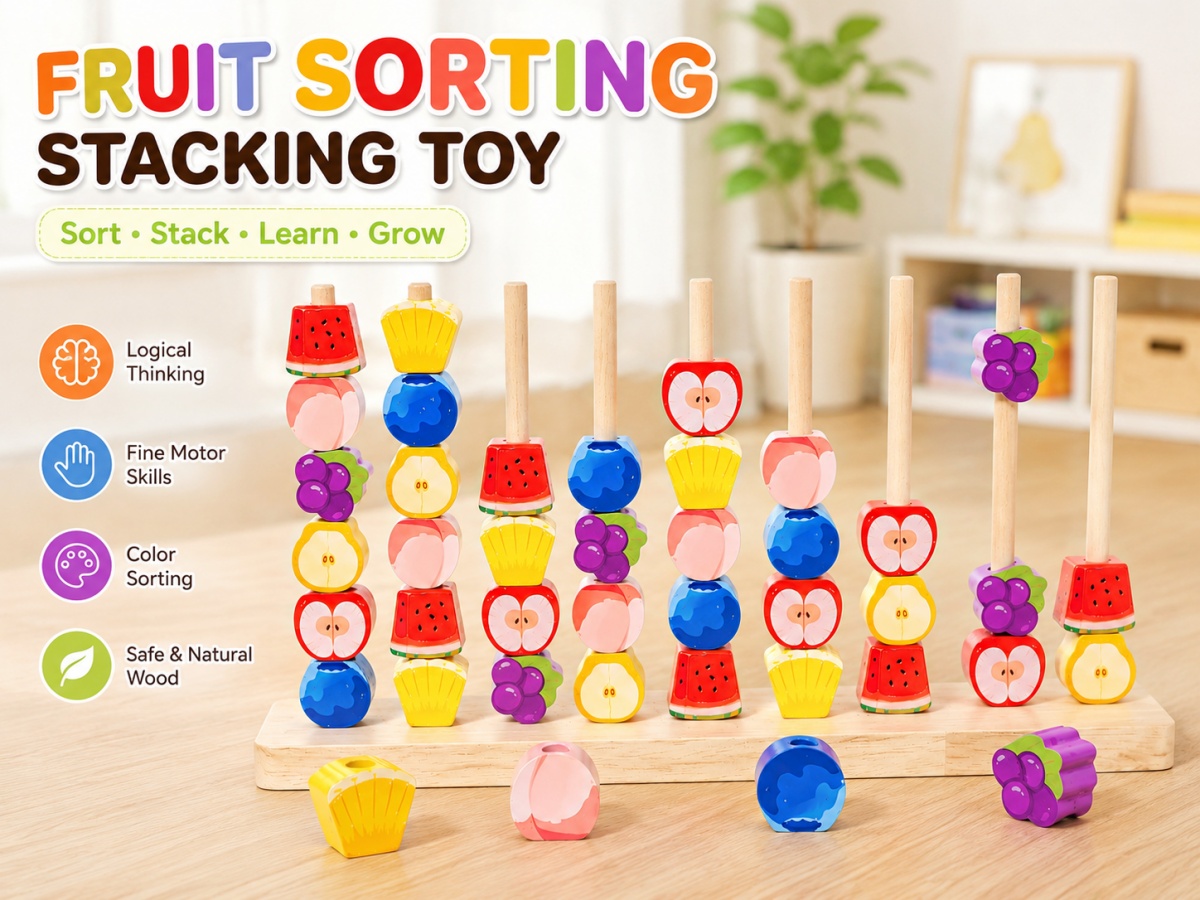
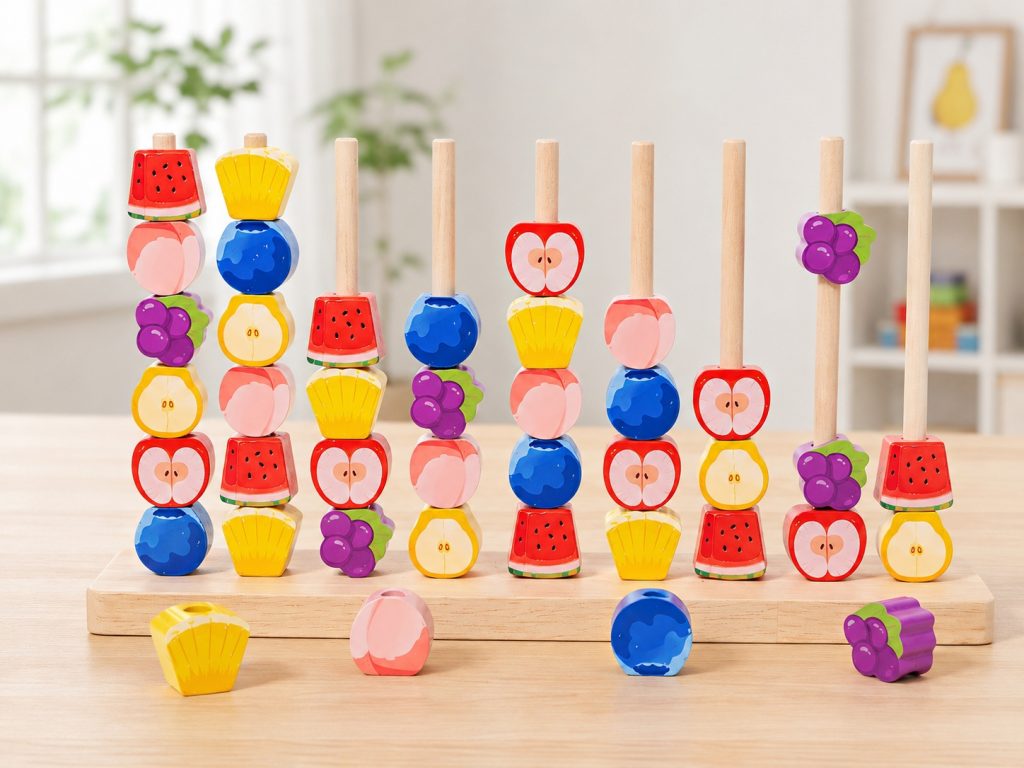
The toy arrives with seven columns of mixed fruit blocks and two additional spare poles. At first glance, children often think the task is simple sorting. But after a few attempts, they realize they must plan movements carefully to avoid blocking the wrong fruit pieces.
Instead of receiving direct instructions for every move, children naturally begin experimenting.
Some start by grouping colors first. Others focus on fruit types. Many discover that using the spare poles strategically makes the task easier. These moments matter because independent learning develops when children test ideas and adjust strategies on their own.
The Puzzle Structure Encourages Self-Guided Thinking
Traditional sorting toys usually have one correct placement system visible immediately. This Fruit Sorting Stacking Toy adds an extra layer:
| Feature | Learning Impact |
| 7 mixed fruit columns | Encourages planning before acting |
| 2 spare poles | Introduces strategic movement |
| Layer-by-layer sorting | Builds sequencing ability |
| Repeated trial attempts | Strengthens persistence |
| Visual fruit grouping | Improves pattern recognition |
The result feels closer to a beginner logic puzzle than a standard preschool stacking game.
That distinction is important for parents searching for toys that hold a child’s attention longer than a few minutes.
How Fruit Sorting Stacking Toy Builds Concentration Naturally
Many parents notice that preschoolers lose focus quickly during repetitive educational activities. However, concentration often improves when children feel ownership over the challenge.
The Fruit Sorting Stacking Toy creates this effect because every successful move leads directly to visible progress.
A child can immediately see:
- which fruit groups are becoming organized
- which poles still need adjustment
- whether a movement strategy is working
This visual feedback loop keeps engagement high without requiring rewards or screen stimulation.
According to data from the American Academy of Pediatrics, hands-on object manipulation activities improve sustained attention in early childhood more effectively than passive digital learning environments.
This becomes particularly noticeable during longer play sessions. Children frequently restart the puzzle voluntarily, attempting faster or more efficient sorting methods after completing the first round.
Repetition Without Boredom
One reason many educational toys fail to maintain long-term interest is predictability. Once children understand the pattern, the activity loses challenge.
This Fruit Sorting Stacking Toy avoids that problem because:
- fruit pieces can be rearranged differently each time
- sorting difficulty changes naturally
- children invent personal “rules” during play
- speed-based challenges emerge organically
As a result, the learning experience evolves with the child instead of becoming repetitive.
Studies on early childhood cognition consistently show that open-ended repetition supports deeper neural learning pathways than single-solution activities.
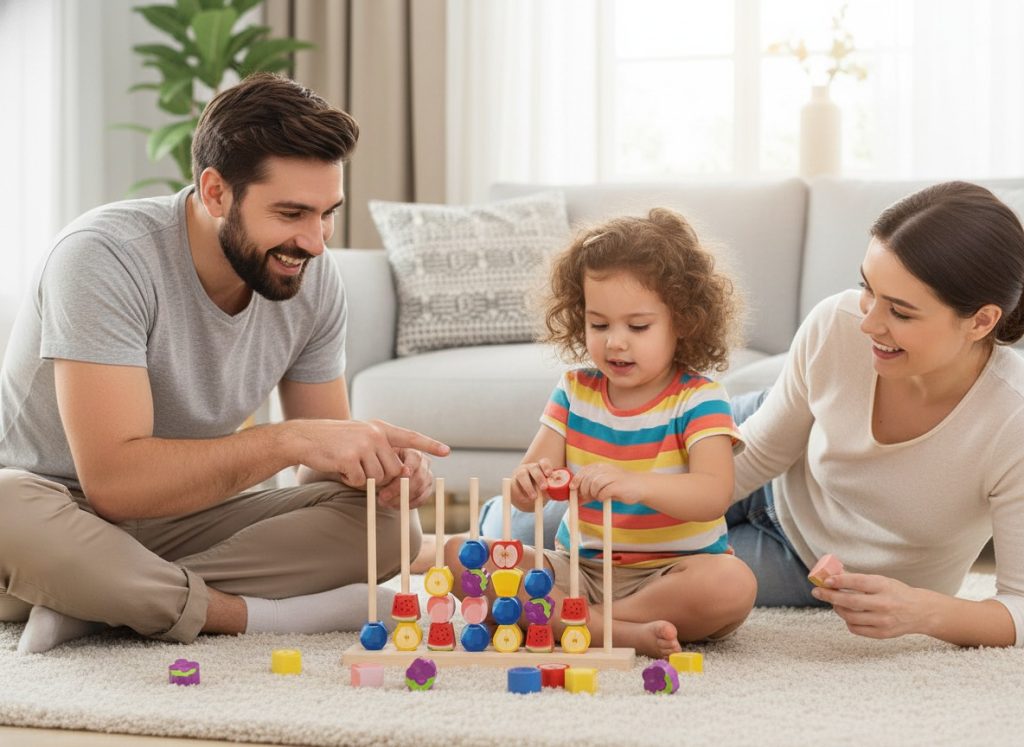
Why Fruit Sorting Stacking Toy Supports Fine Motor Independence
Independent learning is not only cognitive. Young children also need physical confidence to complete tasks without assistance.
The structure of this Fruit Sorting Stacking Toy supports that development in several ways.
Each fruit block is sized for small hands to grip securely. Children must:
- pick up individual fruit pieces carefully
- align the center hole with the wooden rod
- control movement while stacking
- avoid knocking over nearby columns
These repeated motions strengthen:
- finger control
- wrist stability
- bilateral coordination
- hand-eye synchronization
Unlike oversized stacking rings that require minimal precision, the narrower wooden poles demand more controlled placement.
That added precision helps children transition toward independent classroom skills such as pencil control, object organization, and self-directed manipulation tasks.
The Role of Visual Recognition in Independent Preschool Learning
Early independence often begins with recognition confidence.
Before children can follow instructions independently, they need to quickly identify shapes, colors, and object categories without relying on adults for confirmation.
The Fruit Sorting Stacking Toy reinforces this process through its seven distinct fruit designs.
Children repeatedly identify:
- apples
- grapes
- watermelons
- and other recognizable fruit shapes
Because the colors are vivid but non-reflective, children remain visually focused without overstimulation from glossy surfaces.
This matters more than many parents realize.
Bright reflective coatings commonly found on cheaper preschool toys can distract visual processing, especially during extended concentration activities. In contrast, matte-finished fruit blocks help children stay visually organized while sorting.
Visual Learning Benefits Observed During Play
| Activity | Independent Skill Reinforced |
| Matching fruit types | Category recognition |
| Sorting by color | Visual discrimination |
| Rearranging block positions | Spatial reasoning |
| Comparing stack heights | Quantitative awareness |
Over time, children begin solving sorting tasks faster without verbal prompts from adults.
That shift is a strong indicator of growing independent learning behavior.
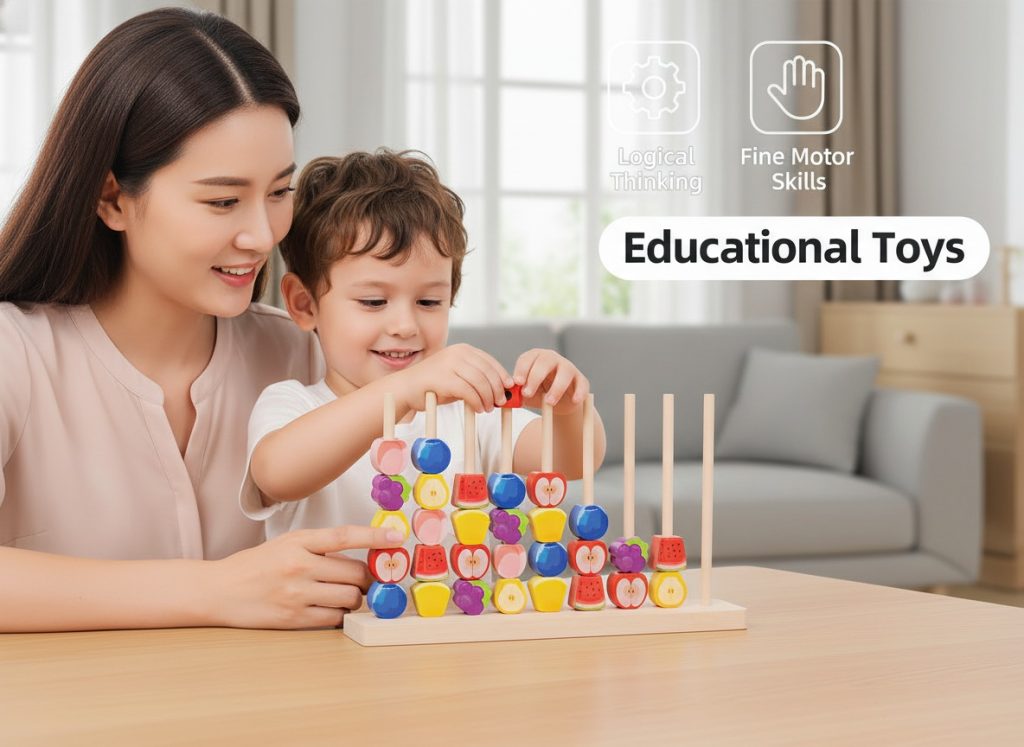
Why Parents Often Use Fruit Sorting Stacking Toy During Quiet Playtime
Independent play becomes difficult when toys require constant adult setup or explanation.
This Fruit Sorting Stacking Toy works well during quiet play periods because the challenge system is visible immediately. Children can restart the game themselves without waiting for instructions.
Many parents use it during:
- morning quiet routines
- screen-free afternoons
- preschool preparation time
- travel-free indoor activities
- parent-child cooperative games
The toy also supports collaborative independence.
Rather than adults controlling the activity, parents often participate by:
- timing sorting rounds
- suggesting alternative strategies
- creating new fruit patterns
- introducing memory challenges
This keeps interaction balanced while still allowing the child to remain the primary problem-solver.
How the Wooden Structure Supports Long-Term Learning Use
Material quality matters most when a toy is used repeatedly.
This Fruit Sorting Stacking Toy uses laser-cut natural wood with rounded edges polished from every angle. The smoother surface becomes especially important during repetitive stacking because preschool children continuously slide fruit blocks across the poles during trial-and-error movement.
Instead of painted plastic connectors that loosen over time, the wooden structure maintains stability during repeated sorting sessions.
The rounded corners also reduce interruption during focused play. Children can reposition pieces quickly without hesitation or discomfort while gripping the blocks.
Although safety information is often discussed generally in the toy industry, in this case the finishing details directly affect usability during long independent play periods.
Conclusion
Independent learning develops gradually through repetition, experimentation, and self-correction. The most effective preschool toys are often the ones that allow children to discover solutions without feeling directed at every step.
Rather than focusing on only one developmental area, this Fruit Sorting Stacking Toy naturally combines logical problem-solving, fruit and color recognition, precision-based stacking, and sustained attention into a single hands-on activity. Because children can experiment with different sorting strategies independently, the toy continues to feel engaging even after repeated play sessions.
The inclusion of seven mixed fruit columns and two spare poles transforms the experience from a basic sorting exercise into a more structured preschool logic challenge. Instead of simply stacking pieces by color, children learn to plan movements, test different solutions, and gradually improve through repeated attempts.
For parents and educators looking beyond ordinary sorting toys, the long-term value comes from how consistently children return to the activity on their own. As their confidence grows, so does their ability to stay focused, solve problems independently, and complete increasingly complex sorting tasks without relying on constant adult guidance.