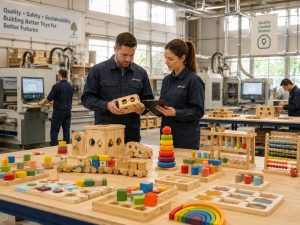
Between ages 3 and 5, children develop foundational motor abilities that directly impact their capacity to write, button clothing, and manipulate everyday objects. Research from the American Academy of Pediatrics indicates that structured play with fine motor skills toys during this developmental window improves precision tasks by up to 47% compared to unstructured activities alone. Parents seeking effective tools to support this growth need toys that engage small muscle groups while maintaining a child’s attention through purposeful challenge.
Why Hand-Eye Coordination Matters for Your Child’s Development
Hand-eye coordination forms the neurological foundation for academic readiness. When toddlers manipulate objects—stacking blocks, threading beads, or sorting shapes—they build neural pathways connecting visual perception to physical response. Occupational therapists identify three critical skills developed through fine motor skills toys: pincer grasp strength (essential for pencil control), bilateral coordination (using both hands simultaneously), and visual-motor integration (translating what eyes see into hand movements).
A 2024 study published in Child Development Quarterly tracked 340 preschoolers over 18 months. Children who engaged with targeted fine motor skills toys for 20 minutes daily demonstrated 34% faster progression in pre-writing skills compared to peers with generalized play exposure.
8 Proven Activities Using Vindstier Fine Motor Skills Toys
Activity 1: Progressive Pattern Building
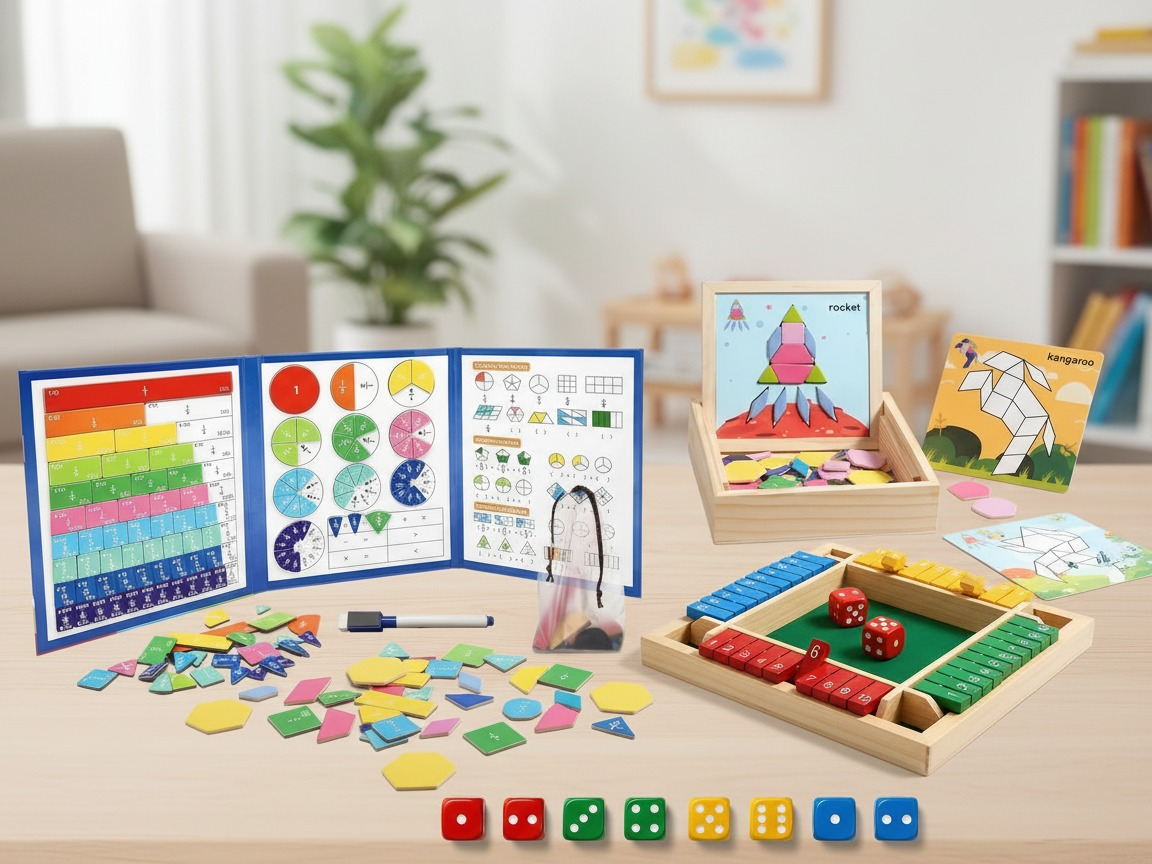
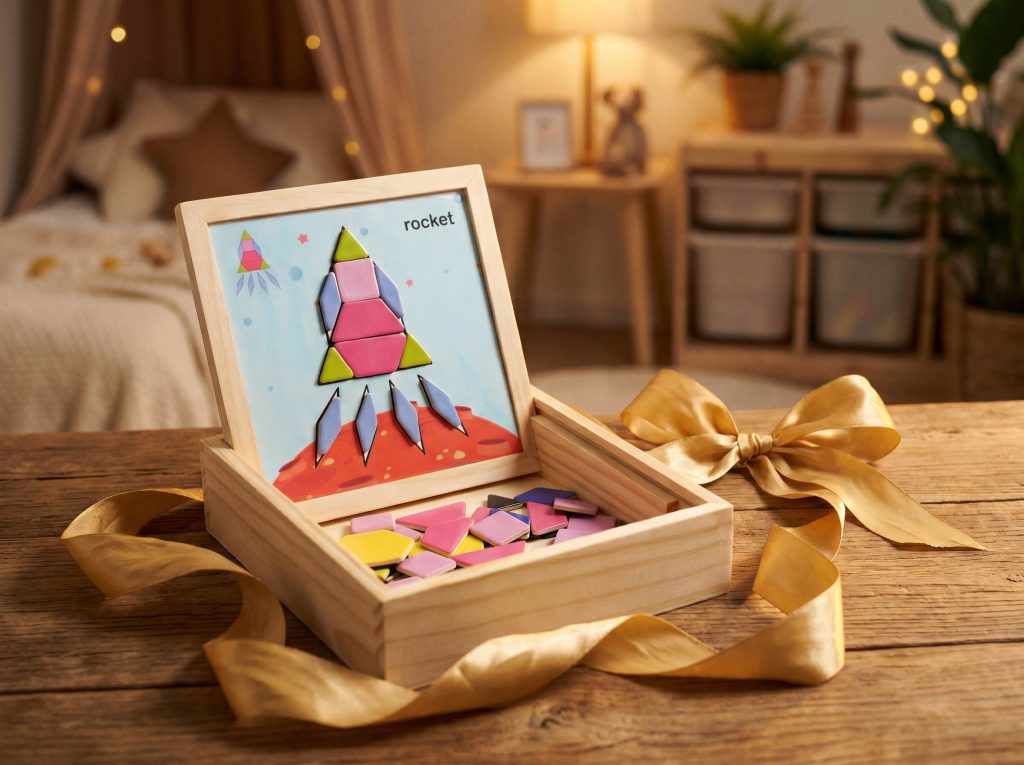
The Vindstier Magnetic Pattern Blocks Set includes 75 EVA soft magnetic pieces that attach firmly to the 7″x7″ solid wood board. The set comes with 30 double-sided challenge cards (60 patterns total) and a detailed instruction manual.
How to Play: Select a challenge card and place it on the wooden board. Guide your child to recreate the pattern using magnetic blocks. Start with simple 3-4 piece designs, then progress through five difficulty levels—from basic shapes to complex symmetrical patterns and vocabulary building exercises.
Developmental Focus: Pincer grasp, shape recognition, spatial reasoning, logical thinking, and organizational skills.
Activity 2: Tower of Hanoi Fruit Sorting
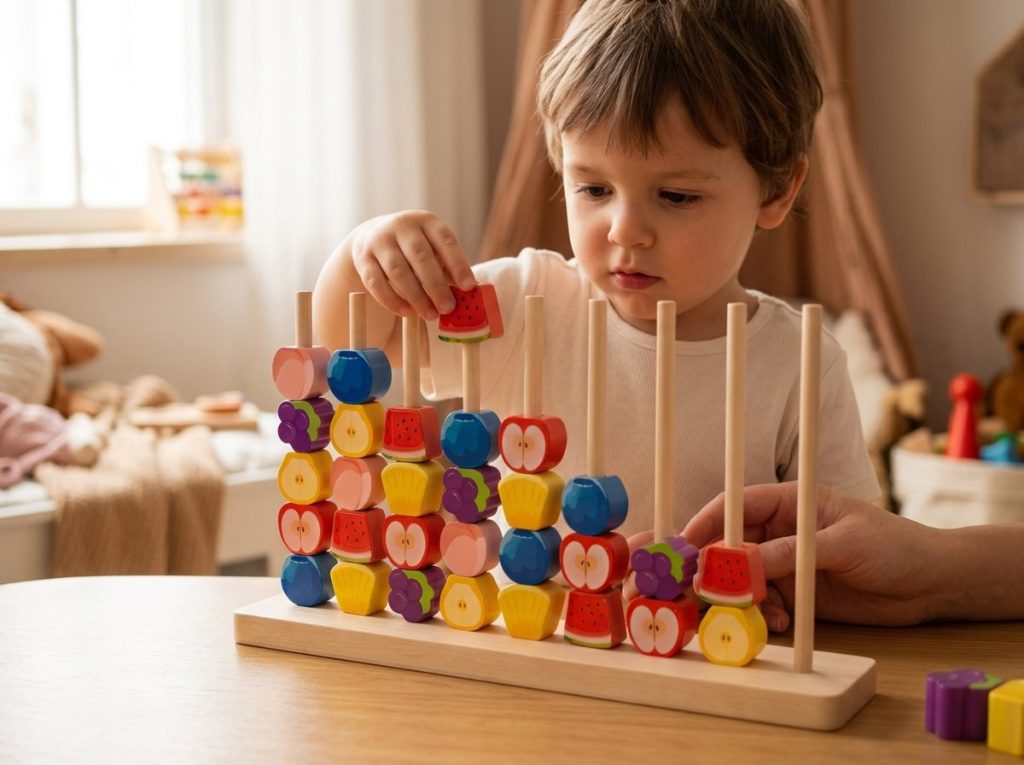
The Vindstier Fruit Sorting Stacking Toy features 7 columns of colorful fruit blocks and 2 spare posts for a logic-based sorting challenge.
How to Play: Scramble the fruit columns, then challenge your child to reorganize them by color and type using only the two spare posts. Like the classic Tower of Hanoi puzzle, larger fruits cannot be placed on smaller ones. Start with 3-column challenges before progressing to full 7-column sorting.
Developmental Focus: Logical thinking, problem-solving, sequential planning, wrist rotation, and hand-eye coordination.
Activity 3: Visual Math with Balance Blocks
The Vindstier Wooden Number Blocks use a “height = value” design where taller blocks represent larger numbers. The set includes 15 double-sided challenge cards (30 tasks) across 5 difficulty levels.
How to Play: Use challenge cards to guide building activities. Start with simple number recognition and stacking, then progress to addition/subtraction concepts by comparing block heights. Advanced levels include balance challenges where children create stable structures while solving math problems.
Developmental Focus: Number sense, visual math comprehension, balance awareness, grip strength calibration, and spatial reasoning.
Activity 4: Magnetic Parking Letter Matching
The Vindstier Magnetic Parking Game includes 26 colorful letter cars sealed under clear acrylic and a magnetic wand. The set comes with 12 double-sided cards featuring 24 early vocabulary words.
How to Play: Call out a letter or show a vocabulary card. Your child uses the magnetic wand to drag the matching letter car to its parking spot. Progress from single letters to spelling simple words by parking multiple cars in sequence (C-A-T). The sealed design keeps all pieces contained—perfect for travel.
Developmental Focus: Letter recognition, phonics, hand stability, fine motor control, and pre-writing muscle development.
Activity 5: Fraction Circle Assembly
The Vindstier Magnetic Fraction Teaching Aids feature color-coded fraction pieces (halves, thirds, fourths, eighths) made from thickened EVA foam with full-coverage magnetic backing. The tri-fold magnetic board doubles as a storage case.
How to Play: Scramble all fraction pieces. Ask your child to rebuild complete circles by matching fractional parts—starting with halves (2 pieces) and progressing to eighths (8 pieces). Use the included dry-erase marker to write equations directly on the board. Each piece shows percentages, decimals, and classic fractions for multi-dimensional learning.
Developmental Focus: Curved edge alignment, proportional reasoning, early fraction concepts, and mathematical foundations.
Activity 6: Dinosaur Maze with Pattern Challenges
The Vindstier Fun Dinosaur Maze features magnetic beads sealed under scratch-resistant acrylic. The 8.6″ square board includes 10 double-sided cards with 20 patterns (ships, umbrellas, etc.) and color-coded dinosaur nests for counting 1-10.
How to Play: Use the magnetic pen (stored in built-in slot) to guide colored beads into matching dinosaur nests. Start with simple counting exercises, then progress to recreating patterns shown on challenge cards. Advanced play includes creating original designs and color sorting.
Developmental Focus: Hand-arm separation, sustained concentration, number recognition, color matching, and visual tracking.
Activity 7: Three-in-One Ball Drop Challenge
The Vindstier Wooden Falling Ball Game combines a classic tumbling tower with balance ring challenges and color sorting. The tower serves as both game base and storage for 30 colored sticks, 4 balls, rings, and dice.
How to Play:
- Game 1 (Pull & Drop): Stack colored sticks, roll dice to determine color, carefully pull matching sticks without dropping balls
- Game 2 (Balance Ring): Create stable structures by balancing rings on stick configurations
- Game 3 (Color Sorting): Race to organize sticks by color after scrambling
Developmental Focus: Cause-effect understanding, spatial awareness, patience, color recognition, and pinpoint accuracy.
Activity 8: Shut the Box Number Strategy
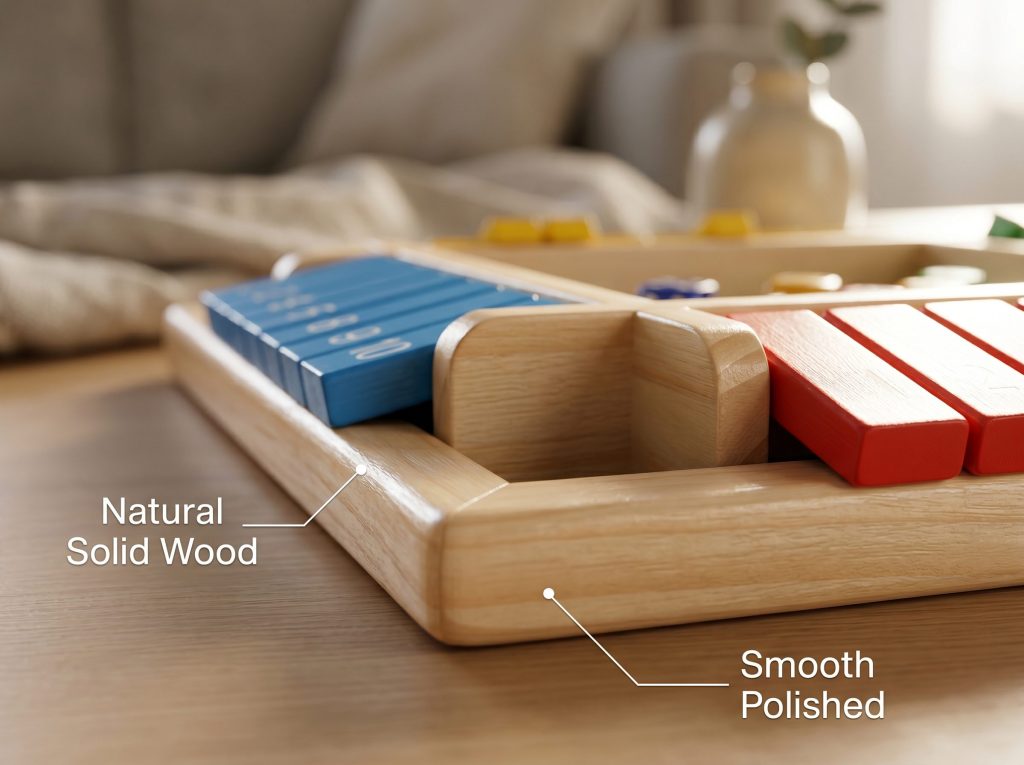
The Vindstier Number Flip Dice Box is a classic 4-player board game made from premium birch wood with noise-dampening felt and anti-slip bottom pads.
How to Play: Roll the dice and flip down any combination of number tiles that equal the total (e.g., roll 7 = flip 7, or flip 3+4, or flip 1+2+4). Continue until no valid moves remain. The player with the lowest remaining tile total wins. Supports 1-4 players for family game nights.
Developmental Focus: Mental math, addition strategies, number bonds, finger independence, strategic thinking, and decision-making.
Why Vindstier Fine Motor Skills Toys Outperform Standard Options
| Feature | Vindstier Products | Standard Market Toys |
| Safety Certifications | Dual CE + CPC certified | Often uncertified imports |
| Material Quality | EVA soft magnetic material + premium solid wood | Variable quality plastics |
| Progressive Learning | Multi-level challenge systems (5 difficulty stages) | Single difficulty level |
| Storage Solutions | Integrated wooden boxes and tri-fold cases | Separate storage required |
| Age Range | 3-8 years with graduated challenges | Narrow 1-2 year engagement |
| Educational Framework | Montessori-inspired STEM integration | Entertainment-focused |
Research shows toys requiring multiple motion types generate 2.3x faster skill acquisition than single-action toys. Every Vindstier product integrates this research for maximum developmental return.
Creating Your Daily 15-Minute Fine Motor Routine
Consistency outperforms duration in motor skill development. A 2025 Johns Hopkins University study found that children practicing 15 minutes daily showed greater improvement than peers practicing 45 minutes three times weekly.
Recommended Weekly Rotation:
- Monday: Magnetic Pattern Blocks (progressive challenges)
- Tuesday: Fruit Sorting (logic puzzles)
- Wednesday: Dinosaur Maze (pattern replication)
- Thursday: Number Flip Box (family game night)
- Friday: Number Balance Blocks (math exploration)
- Weekend: Child’s choice from favorites
This schedule prevents skill plateau by varying motor demands daily while allowing muscle recovery time.
Frequently Asked Questions
Q: Which toy should my 3-5-year-old start with?
A: Begin with the Fruit Sorting Toy or Magnetic Pattern Blocks (beginner cards). Both offer immediate success while building foundational skills.
Q: Are these suitable for children with special needs?
A: Yes. The Dinosaur Maze and Fraction Aids are particularly effective for visual learners and children with ADHD due to sealed components and clear tactile feedback.
Q: What do CE and CPC certifications mean?
A: CE confirms European safety standards; CPC is the U.S. Children’s Product Certificate. Vindstier carries both, ensuring lead-free materials, non-toxic paints, and age-appropriate sizing.
Conclusion
Data consistently shows that children engaging with quality fine motor skills toys for 15 minutes daily develop writing readiness, self-care independence, and classroom task competency months ahead of peers. Vindstier’s product line addresses this critical 3-5 year developmental window through research-backed design and uncompromising safety standards.
Whether through the 75-piece Magnetic Pattern Blocks with graduated challenges, the Tower of Hanoi Fruit Sorter that builds logical thinking, or the Shut the Box game that makes math fun, each Vindstier toy serves a specific developmental purpose. Parents implementing the daily rotation schedule create optimal conditions for motor skill mastery—observable through milestone tracking and confident classroom participation when formal education begins.