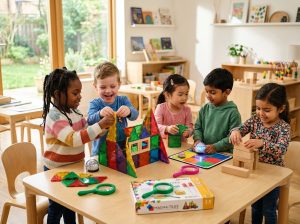

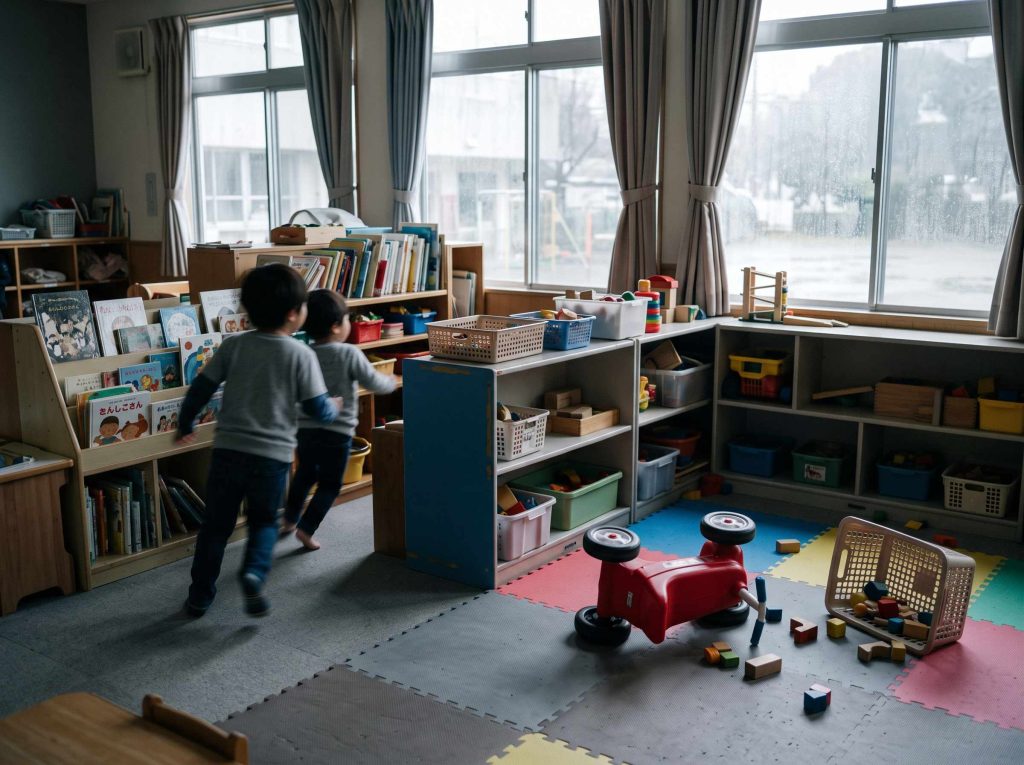
A rainy Tuesday keeps twenty preschoolers inside all morning. By ten o’clock the block corner has become a wrestling ring. Two crashed ride-ons block the doorway, and a teacher spends the hour repeating some version of “walking feet.” Movement did not cause the chaos; the missing place for it did.
Gross motor toys for preschoolers solve a placement problem before they solve anything else. The right climbing station, balance path, and throwing zone convert restless energy into skill work, while the wrong pieces become hazards that disappear into storage by November. This guide matches movement goals to equipment, sizes both against real floor plans, and lists the safety checks worth completing before a purchase order is signed.
Why Gross Motor Toys for Preschoolers Earn Their Floor Space
Movement equipment competes with tables, shelves, and quiet corners for the same square meters, so it needs a stronger argument than “children like to move.” Two research threads provide one.
The Activity Gap Classrooms Quietly Accumulate
World Health Organization guidance for children aged three to four calls for at least 180 minutes of physical activity per day, with at least 60 of those minutes at moderate-to-vigorous intensity (WHO, 2019). A full-day program with a playground can deliver much of that total outdoors. Half-day schedules, winter weeks, and rainy mornings tell a different story, and the shortfall shows up in afternoon behavior long before it shows up in health records.
The gap is structural, not motivational. When a program cannot go outside, gross motor toys for preschoolers become the indoor infrastructure that keeps the daily total honest.
What One Year of Movement Practice Changes
A 2024 longitudinal study in the Italian Journal of Pediatrics tracked children aged four to five across a year of primary-care follow-up. Basic motor competence scores rose across object movement and self-movement. Standing long-jump results improved by roughly nine centimeters, and executive-function tasks measuring working memory and inhibitory control also gained (Legarra-Gorgoñon et al., 2024). The authors connect the motor and cognitive gains through shared processes such as sequencing, planning, and monitoring.
The same sample showed boys scoring higher on object-movement tasks while girls scored higher on balance and stability measures. That pattern is one more argument for a cabinet that trains several movement patterns rather than a single specialty piece.
Gross motor toys for preschoolers are simply the equipment layer that makes such repetition available on an ordinary Tuesday. The same large-motor work that trains a body rehearses the planning loops that classroom learning runs on. That places movement stations in the same conversation as fine motor skills toys for toddlers, as two halves of one motor curriculum rather than rivals for budget.
Two Limits and One Common Mistake
The study’s own boundaries deserve a hearing. Its sample came from one primary-care setting and was not population-representative, and children mature naturally across a year, so part of the measured gain is growth rather than training.
The common mistake is buying movement equipment as an energy drain. A climbing corner that functions only as burn-off gets used unsupervised, wears unevenly, and teaches nothing. The same corner run as a station with turns and adult commentary builds coordination and self-regulation at the same time.
Matching Movement Patterns to the Right Equipment
Product categories describe products, not patterns of movement. A cleaner method starts from the movement a room needs to host, then works backward to equipment. Gross motor toys for preschoolers sort into families this way, and the sorting holds whether the budget covers three pieces or thirty.
Climbing and Balancing Stations
Climbing builds bilateral coordination, grip strength, and the judgment that comes from reading a body on an incline. Low climbers, balance beams, and stepping stones carry that load in a footprint most rooms can spare. Look for load ratings well above the heaviest expected user, handholds sized for preschool grips, and modular pieces that reconfigure into new routes when novelty fades.
Observation closes the loop. A four-year-old who plans a route, adjusts mid-climb, and hands over a turn card is doing the planning work the research describes. A child who freezes at the highest point needs a lower entry route rather than more encouragement, and a modular layout should be able to provide one.
Jumping, Throwing, and Catching Zones
Jumping develops leg power and landing control, while throwing and catching train the hand-eye system at whole-body scale. Floor markers, hopscotch paths, bean bags, and soft balls with targets turn a stretch of hallway into gross motor activities for preschoolers without any permanent installation. Set one rule on day one: throwing happens toward targets, never toward people. The rule is easier to keep when every zone has a built-in target.
Soft balls and bean bags are also the cheapest gross motor toys for preschoolers to evaluate and replace. A taped target on a wall delivers more measurable throwing practice than most battery-powered novelty pieces at several times the price.
Push, Pull, and Ride Options
Ride-ons, wagons, and push carts add load-bearing movement plus early cooperation whenever two children share one wagon. They are also the heaviest and least forgiving category of gross motor toys for preschoolers to host indoors, since they demand the most floor space and the strictest one-way traffic rules.
A taped lane replaces a paragraph of verbal rules. An arrow loop gives riders a lane and gives walkers a boundary, and the adult’s whole instruction collapses into one gesture.
The table condenses the matching logic:
| Movement pattern | Typical equipment | Space needed | Notes for group use |
| Climbing, balancing | Low climbers, beams, stepping stones | 2-3 m² plus fall zones | Rotate turns by card; one climber per three children |
| Jumping, throwing | Hopscotch markers, bean bags, soft balls, targets | A clear 3-4 m strip | Stationary targets keep groups safe |
| Pushing, riding | Ride-ons, wagons, push carts | 4 m² or more with a loop | One-direction traffic only |
A mixed cabinet beats a single imposing piece. Programs covering all three patterns with modest equipment report more participation than programs spending the same budget on one large climber.
Sizing Indoor Gross Motor Toys to Real Rooms
The most common error in buying gross motor toys for preschoolers is not quality but scale. Equipment that looked reasonable in a catalog consumes a small classroom’s entire free floor, and fall zones shrink until the safety file describes a room that no longer exists.
Small-Room Deployments That Still Move
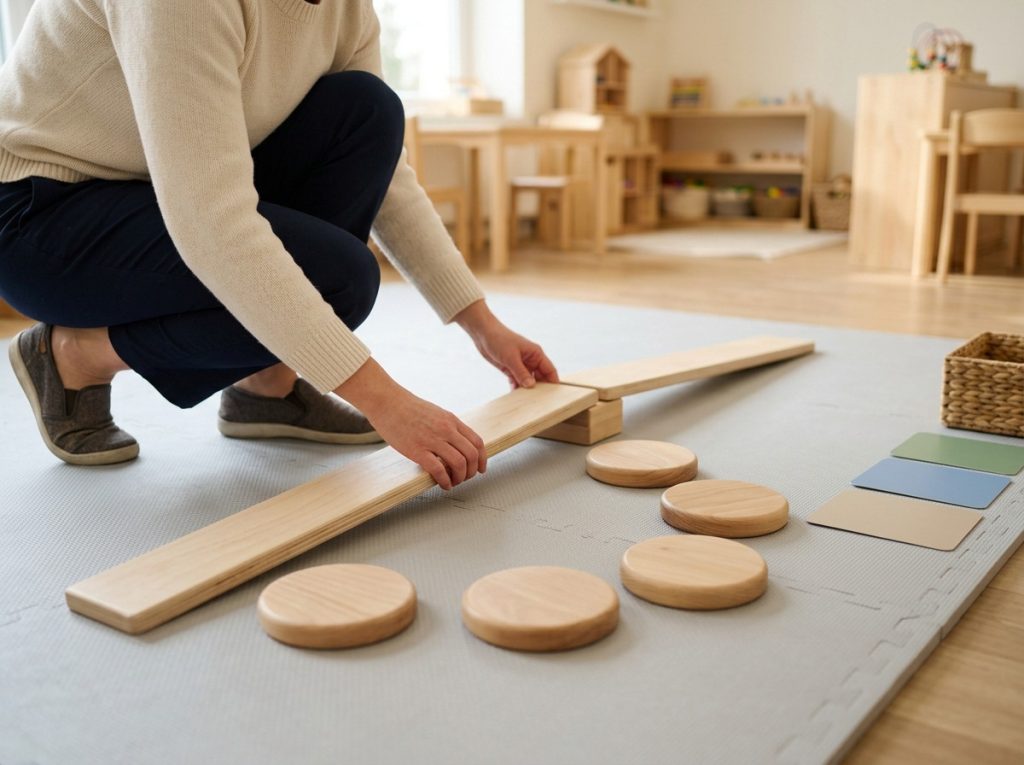
Rooms under forty square meters do better with storable pieces: stepping stones that stack, a beam that separates into short lengths, targets that hang on doors. A defined movement loop, even a short one, channels running better than rules do. Indoor gross motor toys for preschoolers also belong in rotation, with a calm counterpart such as sensory bins for toddlers holding the other end of the room’s volume range.
A two-week station card works better than open access. Monday’s loop might pair the balance beam with a throwing target, while Wednesday swaps in the hopscotch markers and stores the beam. Predictable change keeps a small inventory feeling larger than it is, and it teaches children to work with what is out rather than waiting for favorites.
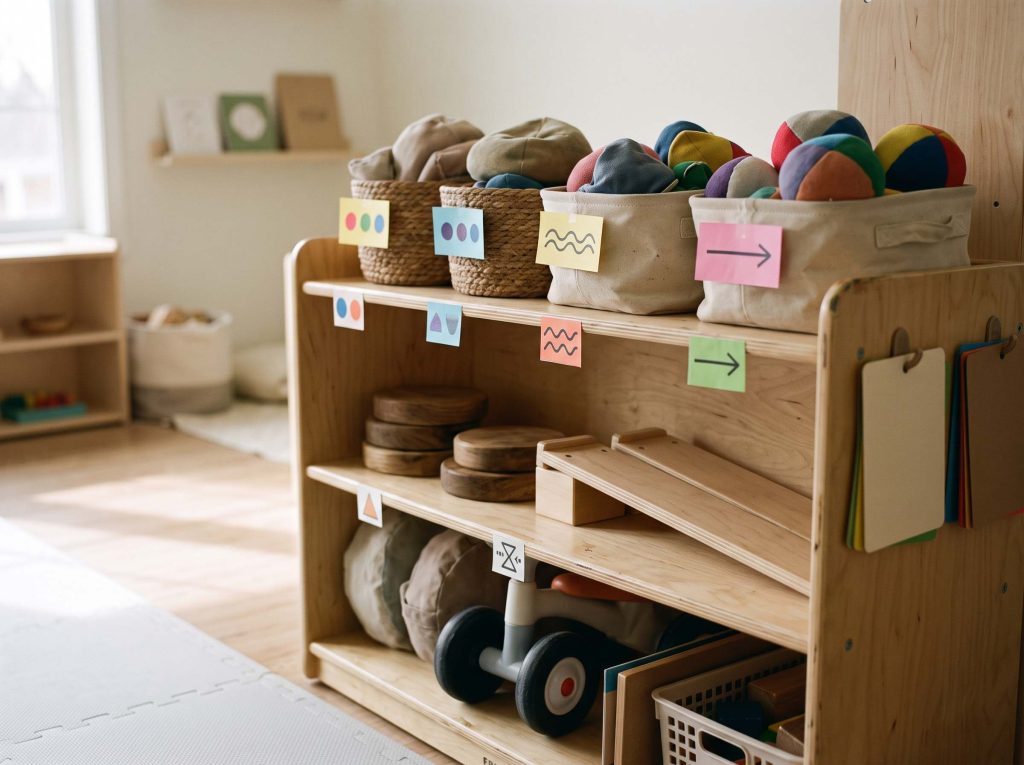
Storage is part of the movement plan, not an afterthought. A wall of labeled tubs keeps inactive zones clear, which is exactly what a fall-zone diagram assumes.
Shared Spaces and Outdoor Extensions
Multi-purpose rooms reward equipment on casters and pieces that flat-pack between uses. Outdoor gross motor toys for preschoolers shift the demands toward UV-stable finishes, sealed hardware, and real anchoring points. Gross motor play equipment sold for playground use should carry its own weather-rating documentation rather than an indoor label with optimistic copy.
Sizing is a safety decision before it is a budget decision. Most indoor incidents happen in overcrowded zones, and no fall-zone rule survives a room packed past its design.
Safety Standards That Hold Up Under Daily Rotation
Movement equipment carries the highest injury surface in a preschool inventory. The safety file deserves the same scrutiny as the invoice, and a few checks cover most of the real risk.
Stability, Fall Zones, and Anchoring
Four checks cover most indoor movement stations:
- The piece does not tip when weight leans hard on its highest edge.
- Fall zones extend at least 1.5 meters from every climbing surface and stay clear of other equipment.
- Anchoring hardware, where required, ships with the unit and matches the floor type.
- Weight and age limits appear on a visible label rather than only in the manual.
A one-minute tip test in the showroom predicts years of behavior. The same session should include crouching to child height, because entrapment gaps and protruding bolts reveal themselves from down there.
Materials and Finishes That Survive a School Year
Movement pieces absorb more abuse than any other category in the room, so finishes and joinery decide the replacement cycle. Sealed birch ply with rounded edges, powder-coated steel, and rotationally molded plastic without sharp seams hold up across a year of daily cleaning.
Documentation matters as much as material. Classroom movement pieces should carry EN71 or ASTM F963 test records, and mixed-material units need testing that covers every material rather than the dominant one alone. The disinfection schedules described in daycare cleaning routines are part of why finish quality shows up in year-two budgets rather than in the catalog.
Rounds of light maintenance extend the cycle further. A monthly check for loose bolts, chipped seals, and worn rubber feet catches most failures before a child finds them the hard way. A logged inspection record also strengthens the file when licensing reviewers visit.
From One Classroom to an Own-Brand Movement Line
The evaluation lens changes when a buyer is equipping twenty rooms with gross motor toys for preschoolers, or when a brand is building its own movement range. Consistency across rooms, batches, and years starts to matter as much as any single design decision, and the supply side becomes part of the product.
What Volume Buyers Should Ask
- Are weight limits, fall-zone diagrams, and cleaning instructions identical across batches?
- Does the supplier test every material in a mixed unit, or only the dominant one?
- Can worn parts be reordered by part number a year later?
- Does the packaging carry assembly instructions in the languages the rooms actually use?
A movement line is a cross-material product by nature. Wooden beams and stepping discs, molded plastic connectors and grips, printed movement-activity cards, and retail-ready packaging each follow a different production and compliance trail. Vindstier builds exactly this kind of range under a single ISO 9001 system, combining wood CNC machining, child-safe plastics molding, and printed components documented at the SKU level for CPC and CE purposes. Prototypes move from design brief to sample in 7-14 days, which lets a program pilot one room before committing a season’s budget.
One quality system beats a relay race of suppliers. A buyer coordinating a wood shop, a molder, and a printer inherits every interface between them, including the blame when a mixed unit fails its audit.
Choosing Gross Motor Toys for Preschoolers: A Buyer’s Summary
The decision compresses into three moves that hold at any budget, followed by one routine that decides whether the equipment ever pays off.
Checking the Shortlist Against the Room
Cover climbing, jumping, throwing, and riding with modest pieces before considering anything imposing. Size the room before the order rather than after delivery, and insist on documentation that names every material in the unit. Compare gross motor activities for preschoolers against the floor plan they will actually occupy, because a zone drawn on paper shrinks the day the boxes arrive.
Making the Routine Part of the Purchase
Equipment delivers its documented value only inside a routine, with turns, targets, and adult commentary that convert movement into practice. Gross motor toys for preschoolers bought as burn-off become furniture within a semester, while the same pieces inside a scheduled station routine compound the motor and self-regulation gains the research describes.
Programs ready to equip multiple rooms with gross motor toys for preschoolers can send Vindstier their floor-plan dimensions and movement goals per age group. The request returns a configuration sheet with prototype timelines and pricing tiers for the planned quantities.