The week after the holidays has a predictable shape in homes with young children. The floor is covered in wrapping paper, the new pile looks impressive, and seven days later most of it sits untouched. The child drifts back to the same two favorites from last year, and the cycle quietly resets for next December. Most holiday gifts for kids are chosen under time pressure, guided by packaging rather than by how the child actually plays.
Selection criteria fix the problem, and they are the same at every scale. A parent buying three presents and a buyer stocking a seasonal assortment face the same core question: which items will still be in play when the tree comes down. This guide covers what the research says about why holiday presents fail, a four-filter framework that predicts longevity, and the timing math that decides retail shelves.
Why Most Holiday Gifts for Kids Leave Rotation by February
What the Evidence Says About Electronic Gifts
A controlled study in JAMA Pediatrics (Sosa, Northern Arizona University, 2016) recorded home play sessions with 26 parent-infant pairs aged 10 to 16 months. During play with electronic toys, adults produced roughly 40 words per minute, against about 56 with traditional toys. Conversational turns and child vocalizations also fell across every measure the researchers tracked.
The toy did the talking, and the give-and-take that drives early language went quiet. The sample was small and largely drawn from college-educated families, so the exact figures are directional rather than universal. The direction itself, however, has stayed consistent across later work: built-in sound tends to replace adult interaction instead of adding to it.
Why Gift Quantity Works Against Play Quality
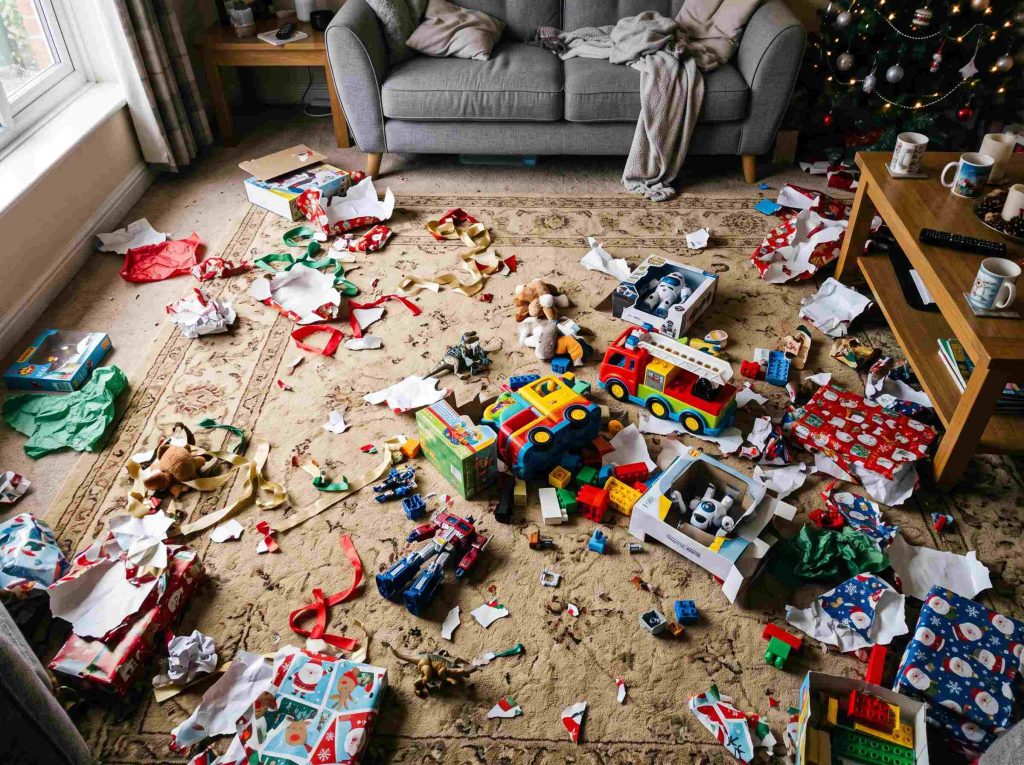
University of Toledo researchers tested quantity directly (Infant Behavior and Development, 2017, 36 toddlers aged 18 to 30 months). In sessions with four toys available, toddlers played longer with each item and invented more distinct ways to use it. In sessions with sixteen, they drifted between objects without settling into anything. Fewer options produced deeper play, which is the opposite of what a generous December pile assumes.
That study ran in a university playroom with unfamiliar toys, so real living rooms will differ in the details. The core finding still matches what teachers report after gift-heavy mornings: abundance itself competes for attention.
Three Levers for Any Gift List
One well-chosen present can outperform five boxed ones. The two studies point at the same levers: interaction quality over built-in noise, depth over volume, and the child’s actual stage over the printed age grade. Those levers sharpen into the four filters below, a repeatable screen for holiday gifts for kids.
A Four-Filter Framework for Choosing Gifts That Last
Filter One: Match the Developmental Stage, Not the Box Age
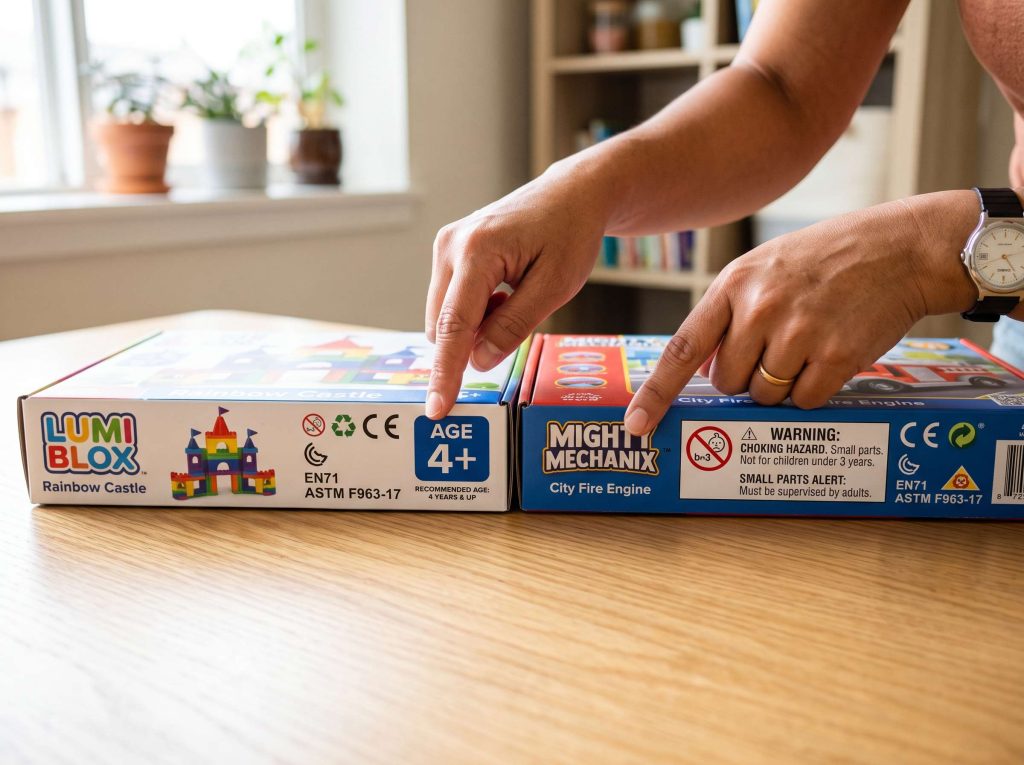
Age grading is a safety boundary, not a development report. A printed “3+” communicates part sizes and testing requirements, and nothing beyond that. A two-and-a-half-year-old who already stacks steadily may be ready for simple construction sets. A four-year-old still consolidating grip strength may abandon a fine-motor game within a week.
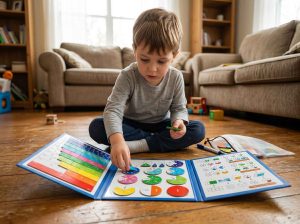
Ten minutes of watching how a child plays beats any shelf label. Dumping, sorting, lining up, and scripting each point to a different category of gift. The observations cost nothing and predict which holiday gifts for kids will stay in rotation better than any trending-products roundup.
Filter Two: Favor Open-Ended Items Over Single-Script Toys
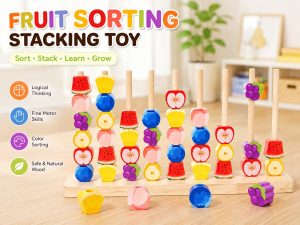
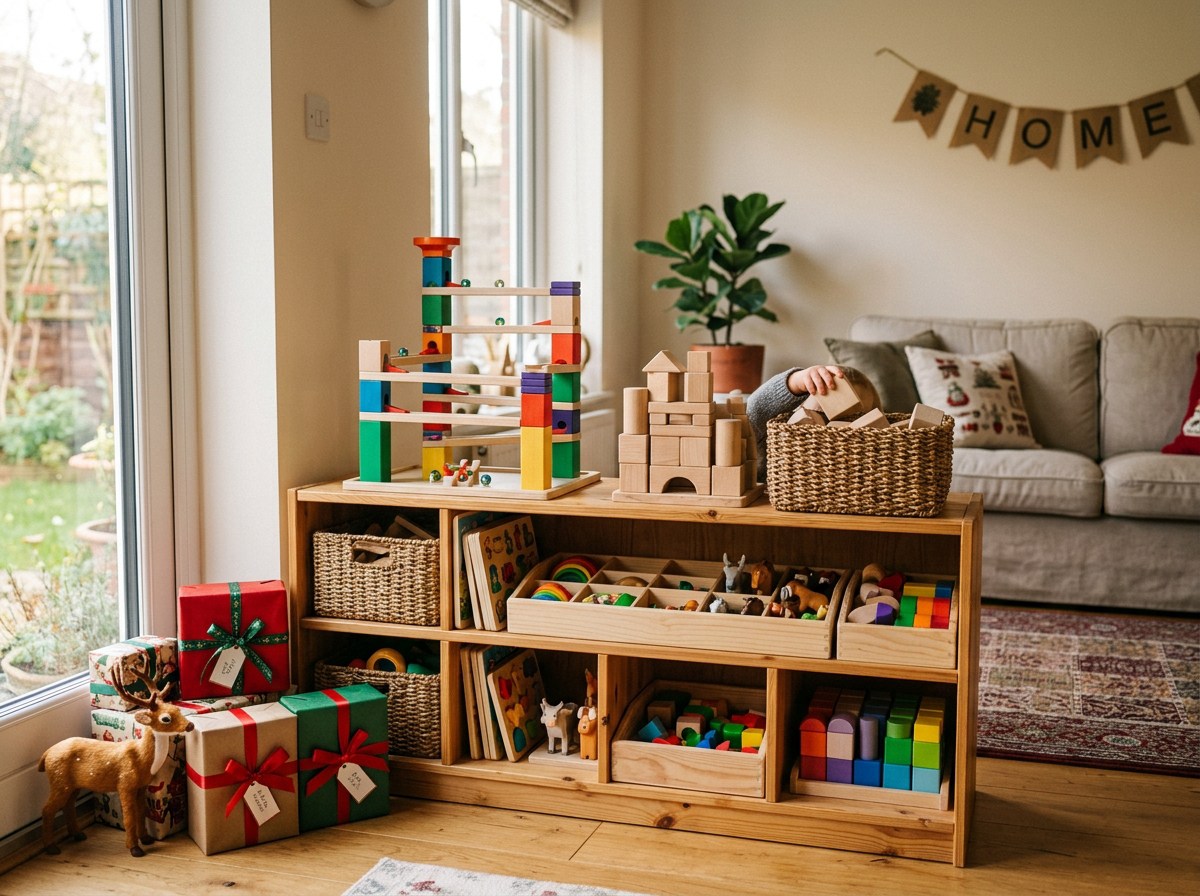
A toy with one script earns one month; a toy with ten scripts earns a year. Single-script items complete themselves: push the button, hear the song, done. Open-ended materials such as blocks, sorting sets, ball tracks, and pretend props carry the child’s own ideas. The same budget buys a much longer runway in the second category.
Filter Three: Apply the Ten-Month Test
Before checkout, project the gift into July. The question is whether the child will plausibly still reach for the item in midsummer, long after the holiday shopping noise has passed. A ball track that supports new arrangements each month passes easily. A licensed tie-in tied to a film release expires with its marketing campaign.
Holiday gifts for kids that pass this test also produce less February clutter. Fewer abandoned items mean fewer pieces headed to donation bins or landfill, which tightens the seasonal budget at the same time.
Filter Four: Check the Safety Floor Before Checkout
Certification marks a floor, not a promise of play value. In the United States, toys manufactured for children must meet the ASTM F963 toy safety standard, made mandatory by federal regulation under 16 CFR Part 1250. Products intended for children aged 12 and under additionally require a Children’s Product Certificate backed by third-party testing. The European Union runs its own EN71 regime for toys sold there.
Gifts mailed across borders follow the destination market’s rules, not the sender’s. Documentation should be current, batch-specific where possible, and available before payment rather than after. A certificate that arrives late is a shipment that arrives late.
Gift Ideas by Age Band: What Stays in Rotation
Ages One to Three: Hands, Cause, and Effect
Toddlers test the world through their hands. The gifts that hold this band respond physically: posting boxes, stackers, simple ball tracks, and percussion pieces. Battery-driven features add little at this stage, because the physical response is the point.
Toddler music sets follow their own selection rules, and a separate guide to rhythm toys and musical instruments for toddlers covers age-matched pieces, group sizes, and daily routines. Whatever the category, the test is whether the child’s action produces a visible, repeatable result.
Ages Three to Five: Rules, Roles, and Early Number Sense
Preschoolers can hold rules and roles, which multiplies what a toy can do. Board games teach turn-taking and graceful losing at exactly the age when both land. A practical framework for choosing board games for preschoolers sorts the market by skill load and session length.
Construction and sorting sets stretch the same band in a different direction. A three-games-in-one wooden falling ball game shows the principle: three rule sets share one set of pieces, so the gift serves a new player and an older sibling alike.
Classroom and Program Gift Lists
Shared-use gifts need a stricter filter than home gifts. Items for a classroom group face eight children a day instead of two, so durability, cleanable surfaces, and multi-player formats decide which shared holiday gifts for kids survive the year. Sorting collections and building bases outlast character tie-ins in this setting by a wide margin.
Teachers also value pieces that can be sanitized between groups, which most electronic and single-fabric items cannot tolerate. Holiday gift drives add one more constraint: donation programs typically request new, boxed items with legible age labels, since loose donated pieces cannot be checked one by one.
The December Traps That Push Gifts Out of Rotation
The Over-Gifting Pile
Generosity can sabotage itself by volume. When a child unwraps a dozen items in one morning, novelty competes with novelty and nothing gets played deeply. The practical fix is staggering: spread holiday gifts for kids across the season and hold one or two back for late January. Each gift then arrives after the last one has been fully mined, and rotation works on gifts exactly as it works on classroom shelves.
Trend Chasing and Licensed Short-Lifecycle Items
Trend toys are aging from the day they ship. A licensed item tied to a movie fades with the campaign, and the February second-hand market fills with barely used copies. Families lose most of the purchase price; retailers lose more, because leftover trend stock marks down hard in Q1. Evergreen categories such as construction, sorting, and games carry no expiry date at all.
The Screen Default for Convenience
Screens are an easy default, not a differentiator. Most households already own the relevant devices, so a screen-shaped gift often duplicates rather than adds. The World Health Organization’s 2019 guidance on early childhood activity caps sedentary screen time for three-to-four-year-olds at one hour. The same guidance calls for at least 180 minutes of varied physical activity daily.
Hands-on gifts sit on the active side of that balance. A screen-saturated December benefits most from something new to do with the hands.
Holiday Season Planning for Buyers and Programs
The same four filters decide store shelves, on a different calendar. A family can still buy holiday gifts for kids in mid-December; a buyer placing volume orders cannot. Every layer of the supply chain eats calendar time that money cannot compress later.
Q4 Lead Times Set the Assortment
The holiday line is decided in September and October, not December. Working backwards from a mid-November shelf date makes the constraint visible:
| Decision | Typical working value |
| Shelf-ready date | mid-November |
| Ocean and inland freight | 4-6 weeks |
| Mass production | 30-45 days |
| Sampling and revisions | 7-14 days |
| Effective order lock | early October |
Each row depends on the one above it, so a two-week sampling delay pushes the whole chain past the window. Experienced buyers request quotations and samples in September for exactly this reason.
One Quality System Across Materials
A certificate describes a standard; a running program shows how that standard behaves across an entire holiday line. Vindstier operates cross-material OEM and ODM production under a single ISO 9001 quality system. The same program can carry FSC-certified wooden components, child-safe plastic parts, and printed packaging with multilingual manuals. Each SKU ships with CPC and CE documentation at batch level, and sampling runs 7-14 days.
For a buyer assembling a mixed holiday catalog, one audited system replaces three supplier audits and three sets of test paperwork. That consolidation matters most in Q4, when every audit week costs shelf days.
Multi-Year Sell-Through Beats Single-Season Hype
Assortments that rest easy are built from evergreen play patterns. A three-games-in-one wooden set sells in any fourth quarter, not just the one riding a trend line. That staying power is what separates durable holiday gifts for kids from single-season novelties. Unsold stock stays sellable next season instead of marking down, and fewer SKUs with deeper play value simplify restocking year after year.
Choosing Holiday Gifts for Kids: The Short Version
The Five-Question Recap
The whole framework compresses into five questions for any checkout:
- Does it match how this child plays today, beyond the printed age grade?
- Does it support more than one script or arrangement?
- Will it plausibly still be in use in July?
- Is the safety documentation current for the destination market?
- Would it still be welcome if it arrived in mid-January?
Timing the Purchase
The calendar rewards early decisions at every scale. Families can apply the recap into mid-December with room to spare, and staggering the unwrapping costs nothing. Program directors ordering shared-use gifts do well to move a month earlier, since group items need evaluation time before the term ends. Gifts that ship across borders need their own buffer, because freight networks tighten sharply in mid-December.
The pattern worth repeating is simple: fewer, better-matched holiday gifts for kids outplay a mountain of boxed novelties, and the research behind that claim has been stable for years. Families can run the five questions at any checkout. Buyers and program leads planning seasonal volume can request a holiday assortment sheet with per-SKU certification documents and a reserved sampling slot through the Vindstier contact page before early October.