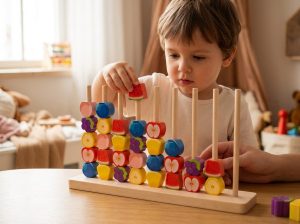
When rain cancels outdoor time, toddler classrooms face a predictable spiral: restless two- and three-year-olds bounce off walls, teachers scramble to improvise activities with limited materials, and what should be quality learning time dissolves into crowd control. The real cost isn’t just the lost recess—it’s the missed developmental window. Toddlers build foundational motor skills, spatial reasoning, and emotional regulation through active, hands-on play, and confining them to sedentary circle time or screen-based content during weather disruptions leaves critical growth areas unaddressed, which is why well-designed rainy day activities for toddlers matter so much for consistent program quality.
How do early childhood programs turn weather disruptions into productive learning opportunities without burning through prep time or requiring specialized training? The answer lies in selecting indoor educational toys designed for open-ended, self-directed engagement—materials that activate multiple developmental domains simultaneously while reducing teacher workload during high-stress schedule changes.
Why Weather-Proof Learning Materials Matter More Than Backup Plans
Most programs treat rainy days as exceptions requiring alternate plans, but weather variability is a structural reality. NOAA data shows that U.S. regions average 100-150 precipitation days annually, meaning 27-41% of school days carry potential outdoor time loss. Relying on improvised solutions—hastily printed worksheets, extended screen time, or repurposed art supplies—creates three compounding problems.
First, developmental continuity breaks. Toddlers thrive on consistent routines that reinforce emerging skills through repeated practice. When outdoor gross motor time disappears without equivalent indoor alternatives, children miss critical repetitions for balance, coordination, and bilateral movement integration during peak neural plasticity windows between 30-60 months.
Second, behavioral challenges escalate. Research from the University of Illinois found that toddlers require 60-90 minutes of active physical play daily to regulate arousal states and maintain attention during structured activities. Without adequate movement outlets, cortisol levels rise, triggering dysregulation that manifests as aggression, tantrums, or withdrawal—exactly when teachers have fewer tools and tighter spaces to manage group dynamics.
Third, teachers absorb compounding stress. Preparing backup activities, managing heightened behavioral needs, and maintaining educational quality simultaneously creates unsustainable workload spikes. A 2023 survey of early childhood educators reported that 68% identified weather-related schedule disruptions as a top-three source of workplace stress, directly correlated with burnout and turnover intentions.

The solution isn’t better backup plans—it’s infrastructure. Programs that invest in versatile indoor educational toys designed for autonomous toddler engagement eliminate the improvisation burden entirely. These materials don’t require lesson plan rewrites; they slot into existing routines while delivering equivalent or superior developmental outcomes compared to outdoor play, making effective rainy day activities for toddlers a matter of strategic material selection rather than constant teacher adaptation.
For purchasing decision-makers, this represents a shift from viewing rainy day materials as discretionary add-ons to recognizing them as core infrastructure that protects program quality, staff retention, and enrollment stability. The cost comparison becomes straightforward: the expense of maintaining consistent educational standards through weather disruptions versus the cumulative costs of staff turnover, parent dissatisfaction, and developmental gaps that require later intervention.
Selecting Indoor Educational Toys That Match Outdoor Developmental Gains
Effective rainy day activities for toddlers don’t simply occupy time—they deliver equivalent developmental outcomes to outdoor play across four critical domains: gross motor development, spatial-cognitive skills, social-emotional regulation, and sensory integration. Understanding how specific material categories map to these domains allows programs to build strategic inventories rather than random toy collections.
| Developmental Domain | Indoor Material Categories | Key Learning Outcomes | Space Requirements |
|---|---|---|---|
| Gross Motor Development | Soft foam climbing structures, balance beams, indoor stepping stones, push-pull toys with resistance | Balance, coordination, bilateral movement integration, large-muscle strength | 80-120 sq ft (compared to 400+ sq ft outdoor) |
| Spatial-Cognitive Skills | Building blocks, magnetic tiles, large interlocking construction sets, modular foam shapes | Spatial relationships, cause-effect reasoning, problem-solving, scaffolded complexity mastery | 40-60 sq ft per activity zone |
| Social-Emotional Regulation | Oversized building sets, collaborative art projects, dramatic play props, sensory tables | Turn-taking, shared goals, conflict resolution, parallel and associative play practice | 60-80 sq ft for collaborative zones |
| Sensory Integration | Sensory bins (rice, beans, water beads, kinetic sand), textured mats, resistance bands, weighted lap pads | Tactile input, proprioceptive awareness, vestibular processing, body awareness | 30-50 sq ft for sensory stations |
Gross Motor Development
Gross motor development indoors requires materials that safely accommodate large-muscle movements within confined spaces. Older toddlers and young preschoolers need opportunities for climbing, balancing, pushing, pulling, and whole-body coordination. Soft foam climbing structures, balance beams, indoor stepping stones, and push-pull toys with resistance create movement challenges comparable to playground equipment. The key distinction from outdoor play isn’t intensity—it’s spatial efficiency. A well-designed indoor gross motor setup occupies 80-120 square feet while supporting the same fundamental movement patterns as a 400+ square foot outdoor play zone, making these materials essential infrastructure for maintaining consistent rainy day activities for toddlers.
Spatial-Cognitive Development
Spatial-cognitive development through hands-on manipulation becomes the indoor parallel to outdoor exploration. Building blocks, magnetic tiles, large interlocking construction sets, and modular foam shapes allow toddlers to experiment with spatial relationships, cause-effect reasoning, and problem-solving through trial and error. These materials offer a unique advantage over outdoor play: controlled variables. While outdoor environments present infinite but unstructured spatial puzzles, quality construction toys provide scaffolded complexity that toddlers can independently navigate, building confidence through mastery before advancing to more complex challenges.
Social-Emotional Regulation
Social-emotional regulation benefits from cooperative play materials that encourage parallel and associative play without requiring complex rule-following. Oversized building sets, collaborative art projects, dramatic play props, and sensory tables create natural opportunities for turn-taking, shared goals, and conflict resolution practice in low-stakes contexts. The indoor environment’s reduced stimulation compared to outdoor spaces actually enhances some toddlers’ capacity for sustained social engagement, particularly for children with sensory sensitivities or emerging self-regulation skills, delivering social learning outcomes that outdoor free play alone cannot guarantee during structured rainy day activities for toddlers.
Sensory Integration
Sensory integration needs don’t pause during weather disruptions. Older toddlers and preschoolers require varied tactile, proprioceptive, and vestibular input to develop body awareness and sensory processing skills. Indoor sensory bins with varied materials (rice, beans, water beads, kinetic sand), textured mats, resistance bands, and weighted lap pads provide controlled sensory experiences. Unlike outdoor sensory play, which offers rich but unpredictable input, indoor sensory materials allow teachers to target specific sensory needs—particularly valuable for children with sensory processing differences who benefit from predictable, modulated input.
The selection framework for purchasing teams centers on multi-domain materials—toys and equipment that simultaneously address multiple developmental areas rather than single-purpose items. A high-quality magnetic building set, for example, develops fine motor skills, spatial reasoning, problem-solving, and collaborative play simultaneously, delivering higher ROI per square foot of storage and floor space than toys addressing only one domain.
Materials must also meet three operational criteria: independent accessibility for toddlers without constant adult facilitation, durability through intensive daily use across multiple age groups, and low-maintenance cleaning protocols that fit within existing sanitation routines. For full institutional durability specifications and material benchmarks, refer to our guide to durable educational toys for schools. Products requiring adult setup, frequent component replacement, or specialized cleaning processes create hidden costs that erode their practical value regardless of developmental benefits.
For a whole-classroom toy selection framework covering all developmental domains and inventory strategy, see our complete preschool classroom toys selection guide.
Implementation Strategies for Rainy Day Activities for Toddlers That Cut Prep Time
Owning quality materials solves only half the equation—implementation design determines whether rainy day activities for toddlers genuinely reduce teacher burden or simply shift it. Effective strategies prioritize toddler autonomy, minimize transition friction, and eliminate the need for activity-specific lesson planning.
Accessible Storage Systems
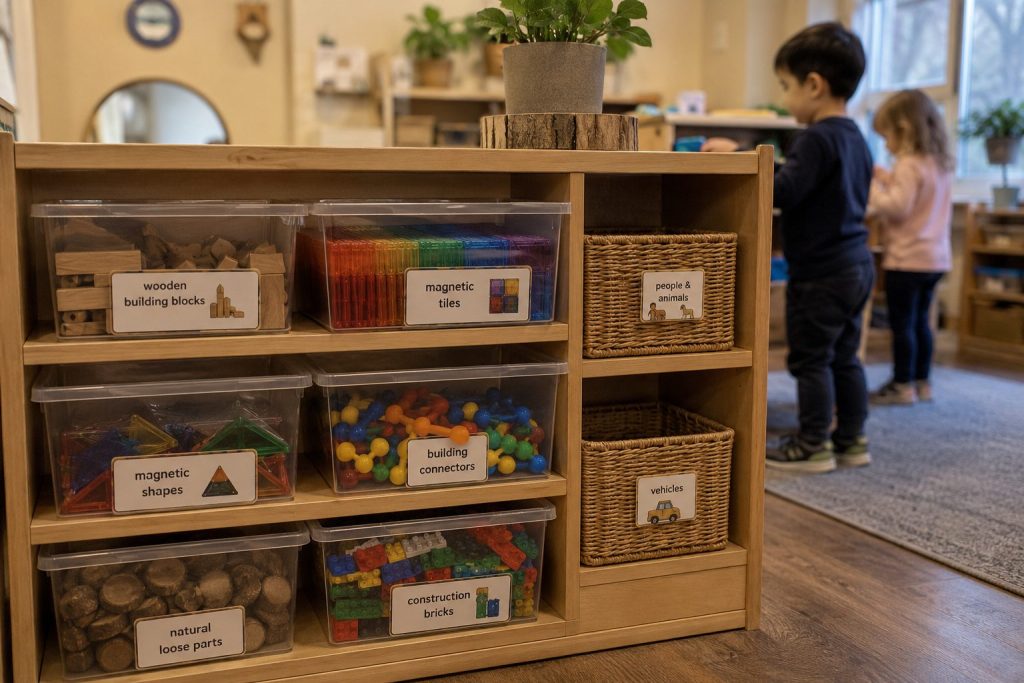
Accessible storage systems transform materials from teacher-distributed resources into child-initiated activities. Open shelving units at toddler height (24-30 inches), with clear bins labeled by visual icons rather than text, allow children to independently select, use, and return materials without teacher intervention. This mirrors the Montessori prepared environment principle but adapted for group care realities: materials remain available but organized, supporting choice without chaos. Programs implementing accessible storage report 40-50% reductions in teacher time spent managing material distribution and cleanup during unstructured play periods, directly enhancing the efficiency of rainy day activities for toddlers.
Rotation Schedules
Rotation schedules maintain novelty without requiring new purchases. Dividing materials into three sets and rotating them every 3-4 weeks creates perceived novelty that sustains engagement, leveraging toddlers’ limited long-term memory. A set that felt familiar in September becomes exciting again in December. This approach delivers the engagement benefits of constantly purchasing new toys at zero incremental cost, while reducing visual clutter that can overwhelm toddlers and make cleanup more difficult.
Zone-Based Layouts
Zone-based layouts replace teacher-directed activity transitions with environmental cues that guide behavior. Designating distinct areas for active play, construction, sensory exploration, and quiet activities allows toddlers to self-select intensity levels based on their current regulation state. A child escalating toward dysregulation can move to the sensory zone; a child seeking challenge migrates to the construction area. Teachers shift from directing individual children to monitoring flow patterns and providing targeted support where needed, fundamentally changing the adult role from activity manager to environmental facilitator during rainy day activities for toddlers.
Open-Ended Activity Frameworks
Open-ended activity frameworks eliminate lesson-plan dependency. Rather than scripting specific activities (“build a tower with magnetic tiles”), teachers establish broad invitations (“builders zone is open”) that accommodate varied developmental levels and interests simultaneously. A younger toddler explores tile textures and cause-effect by stacking and knocking down; an older preschooler constructs representational structures and narrates stories. Both engage meaningfully with identical materials without requiring differentiated teacher preparation.
This implementation approach delivers compound benefits for programs. Teachers experience reduced cognitive load during schedule disruptions, allowing them to maintain calm presence that supports children’s emotional regulation. Children develop self-direction and decision-making skills through repeated practice selecting and engaging with activities independently. Parents observe their children demonstrating skills like sustained focus and collaborative play, increasing satisfaction with program quality even during challenging weather stretches.
For purchasing decision-makers, these implementation strategies clarify the total cost equation. Materials requiring extensive teacher prep, constant supervision, or frequent replacement actually cost more per hour of quality engagement than higher-priced durable goods that support autonomous play. The evaluation question shifts from “what’s the unit cost?” to “what’s the cost per hour of independent, developmentally appropriate engagement?”
Magnetic Building Toys as Weather-Proof Learning Infrastructure
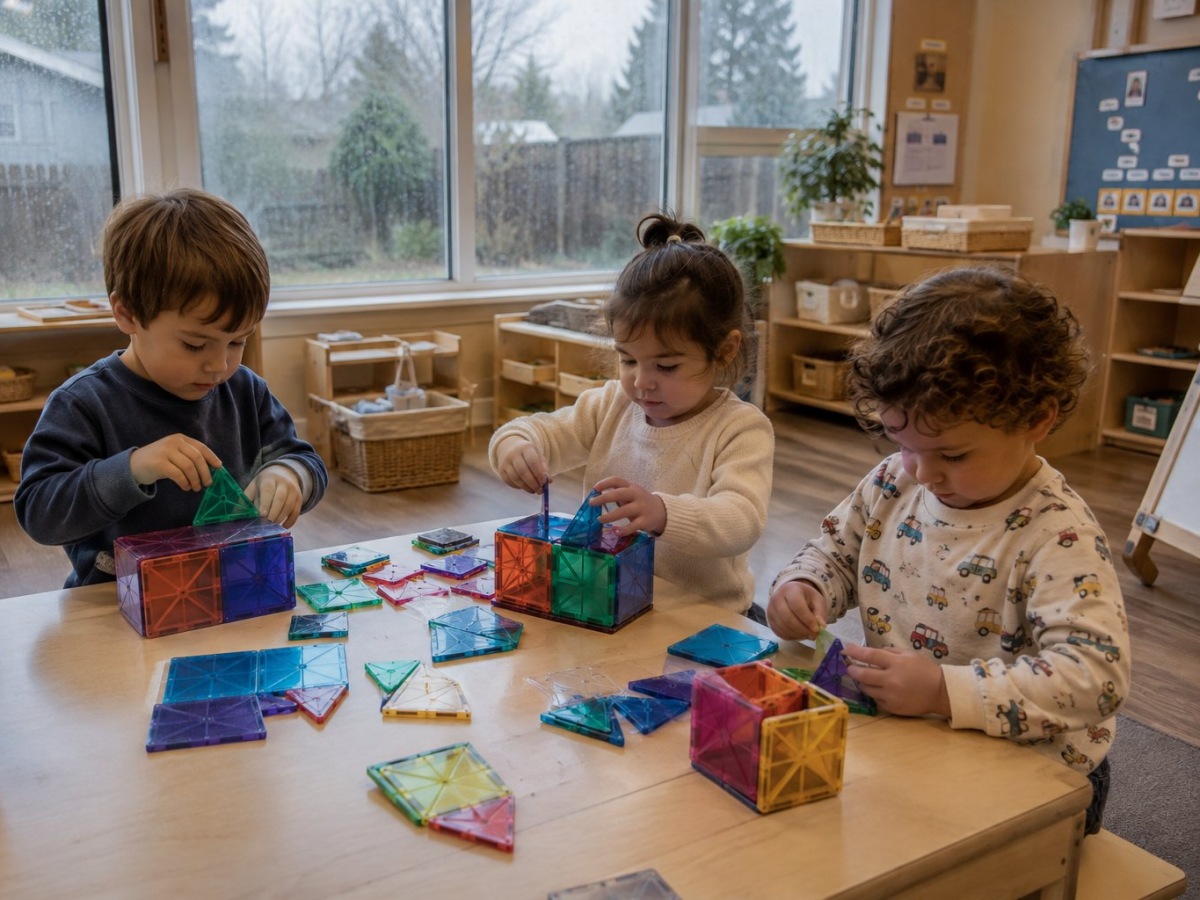
Within the landscape of indoor educational materials, magnetic building sets occupy a unique position: they simultaneously address gross motor development (for younger toddlers), fine motor skills, spatial reasoning, collaborative play, and independent engagement—while requiring near-zero teacher facilitation and minimal storage space. Understanding why these materials perform differently than conventional building blocks or puzzles clarifies their growing adoption across early childhood programs.
The magnetic connection mechanism solves toddlers’ primary frustration with traditional building materials: structural instability. Young preschoolers lack the fine motor precision and force modulation to stack wooden blocks without frequent collapses, creating repeated failure experiences that trigger emotional dysregulation. Magnetic tiles connect with minimal pressure and hold positions even when bumped, allowing toddlers to execute their spatial ideas without constant structural failure. This shifts the challenge from motor execution to conceptual planning—exactly where learning should concentrate during this developmental period.

Transparency and light interaction create unique sensory-cognitive integration opportunities. When toddlers build near windows or light tables, magnetic tiles become impromptu color-mixing labs and light experiments. This emergent STEM learning happens without teacher scripting; the material properties invite exploration. Programs using magnetic building sets near natural light sources report extended engagement periods (15-20 minutes average for younger toddlers, 25-35 minutes for preschool-age children) compared to opaque building materials, likely due to the additional sensory feedback layer that maintains attention.
Scalability across age ranges protects investment longevity. The same magnetic tile set grows with children from older toddler years (30-36 months) through preschool ages 3-5, adapting from simple cause-effect stacking to more complex representational designs and collaborative projects. This multi-year usability span is unusual among toddler materials; most toys target narrower developmental windows.
The Vindstier magnetic building tile system addresses classroom functionality through design features that extend durability and usability. The 1.5mm tile thickness prevents warping under repeated stress, while riveted magnet housings eliminate the primary failure mode of budget alternatives. The tile size (standard 3-inch squares and triangles) balances toddler grasp requirements with construction stability. Color selection follows research on visual processing in early childhood: six distinct hues at high saturation levels support color recognition without cognitive overwhelm, while 70% light transmission balances color vibrancy with see-through functionality. Storage design allows 100+ piece sets to occupy less than 0.5 cubic feet, addressing space constraints in programs operating in shared or repurposed facilities.
Complementary materials like soft foam climbing structures and sensory bins extend the range of effective rainy day activities for toddlers, each addressing different developmental domains while maintaining the same autonomous-engagement design principle that reduces teacher workload during weather disruptions.
Measuring Engagement Success and Recognizing Implementation Gaps
Quality materials don’t automatically translate to effective learning—implementation success requires observable metrics that help teachers and administrators distinguish genuine engagement from simple time-filling. Understanding what productive engagement looks like in rainy day activities for toddlers, and what signals implementation problems, allows programs to optimize their investments rather than just hoping materials work.
| Engagement Indicator | Age 24-30 Months (Younger Toddlers) | Age 30-36 Months (Older Toddlers) | Age 3-4 Years (Preschool) | Problem Signals |
|---|---|---|---|---|
| Sustained Attention Duration | 10-15 minutes per material | 15-20 minutes per material | 20-30 minutes per material | Consistently shorter durations suggest material-capability mismatch or environmental distractions |
| Independent Problem-Solving | Simple trial-error with immediate retry | Multiple approach variations after failure | Systematic testing of alternatives before seeking help | Repeated failed attempts without modification or immediate help-seeking indicates frustration or learned helplessness |
| Collaborative Play | Parallel play alongside peers | Early associative play with material sharing | Coordinated play with shared goals and role assignment | Persistent conflict over access or complete isolation suggests quantity shortage or accessibility issues |
| Language Use | 2-3 word phrases describing actions | Simple sentences narrating construction process | Complex narration, peer conversation, and story-building | Complete silence across all children may indicate insufficient cognitive challenge |
| Teacher Intervention Frequency | Occasional redirection and safety supervision | Minimal conflict mediation, primarily monitoring | Near-zero facilitation beyond general environmental oversight | Constant teacher involvement indicates material doesn’t support autonomous engagement |
| Cleanup Cooperation | Cooperative with consistent prompting | Independent cleanup with simple reminders | Self-initiated cleanup as part of routine | Consistent refusal suggests activity created frustration rather than satisfaction |
Sustained Attention Duration
Sustained attention duration serves as the primary engagement indicator. For younger toddlers (24-30 months), meaningful engagement spans 10-15 minutes with a single material before natural attention shifts. For older toddlers (30-36 months), this extends to 15-20 minutes. For preschool-age children (3-4 years), 20-30 minutes represents typical sustained focus. These benchmarks reflect developmental norms; materials or setups producing consistently shorter durations signal mismatch between material complexity and child capabilities, or environmental distractions disrupting focus during rainy day activities for toddlers.
Independent Problem-Solving Behaviors
Independent problem-solving behaviors indicate cognitive engagement rather than simple sensory exploration. Watch for trial-and-error sequences: attempting a construction approach, encountering failure, modifying the approach, and retrying. This pattern demonstrates active reasoning rather than random manipulation. If children repeatedly attempt the same failed approach without modification, or immediately seek teacher help rather than experimenting, the material may be too complex for their current skill level or they’ve learned helplessness from previous experiences with materials that frustrated them.
Collaborative Play Emergence
Collaborative play emergence provides social-emotional engagement evidence. Toddlers naturally begin parallel play (playing alongside peers with similar materials) around 24-30 months, transitioning toward associative play (interacting around shared materials without coordinated goals) by 30-36 months, and developing cooperative play with shared objectives by preschool years. Materials effectively supporting social development create these interactions organically—children naturally share, compare constructions, or build adjacent structures that spark conversation. If materials consistently produce conflict over access or isolated parallel play never evolving toward interaction, redesign storage accessibility or increase material quantity to reduce competition, particularly critical for successful rainy day activities for toddlers in confined spaces.
Language Use During Play
Language use during play signals meaningful cognitive processing. Toddlers narrating their actions (“big tower,” “car goes in”), asking questions about their constructions, or engaging peers in play-related conversation demonstrate integration of concepts with language development. Silence during play isn’t necessarily problematic—some children process internally—but complete absence of any language use across all children during a specific activity may indicate the material doesn’t invite linguistic processing or lacks sufficient cognitive challenge to activate language centers.
Teacher Intervention Frequency
Teacher intervention frequency reveals whether materials truly reduce workload or simply shift it. Effective rainy day activities for toddlers require minimal adult facilitation: occasional redirection to support sharing, rare scaffolding when children become genuinely stuck, and general supervision to ensure safety. If teachers find themselves constantly initiating activity extensions, resolving conflicts, or reengaging children who’ve lost focus within 5-7 minutes, the material isn’t delivering autonomous engagement—it’s creating a teacher-dependent activity that compounds rather than reduces weather-day stress.
Cleanup Cooperation
Cleanup cooperation offers a proxy measure for overall activity satisfaction. Toddlers resist transitioning away from activities they find genuinely engaging, but typically cooperate with cleanup for activities they enjoyed (compared to outright refusal for activities they found boring or frustrating). Consistent cleanup battles specifically with certain materials may signal they’re not as engaging as adult assumptions suggest, or that the activity creates frustration that manifests during the transition rather than during play, a critical consideration when evaluating rainy day activities for toddlers.
Boundaries and Realistic Limitations
Indoor educational toys effectively substitute for outdoor play’s physical and cognitive development opportunities, but they don’t fully replace outdoor environments’ unique contributions. Two limitations matter most for program planning around rainy day activities for toddlers.
Sensory input variety remains constrained indoors. Outdoor environments provide unpredictable wind, temperature variation, natural scents, and complex visual patterns (trees, clouds, wildlife) that activate sensory processing systems in ways indoor spaces cannot replicate. Toddlers with sensory processing sensitivities particularly benefit from outdoor time’s rich, non-threatening sensory input. Quality indoor materials mitigate but don’t eliminate this gap—programs should prioritize outdoor time whenever possible and view rainy day activities for toddlers as weather-driven substitutes rather than equivalents.
Gross motor development ceiling exists in indoor spaces. Older toddlers and preschoolers need opportunities for running, jumping from heights, climbing challenging structures, and unrestricted large-muscle movements that indoor safety constraints necessarily limit. A child ages 3-4 ready to practice running at speed or jumping from progressively higher platforms cannot safely do so indoors. Indoor gross motor materials effectively maintain existing skills and support foundational movements but cannot fully substitute for outdoor play’s role in advancing to more complex gross motor milestones, which means even well-designed rainy day activities for toddlers function best as temporary bridges rather than permanent replacements.
Common implementation mistakes undermine even quality materials. Rotating materials too frequently (weekly) prevents toddlers from achieving mastery and creates constant novelty-seeking rather than deep engagement. Over-organizing materials, with rigid rules about where and how children use them, eliminates the open-ended exploration that drives learning. Under-purchasing quantities, forcing toddlers to wait or share at ratios that guarantee conflict, transforms collaboration opportunities into frustration triggers. Mixing materials designed for different developmental levels in the same storage area overwhelms decision-making and reduces engagement with any single option.
Purchase decisions also carry common pitfalls. Prioritizing visual appeal to adults over functional design for toddlers yields Instagram-worthy classrooms with low actual play value. Buying numerous single-purpose toys rather than fewer multi-domain materials fragments budgets without proportional learning outcomes. Selecting materials requiring significant adult facilitation ignores implementation reality—teachers cannot provide individualized guidance to multiple toddlers simultaneously during weather-disrupted schedules, exactly when effective rainy day activities for toddlers should minimize rather than increase teacher workload.
Conclusion
Weather disruptions challenge early childhood programs to maintain developmental continuity and educational quality under constrained conditions, but programs treating rainy days as crises rather than routine realities bear unnecessary costs in teacher stress, child development, and family satisfaction. Strategic investment in versatile indoor educational toys—particularly those supporting autonomous engagement across multiple developmental domains—transforms weather variability from a programmatic vulnerability into a non-event. Well-planned rainy day activities for toddlers prioritize materials offering extended durability, multi-age usability, and minimal teacher facilitation requirements, ensuring consistent learning outcomes regardless of weather while protecting staff capacity and program sustainability.
The infrastructure approach evaluates materials not by unit cost but by cost-per-hour of quality engagement across expected lifecycle, considering factors like durability specifications, storage efficiency, sanitation compatibility, and the hidden cost savings of reduced teacher cognitive load during high-stress schedule disruptions. For educators, building material inventories where rainy days require zero lesson plan adjustments creates environments where children transition seamlessly between outdoor and indoor learning because both offer equivalent developmental opportunities through different means. For purchasing decision-makers and program administrators, recognizing effective rainy day activities for toddlers as core infrastructure rather than supplementary enrichment protects the dual priorities of child development quality and operational stability across the 27-41% of annual school days affected by precipitation.