A school orders a full set of building blocks in September. By February, a third of the pieces are cracked, connectors are missing, and two teachers have quietly removed the sets from rotation because managing broken components takes more time than the activity is worth. It’s a common and costly problem with educational toys for schools: the procurement officer ends up facing a mid-year replacement order — unbudgeted, unjustified, and entirely preventable.
Durability in educational toys for schools isn’t a premium feature. It’s the baseline condition for any toy to deliver educational value at all. Yet most selection frameworks still prioritize theme, price point, and age labeling over the structural and material factors that determine whether a product survives daily institutional use across multiple classrooms, multiple years, and hundreds of children.
This guide breaks down the specific standards, material criteria, and procurement logic that distinguish toys worth buying for institutional settings from those that perform well in single-household conditions but fail under school-load stress.
Why School Use Destroys Consumer-Grade Toys Faster Than Expected
The usage gap between home and school environments is larger than most procurement guides acknowledge. A toy used at home might see 30–60 minutes of interaction per day, by one or two children, with adult supervision. The same toy in a learning center classroom faces 4–6 hours of active use, across 15–25 children per session, through multiple daily rotations, with storage and redistribution cycles happening two to four times daily.
Material fatigue under institutional load follows a different curve. Consumer-grade plastics rated for normal wear begin showing stress fractures under high-cycle loading — repeated bending, snapping, stacking, and dropping — significantly faster than product testing at typical home-use frequencies would predict. The same applies to fabric components, wooden joints, and painted surfaces.
For school procurement officers, this usage gap has a direct cost implication. A toy priced 40% higher than a consumer alternative but rated for three times the institutional cycle volume typically delivers a lower total cost per use-hour. The unit price comparison that dominates many purchasing decisions captures only the acquisition cost, not the lifecycle cost — which is the figure that actually matters for budget planning. This usage gap is why standard consumer products rarely work as long-lasting educational toys for schools.
For teachers, the practical consequence is simpler: broken toys generate classroom friction. Time spent identifying damaged pieces, managing children’s frustration with malfunctioning components, or substituting activities because materials are unavailable compounds across a semester into a measurable loss of instructional time.
Material Standards That Predict Institutional Durability

When evaluating educational toys for schools for institutional durability, material performance under high-cycle use is the first filter. Not all materials perform equally under school conditions, and understanding which specifications to request from suppliers gives procurement teams a functional filter that goes beyond brand claims.
Plastics: ABS vs. standard polypropylene
Acrylonitrile butadiene styrene (ABS) plastic is the benchmark material for durable educational manipulatives. Its impact resistance under repeated mechanical stress is significantly higher than standard polypropylene, and it maintains dimensional stability across the temperature ranges typical in school storage environments. When evaluating plastic educational toys, requesting material specification sheets from suppliers and confirming ABS construction in structural components is a reasonable procurement standard. This is a core quality benchmark for plastic educational toys for schools intended for daily institutional use.
Surface finish matters separately from base material. Matte or texture-treated surfaces resist visible scratching better than high-gloss finishes, which show wear rapidly in shared-use environments and create a perception of lower quality even when structural integrity remains intact.
Wood: grade, joinery method, and finish type
Wooden educational toys vary significantly by timber grade and construction method. Toys made from solid hardwood — beech, maple, birch — consistently outperform those made from MDF, particle board, or low-grade softwood in institutional settings. Joint construction — whether pieces are doweled, mortised, or simply glued — determines whether components survive drop impact and lateral stress without separating.
Paint and finish type on wooden toys carries compliance implications as well as durability ones. Water-based, non-toxic finishes certified to EN 71-3 or ASTM F963 standards are the baseline for any product used with children under 12. Finishes should also be evaluated for chip resistance under mechanical abrasion, since paint flaking creates both a safety concern and accelerated visual degradation. These construction and finish standards define reliably long-wearing wooden educational toys for schools.
Fabric and soft components
Soft educational toys, sensory materials, and fabric-based learning tools require specific attention to seam construction and fill material. Double-stitched seams with reinforced stress points substantially outlast single-stitch construction under the pull and compression forces children apply during play. Fill materials should be certified non-toxic and washable, since hygiene maintenance over a school year adds significant use stress that home-use products are typically not engineered for.
Six Key Criteria for Choosing Educational Toys for Schools

Selecting educational toys for schools requires evaluating six dimensions that consumer retail review frameworks rarely address in combination. For a whole-classroom toy selection framework covering developmental value and inventory strategy, see our complete preschool classroom toys selection guide.
Safety certification scope
ASTM F963 (US), EN 71 (EU), and CPC (Children’s Product Certificate) certifications are the compliance floor. For institutional procurement, it’s worth confirming that certification applies to the specific product variant being purchased — not just a parent product line — since component differences between variants can affect certification validity. Verifying full certification coverage is a non-negotiable step for sourcing educational toys for schools.
Piece count manageability
Sets with high piece counts deliver greater play complexity but create proportionally higher management overhead. A 200-piece construction set used across 20 children generates sorting, distribution, and inventory challenges that reduce effective instructional time. The optimum piece count depends on storage infrastructure, activity design, and available staff time — not just educational scope.
Age-range span
Products with a documented functional range across multiple developmental stages offer better institutional ROI than those optimized for a narrow age band. A manipulative that supports both early counting activities and more complex pattern work can remain in rotation through multiple grade levels, reducing per-year acquisition cost.
Replacement part availability
Even the most durable products lose individual components over time in institutional use. Suppliers who offer replaceable parts — individual tiles, connectors, or pieces sold separately — extend effective product life significantly. This should be a confirmed procurement requirement, not an assumed feature. This is an often-overlooked factor that extends the usable life of educational toys for schools dramatically.
Cleaning and sanitization compatibility
Materials must withstand the cleaning agents used in school environments. Foam components, certain painted surfaces, and some adhesive joints degrade with repeated exposure to standard disinfectants. Requesting sanitization compatibility specifications prevents premature degradation from routine maintenance.
Storage design and stackability
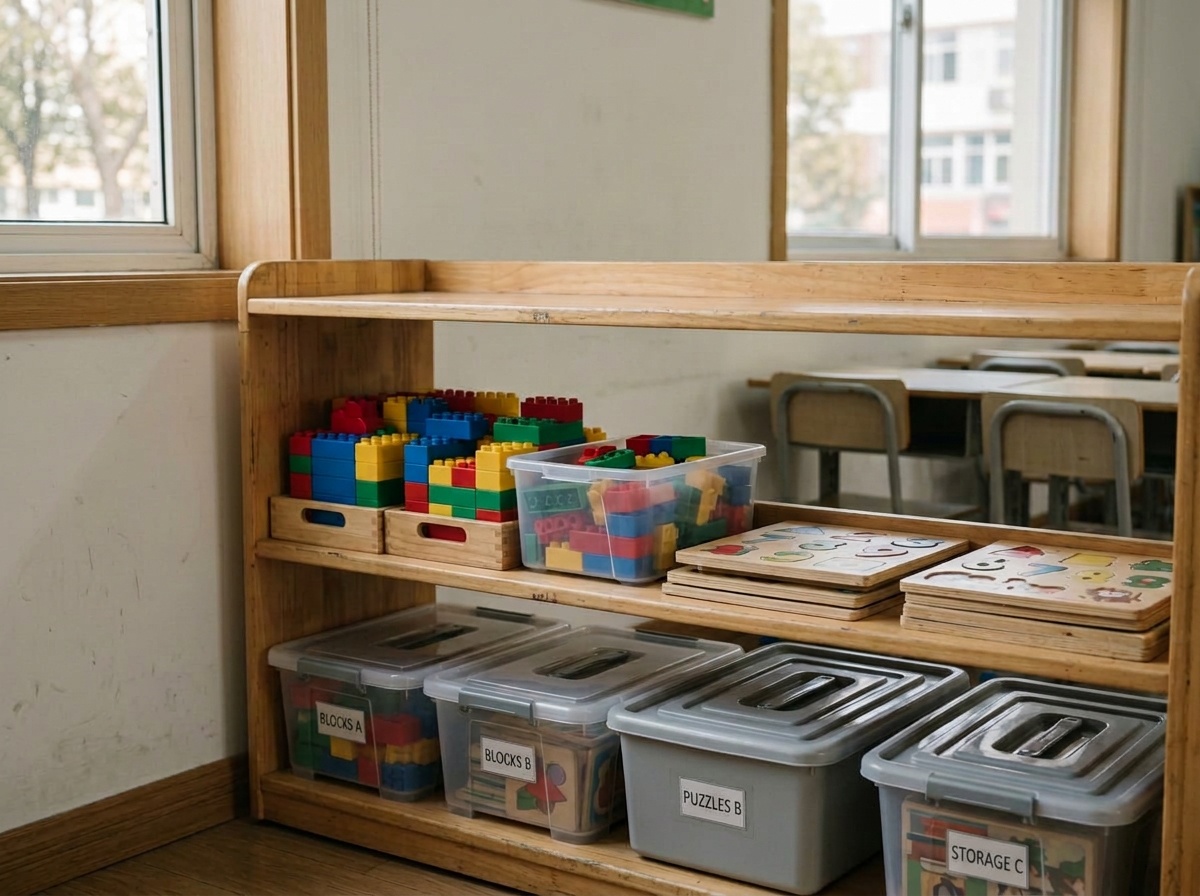
Toys that come with or are compatible with labeled, stackable storage systems reduce classroom transition time, improve inventory management, and decrease the physical handling that contributes to component wear. Products without storage solutions impose that design burden on teachers, who improvise solutions that often accelerate damage. Built-in storage design directly reduces handling damage and extends the service life of educational toys for schools.
How Teachers Can Evaluate Durability Before a Full Classroom Rollout
Classroom pilot testing is the most reliable way to verify whether educational toys for schools will hold up under real-world conditions. A structured pilot evaluation — even with a single classroom set over four to six weeks — generates useful data before a school commits to full-scale purchasing.
The most informative pilot protocol focuses on three observable indicators. First, track component loss rate: how many pieces cannot be accounted for after each session, and whether that rate increases or stabilizes over the evaluation period. Second, observe connector and joint integrity: listen for sounds of stress fractures, watch for connectors that become progressively looser over repeated use, and note any pieces that deform under normal load. Third, record teacher time allocated to material management per session — distribution, collection, sorting, and damage identification. If management time exceeds 15% of total activity time, either the product design or the classroom system requires adjustment.
For teachers managing mixed-age or multi-group classrooms, a secondary evaluation criterion is cross-group adaptability. Can the same set be used across different activity formats without modification? Products that require significant teacher preparation between group uses reduce the instructional efficiency gains that motivate the investment in quality materials.
The pilot data also provides a stronger internal justification for budget requests. Concrete numbers — piece loss rate, management time per session, observable wear indicators — make a more persuasive case to school administrators than general durability claims from product literature.
What Durable Design Actually Looks Like in Practice

These small design details are what separate truly durable educational toys for schools from residential-grade alternatives. Durability is expressed through specific engineering decisions, not just material quality, and understanding what to look for enables procurement teams and teachers to evaluate products more accurately than brand reputation or price tier alone would allow.
Connector tolerance engineering
Connector tolerance engineering is one of the more consequential design factors in construction-type educational toys. Connectors that fit too loosely fail to hold under normal use; connectors that fit too tightly require force that exceeds the hand strength of younger children and creates joint fatigue over repeated cycles. Well-engineered connectors maintain consistent resistance across thousands of connection cycles — a specification that reputable manufacturers can provide from standardized testing. Precision engineering here is what separates long-lasting educational toys for schools from disposable consumer alternatives.
Edge and corner geometry
Edge and corner geometry affects both safety and longevity. Rounded edges on plastic and wooden components reduce chipping and cracking under impact stress, while also reducing injury risk during high-energy play. Sharp-edged components that look clean in product photography often show stress fractures at corners earlier than rounded designs under institutional use conditions. This simple design detail contributes significantly to the real-world longevity of educational toys for schools.
Color stability under use conditions
Color stability under UV exposure and cleaning cycles matters more in school environments than in home contexts, where products are less exposed to both factors. Colorfast dyes and pigments that maintain visual clarity over time support the pedagogical function of color-coded educational materials — a building set where red pieces have faded to orange undermines color-recognition activities regardless of structural integrity.
Vindstier Educational Toys: Designed for Institutional Standards
The selection criteria above describe a demanding specification set that consumer products rarely meet in full combination. Vindstier’s line of educational toys for schools was developed specifically to address the durability, compliance, and manageability requirements of institutional use environments.
Core construction components use ABS plastic with impact resistance tested to institutional cycle volumes — not consumer-use benchmarks. Connector tolerance is calibrated to maintain consistent resistance across a verified 5,000+ connection cycles under standardized mechanical testing protocols. All products carry current ASTM F963 and EN 71 certification, with CPC documentation available for US institutional procurement.
The product range is designed with age-span flexibility, supporting developmental activities from ages 3 through 8 within the same core set, which extends useful classroom life and reduces the per-year cost when spread across multiple grade levels or ability groups. Individual replacement components are available through the distributor network, eliminating full-set replacement as the only response to piece loss.
Storage systems are included as standard with classroom-scale sets, with labeled, stackable containers sized for standard school shelving. Sanitization compatibility has been verified for common institutional cleaning agents, with specific guidance available in the product documentation.
For procurement teams evaluating suppliers, Vindstier offers sample sets for structured pilot evaluation prior to volume commitment. Distributor pricing and institutional volume terms are available through direct inquiry.
Recognizing When Durability Alone Isn’t Enough
Even the highest-quality educational toys for schools will underperform if selected without matching real use context. Several common purchasing errors persist even when durability standards are applied correctly.
Over-specifying for the actual use context is one of them. A product engineered for high institutional cycle volumes is not automatically better than a lower-rated alternative if the school’s rotation schedule means a set will physically see far fewer cycles over its intended service life. Matching durability specification to actual institutional load prevents over-investment in capabilities that don’t translate to observable benefit.
Durability without pedagogical coherence produces a different failure mode. Extremely durable toys that don’t align with curriculum objectives, developmental stages, or classroom activity formats generate low utilization — which means the per-use cost of a highly durable product can still exceed that of a less durable product with higher actual engagement. Durability serves educational value; it doesn’t substitute for it.
The single-supplier concentration risk is worth noting for larger procurement programs. Institutional dependence on one product line for core manipulatives creates vulnerability if supply chain issues affect availability or replacement parts. Maintaining supplier diversity across product categories is a reasonable risk-management practice for district-level procurement.
Finally, teacher familiarity affects realized durability in ways that product testing doesn’t capture. Products that teachers don’t understand how to use correctly tend to experience accelerated wear from misuse — forcing connectors in wrong orientations, storing products in ways that stress structural joints, or using materials in activity formats they weren’t designed for. Supplier-provided onboarding resources or professional development support meaningfully extends product service life by closing the gap between designed use and actual use. Proper onboarding helps schools get the maximum service life from their educational toys for schools.
Conclusion
For school procurement officers, the core shift this framework calls for is moving from unit price comparison to lifecycle cost analysis. Educational toys for schools that meet institutional material standards, carry appropriate safety certifications, offer replacement part support, and come with compatible storage systems consistently deliver lower total cost per use-hour than consumer-grade alternatives — even when their acquisition price is higher.
For teachers and learning center directors, the practical takeaway is that durability and instructional quality are not independent variables. Materials that fail mid-year, require excessive management time, or create safety concerns from wear damage reduce teaching effectiveness in concrete, measurable ways. Selecting for institutional durability is a direct investment in available instructional time.
For distributors and resellers evaluating which product lines to carry for the school market, institutional buyers apply different decision criteria than retail consumers. The ability to provide material specifications, certification documentation, replacement part programs, and lifecycle cost data — not just unit pricing — determines positioning in institutional sales conversations.
Ready to evaluate Vindstier’s institutional range? Request a sample set, certification documentation, or volume pricing for your next procurement cycle — contact the team directly for distributor and school inquiries.