

Four-year-olds ask an average of 73 questions per hour, according to researchers at the University of Michigan. Yet most preschool curricula still prioritize literacy and social skills, leaving systematic science and problem-solving development to “play time” without structured learning goals. Teachers report wanting to nurture this natural curiosity but struggle with the gap between abstract concepts and what a preschooler can actually grasp. Generic building blocks and shape sorters don’t bridge that gap—they’re too open-ended for targeted skill development, yet too simple to introduce real scientific thinking. The real challenge isn’t finding products labeled “educational.” It’s identifying STEM toys for 4 year olds that translate complex ideas like cause-and-effect, spatial reasoning, and basic engineering into experiences children can understand through hands-on exploration, while giving teachers clear pathways to guide that learning without needing a science degree themselves.
Why Four Is the Critical Window for STEM Foundation
Between ages 3.5 and 5, children develop what developmental psychologists call “intuitive physics”—the ability to predict how objects will behave based on physical properties rather than magical thinking. Research from Johns Hopkins University shows this window is when children naturally begin testing hypotheses through repeated experimentation, building mental models of how the world works. Miss this period, and you’re not just delaying exposure—you’re missing the developmental stage when abstract concepts can be anchored to concrete experience most effectively.
This matters for three specific learning outcomes that become significantly harder to develop later. First, understanding that problems have multiple solution paths, not just one “right answer” the teacher knows. Four-year-olds who engage with open-ended construction challenges show stronger divergent thinking at age seven compared to peers who only followed step-by-step instructions. Second, the ability to persist through trial and error without frustration. Children who experience low-stakes failure in structured play contexts develop higher tolerance for academic challenges in elementary school. Third, spatial reasoning skills that directly predict mathematics performance—a 2013 study in the Journal of Educational Psychology found that spatial skills at age four accounted for 23% of variance in fifth-grade math scores, even controlling for other cognitive factors.
The classroom challenge is that most preschool teachers lack time and training to design science activities from scratch. They need tools that do the pedagogical heavy lifting—where the materials themselves scaffold the learning progression without requiring constant adult intervention, yet offer clear entry points for teacher-guided extension when time allows.
What Separates Quality STEM Toys for 4 Year Olds from Dressed-Up Playthings
Walk through a toy store’s “educational” aisle and you’ll see plenty of products claiming to teach engineering or science. Most fall into three categories that look educational but deliver minimal learning value. First, electronic toys with pre-programmed responses that give feedback regardless of what the child actually does—pressing any button triggers lights and sounds, so there’s no real cause-and-effect learning. Second, single-solution puzzles where there’s only one way to complete the task, eliminating the experimentation that builds problem-solving skills. Third, products pitched at the wrong developmental level—either so simple they’re mastered in one session, or so complex they require constant adult direction, removing the child’s agency.
Quality STEM toys for 4 year olds share four observable characteristics. They must offer immediate, honest feedback where the child can see whether their approach worked—a structure either stands or falls, a marble either completes the track or doesn’t. No ambiguous “good try” responses that mask whether the solution actually functioned. They need multiple difficulty levels embedded in the same tool, so a child can start with simple challenges and progress without needing to buy new materials. They should support both independent exploration and guided learning—a child can discover on their own, but a teacher can also introduce specific concepts like symmetry or balance through structured challenges. And they must produce varied outcomes from the same components, so repeated play remains genuinely engaging rather than just repetition.
For classroom adoption of STEM toys for 4 year olds, add three practical requirements. The tool must withstand daily use by multiple children without breaking—preschool teachers report that fragile products become unusable within weeks, turning “educational investments” into wasted budget. Storage and setup time matter enormously; anything requiring more than two minutes to prepare or clean up simply won’t get used regularly. And the learning should be observable to teachers and parents alike, not hidden inside a black-box electronic system where adults can’t see what cognitive work is actually happening.
Matching STEM Toys for 4 Year Olds to Specific Developmental Goals
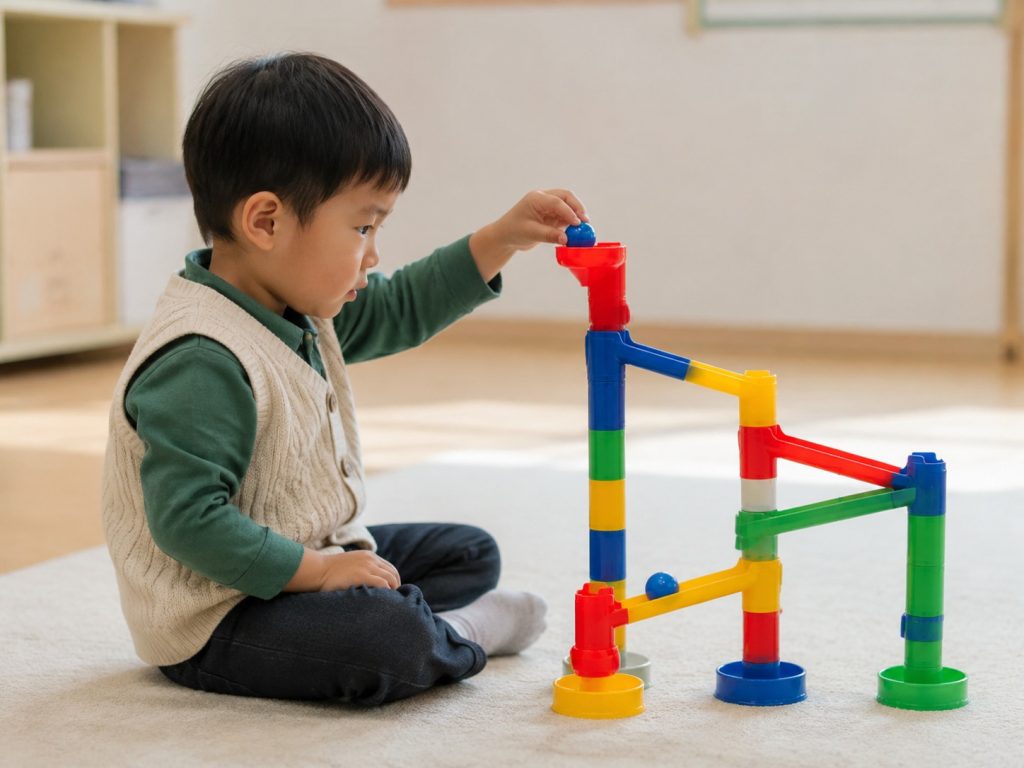
Different construction and building tools target different cognitive skills, and understanding these alignments helps teachers and procurement teams build a coherent toolkit rather than a random collection of “educational” items.
Construction systems with interlocking pieces develop spatial reasoning and fine motor control simultaneously. The key differentiator is whether the system requires precise alignment—toys with forgiving connections are appropriate for younger fours who are still developing hand-eye coordination, while those requiring exact positioning challenge older fours ready for more precision work. The learning happens when children discover that three-dimensional structures need different support strategies than flat patterns, typically through the direct experience of watching their towers collapse and figuring out why. Teachers can extend this by introducing vocabulary like “base,” “stable,” and “balance” during play, anchoring abstract concepts to concrete experiences the child just had.
Cause-and-effect chains like marble runs or dominoes teach sequential thinking and prediction. The cognitive load here is planning multiple steps ahead and revising predictions when outcomes don’t match expectations. The best STEM toys for 4 year olds in this category offer modular components that connect in multiple configurations, so children learn that changing one element affects the entire sequence—a fundamental principle of systems thinking. This becomes especially valuable for children who struggle with impulse control, as building a functional marble run requires pausing to think through consequences before placing each piece.
Early engineering kits that involve gears, levers, or simple machines make abstract mechanical concepts tangible. Four-year-olds won’t understand the physics terminology, but they can absolutely grasp that turning one gear makes another turn the opposite direction, or that a longer lever requires less force. These tools work best when they’re transparent—literally. Being able to see how internal mechanisms function matters more for learning than polished finished products. The classroom value is giving teachers concrete props for explaining concepts that are otherwise impossible to demonstrate at this age level.
Sorting and classification systems develop categorical thinking and pattern recognition. While these sound basic, the complexity escalates quickly when children move from single-attribute sorting to multiple attributes simultaneously, or from teacher-defined categories to child-invented classification systems. Tools that support this progression—offering enough variety in shapes, colors, sizes, and textures—turn simple sorting into genuine cognitive work. For preschool programs focused on math readiness, these skills directly transfer to number sense and early data analysis.
How to Actually Use STEM Toys for 4 Year Olds for Learning Outcomes
Purchasing educational construction sets accomplishes nothing if they become free-play items without learning objectives. The most effective classroom integration of STEM toys for 4 year olds follows a three-phase approach that maximizes both independent exploration and guided skill development.
Free exploration comes first, but with one critical structure: introduce only half the components initially. Giving a four-year-old 150 marble run pieces on day one creates overwhelm, not engagement. Start with 15-20 pieces and let children discover basic functionality without teacher direction. Watch for the moment when initial novelty fades and patterns emerge in how children approach the materials—that’s your signal they’re ready for introduced challenges. This phase typically takes 3-5 sessions of 15-20 minutes each.
Guided challenges should present specific problems with multiple solution paths. Instead of “build a tall tower,” frame it as “can you build a tower where you can see through every level?” or “make a structure that uses every blue piece.” These constraints force problem-solving while preserving creative freedom. The teacher’s role is asking reflective questions when children get stuck: “What happened when you tried that? What could you change?” rather than providing solutions. Document successful strategies with photos so children can revisit and improve their own designs—this metacognitive step is where deep learning happens.
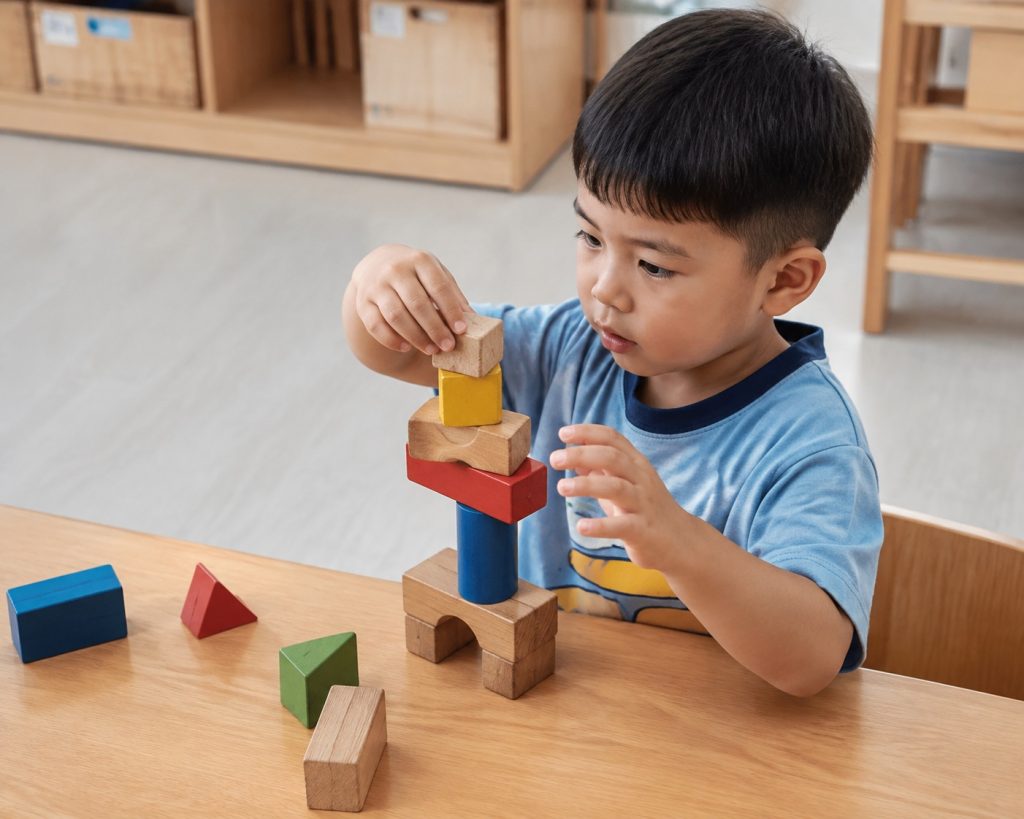
Extension activities connect the hands-on work to broader concepts. After children have built multiple configurations, introduce prediction: “Before you add that curve piece, where do you think the marble will go?” Then test and discuss why predictions matched or didn’t match reality. This simple practice develops the scientific method’s core cycle—hypothesize, test, analyze, revise—in language four-year-olds can access. For procurement teams evaluating STEM toys for 4 year olds, these extensions are how a single purchase delivers months of differentiated learning rather than a few weeks of novelty play.
The evaluation metric that matters most: Can children approach novel problems with confidence rather than waiting for adult direction? If students start applying trial-and-error strategies to unrelated challenges—figuring out how to balance the class see-saw or organizing dramatic play props—the transfer learning is working.
When Construction-Based Learning Needs Specialized Tools
Most early childhood programs own basic unit blocks and generic building sets. These work well for open-ended play but often lack the specific design features that target advanced spatial reasoning and engineering concepts. The learning ceiling matters more than most educators realize—if children master a tool’s full complexity within a month, continued use becomes repetition rather than progressive skill development.
Vindstier’s magnetic construction systems address this through three deliberate design choices informed by classroom feedback. First, the magnetic connection system eliminates the fine-motor frustration that causes many four-year-olds to abandon traditional snap-together blocks, while still providing honest structural feedback—weak magnetic hold means the design needs reinforcement, teaching load distribution concepts through direct experience. Second, the component variety includes curves, angles, and rotating joints alongside basic shapes, enabling children to progress from flat patterns to functional mechanical models like wheels and simple gear trains. Third, the translucent material makes internal structure visible, so children can observe how weight distribution affects stability rather than learning through abstract explanation.
The procurement value shows up in longevity metrics. Traditional wooden blocks are durable, but their learning applications plateau quickly—kindergarten classrooms rarely use them for structured activities because they lack mechanical functionality. Magnetic systems continue supporting curriculum objectives through second grade when properly integrated with teaching goals around simple machines and structural engineering. For programs evaluating STEM toys for 4 year olds based on cost-per-learning-hour rather than just upfront price, that extended utility matters significantly. Vindstier sets withstand the specific wear patterns of institutional use—magnetic strength tested to 15,000+ connection cycles, ABS plastic rated for repeated floor drops, and component-level replacement availability so one broken piece doesn’t retire an entire set.
The practical classroom difference is setup efficiency. For classrooms integrating STEM toys for 4 year olds into daily rotation, three practical requirements separate tools that get used from those that collect dust. Teachers report getting magnetic construction into regular use more consistently than alternatives requiring adult assembly or complicated cleanup, which directly impacts learning outcomes. A tool that’s actually used four times per week delivers exponentially more value than a “better” tool used monthly because it’s stored on a high shelf.
How to Tell If STEM Toys for 4 Year Olds Are Delivering Real Learning
Parents and teachers need concrete indicators that development is occurring, not just engagement or enjoyment. Watch for these specific behavioral shifts over 6-8 weeks of regular use with STEM toys for 4 year olds.
Children begin approaching problems systematically rather than randomly. Instead of piling blocks until collapse and starting over, they start testing small changes one variable at a time. This shows developing executive function and hypothesis testing—core scientific thinking skills. You’ll also notice longer persistence before requesting help. If initial frustration tolerance was 2-3 minutes, watch for that stretching to 8-10 minutes as children internalize that struggle is part of the process, not a signal to quit.
Language development provides another clear marker when children use STEM toys for 4 year olds regularly. Children start using comparative and causal language spontaneously: “This one is more stable because it has a wider bottom” or “It keeps falling because the heavy blocks are on top.” This indicates they’re forming mental models of physical principles, not just memorizing teacher phrases. Also note whether children begin teaching peers—explaining their strategies to classmates is a strong signal they’ve moved from unconscious competence to conscious understanding.
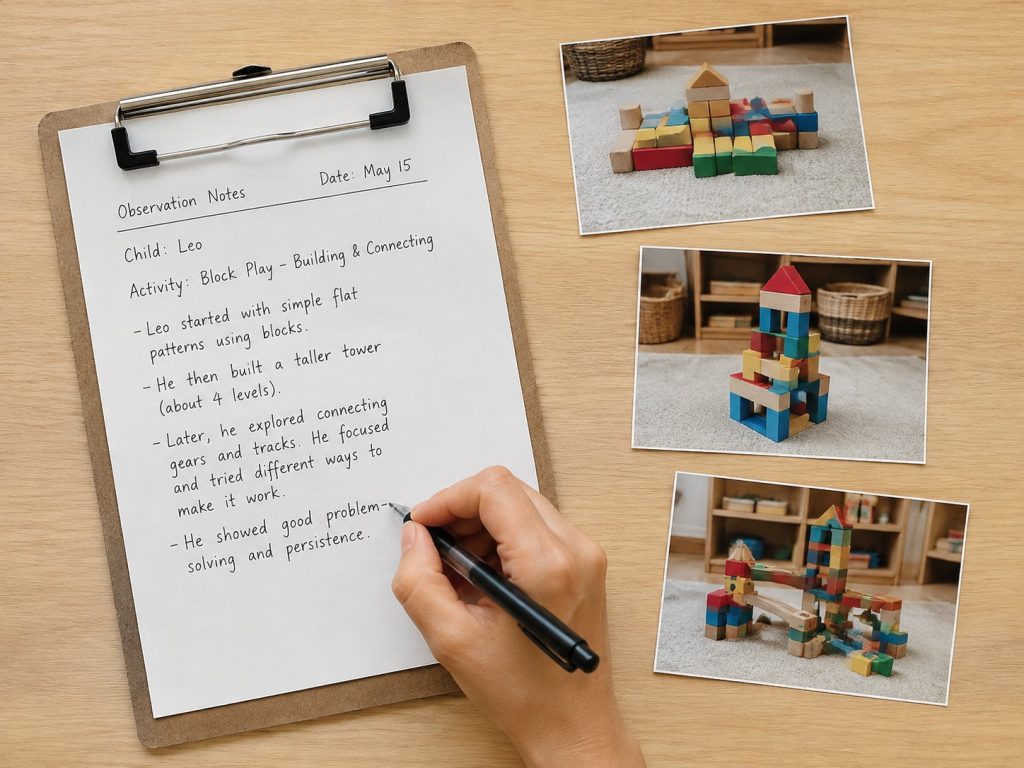
Transfer to non-toy contexts offers the strongest evidence that STEM toys for 4 year olds are working. Do children apply construction strategies to other materials? Are they proposing experiments to answer questions instead of just asking adults? When classroom conflicts arise, do they suggest trying different approaches rather than insisting on a single solution? These generalizations prove the learning wasn’t toy-specific but developed broader cognitive capacities.
Where Educational Construction Tools Can’t Deliver
No product, however well-designed, replaces the learning that happens through unstructured outdoor exploration, messy sensory play, or collaborative social negotiation. Construction-based learning offers structured skill development, but development requires balance across domains.
Four-year-olds need ample free play with loose parts—sticks, cardboard, fabric scraps, natural materials—where there are no predetermined outcomes or “correct” uses. This builds creative problem-solving in contexts where the problems are also child-invented, developing agency that structured activities can’t fully replicate. Programs that allocate 70% of play time to child-directed loose parts exploration and 30% to guided activities typically see better outcomes than those reversing that ratio, even in science-focused curricula.
Social-emotional learning is distinct from cognitive skill development. Construction activities that require turn-taking and collaboration offer some benefits, but they’re not substitutes for relationship-building activities, conflict resolution practice, or emotional regulation work. Some children will need separate support developing frustration tolerance before building challenges become productive rather than overwhelming. Teachers should watch for the child who destroys others’ creations or refuses to engage when initial attempts fail—these signal readiness concerns that need addressing first.
Screen-based “educational apps” are often marketed as complementary to physical building sets. Research consistently shows that four-year-olds learn spatial reasoning, cause-and-effect, and problem-solving skills significantly better from physical manipulation than digital interaction at this developmental stage. The proprioceptive feedback from hands-on building—how materials feel, how much force is needed, how balance shifts—provides crucial learning data that touchscreens simply don’t offer.
Conclusion
Choosing STEM toys for 4 year olds requires evaluating whether tools offer immediate feedback, support progressive difficulty, and allow both independent exploration and guided learning. The developmental window between ages 3.5 and 5 is when physical manipulation translates most effectively into cognitive understanding—miss it, and you’re teaching the same concepts later through worksheets alone.
A single well-designed construction system used consistently across a semester delivers measurably better outcomes than rotating through multiple types without depth of engagement. For schools and programs evaluating STEM toys for 4 year olds, this means assessing purchases based on total learning hours delivered and documented durability under institutional use. For teachers, it means protecting daily play time and recognizing these as core curriculum materials that genuinely develop the problem-solving capacities formal academics will later require.
The marker of success with STEM toys for 4 year olds is whether children begin applying systematic problem-solving strategies beyond the toy itself—testing variables, persisting through failure without prompting, or explaining reasoning using causal language. That transfer is what separates genuine learning tools from time-fillers, and it’s the metric worth evaluating when deciding whether your current toolkit is working.