
Walk into any early childhood classroom, and you’ll likely spot two things on the shelves: a bin of traditional wooden blocks and some form of magnetic building toys. Both have earned their place in educational settings, but they serve different developmental purposes, and the gap between them matters more than most educators realize.
Teachers working with children ages 3 to 8 face a recurring challenge. Young learners need to grasp spatial relationships, geometric principles, and basic engineering concepts, yet their fine motor skills and attention spans limit how deeply they can engage with construction-based play. Traditional blocks have addressed this for over a century. Magnetic building toys offer something fundamentally different: they reduce the physical barrier to entry while expanding the cognitive ceiling of what children can explore.
The question isn’t which toy is “better” in some abstract sense. It’s which tool supports specific learning outcomes more effectively, and under what conditions each one belongs in a classroom, a curriculum plan, or a bulk purchasing decision.
This article breaks down the developmental, pedagogical, and practical differences between magnetic building toys and traditional blocks. It’s written for educators evaluating classroom materials, school buyers weighing long-term investment, and distributors seeking products that align with real instructional demand.
How Construction Play Supports Cognitive Development
Construction-based play isn’t just about keeping children busy. The link between spatial construction and mathematical reasoning is one of the more consistent findings in developmental research. Wolfgang, Stannard, and Jones’s longitudinal study, published in the Journal of Research in Childhood Education, tracked preschool children’s block play performance and found that it significantly predicted their mathematics achievement scores through middle school. The mechanism reflects something deeper than play: children who build are making predictions, testing hypotheses, observing consequences, and revising their approach — the same cognitive operations that underpin mathematical thinking.
More recently, Nora Newcombe and colleagues at Temple University have documented the spatial-mathematical connection with greater precision. Their work demonstrates that spatial assembly skills in early childhood are among the strongest non-verbal predictors of later math achievement, particularly in areas like geometry, proportional reasoning, and number line estimation. What this research implies for educators is direct: materials that develop spatial reasoning aren’t supplementary enrichment. They’re foundational academic preparation.
What separates one building material from another is the range of spatial operations it invites. A tool that only allows stacking develops different cognitive skills than one that allows connection across multiple planes. A tool that collapses easily teaches different lessons than one that holds its form under stress. This is where the distinction between magnetic building toys and traditional blocks becomes educationally significant.
Traditional Blocks: Strengths and Structural Limitations
Wooden unit blocks, first standardized by Caroline Pratt in the early 1900s, remain one of the most studied educational materials in early childhood research. Their strengths are well documented.
Traditional blocks teach weight distribution, symmetry, and balance through immediate physical feedback. When a tower falls, the child learns something concrete about structural integrity. The proportional relationships between block sizes — half-units, units, doubles, quadruples — introduce ratio concepts implicitly. Open-ended play with blocks correlates with improved spatial vocabulary, as children describe positions, orientations, and relationships.
However, traditional blocks carry inherent limitations that become visible in structured classroom settings. Gravity-dependent construction restricts building to vertical stacking and horizontal spreading. Children cannot easily create enclosed3D forms, suspended structures, or geometric shapes without advanced engineering knowledge. Constructions are fragile. A bumped table or an enthusiastic neighbor can destroy ten minutes of careful work, which creates frustration rather than learning in many young children. For children with developing fine motor control, the precision required to balance blocks can become a barrier rather than a scaffold.
These aren’t flaws in the traditional block concept. They’re boundaries that define what the tool can and cannot teach.
Magnetic Building Toys: Expanding the Construction Vocabulary
Magnetic building toys change the fundamental physics of construction play. Instead of relying on gravity and friction, pieces connect through magnetic force along edges or faces. This single mechanical difference creates a cascade of pedagogical possibilities.
When panels snap together magnetically, children can build outward, upward, and inward simultaneously. A four-year-old who cannot yet balance a traditional block tower six units high can construct a cube, a pyramid, or a geodesic form with magnetic tiles. The magnetic connection is forgiving enough that imprecise placement still results in a successful join, yet specific enough that geometric relationships remain accurate.
This shifts the cognitive demand from motor precision to spatial reasoning. Children spend less energy managing balance and more energy exploring form, symmetry, rotation, and transformation. They can flatten a3D shape into its net and reassemble it, experiencing the relationship between 2D and 3D representation directly through their hands.
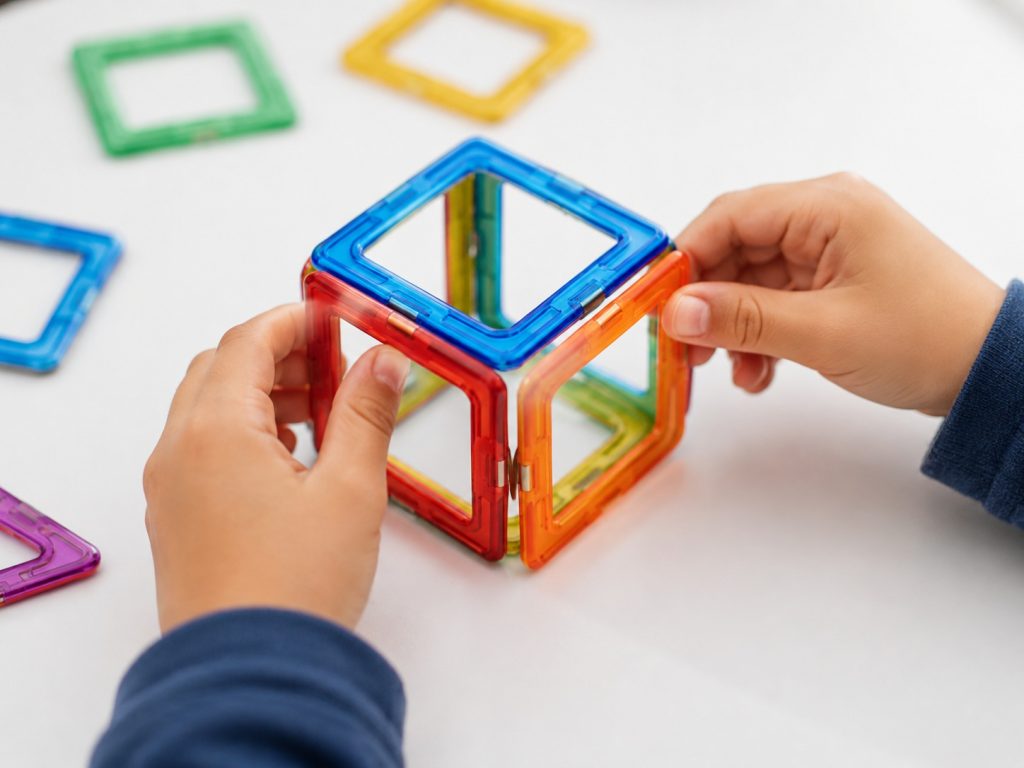
For classroom environments specifically, magnetic building toys offer structural resilience that traditional blocks cannot match. Constructions hold together when moved, displayed, or accidentally bumped. This durability of the built form means children can revisit, modify, and extend their work across multiple sessions, supporting iterative thinking and long-term project development.
Age-by-Age Application: Matching the Tool to the Developmental Stage
Understanding which tool to deploy requires more than knowing general developmental stages. It requires mapping the material to specific curriculum objectives at each grade level.
Ages 3–4 (Preschool): At this stage, fine motor precision is still developing and frustration tolerance is low. Traditional blocks often exceed young children’s motor capacity before they can engage with the spatial concepts the blocks are meant to teach. Magnetic building toys lower this barrier significantly. A three-year-old can successfully enclose a space, create a roof, or build a tall structure with magnetic tiles where traditional stacking would repeatedly fail. The primary learning value at this age is building construction confidence and establishing basic spatial vocabulary: inside, outside, flat, tall, open, closed. Success with the material is a prerequisite for cognitive engagement with it.
Ages 5–6 (Kindergarten): Most national early learning standards at the kindergarten level introduce2D and 3D shape recognition, and the relationship between them. This is precisely where magnetic building toys demonstrate their strongest curriculum alignment. Children can construct a cube from six square panels, physically count the faces, trace the edges where panels meet, and identify the corner vertices — all through direct manipulation. Flattening the cube back into a cross-shaped net and rebuilding it makes the 2D-to-3D transformation tactile and repeatable. Traditional blocks cannot make the faces, edges, and vertices of solid forms physically accessible in the same way.
Ages 6–8 (Grades 1–2): By first and second grade, geometry standards extend into area concepts, volume reasoning, symmetry, and introductory STEM project work. Magnetic building toys support all of these in ways traditional blocks cannot match at scale. Children can build structures that must enclose a specific number of cubic units, explore symmetry by mirroring panel arrangements across an axis, or collaborate on engineering projects like bridges and enclosures. The structural stability of magnetic construction means group projects can span multiple class sessions without being rebuilt from scratch each time — a practical necessity for project-based STEM integration.
Traditional blocks remain valuable at every age level for physics-based exploration: weight, balance, load distribution, and structural failure. The most effective classrooms deploy both materials based on the learning objective, not as competing choices.
Direct Comparison: Learning Outcomes by Domain

Rather than declaring one tool superior, educators benefit from understanding which developmental domains each tool serves most effectively.
Spatial reasoning and geometry represent the area where magnetic building toys demonstrate the clearest advantage. The ability to construct accurate geometric solids, explore faces, edges, and vertices through physical manipulation, and transform between 2D nets and 3D forms gives magnetic tiles a direct connection to mathematical curriculum standards. Traditional blocks support spatial awareness through position and balance, but they cannot replicate the geometric specificity that magnetic construction provides.
Physics and engineering principles favor traditional blocks in some respects. Gravity-based construction teaches weight, load-bearing, and structural failure in ways that magnetism-based construction does not. A child who builds exclusively with magnetic tiles may not develop intuitive understanding of center of gravity or cantilever principles. However, magnetic building toys teach connection strength, structural rigidity through triangulation, and basic architectural principles like truss systems.
Fine motor development differs between the two. Traditional blocks demand precise placement and steady hands. Magnetic building toys require less precision for connection but introduce different motor patterns: rotation, edge alignment, and controlled separation of magnetic joints. Neither is superior for motor development overall, but they develop different aspects of hand control.
Collaborative construction and social learning tilts toward magnetic building toys in most classroom observations. Because magnetic structures hold together under movement, multiple children can contribute to a single project without the constant threat of collapse. This reduces conflict, supports turn-taking in a more forgiving environment, and allows for larger collaborative projects that remain intact across play sessions.
Creative expression and open-ended play depends heavily on the specific product. High-quality magnetic building toys with diverse piece shapes — squares, triangles, hexagons, curved panels — can match or exceed the creative range of traditional block sets. However, basic sets with only squares and triangles may restrict creative expression compared to a comprehensive unit block collection.
What Teachers Report from Classroom Use
Educators who have integrated both tools into their classrooms consistently note several patterns.
Teachers working with mixed-ability groups find that magnetic building toys reduce the frustration gap between children at different developmental stages. A child who struggles with the precision of block stacking can still achieve complex constructions with magnetic tiles, maintaining engagement and building confidence while developing spatial skills. This accessibility doesn’t come at the cost of challenge for more advanced builders, because the geometric complexity available through magnetic construction scales upward significantly.
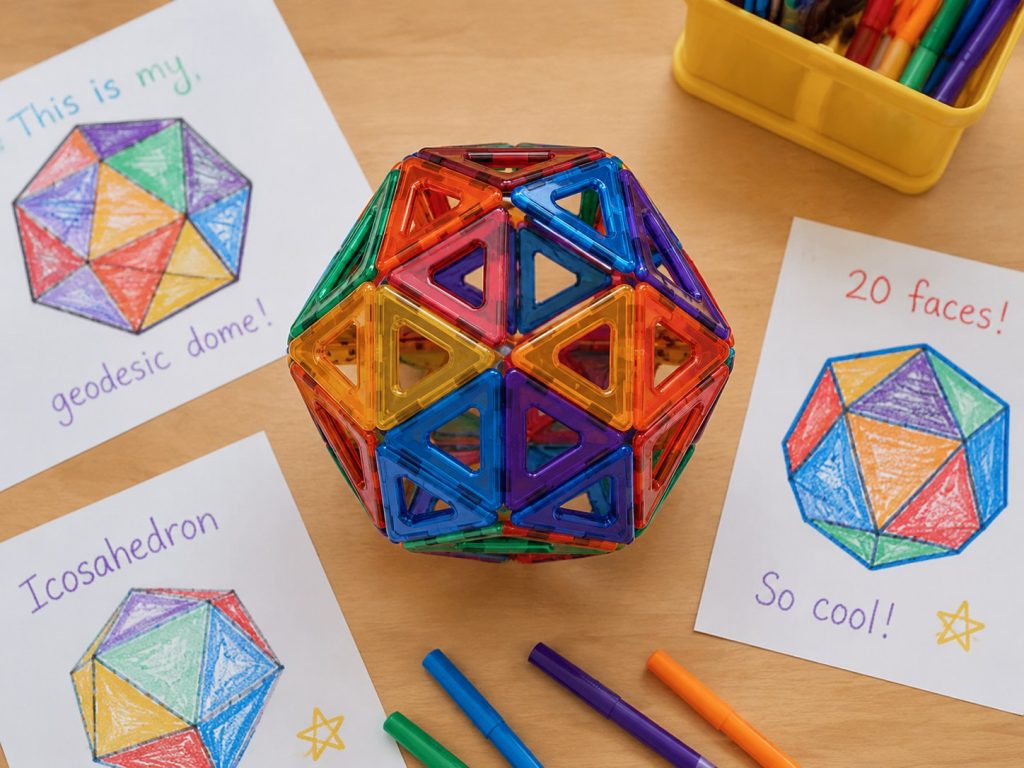
In structured math lessons, teachers report that magnetic building toys serve as more effective manipulatives for geometry instruction than traditional blocks. When teaching about faces and edges, a child can construct a cube from six square tiles, count the faces by touching each panel, identify the edges where panels meet, and count vertices where corners join. This physical access to geometric structure is difficult to replicate with solid wooden blocks.
For free play periods, many teachers maintain both options and observe natural self-selection. Children working through spatial challenges tend to gravitate toward magnetic tiles. Children exploring weight, height, and dramatic play scenarios tend to choose traditional blocks. This self-selection reflects the genuinely different developmental purposes each tool serves.
The Procurement Perspective: Cost, Durability, and Classroom ROI
School buyers and educational product distributors evaluate materials differently than individual parents. Classroom purchasing decisions weigh durability across hundreds of users, replacement costs, storage requirements, versatility across age groups, and alignment with educational standards.
Traditional wooden blocks score well on durability. Quality hardwood blocks can last decades in classroom use with minimal maintenance. Their limitation appears in versatility: a set of unit blocks serves one primary purpose, with limited crossover into structured curriculum objectives beyond open-ended construction and basic physics exploration.
Magnetic building toys present a different cost profile. Initial investment per piece is typically higher. However, the curriculum coverage per dollar invested is substantially broader. A single professional-grade magnetic building set can function across at least four distinct instructional contexts: geometry lesson support (faces, edges, vertices,2D-to-3D transformation), free construction and creative play, pattern and symmetry exploration, and collaborative STEM project building. In practice, this means one set of magnetic tiles can replace what would otherwise require two to three separate teaching aid purchases — a geometry manipulative set, a pattern block collection, and a construction material — while serving a wider age range and requiring less storage space. For school buyers calculating cost per instructional use rather than cost per unit, this multi-function coverage shifts the ROI calculation significantly.
The magnetic connection mechanism does degrade over time with heavy classroom use, making magnet strength and housing durability critical purchasing criteria. This is precisely where product quality differentiation matters most for institutional buyers.
What Distinguishes Professional-Grade Magnetic Building Toys
The educational toy market is saturated with magnetic construction products that look similar in photographs but perform very differently in classroom environments. For buyers evaluating magnetic building toys at scale, several factors separate professional-grade products from consumer-grade alternatives.
Safety certification and regulatory compliance is the non-negotiable starting point for any institutional purchase. Schools and distributors sourcing materials for children must verify that products meet applicable safety standards: ASTM F963 in the United States, CPSIA compliance for lead and phthalate content, CE marking for European markets, and EN71 adherence for toy safety across EU jurisdictions. These aren’t marketing designations — they’re legal requirements for institutional procurement and prerequisites for most school district purchasing approvals. Professional-grade magnetic building toys carry verified certification documentation. Consumer-grade products frequently do not, creating compliance liability for the purchasing institution.
Magnet strength and consistency determine whether children can build structures tall and complex enough to support genuine learning. Weak magnets limit construction to small, flat arrangements. Consistent magnetic polarity across all pieces ensures that any face connects to any other face without frustrating connection failures that interrupt cognitive flow.
Panel material and construction affect both safety and longevity. Solid ABS plastic with ultrasonic welding prevents magnet dislodgement, which represents both a choking hazard and a functional failure. Panel thickness affects structural rigidity: thin panels flex under the weight of larger constructions, limiting building complexity.
Edge design impacts both connection reliability and child safety. Sealed, rounded edges protect children while maintaining clean geometric lines that support accurate spatial learning.
Vindstier’s magnetic building tile systems are engineered specifically for institutional environments where all of these factors determine whether a product survives its first semester. The panel construction uses reinforced ABS with fully sealed magnet housing. Products carry relevant international safety certifications required for school and institutional procurement across major markets. The magnetic strength is calibrated to support structures complex enough for upper-elementary geometry exploration while remaining separable by three-year-old hands. For schools and distributors evaluating bulk purchases, this combination of documented safety compliance, institutional durability, and curriculum-aligned design represents the core product standard.
Integrating Both Tools: A Curriculum-Aligned Approach
The most effective early childhood classrooms don’t choose between magnetic building toys and traditional blocks. They deploy each tool strategically based on learning objectives.
For units focused on balance, weight, and gravity, traditional blocks remain the stronger choice. Children need to experience structural failure caused by physical forces to develop intuitive physics understanding.
For geometry, spatial transformation, and mathematical reasoning units, magnetic building toys provide direct physical access to concepts that traditional blocks can only approximate. When a second-grade teacher needs students to understand that a cube has six faces, twelve edges, and eight vertices, magnetic tiles make this knowledge tactile rather than abstract.
For open-ended creative construction and collaborative projects, offering both tools simultaneously gives children agency to select the material that matches their current developmental edge. Some children need the challenge of gravity-based building. Others need the expanded geometric vocabulary that magnetic connection provides.
For STEM integration projects, magnetic building toys typically offer more versatile scaffolding. Designing a structure that must enclose a specific volume, creating a bridge that spans a gap, or building a habitat for a classroom animal all benefit from the structural reliability and geometric precision that magnetic construction provides.
Making the Purchasing Decision
For educators and institutional buyers weighing investment in construction-based learning materials, the decision framework comes down to purpose, population, and longevity.
If your primary goal is supporting geometry and spatial reasoning across multiple grade levels with a single material investment, magnetic building toys deliver stronger curriculum alignment per dollar spent. If your goal is open-ended sensory play and physics exploration for the youngest learners, traditional blocks retain significant value.
For schools building or refreshing their manipulative libraries, the evidence supports investing in high-quality magnetic building toys as a primary construction material, supplemented by traditional blocks for specific physics-based learning objectives. The key word is high-quality. Institutional-grade magnetic tiles from manufacturers like Vindstier — certified to applicable safety standards, designed for repeated classroom use, and aligned with curriculum objectives across the3-to-8 age range — represent a fundamentally different investment than consumer-grade products that fail under daily group use.
Distributors and educational brands evaluating product lines should note the market trajectory: demand for magnetic building toys in institutional settings continues to grow as curriculum standards increasingly emphasize spatial reasoning, geometric fluency, and STEM integration in early grades. Products that combine educational credibility, institutional durability, and documented safety compliance occupy the strongest and most defensible market position.
Conclusion
The comparison between magnetic building toys and traditional blocks isn’t a competition with a single winner. It’s a question of matching tools to developmental purposes with precision.
Traditional blocks teach lessons about gravity, balance, and physical consequence that magnetic construction cannot replicate. Magnetic building toys open geometric, spatial, and collaborative learning pathways — pathways that developmental research now connects directly to long-term mathematical achievement — that gravity-dependent construction cannot access at the same depth. Both belong in well-resourced educational environments, deployed according to the learning objective rather than as interchangeable alternatives.
What has shifted is the recognition that magnetic building toys aren’t simply a modern novelty. They’re a distinct category of spatial manipulative that supports curriculum-aligned learning outcomes from preschool through second grade, with a single product set covering instructional needs that would otherwise require multiple separate material investments. For teachers, schools, and educational product buyers making informed decisions about classroom materials, understanding this distinction is the difference between purchasing toys and investing in learning infrastructure.