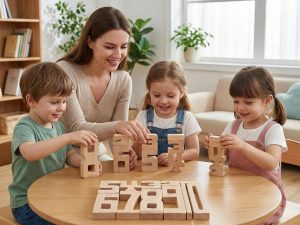
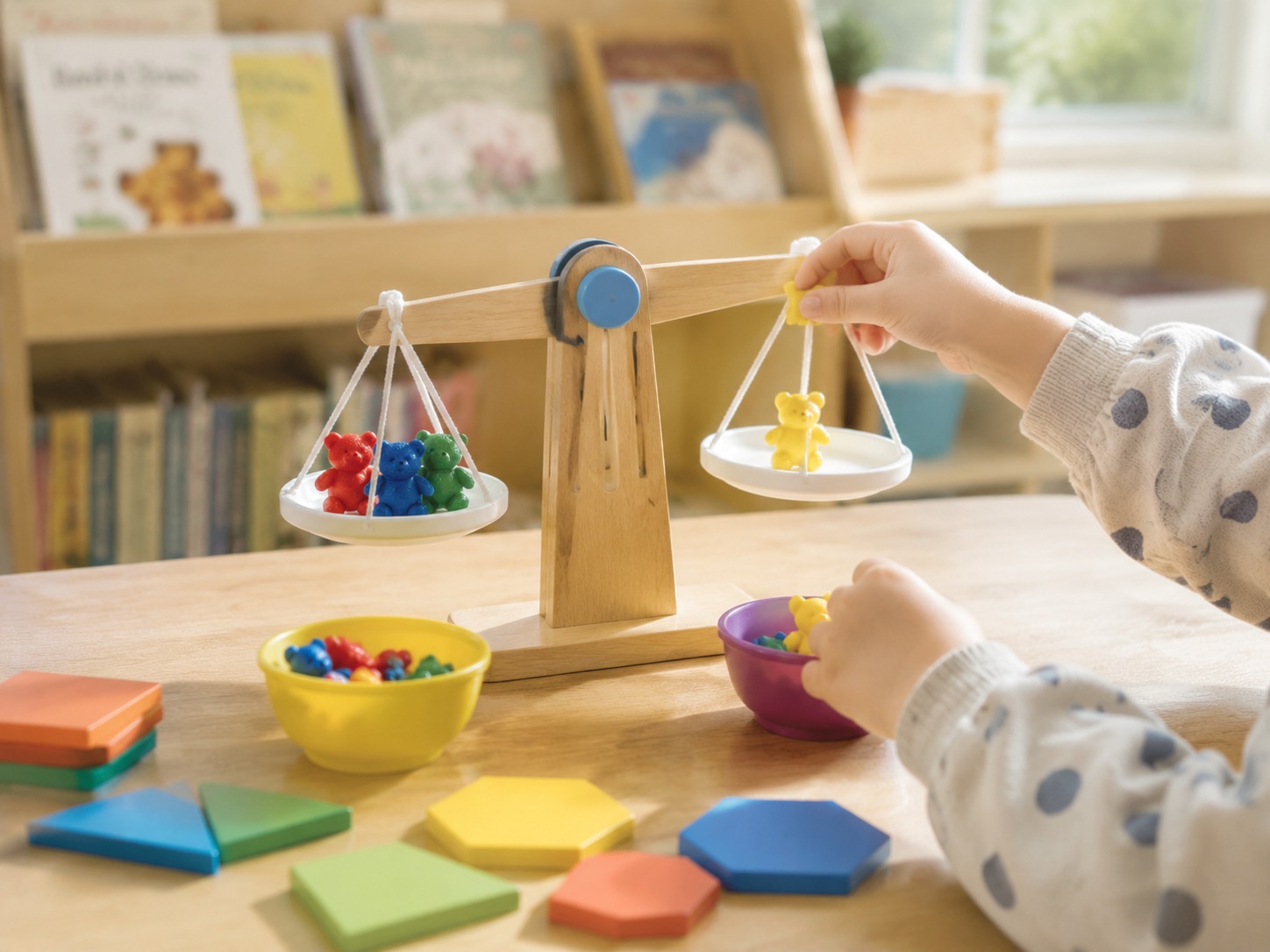
Four-year-olds sit at a cognitive crossroads. They’ve outgrown cause-and-effect toys but lack the attention span for structured workbooks. Teachers know this phase well: children ask endless “why” questions, want to build elaborate structures, then abandon them mid-project to chase a new idea. Finding the right educational toys for 4 year olds is uniquely challenging—traditional classroom materials often miss this window, either too simple to hold interest or too complex to complete independently.
The gap shows up in real classrooms. A preschool teacher in California noted that her students could identify shapes but couldn’t explain why a triangle stays stable while a rectangle wobbles. Another educator found her class losing focus during circle time because demonstration materials required too much adult guidance. The problem isn’t the children’s capacity—it’s that most learning tools either lecture at them or leave them guessing.
What if the toy itself taught the concept? Not through flashing lights or voice prompts, but through design that makes abstract ideas physically obvious. That’s the shift redefining educational toys for 4 year olds: from passive entertainment to active discovery tools that let children test hypotheses, fail safely, and iterate without adult intervention.
Why Four-Year-Olds Need Tools Built for Their Exact Developmental Stage
At four, children enter what developmental psychologists call the “intuitive thought substage”—they can grasp symbolic relationships but still think concretely. Tell them “addition means putting together” and they’ll nod. Hand them manipulatives and they’ll discover it. This isn’t about dumbing down concepts; it’s why high-quality educational toys for 4 year olds outperform workbooks: they match input method to brain architecture.
Research from the Perry Preschool Project tracked children for decades and found that high-quality early learning experiences—particularly hands-on problem-solving—correlated with better executive function at age 40. The key phrase: hands-on problem-solving. Not worksheets. Not apps. Physical tools that require planning, adjustment, and spatial reasoning.
The commercial toy market floods this age group with two extremes: battery-powered “learning systems” that dispense facts through repetition, or open-ended blocks with zero scaffolding. Both miss the mark for educational toys for 4 year olds. Four-year-olds need structured open play—toys with clear learning goals embedded in designs that permit experimentation. A balance beam that shows weight distribution visually. Building sets where structural stability is immediately obvious. Sorting games where categories emerge through use rather than labels.
For institutional buyers, this distinction matters commercially. A toy that teaches once gets used once. A tool that supports iterative learning gets pulled out daily for a year, justifying its shelf space and per-child cost. Teachers spend less time demonstrating and more time observing skill development. Distributors find these products command higher margins because they’re harder to replicate and easier to position as curriculum-aligned.
What Separates Genuine Learning Tools from Dressed-Up Entertainment
Walk into any big-box toy aisle and you’ll see “educational” stamped on dozens of products marketed as educational toys for 4 year olds, most of which teach nothing beyond battery replacement. The giveaway: if removing the electronics leaves you with a shapeless plastic shell, it was never about learning. Quality educational toys for 4 year olds function because of their design, not their sound chips.
Three criteria separate real tools from marketing. First, immediate feedback loops—the toy shows results without adult interpretation. Magnetic tiles either hold their structure or collapse. Balancing games tip when weight distribution fails. Pattern blocks either tessellate or leave gaps. The physics teaches.
Second, multiple solution paths. If there’s only one correct answer, it’s a quiz, not a learning tool. Four-year-olds learn through comparison: this tower fell, that one didn’t, what’s different? Toys that permit variation let children build their own understanding rather than memorizing yours.
Third, transparent cause and effect. Children should see why something works, not just that it works. A gear set where the mechanisms are visible teaches mechanical advantage. An opaque battery box teaches nothing about gears even if it moves. Transparency isn’t about literal see-through plastic—it’s about designs where the learning principle is observable during play.
For procurement teams evaluating vendors of educational toys for 4 year olds, these criteria provide hard vetting questions. Ask: “If I remove the instructions, can a child still discover the core concept?” If the answer requires extensive teacher guidance, the toy outsources its educational function to staff time—a hidden cost that adds up across a school year. Retailers and distributors find these products solve a positioning problem: parents buying for birthdays want engagement, teachers buying for classrooms want curriculum value. Products that deliver both capture two markets without splitting inventory.
How to Choose Educational Toys for 4 Year Olds That Build Real Pre-Academic Skills
Most product descriptions for educational toys for 4 year olds list skills—”teaches counting, colors, shapes”—without explaining how. That vagueness covers gaps. Real skill-building toys don’t just expose children to concepts; they create conditions where practicing the skill is the only way to succeed at play.
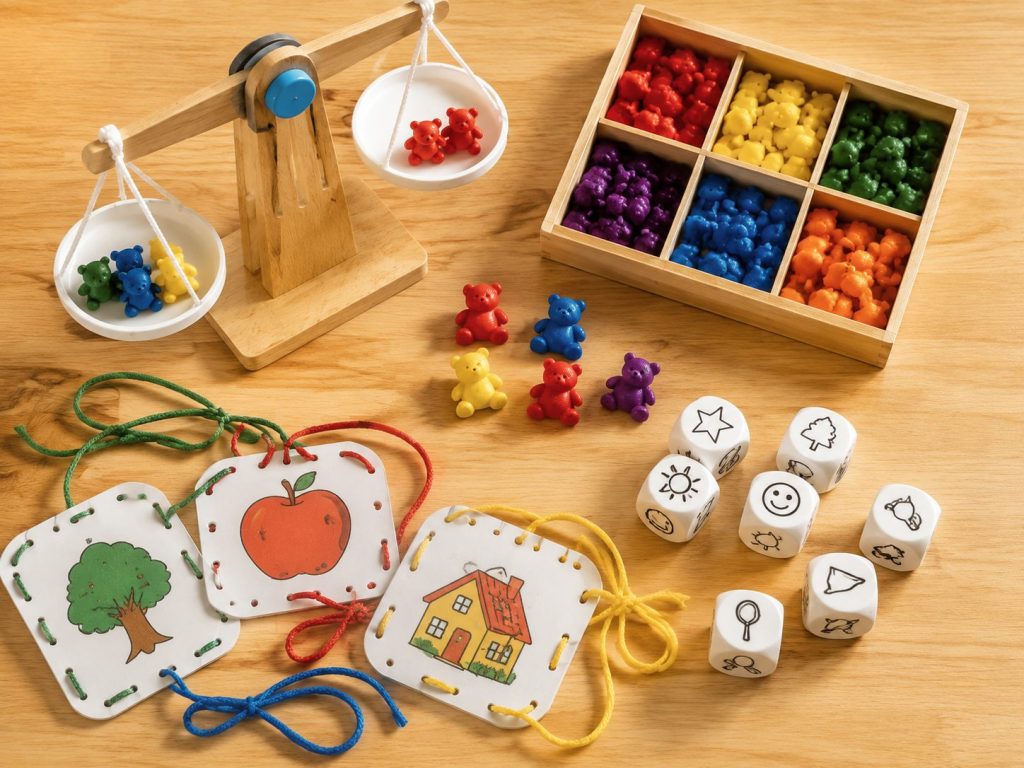
For early math foundations, look for toys that make quantity and comparison physical. Counting bears teach one-to-one correspondence when children distribute them into cups. Balance scales make “more” and “less” visible as tilt and level. Pattern blocks build spatial reasoning when children discover that two triangles equal one rhombus. The math isn’t layered on top—it’s embedded in the goal of play.
For literacy precursors, prioritize oral language and sequencing over letter recognition. Storytelling dice with image faces prompt narrative construction—beginning, middle, end. Sequencing cards for daily routines build temporal vocabulary. Rhyming games strengthen phonological awareness more effectively than alphabet drills, which most four-year-olds aren’t developmentally ready to retain anyway.
For executive function, seek toys that require planning before action. Marble runs fail if you don’t sequence components correctly. Memory matching games improve working memory only when you increase grid size progressively. Simple board games with turn-taking and rule-following build impulse control—skills that predict kindergarten readiness better than early reading.
Fine motor development needs toys children can start, execute, and complete independently. Lacing cards, chunky pegboards, and large tweezers for sorting all build hand strength and precision without frustration. If they need help at every step, the motor challenge is too advanced.
Schools sourcing educational toys for 4 year olds should audit inventory against these functional categories, not just aesthetic ones. A shelf full of puzzles might look diverse but only builds one skill set. Balanced classrooms need tools across cognitive domains, with multiples of high-use items so children aren’t waiting.

The Classroom Advantage: Differentiated Instruction at Scale
The best educational toys for 4 year olds function as silent teaching assistants. While a teacher works with a small group, the rest of the class isn’t just staying busy—they’re engaging with tools calibrated to their level. This isn’t babysitting; it’s differentiated instruction at scale.
A Montessori-trained educator put it simply: “I can’t clone myself, but I can populate the room with materials that meet children where they are.” She keeps three tiers of the same toy type available—basic pattern cards for emerging learners, complex tessellation challenges for advanced students, open-ended blocks for sensory-focused play. Same concept, differentiated access.
Effective teachers rotate educational toys for 4 year olds based on observed skill gaps, not calendar months. If assessment shows weak spatial reasoning across the class, construction toys move to prominent shelf space. If several children struggle with impulse control, cooperative board games enter the rotation. The toys become diagnostic tools as much as learning ones.
For staff, the labor math matters. A toy that requires five minutes of teacher setup per use doesn’t scale. One children can retrieve, use, and clean up independently multiplies instructional reach. This independence factor should be a line item in procurement rubrics, not an afterthought. High-quality toys supporting extended independent play reduce adult-to-child ratio pressure; cheaper toys that break or need constant supervision create hidden staffing costs.
How Vindstier Designs Address the Four-Year-Old Learning Gap
Most toy manufacturers design for retail parents—bright colors, big boxes, long feature lists. Vindstier designs educational toys for 4 year olds for the Tuesday morning classroom moment: when a teacher needs students engaged in meaningful work without redirection every three minutes.
Take the magnetic construction set. Consumer-grade magnetic tiles lose magnetism within months. Vindstier’s system uses neodymium magnets tested to 500+ connection cycles without strength degradation. That’s not a spec for spec’s sake—it’s the difference between a toy that works in September and one still pulling its weight in May. For schools buying in bulk, it means lower replacement frequency and better per-child-hour cost.
The design itself teaches structural principles. Triangles lock rigid. Squares flex. Children discover this through building failures, then apply it to create stable towers. No instruction manual, no teacher demonstration required. The learning is in the consequence, not the explanation.
The balance and measurement set solves another gap. Standard balance scales for this age use opaque buckets—children see the tilt but not the reason. Vindstier’s version uses clear chambers and calibrated weights marked with both numeral and dot quantity. A child places three weights on one side, sees three dots, then experiments on the other side until the beam levels. They’re building number sense and equivalence through physical trial, not memorization.
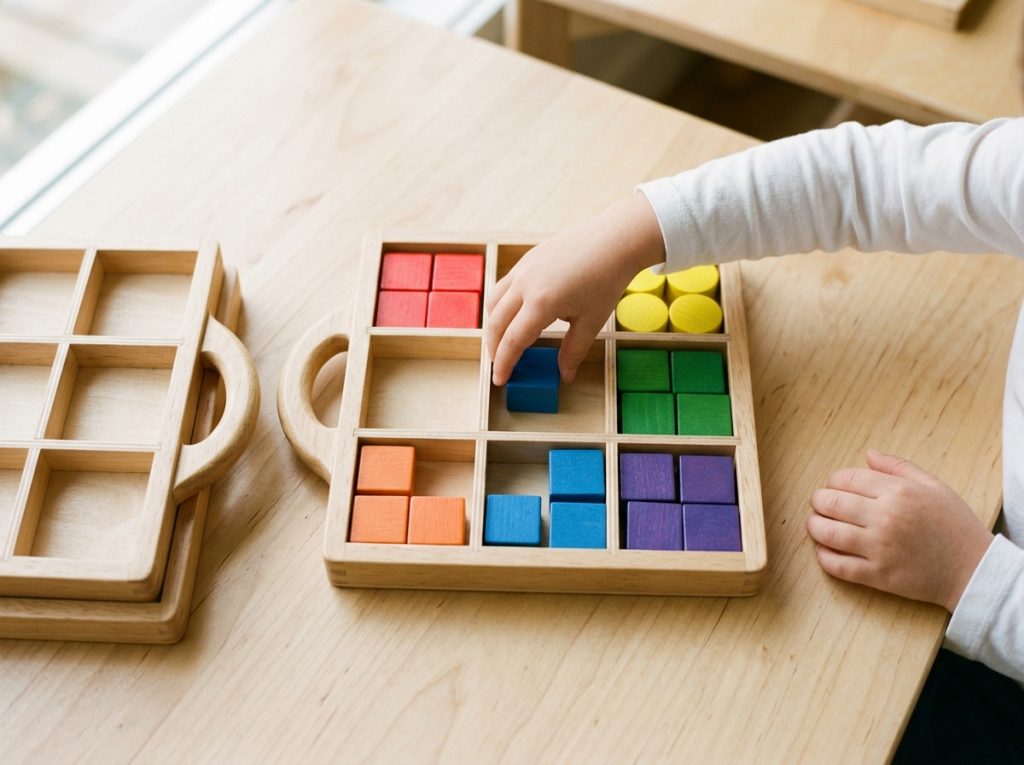
The sorting trays address a universal preschool pain point: loose manipulatives that spill, scatter, and disappear under furniture. Vindstier’s system uses stackable trays with built-in sorting zones and a carrying handle. Setup takes seconds. Cleanup doesn’t require crawling under tables. Teachers use them across math, art, and sensory activities—flexibility that extends product lifespan.
For distributors, these features translate to sell-through advantages. When a school’s early pilot order leads to district-wide adoption, it’s because the product solved operational problems, not just learning ones. Teacher-to-teacher recommendations carry more weight than any brochure.
What to Look for When Evaluating Durability and Long-Term Value
Educational toys for 4 year olds face brutal classroom conditions. They’re dropped, thrown, chewed, and subjected to spills. A product’s month-one appearance means nothing—what matters is how it looks after six months of daily use by 20 children.
When evaluating educational toys for 4 year olds, material honesty matters. If it’s plastic, it should be ABS or polycarbonate—not brittle material that cracks on first impact. Wood should be hardwood, not pressed particleboard that swells when wet. Metal components should resist rust in humid classrooms. These aren’t premium features; they’re baseline requirements for products meant to educate, not end up in a landfill after one season.
Age-span adaptability extends useful life. A toy that only works for four-year-olds has a 12-month window. One that scales from age 3 to 6 stays relevant across three enrollment cohorts. Look for systems where complexity increases through combination, not replacement. Blocks that start as stacking toys then become pattern templates then serve as math manipulatives justify their cost across multiple learning stages.
Repairability changes the cost math. When a single part breaks in a 50-piece set, can you order a replacement or does the entire set become waste? Manufacturers who stock spare parts design for institutional longevity, not planned obsolescence. This is a direct question procurement teams should ask during vendor evaluation.
For schools with tight budgets, per-year cost matters more than per-unit price. A $15 toy used twice versus a $40 tool used daily for two years—the expensive one costs less. CFOs appreciate total cost of ownership calculations, not just invoice amounts. For retailers, durability determines return rates and long-term customer loyalty.
When Educational Toys Aren’t Enough: Recognizing the Limits
No set of educational toys for 4 year olds replaces human instruction, and overselling capability damages credibility. Four-year-olds need responsive adults who ask questions, model thinking, and scaffold challenges. Toys create conditions for learning; teachers drive learning.
Some concepts require direct teaching before manipulatives make sense. A child won’t discover number symbols through blocks alone. They need someone to introduce the symbol, then use manipulatives to build understanding of what that symbol represents. The toy supports; it doesn’t substitute.
Screen-free toys can’t address every learning modality. Some children with auditory processing differences benefit from apps that isolate sound patterns. Others with fine motor delays need adaptive tools before standard manipulatives are accessible. Quality programs layer approaches—toys for hands-on learning, digital tools for specific interventions, direct instruction for explicit skills.
The biggest risk: using “educational” as an excuse for passive parenting or understaffed classrooms. A room full of excellent toys with no adult interaction produces less learning than an empty room with an engaged teacher. The toys amplify quality teaching; they don’t replace it. For program directors, this means toy budgets and professional development budgets are partners, not competitors.
Matching Toys to Individual Learning Profiles
Selecting educational toys for 4 year olds that work for diverse skill levels requires looking beyond one-size-fits-all age labels. Four-year-olds vary wildly in development. Some read simple words; others are still mastering scissors. Generic “age 4” recommendations ignore this spread, leading to boredom or frustration.
For children with advanced cognitive skills but typical motor skills, choose complex problem-solving toys that don’t require fine dexterity. Logic puzzles, pattern challenges, and strategy games let them work at their cognitive level without motor frustration.
For children with strong motor skills but emerging language, opt for building and construction toys where success doesn’t require verbal instruction. Visual assembly guides and open-ended creation tools let them lead with their strength while naturally building vocabulary through play narration.
For children needing sensory regulation, seek toys with built-in sensory feedback—textured surfaces, weight, resistance. These aren’t “special needs” tools; they’re good design for all children, particularly valuable for those who seek proprioceptive input to focus.
Teachers managing diverse classrooms stock educational toys for 4 year olds with this variation in mind. The goal isn’t one perfect toy; it’s an ecosystem where every child finds entry points to core concepts through their strongest modality. The sweet spot is achievable challenge—success within reach after effort.
Key Takeaways
- The best educational toys for 4 year olds deliver immediate feedback, support multiple solution paths, and make cause-and-effect visible without adult interpretation.
- Quality learning tools align with four-year-olds’ concrete thinking stage, turning abstract math and STEM concepts into tangible, hands-on experiences.
- Total cost of ownership—durability, age-span adaptability, and replacement part availability—matters more than upfront price for classroom procurement.
- Quality educational toys for 4 year olds amplify good teaching; they do not replace trained educators and targeted adult interaction.
Action Guide by Role
Classroom teachers
Audit current educational toys for 4 year olds using the three-question test: Does it provide immediate feedback? Does it permit multiple solutions? Is the cause-and-effect visible? Remove toys that fail all three, and request budget for tools that pass.
School procurement teams
Shift RFPs from feature lists to performance requirements. Require vendors to provide data on durability testing, age-span adaptability, and replacement part availability. Pilot educational toys for 4 year olds for six weeks in a real classroom before placing bulk orders.
Distributors and retailers
Train sales staff to ask customers about use context, not just child age. Classroom-use toys have different requirements than home-use toys. Provide return customers with maintenance guides and replacement part options to build long-term loyalty.
Curriculum directors
Map existing toy inventory to learning standards, not just play categories. Identify gaps where standards lack supporting materials. When teachers report students struggling with a concept, first evaluate what manipulative tools are available before adjusting teaching approaches.
When selected intentionally, educational toys for 4 year olds move far beyond playtime filler to become foundational tools that build the cognitive, motor, and social skills children need for long-term academic success.