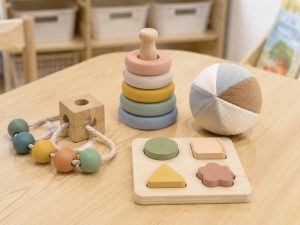
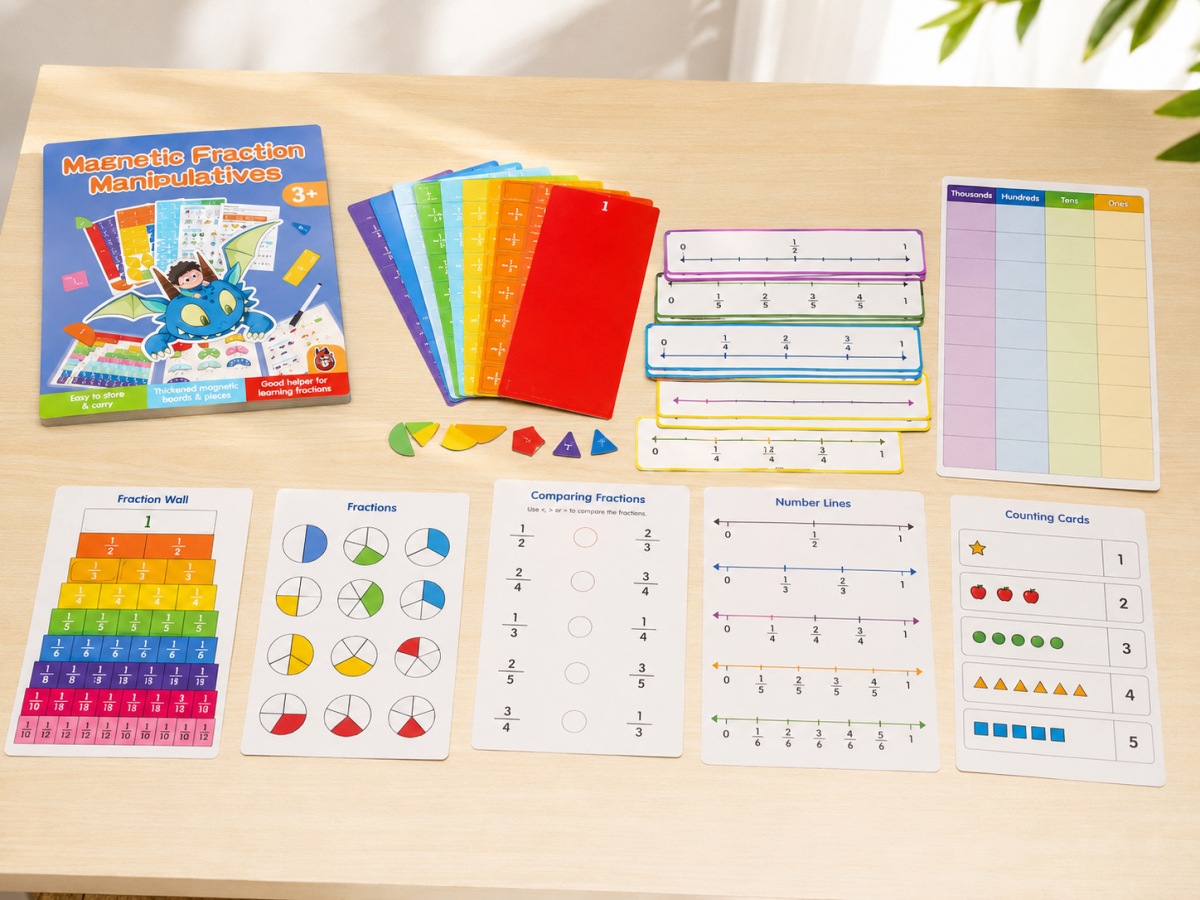
Mathematics education is evolving from traditional memorization-based methods toward more interactive and practical learning approaches. Schools, curriculum developers, educational brands, and classroom resource suppliers are increasingly looking for learning materials that help children understand mathematical concepts through direct interaction rather than simple repetition.
For educational product buyers, the challenge is no longer simply finding a mathematics learning product. The real challenge is developing solutions that combine educational effectiveness, reliable manufacturing, safe materials, competitive pricing, and customization flexibility.
This is where Math Manipulatives have become increasingly important.
In the education industry, Math Manipulatives refer to physical learning resources that allow students to represent mathematical concepts through visual models, hands-on activities, and interactive exercises. Instead of only reading numbers or formulas, students can explore mathematical relationships by touching, arranging, comparing, and analyzing learning materials.
For example, many young learners find fractions difficult because symbols such as 1/2 or 1/4 represent abstract ideas. However, through fraction books, fraction cards, and visual fraction activities, students can clearly understand how parts relate to a whole and gradually develop stronger mathematical thinking.
For B2B buyers, these products represent more than classroom materials. They are educational resources that support curriculum development, improve classroom engagement, and provide opportunities for brands to build differentiated product lines.
As a professional educational product manufacturer, understanding the connection between classroom requirements and production capabilities is essential for developing competitive Math Manipulatives solutions for global markets.
“Effective mathematics learning happens when students can connect abstract concepts with visual and physical experiences.”
Math Manipulatives: How Hands-On Learning Improves Mathematical Understanding
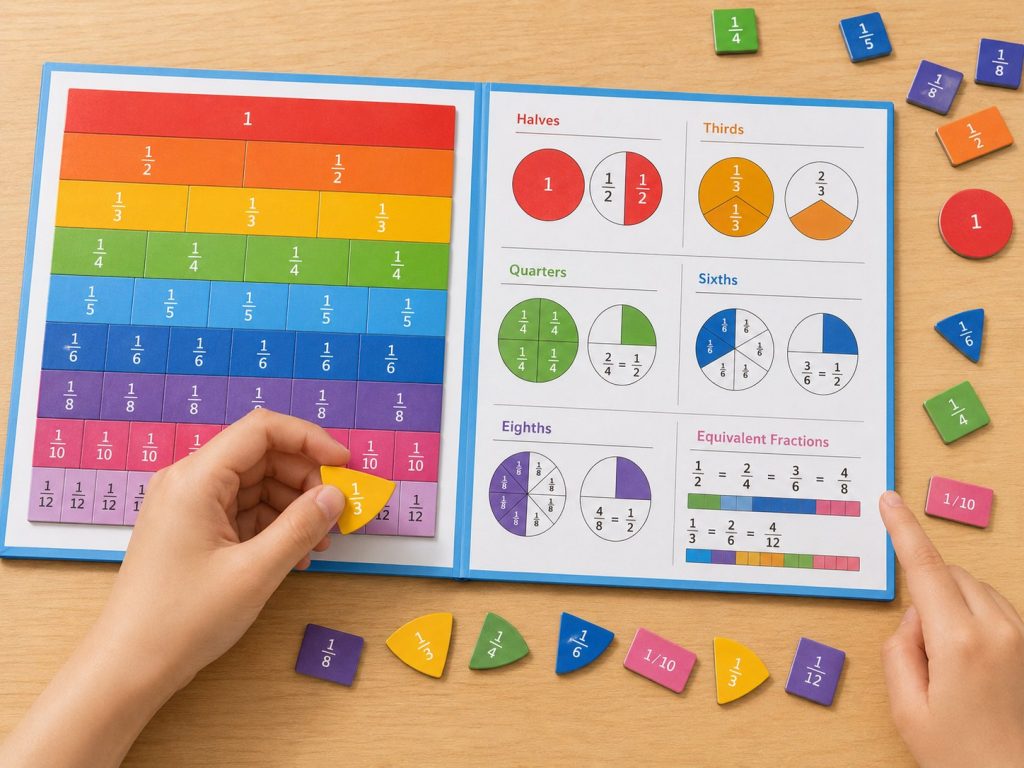
Mathematical concepts are naturally abstract. Numbers, fractions, measurements, and numerical relationships require children to develop logical thinking skills that are often difficult to build through textbooks alone.
Math Manipulatives help bridge the gap between abstract concepts and practical understanding by transforming mathematical ideas into visible and interactive learning experiences.
The learning approach behind these materials follows a gradual process. Students first interact with physical learning resources, then develop visual understanding, and finally apply mathematical concepts independently.
Fraction learning provides a clear example. When students only see fraction symbols, they may memorize procedures without truly understanding the meaning behind them. Fraction books and fraction cards provide visual explanations and interactive exercises that allow learners to compare different values, recognize equivalent fractions, and understand the relationship between numbers and quantities.
Number line cards support another important area of mathematical development. By visually placing numbers in sequence, students can better understand numerical order, addition, subtraction, and the distance between values.
Counting cards are commonly used in early mathematics education because they help children connect numbers with actual quantities. Meanwhile, place value charts allow students to understand how the position of a digit changes its value, creating a foundation for more advanced arithmetic learning.
For schools and educational brands, these products provide measurable teaching value because they support different learning stages instead of focusing only on memorization.
Common Types of Math Manipulatives Used in Classrooms
The global market for mathematical learning resources includes various product formats, but the most widely adopted products are designed around specific teaching objectives.
Paper-based products remain one of the most popular categories because they combine educational flexibility with efficient production. Compared with heavier classroom materials, paper-based resources are easier to customize, package, and distribute internationally.
Fraction books are a typical example. These products usually combine visual explanations, exercises, and interactive activities to help students understand concepts such as parts of a whole, fraction comparison, and equivalent fractions.
Fraction cards are another commonly used classroom resource. Teachers can use them for matching activities, comparison exercises, and group learning tasks, allowing students to develop mathematical reasoning through interaction.
Number line cards help students visualize numerical relationships, while counting cards support early learners in developing number recognition and basic calculation skills.
Place value charts are widely used in elementary education because they provide a clear visual method for explaining ones, tens, hundreds, and decimal concepts.
| Product Type | Learning Purpose | Common Material |
|---|---|---|
| Fraction Books | Understanding fractions, parts of a whole, and visual comparison | Paperboard, coated paper |
| Fraction Cards | Fraction recognition, comparison, and classroom activities | Paperboard |
| Number Line Cards | Number sequence, addition, and subtraction concepts | Laminated paper |
| Counting Cards | Quantity recognition and early arithmetic skills | Paperboard |
| Place Value Charts | Understanding numerical structure and decimal concepts | Coated paper |
For manufacturers serving international education markets, paper-based Math Manipulatives provide strong commercial advantages because they allow flexible content development while maintaining efficient production and transportation.
Material Selection for Math Manipulatives: A B2B Purchasing Perspective
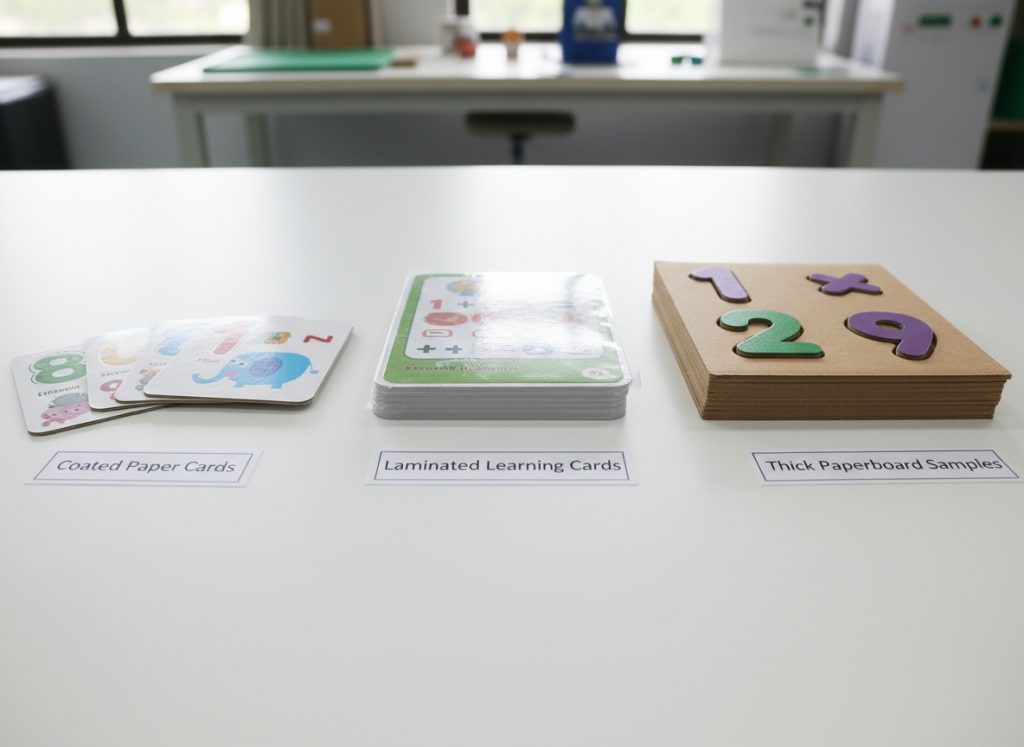
For international buyers, material selection directly influences product positioning, production costs, shipping efficiency, and customer expectations.
Although Math Manipulatives can be produced using different materials, paper-based solutions remain highly suitable for many educational applications because classroom resources often require lightweight, scalable, and customizable formats.
Paperboard and coated paper are commonly used for products such as fraction books, activity cards, and mathematical learning charts. These materials support high-quality printing, allow customized educational content, and are suitable for producing large classroom quantities.
Compared with heavier materials, paper-based products usually provide advantages in international logistics. Lower product weight helps reduce transportation costs, while flexible printing processes make it easier for brands to create different language versions, curriculum adaptations, and packaging styles.
Laminated paper solutions can further improve durability by providing better resistance against repeated classroom handling. This makes them suitable for reusable learning cards and activity materials.
Wood and plastic materials may also be selected for specific mathematical learning products where stronger physical interaction or long-term durability is required. However, for educational publishers, curriculum companies, and classroom resource suppliers, paper-based products often provide a more efficient balance between cost control and customization flexibility.
| Material Type | Main Characteristics | Suitable Applications |
|---|---|---|
| Paperboard / Coated Paper | Lightweight, printable, cost-efficient, easy to customize | Fraction books, learning cards, math charts |
| Laminated Paper | Improved durability and reusable performance | Classroom cards and activity materials |
| Wood | Strong structure and premium appearance | Durable mathematical learning tools |
| Plastic | High durability and repeated-use capability | Long-term classroom resources |
From a supply chain perspective, the ideal material choice depends on product purpose, target market, and purchasing volume.
For example, a curriculum supplier preparing thousands of classroom sets may prioritize paper-based Math Manipulatives because they provide better cost control and easier international shipping. A specialty educational retailer may select more durable formats to support premium positioning.
Successful educational product development requires balancing learning value, manufacturing efficiency, and market expectations rather than focusing only on material cost.
Math Manipulatives: Manufacturing Standards, Safety Requirements, and Product Development
For educational brands and distributors, developing competitive Math Manipulatives requires more than creating attractive learning materials. The manufacturing process directly influences product durability, classroom usability, safety compliance, and long-term market acceptance.
Unlike ordinary printed materials, mathematical learning resources designed for children need to withstand frequent handling. A fraction book may be used repeatedly by different students, while fraction cards and number activities may be shared during classroom lessons, group exercises, and home learning activities.
Therefore, manufacturers need to control multiple production details, including paper thickness, printing accuracy, surface protection, cutting precision, and packaging quality. For paper-based products, selecting suitable paperboard or coated paper is essential to ensure that learning materials maintain good structure while remaining lightweight and easy to distribute.
Printing quality is another important factor for mathematical learning resources. Products such as fraction cards, number line cards, and place value charts rely heavily on clear visual presentation. Incorrect colors, unclear numbers, or inconsistent printing results may affect how students understand and interact with the materials.
For international markets, educational product buyers also pay close attention to safety requirements and compliance standards. Suppliers serving Europe and North America commonly need to consider standards such as:
- EN71 Part 1-3 for European toy safety requirements
- ASTM F963 for the US toy market
- CE marking requirements for applicable products
These standards evaluate important aspects such as mechanical safety, material safety, and product reliability.
For paper-based Math Manipulatives, manufacturers should also carefully manage printing inks, coating materials, cutting processes, and packaging materials. Smooth edges, secure assembly, and child-safe material choices help ensure that products are suitable for preschool and elementary learning environments.
“For educational products, manufacturing quality directly affects classroom performance, customer trust, and long-term brand reputation.”
For overseas buyers, working with suppliers who understand both educational requirements and international production standards can reduce quality risks and improve product launch efficiency.
OEM/ODM Development Process for Math Manipulatives
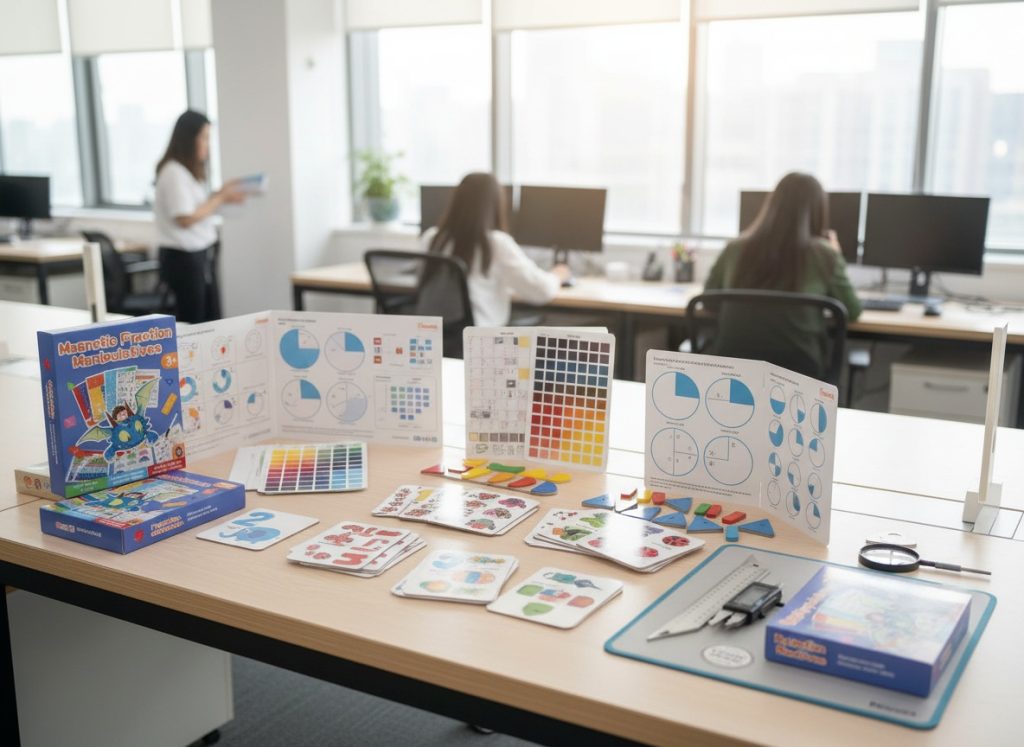
The global education market increasingly values customized learning resources. Schools, curriculum companies, and educational brands often require products that match specific teaching systems, age groups, and regional learning requirements.
A professional OEM/ODM supplier can support the complete development process, from initial concept confirmation to large-scale production.
The process usually begins with defining the educational purpose, target users, product format, and market positioning. For example, a brand may develop a fraction book focused on basic fraction recognition for younger learners or a more advanced fraction activity set for elementary students.
After confirming the product concept, manufacturers typically move into prototype development. During this stage, suppliers create samples to evaluate the product structure, educational content presentation, material selection, printing quality, and user experience.
Sample approval is a critical stage before mass production. It allows buyers to confirm whether the final product meets their brand standards and market expectations before committing to larger production quantities.
Once the sample is approved, manufacturers proceed with production planning, quality inspection, and shipment preparation. A complete manufacturing process usually includes material inspection, printing checks, production monitoring, final product inspection, and packaging verification.
For paper-based Math Manipulatives, customization options are highly flexible. Educational brands can develop products with:
- Customized educational content
- Different language versions
- Brand logo printing
- Unique illustrations and layouts
- Retail packaging solutions
- Classroom bundle configurations
This flexibility allows brands to create products adapted to different educational markets rather than competing only with standard products.
A capable OEM/ODM partner should not only provide manufacturing capacity but also participate in product improvement, production optimization, and market adaptation.
How to Choose the Right Math Manipulatives Supplier
Selecting a reliable supplier is one of the most important decisions for educational brands, wholesalers, and distributors. While product price is an important consideration, experienced buyers usually evaluate suppliers based on overall manufacturing capability, quality consistency, and long-term cooperation potential.
A suitable supplier should understand both educational objectives and production requirements. Manufacturing a fraction book or a set of mathematical learning cards requires more than accurate printing. Suppliers need to understand how children interact with products, how teachers use them in classrooms, and how materials perform after repeated use.
For overseas buyers, production consistency is especially important. A product that performs well during sampling must maintain the same quality level when produced in thousands of units.
Professional buyers usually evaluate suppliers through several key areas:
| Evaluation Area | What Buyers Should Consider |
|---|---|
| Product Development Capability | Can the supplier support customized educational concepts and prototype development? |
| Material Management | Can the supplier maintain consistent paper quality, printing results, and finishing standards? |
| Quality Control | Are inspections performed throughout production and before shipment? |
| Compliance Knowledge | Does the supplier understand EN71, ASTM F963, CE, and international export requirements? |
| Production Flexibility | Can the supplier support different quantities, packaging formats, and market requirements? |
Beyond production capability, communication efficiency also has a direct impact on project success. Educational products often require adjustments during development, especially when adapting content for different languages, curriculum systems, or target age groups.
A supplier who can provide accurate samples, professional recommendations, and stable production management becomes a valuable business partner rather than simply a manufacturing source.
For B2B buyers, the ideal supplier relationship is built on product knowledge, manufacturing reliability, and the ability to support continuous product development.
Conclusion
The increasing demand for interactive learning methods has made Math Manipulatives an important category in the global education market. By helping students visualize and interact with mathematical concepts, these resources transform complex ideas into practical learning experiences.
For educational brands, wholesalers, and school suppliers, products such as fraction books, fraction cards, number line activities, counting cards, and place value charts provide opportunities to develop valuable classroom solutions with strong market potential.
Among different material options, paper-based mathematical learning resources remain highly attractive for many B2B applications because they offer flexible customization, efficient production, and convenient international logistics. With professional printing technology, reliable quality control, and appropriate safety management, these products can meet the expectations of schools, distributors, and educational retailers.
Choosing the right manufacturing partner is equally important. A professional OEM/ODM supplier should support the entire development journey, including product concept planning, prototype creation, customization, production management, and final quality inspection.
For companies planning to expand their educational product portfolio, customized Math Manipulatives can provide new business opportunities while delivering meaningful learning value to students.
Whether you are developing a new educational product line or expanding your existing catalog, our team can support customized Math Manipulatives solutions from concept development to mass production. Contact us to discuss your product requirements and explore suitable OEM/ODM cooperation opportunities.