

As early childhood education increasingly emphasizes creativity and experiential learning, educational resources that encourage hands-on exploration are receiving more attention than ever before. Among them, Magnetic Toys have emerged as one of the fastest-growing categories in preschool classrooms, daycare centers, and home learning environments.
Research suggests that open-ended play contributes to cognitive development, spatial reasoning, and collaborative problem-solving. Because Magnetic Toys combine these elements with engaging building experiences, educators and parents are increasingly incorporating them into everyday learning activities.
Industry data also indicates that demand for STEM toys and educational construction toys continues to grow, reflecting a broader shift toward play-based learning approaches.
Studies show that children learn more effectively when they can manipulate objects, test ideas, and observe cause-and-effect relationships through active exploration.
Why Are Magnetic Toys Gaining Attention in Early Childhood Learning?
Unlike single-purpose toys, Magnetic Toys encourage children to build, redesign, and experiment freely. This open-ended nature aligns closely with Montessori-inspired learning and project-based educational approaches.
Many preschool teachers report that children tend to remain engaged longer when learning materials offer multiple ways to play and create. This flexibility allows the same set of magnetic building toys to support different developmental stages and classroom activities.
Supporting Creativity and Independent Thinking
Research indicates that open-ended educational toys can help children develop creativity and problem-solving abilities. Through trial and error, children learn to test ideas and make adjustments independently.
Encouraging Cooperative Learning
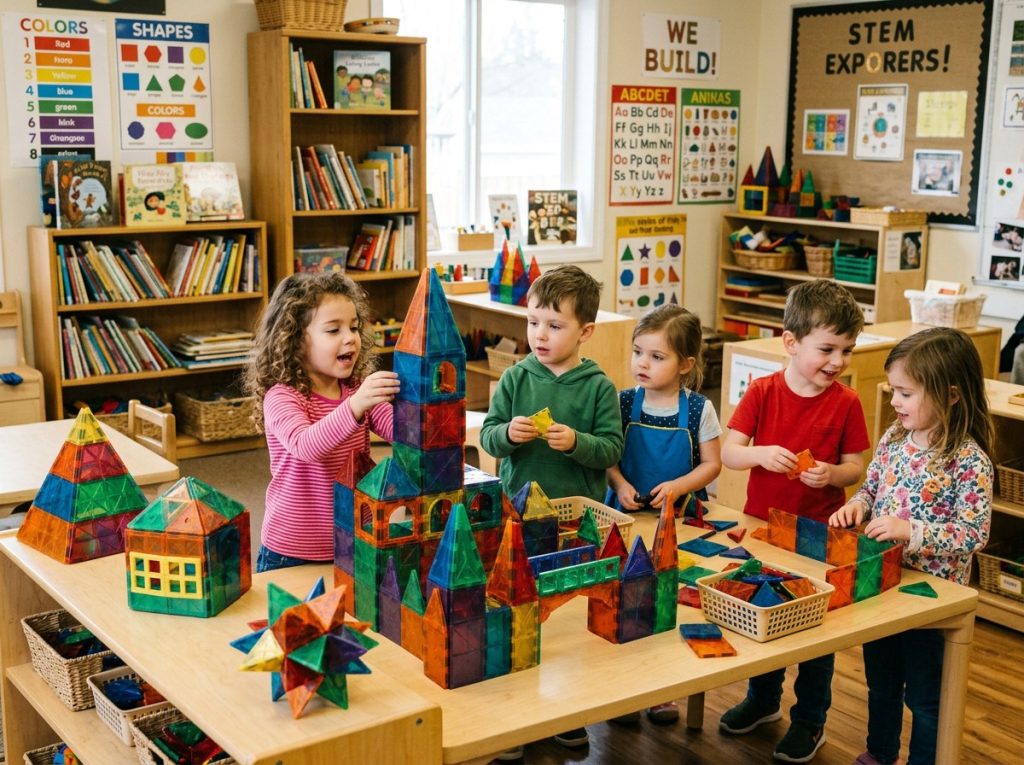
Classroom observations suggest that group building activities naturally promote communication and teamwork. Children often exchange ideas, discuss structures, and solve challenges together, making Magnetic Toys valuable tools for social interaction.
Integrating with Modern Teaching Methods
Preschools that adopt STEM and Montessori-inspired practices frequently incorporate magnetic tiles and construction toys into daily lessons. Their versatility allows teachers to design activities that combine play with practical learning experiences.

How Magnetic Toys Support Preschool Development
Research findings suggest that hands-on building activities contribute to several areas of childhood development. Rather than focusing on one skill alone, Magnetic Toys help children strengthen fine motor coordination, spatial awareness, and communication abilities simultaneously.
Fine Motor Skill Development
Connecting magnetic pieces requires precision and hand control. Repeated manipulation helps children improve finger strength and coordination, which are important foundations for writing and daily tasks.
Spatial Reasoning and Geometry Awareness
Building three-dimensional structures introduces concepts such as symmetry, balance, angles, and geometric relationships. Studies have shown that early spatial experiences are closely associated with later mathematics performance.
Communication Through Cooperative Play
When children participate in group projects, they learn how to express ideas, negotiate solutions, and collaborate toward shared goals. These interactions contribute positively to both cognitive and emotional development.
| Development Area | Benefits Provided by Magnetic Toys |
| Fine Motor Skills | Finger control and hand coordination |
| Creativity | Open-ended building experiences |
| Spatial Thinking | Understanding shapes and structures |
| STEM Awareness | Basic engineering and geometry concepts |
| Social Skills | Communication and teamwork |
| Problem-Solving | Trial-and-error learning |
What Makes Magnetic Toys Different from Traditional Building Toys?
Traditional building blocks have long been used in preschool education. However, Magnetic Toys offer several characteristics that make them especially suitable for modern learning environments.
Faster Construction and Immediate Feedback
Magnetic connections enable children to assemble and modify structures quickly. This immediate response encourages experimentation and reduces frustration.
More Possibilities for Three-Dimensional Designs
Compared with conventional blocks, magnetic tiles can connect from multiple directions, allowing children to create cubes, towers, castles, vehicles, and geometric sculptures with greater flexibility.
Visually Engaging Learning Experiences
Transparent panels and vibrant colors enhance sensory play and increase children’s interest in building activities.
Magnetic Toys vs Traditional Building Blocks
| Feature | Magnetic Toys | Traditional Wooden Blocks |
| Three-Dimensional Structures | Excellent | Moderate |
| STEM Learning Support | Strong | Moderate |
| Rebuilding Speed | Fast | Slow |
| Collaborative Activities | High | Medium |
| Shape Variety | Extensive | Limited |
| Design Flexibility | High | Moderate |
Many educators find that magnetic building toys encourage children to experiment with more complex structures because pieces can be assembled and adjusted with less effort.
Common Classroom Activities Using Magnetic Toys
The versatility of Magnetic Toys allows teachers and parents to create a wide range of learning experiences. As a result, these educational toys are frequently used in preschool classrooms and daycare centers.
STEM Exploration Centers
Teachers often use magnetic tiles to introduce simple engineering concepts, shapes, and geometric patterns.
Group Building Projects
Collaborative activities encourage communication and teamwork while helping children learn from one another.
Montessori-Inspired Learning Areas
Because Magnetic Toys promote self-directed exploration, they fit naturally into Montessori-style environments.
Home-Based Learning Activities
Parents increasingly use magnetic building toys during family playtime to encourage screen-free learning experiences.
Why Are Schools and Parents Investing More in Magnetic Toys?
Growing interest in educational toys reflects broader changes in teaching philosophies and parenting preferences.
Increasing Focus on STEM Education
As STEM education becomes more prominent, schools are seeking learning tools that introduce engineering and problem-solving concepts in age-appropriate ways.
Demand for Screen-Free Activities
Parents are looking for alternatives that provide meaningful engagement without relying on electronic devices. Magnetic Toys offer opportunities for creativity and interaction through physical play.
Durability and Long-Term Use
Products designed for classroom environments are typically engineered for repeated use. Many sets feature panels measuring 2–3 mm in thickness and contain fully enclosed ferrite magnets approximately 18 mm × 4 mm in size, helping maintain structural stability during everyday play.
Rather than being driven by a single factor, the popularity of Magnetic Toys reflects changing expectations regarding early childhood education and learning resources.
Important Factors to Consider When Selecting Magnetic Toys
With numerous products available, educators and distributors often evaluate several factors before making purchasing decisions.
| Selection Criteria | Key Considerations |
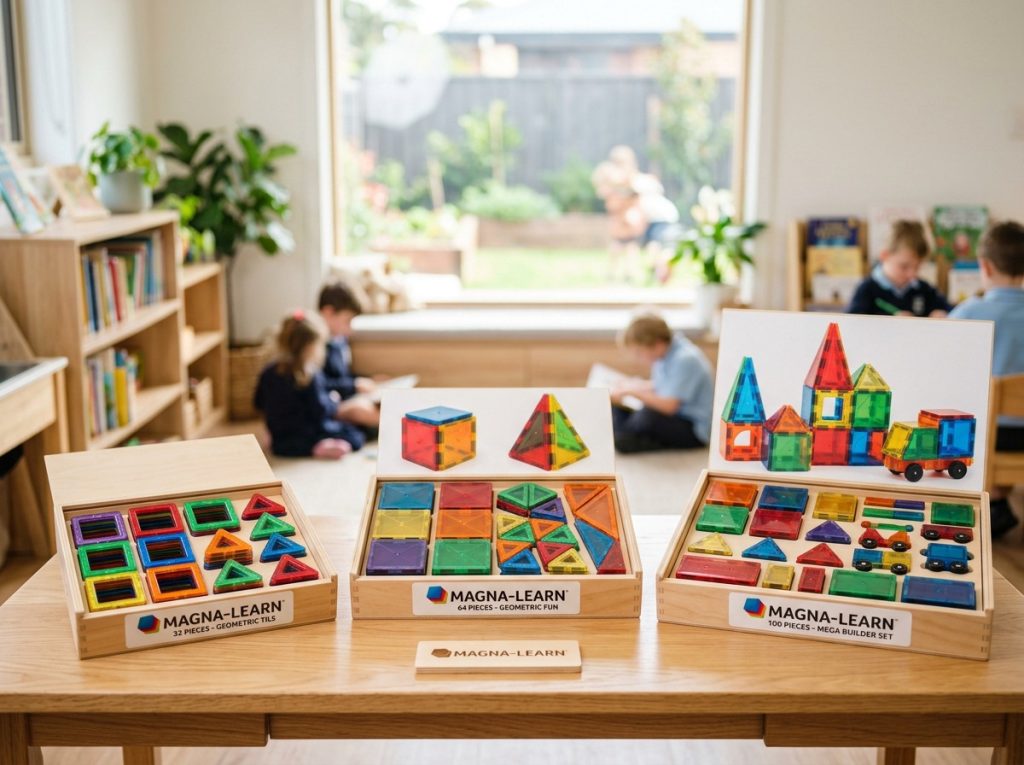
| Piece Quantity | 32, 64, 100, 128, or 200-piece sets |
| Magnet Strength | Structural stability |
| Panel Thickness | Typically 2–3 mm |
| Edge Design | Rounded edges for comfortable handling |
| Shape Variety | Squares, triangles, rectangles and specialty pieces |
| Educational Value | STEM and open-ended learning support |
Many preschool teachers report that larger configurations provide more opportunities for collaborative activities and imaginative play.
What Do Schools and Distributors Look for in Magnetic Toys Suppliers?
From a commercial perspective, product quality and supply consistency are important considerations. Distributors serving educational institutions often prioritize manufacturers that can provide stable production and flexible customization options.
Consistent Magnet Strength
Reliable magnetic performance helps ensure that structures remain stable during repeated classroom use.
Stable Product Quality
Uniform panel thickness and consistent manufacturing standards contribute to long-term durability.
Custom Packaging and Branding Options
Private-label packaging and customized color combinations are increasingly requested by educational brands and distributors.
OEM and ODM Support
Many buyers prefer working with manufacturers that offer OEM and ODM services to develop products tailored to specific market requirements.
Bulk Order Availability
Wholesale magnetic toys and large classroom packs help schools and distributors meet different purchasing needs efficiently.
How Magnetic Toys Are Shaping the Future of Preschool Education
Educational experts increasingly recognize the value of experiential learning. Magnetic Toys align with modern teaching philosophies by encouraging children to explore, experiment, and create independently.
As project-based learning becomes more common, magnetic building toys are expected to play an increasingly important role in preschool education. Their versatility allows educators to combine creativity with STEM learning in ways that are both engaging and practical.
From home learning spaces to daycare centers and classrooms, Magnetic Toys are evolving from simple play products into meaningful educational tools that support creativity, logical thinking, and problem-solving.
Frequently Asked Questions About Magnetic Toys
At What Age Can Children Start Using Magnetic Toys?
Most manufacturers recommend products intended for children aged 3 years and above, depending on piece size and product configuration.
Are Magnetic Toys Helpful for STEM Learning?
Research indicates that magnetic building toys can introduce basic concepts related to geometry, engineering, balance, and spatial reasoning. For this reason, they are commonly used as STEM toys in preschool settings.
How Many Pieces Are Suitable for Classroom Use?
Smaller 32-piece and 64-piece sets are often used for individual play, while 100-piece, 128-piece, and 200-piece classroom packs are more suitable for collaborative activities and group projects.
Why Are Magnetic Tiles Popular in Montessori-Inspired Learning?
Because magnetic tiles encourage self-directed exploration and open-ended creativity, they align well with Montessori-inspired educational environments.
Conclusion
Research findings, classroom observations, and industry trends collectively explain why Magnetic Toys are becoming increasingly popular in preschool education. Their ability to combine creativity, spatial reasoning, and early STEM learning makes them valuable resources for both educators and families.
As preschool education continues to emphasize hands-on learning and collaborative experiences, demand for Magnetic Toys is expected to grow further. For schools, distributors, and educational brands, choosing products with reliable magnetic performance, diverse piece configurations, and consistent manufacturing standards can provide long-term value while supporting a wide range of learning environments.
With their combination of educational benefits and design flexibility, Magnetic Toys are likely to remain an important part of modern preschool education for years to come.