

Here’s something most parents figure out the hard way: fractions don’t click from explanation. You can say “one half means two equal parts” seventeen times and watch a 6-year-old nod politely while understanding nothing. The moment clicks when they pick up a red bar, slide two smaller pieces next to it, and see for themselves that they match exactly.
That’s the actual problem vindstier’s magnetic fraction teaching aids were built to solve. Not “making math fun” — that’s marketing language. The real problem is the gap between symbolic notation and physical reality that trips up kids somewhere between ages 4 and 8, depending on how they learn.
So which age group gets the most out of this specific set? The answer is less obvious than you’d expect.
What’s Actually Inside These Magnetic Fraction Teaching Aids
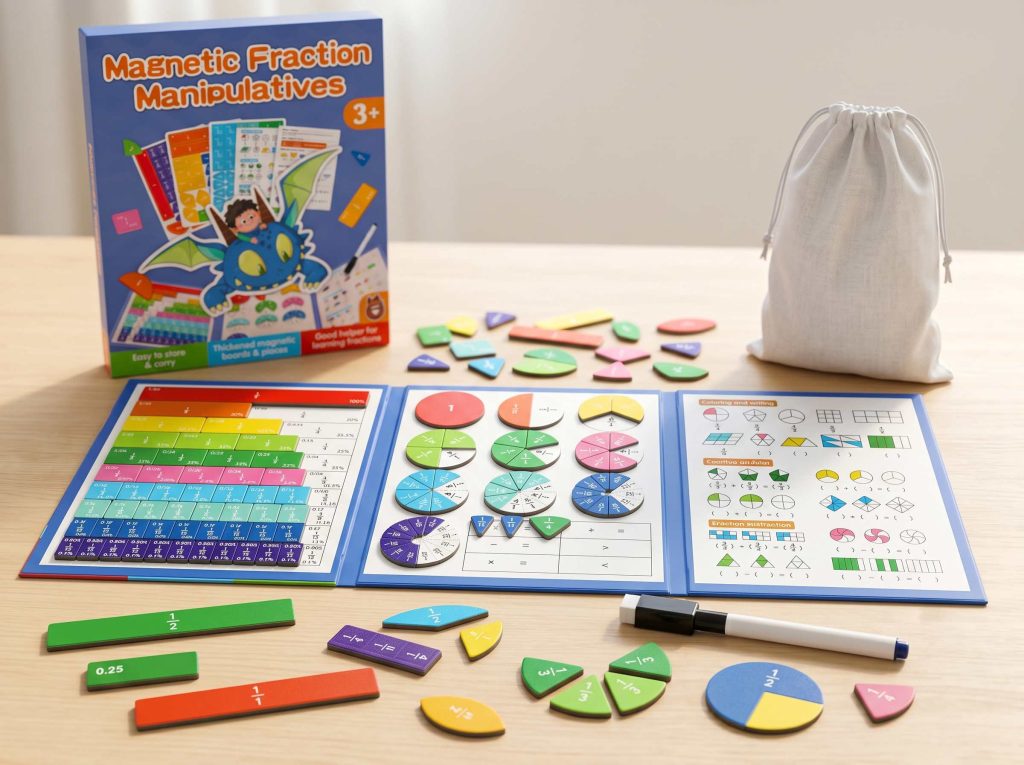
The set includes color-coded fraction bars, fraction circles, a write-and-wipe magnetic whiteboard, and a foldable magnetic board that closes like a book and holds every piece in place. The marker stores inside. Nothing rattles loose.
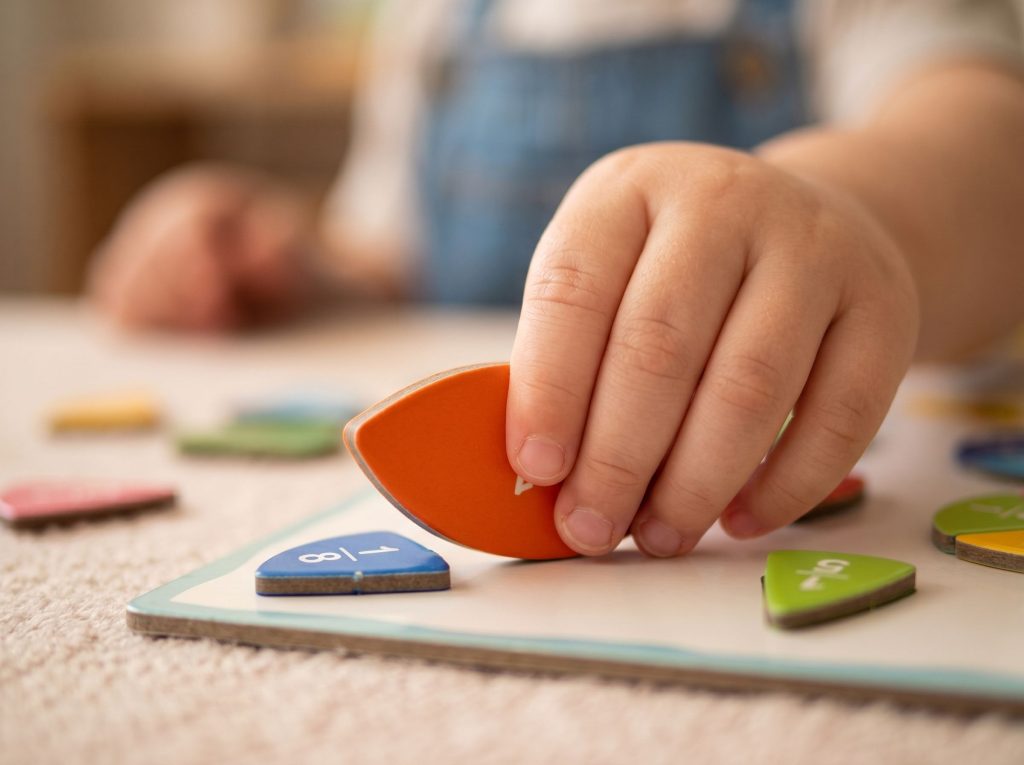
The fraction pieces are thick. Not “slightly chunkier than the cheap version” thick — meaningfully thick, with smooth edges that don’t catch on small fingers. This is the design decision that separates a functional magnetic fraction teaching aid from a frustration device for the 3-to-5 age range. Thin foam fraction pieces warp. They curl at the edges after a few weeks. These don’t.
The whiteboard is magnetic, which means fraction bars stick to it. A child places ½ on the board, adds ¼, writes the equation below it, checks the answer by rearranging the pieces, erases, starts over. That cycle — place, write, check, reset — is what makes this a learning tool rather than a sorting toy.
The folding case is the sleeper feature. Every piece has a place. The board snaps shut. You can hand this to a child in a car and not spend the return trip collecting eighths from under the seat.

Ages 3 to 5: Before the Vocabulary, There’s the Shape
Nobody teaches a 4-year-old what ¾ means. That’s fine. That’s not what’s happening at this age, and these magnetic fraction teaching aids don’t pretend otherwise.
What a 3-to-5-year-old actually does with this set: sorts pieces by color, figures out which ones are bigger, discovers that two small pieces fit over one large piece, and builds patterns. None of that involves fractions as a concept. All of it builds the perceptual foundation that fraction instruction will land on later.
The thick edges matter here more than anywhere else. A 4-year-old’s grip strength is still developing. Pieces that slip, bend, or require precise handling kill the activity in under two minutes. These pieces stay where you put them. They pick up cleanly. The magnetic whiteboard at this stage is a drawing surface — scribbling, wiping, scribbling again. The mathematical function comes later. The comfort with the tool starts now.
Parents who buy this expecting a 3-year-old to learn fractions will be disappointed. Parents who buy this understanding they’re giving their child two years of tactile preparation before formal instruction starts will get exactly what they paid for.
Ages 5 to 7: Where Magnetic Fraction Teaching Aids Deliver the Clearest Academic Return
A 6-year-old who’s been staring at ½ + ¼ on a worksheet for ten minutes will resolve it in about thirty seconds by sliding the bars together on the magnetic board. Not because the toy is magic. Because the answer is now visible, physical, and self-verifying.
This age window is where the full system activates. The color-coded bars give children a visual reference that printed worksheets can’t provide — each fraction has a consistent color across the entire set, so ¼ always looks like ¼, regardless of context. That consistency is what lets a child start building intuition rather than just memorizing.
The write-and-wipe board becomes a genuine workspace at this stage. A child places the pieces, writes the equation below them, checks by rearranging, erases, tries again. The resetting matters — it lowers the stakes. There’s no crossed-out wrong answer sitting there as evidence of failure. The board is clean. Try again.
For homeschooling families, the portability of these magnetic fraction teaching aids closes a gap that most math manipulatives can’t. The folding board means a structured fraction lesson can happen in a waiting room, on a long drive, at a kitchen table, or on a plane — same pieces, same whiteboard, same learning — without the fifteen-minute setup and cleanup that makes most hands-on math activities impractical outside a dedicated school setting.
The non-toxic construction is relevant here in a specific way: 5-to-7-year-olds still press objects against their faces while thinking. They hand pieces to younger siblings. The material safety of this set isn’t a general certification claim — it’s a practical consideration for exactly how this age group physically handles learning tools during a forty-minute math session.
Ages 7 to 9: Using Magnetic Fraction Teaching Aids to Remediate Without Pressure
Some kids hit Grade 2 or Grade 3 and fraction concepts simply didn’t stick the first time through. This happens. It’s common. It’s also one of the harder problems to address because returning to a topic a child has already “learned” — and gotten wrong answers on — carries its own psychological weight.
These magnetic fraction teaching aids handle this quietly. There are no wrong answers written on paper. Nothing to erase awkwardly in front of a parent. A child who can’t explain why ⅔ is larger than ½ can settle the question in fifteen seconds by placing the bars side by side. The comparison is physical. It’s immediate. It doesn’t require the child to trust an explanation — they can see it.
For parents working with a child who’s developed anxiety specifically around fractions, reintroducing the concept through physical manipulation before returning to written work is a well-documented approach. The set provides the physical layer without requiring any explicit acknowledgment that the child is “going back to basics.”
The whiteboard continues to earn its place at this age — repeated practice without the visual accumulation of mistakes is exactly what children in this category need more of.
The Portability Argument, Made Honestly
Most educational toy descriptions that mention portability mean “it fits in a bag.” That’s a low bar.
The vindstier folding design means every fraction circle and rectangle has a specific place, held magnetically, in a case that closes completely. The marker is inside the case. When you open it, everything is there. When you close it, nothing escapes.
This matters for a specific family type: parents who treat non-screen time in transit as learning time. A flight from Chicago to London is nine hours. A road trip from Denver to Salt Lake City is seven. The difference between a magnetic fraction teaching aid that travels and one that stays home isn’t the size — it’s whether the pieces stay organized when a 6-year-old opens and closes it eight times between takeoff and landing.
This set is designed for the eighth opening.
On Certifications — What They Actually Cover Here
CE and CPC certifications show up on a lot of toy packaging. Worth clarifying what they mean for this specific product.
CE certification confirms this set meets European Union safety standards — material composition, mechanical hazard testing, and labeling requirements for children’s products. CPC certification is the U.S. requirement under the Consumer Product Safety Improvement Act, covering chemical content limits, physical and mechanical properties, and flammability for products intended for children under 12.
Both certifications apply to the specific materials used in these fraction pieces and the magnetic whiteboard — not to the vindstier brand in general. For wholesale buyers and educational retailers who need to verify compliance documentation for import or retail listing, the certification applies product-specifically, which simplifies the paperwork considerably.
For parents, the short version: the non-toxic claim on the box is backed by testing, not just stated.
Conclusion
The age group that benefits most from magnetic fraction teaching aids isn’t a single answer — it’s a window that opens around age 3 and stays useful through age 9, with the clearest academic return landing between 5 and 7.
What keeps this set relevant across that entire span is the same thing that makes it worth recommending in the first place: the thick magnetic pieces that survive years of small-hand use without warping, the erasable whiteboard that turns repeated practice into low-stakes exploration, and the folding case that makes a complete fraction workspace genuinely portable rather than theoretically portable.
If a child is anywhere in the 3-to-8 range and fractions are anywhere on the horizon — near or distant — this set will find a use before it finds a shelf.