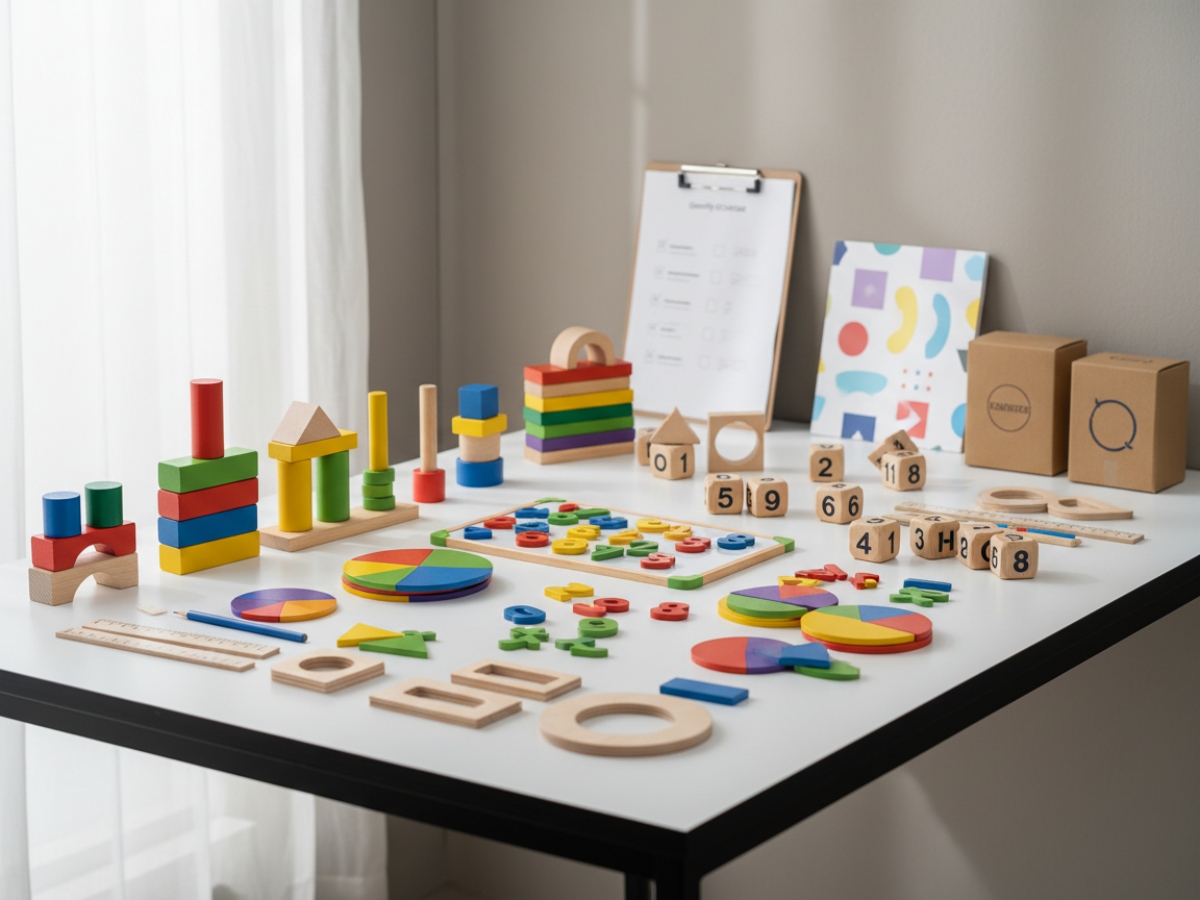
For decades, traditional math worksheets have been widely used in classrooms. They are convenient, easy to distribute, and effective for practicing calculations. However, as education continues to focus more on understanding rather than memorization, teachers and schools are looking for learning methods that help children build stronger mathematical foundations.
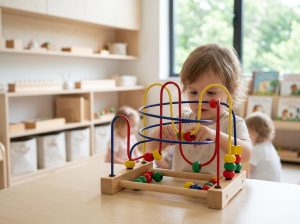
This change has increased interest in math manipulatives — hands-on learning tools that allow children to explore mathematical concepts through physical interaction.
Unlike worksheets, which often introduce mathematics through numbers and symbols, math manipulatives help children experience concepts before moving into abstract thinking. By counting objects, creating patterns, comparing quantities, and visualizing relationships, children can develop a deeper understanding of how mathematics works.
For educational toy brands, wholesalers, and retailers, this trend also represents a growing market opportunity. Schools and parents are increasingly searching for products that combine educational value with engaging play experiences.
Why Traditional Math Worksheets Have Limitations
Traditional worksheets are not ineffective. They remain useful for reviewing knowledge, practicing calculations, and evaluating student progress. The challenge is that worksheets often focus on the final answer rather than the thinking process behind it.
For young learners, mathematics is naturally an abstract subject. Before children can understand numbers and formulas, they need to understand what those numbers represent.
For example, a worksheet may ask:
5 + 3 = ?
An adult immediately understands that the problem represents combining two groups. However, a young child first needs to understand the meaning of “5” and “3” through real experiences.
When children rely only on worksheets, some may learn to follow procedures without developing strong number sense. They may know how to complete a calculation but struggle when facing a new type of problem.
This is why many educators emphasize the importance of moving from concrete experiences to abstract concepts. Children often learn mathematics more effectively when they first interact with physical objects, then use visual representations, and finally work with numbers and symbols.
Math manipulatives support this process by creating a bridge between real-world experiences and mathematical thinking.
How Math Manipulatives Build Deeper Understanding
Making Abstract Concepts Easier to Understand
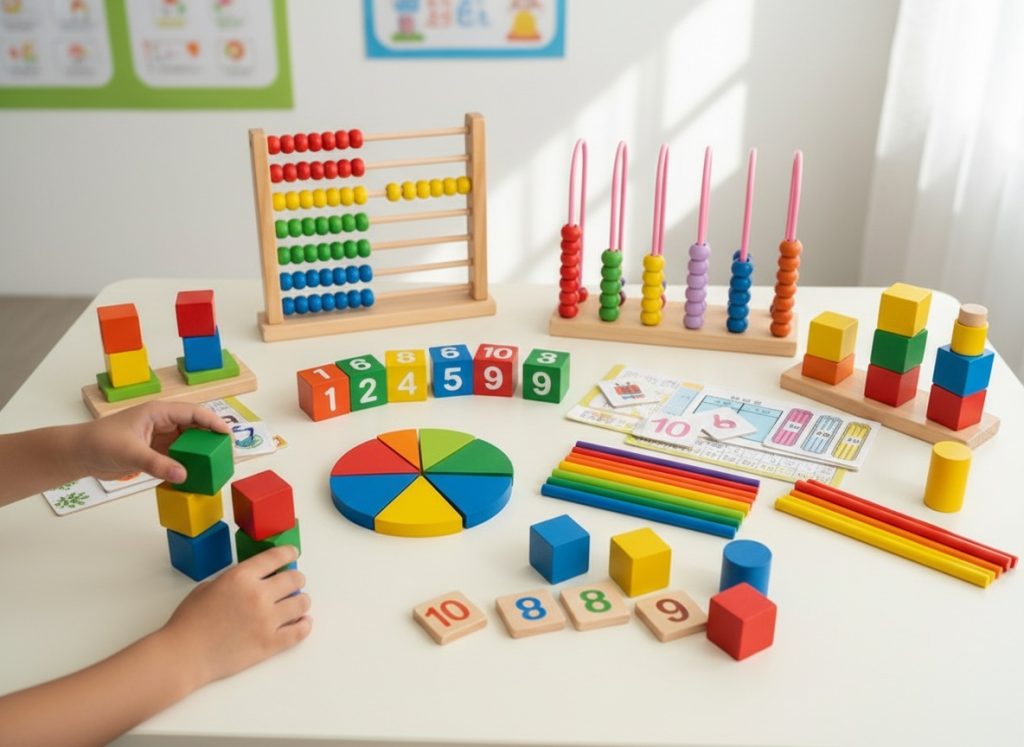
One of the biggest advantages of math manipulatives is that they make invisible mathematical ideas visible.
Concepts such as fractions, place value, and geometric relationships can be difficult for children when presented only through written explanations. A worksheet may show that one-half is written as 1/2, but younger learners may not understand what that actually means.
With fraction models, children can physically divide objects into equal parts and compare different amounts. Through this interaction, they begin to understand the relationship between parts and wholes.
The same principle applies to counting tools, number blocks, and pattern-based learning products. These resources allow children to connect mathematical symbols with real quantities and visual experiences.
This early understanding becomes the foundation for more advanced skills, including multiplication, division, measurement, and problem-solving.
Developing Number Sense Through Hands-On Practice
Strong number sense is essential for future mathematics learning. Children with good number sense can recognize relationships between numbers, estimate quantities, and choose effective strategies when solving problems.
However, number sense is difficult to build through repetition alone.
Math manipulatives allow children to explore numbers in a meaningful way. When using counting objects or number-based learning tools, children can group, separate, compare, and reorganize quantities.
For example, a child using counting blocks can discover that different arrangements may represent the same number. This simple experience helps develop flexibility in mathematical thinking.
For teachers, this also provides valuable insight into how children understand concepts. Instead of only seeing whether an answer is correct, educators can observe the child’s reasoning process and provide more targeted guidance.
Why Math Manipulatives Create Better Learning Outcomes
Moving From Memorization to Mathematical Thinking
The main difference between math manipulatives and traditional worksheets is not simply the use of physical materials. The deeper difference is how children develop mathematical understanding.
Worksheets usually focus on practicing skills that students have already learned. They are useful for improving calculation accuracy and reinforcing knowledge. However, they often provide limited opportunities for children to explore why a mathematical concept works.
Math manipulatives encourage children to actively participate in the learning process. Instead of only reading numbers and writing answers, children can move objects, test ideas, and discover relationships between quantities.
For example, when learning multiplication, a worksheet may show:
4 × 3 = ?
A child may memorize that the answer is 12, but this does not always mean they understand the concept of multiplication. By using counting blocks, children can create four groups of three objects and see that multiplication represents repeated addition.
This hands-on experience helps children move from simply remembering answers to understanding mathematical principles.
Supporting the Concrete-Pictorial-Abstract Learning Process
One important reason math manipulatives are effective is that they support the Concrete-Pictorial-Abstract (CPA) learning approach.
This approach explains that children often understand mathematics best when they move through different stages of learning, from physical experiences to visual understanding and finally to abstract concepts.
Concrete Learning: Understanding Through Physical Objects
In the concrete stage, children interact directly with physical materials. They count objects, compare sizes, build patterns, and explore mathematical relationships through hands-on activities.
Math manipulatives provide this foundation by allowing children to experience concepts before they are introduced to abstract symbols.
For example, before learning fractions on paper, children can use fraction pieces to understand how a whole can be divided into equal parts.
Pictorial Learning: Connecting Objects With Visual Models
After children understand a concept through physical experience, they can move toward pictures, diagrams, and visual representations.
At this stage, students begin connecting real objects with mathematical drawings and models. These visual connections make it easier for children to transition toward more complex mathematical ideas.
Abstract Learning: Working With Numbers and Symbols
The final stage involves using numbers, equations, and mathematical formulas.
When children reach this stage after meaningful hands-on experiences, they are more likely to understand the logic behind mathematical operations instead of memorizing steps.
For younger learners, this gradual progression is especially valuable because it matches their natural cognitive development.
Encouraging Problem-Solving and Independent Learning
Another advantage of math manipulatives is that they encourage children to explore different ways of solving problems.
Traditional worksheets often follow a fixed structure. Students read a question, apply a method, and write an answer. This type of practice is useful, but it may not encourage deeper thinking.
Math manipulatives create opportunities for exploration.
When children work with learning tools, they can experiment with different strategies and learn from mistakes. For example, when building patterns with blocks, students may discover multiple ways to organize objects and explain their reasoning.
This process develops important skills beyond mathematics, including logical thinking, creativity, decision-making, and communication.
For educators, this changes the focus from simply asking “What is the answer?” to asking “How did you solve it?” and “Why does this method work?”
These questions help children become more confident and independent learners.
Why Teachers Use Math Manipulatives in Modern Classrooms
Classrooms today include students with different learning abilities and levels of understanding. Teachers need resources that can support various learning needs while keeping students engaged.
Math manipulatives provide this flexibility.
A single learning tool can often be adapted for different activities. Younger children may use counting materials to develop number recognition, while older students can use similar resources to explore patterns, measurement, or problem-solving.
This makes math manipulatives valuable classroom resources rather than single-purpose teaching materials.
They are also useful for group learning. Teachers can create collaborative activities where students discuss their ideas, compare solutions, and learn from each other.
This interactive learning environment is difficult to achieve through worksheets alone.
The Growing Demand for Hands-On Math Learning Products
The increasing popularity of math manipulatives reflects a broader change in the educational market.
Schools, parents, and educational organizations are placing more emphasis on practical understanding, STEM education, and skills that prepare children for future learning.
As a result, educational buyers are looking for products that offer more than short-term entertainment. They want learning tools that support meaningful development and provide clear educational value.
For educational brands, wholesalers, and retailers, this creates opportunities to develop products with stronger market positioning.
Compared with traditional learning materials, well-designed math manipulatives offer several advantages:
They can be reused across different activities and age groups.
They support both classroom and home learning environments.
They combine educational benefits with engaging play experiences.
They align with current trends in early childhood education and STEM learning.
However, market success depends on more than simply creating a product that looks educational. Product design, safety standards, manufacturing quality, and supplier expertise all influence whether a math manipulative can succeed internationally.
What Educational Buyers Should Consider When Selecting Products
For brands and distributors, choosing the right math manipulatives requires evaluating both educational value and commercial potential.
A successful product should solve a real learning need while also meeting the expectations of teachers, parents, and retailers.
Products with clear educational purposes are easier to market because buyers can immediately understand their benefits. A counting tool should help develop number skills, while a fraction learning product should make complex concepts easier to visualize.
At the same time, quality and durability are essential. Educational products are often used repeatedly in classrooms and homes, meaning they must be designed for long-term use.
For companies entering this category, partnering with an experienced educational toy manufacturer can help ensure that products are not only attractive but also meaningful learning resources.
How to Choose the Right Math Manipulatives for International Markets
Selecting the right math manipulatives requires looking beyond product appearance and price. For educational brands, wholesalers, distributors, and retailers, the best products combine meaningful educational value, engaging design, reliable quality, and manufacturing capabilities that support long-term business growth.
Educational Value Should Be the Foundation of Product Selection
For educational buyers, selecting the right math manipulatives starts with evaluating their learning purpose rather than their appearance. While attractive colors and creative designs can capture children’s attention, long-term success depends on whether a product truly supports learning objectives.
A high-quality math manipulative should help children understand mathematical concepts through meaningful interaction. Whether the product focuses on counting, fractions, geometry, or logical thinking, its educational purpose should be clear.
For example, a number learning tool should not simply display numbers. It should help children understand quantities, relationships, and basic mathematical operations. Likewise, a fraction learning product should allow students to visualize parts and wholes instead of only memorizing fraction symbols.
This is becoming increasingly important for international buyers. Schools, parents, and educational retailers are looking for products that provide measurable learning value rather than products that simply use educational claims as marketing labels.
For brands and distributors, products with strong educational foundations are easier to position in competitive markets and help build long-term customer trust.
Product Design Should Balance Learning and Engagement
One challenge in developing math manipulatives is finding the right balance between educational purpose and children’s interest.
A product that feels too academic may resemble traditional classroom exercises, while a product designed only for entertainment may fail to deliver meaningful educational value.
Successful math manipulatives combine both elements. They encourage children to learn naturally through exploration, interaction, and problem-solving.
For example, well-designed learning tools encourage children to build mathematical patterns, compare quantities, explore different solutions, and develop logical thinking through hands-on activities.
The goal is not simply to teach correct answers but to encourage children to think independently.
This type of design also extends a product’s lifespan. A flexible math manipulative can support increasingly challenging activities as children grow, making it more valuable for families, schools, and retailers.
For educational brands, products with longer learning cycles often offer stronger market potential because customers can clearly recognize their practical benefits.
Manufacturing Standards That Global Buyers Should Evaluate
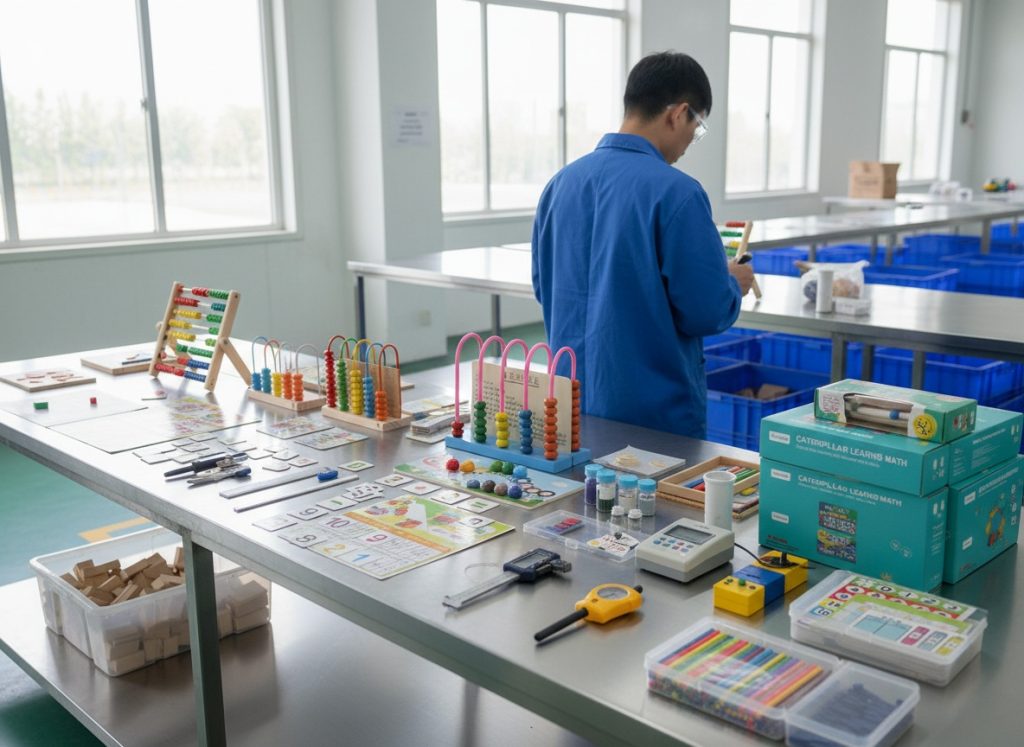
Educational value alone is not enough when sourcing math manipulatives for international markets. Buyers also need products that meet global quality standards while supporting long-term brand development.
Safety, Durability, and Compliance for Global Markets
For international buyers, safety, durability, and compliance are equally important when selecting a math manipulatives supplier.
Children’s educational products must meet different safety expectations depending on their target markets. In North America and Europe, buyers commonly consider standards such as ASTM F963, EN71, and other applicable children’s product regulations.
However, compliance should not be viewed only as a certification requirement. Product quality is reflected in everyday use.
Classroom learning tools are handled frequently by multiple children, so materials should be durable, surfaces should be smooth, and product structures should withstand repeated use.
A professional supplier should also maintain a consistent quality control system covering material selection, production processes, and final inspection.
For wholesalers and retailers, this helps reduce product complaints while protecting long-term brand reputation.
Why OEM and ODM Capability Matters for Educational Brands
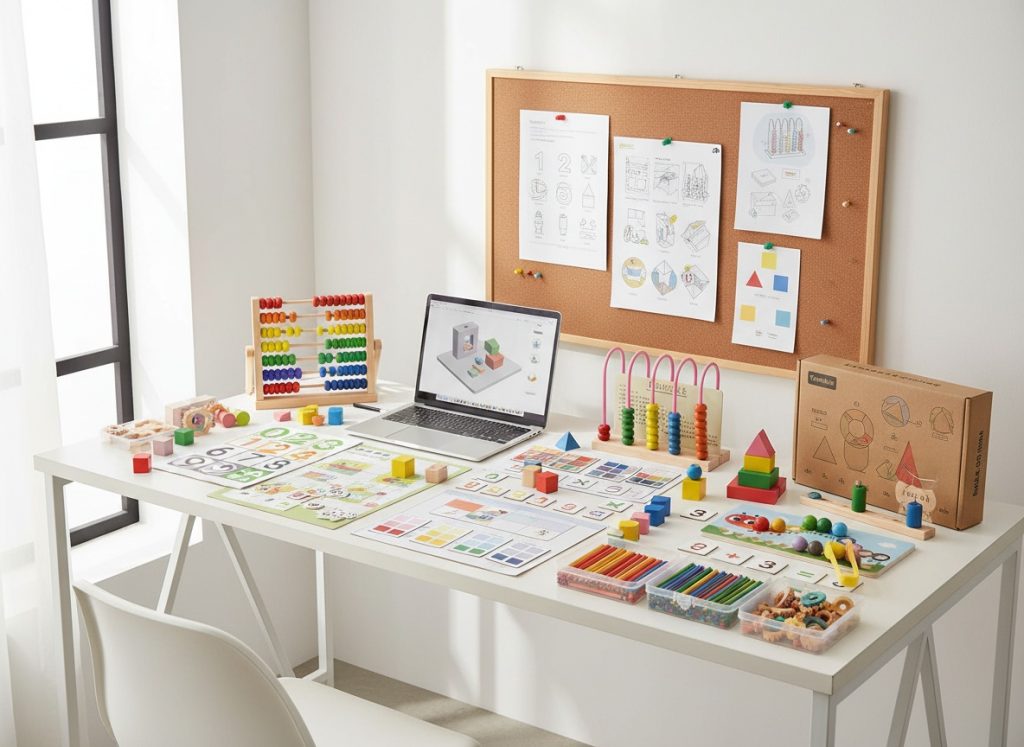
As competition in the educational toy industry continues to grow, customization has become an important strategy for brands seeking market differentiation.
Many buyers are no longer interested in selling identical products available from multiple suppliers. Instead, they are looking for solutions that match their own brand identity, customer needs, and market positioning.
An experienced OEM or ODM supplier can help brands develop differentiated math manipulatives through customized product functions, unique designs and packaging, different difficulty levels for various age groups, and educational content tailored to specific learning goals.
For example, a preschool-focused brand may require simple counting and sorting products, while a classroom resource provider may need more advanced tools for teaching fractions, geometry, or STEM concepts.
The ability to customize products allows brands to strengthen their product portfolios and reduce direct price competition.
Choosing a Manufacturing Partner With Educational Experience
Sourcing math manipulatives is different from sourcing ordinary toys. A reliable manufacturing partner should understand not only production requirements but also the educational purpose behind each product.
A capable supplier should support the entire product development process, from initial concepts to final production.
Important capabilities include understanding children’s learning needs, offering practical design suggestions, maintaining stable production quality, supporting OEM and ODM customization, and ensuring compliance with international standards.
For educational brands, this type of partnership creates greater long-term value than simply choosing the lowest-cost manufacturer.
A supplier with experience in educational products can help transform ideas into practical learning tools that meet the expectations of schools, parents, distributors, and retailers.
Future Market Opportunities
As educational investment continues to grow worldwide, demand for hands-on learning resources is expected to remain strong. This creates long-term opportunities for brands, wholesalers, and manufacturers specializing in math manipulatives.
The Future Opportunity of the Math Manipulatives Market
Math manipulatives are becoming increasingly important across early childhood education, STEM learning, homeschooling, tutoring programs, and classroom teaching resources.
For educational toy companies and suppliers, this creates opportunities to develop products that combine educational value with commercial potential.
However, future market leaders will not be defined only by attractive designs or competitive pricing. The strongest products will combine thoughtful educational design, reliable manufacturing, safety compliance, and responsive supplier support.
For international buyers, choosing the right manufacturing partner is more than a sourcing decision—it is an investment in building a competitive educational product portfolio that can meet evolving market demands for years to come.
Conclusion
As education continues to shift toward active, student-centered learning, math manipulatives have become an essential part of modern mathematics instruction. By transforming abstract concepts into tangible experiences, they help children develop stronger conceptual understanding, greater confidence, and lasting problem-solving skills.
For educational brands, wholesalers, distributors, and retailers, the opportunity extends beyond supplying classroom resources. Choosing math manipulatives with proven educational value, reliable quality, and flexible customization options allows businesses to meet evolving market demands while creating products that genuinely support children’s learning.
In an increasingly competitive educational toy market, long-term success depends not only on product innovation but also on working with manufacturing partners that understand both educational objectives and international quality standards. By combining thoughtful product design, compliance, and professional OEM/ODM support, brands can build a stronger product portfolio and achieve sustainable growth in global markets.