Three-year-olds are at one of the most critical developmental windows in early childhood. Their brains are processing language at a rapid rate, their fine motor skills are forming, and their capacity for symbolic play is just beginning to take shape. Yet many of the toys marketed for this age group fail to match that reality — designed to attract buyers, not to genuinely support learning.
For teachers, early childhood educators, and school procurement teams, this creates a real sourcing challenge. The question isn’t simply what’s popular for 3 year olds. It’s what learning toys for 3 year olds actually deliver measurable developmental value in a classroom or daycare setting, and which ones hold up to daily use across multiple children.
This guide breaks down the categories that matter most, the research that supports each, and how to evaluate options from a practical, educational standpoint.
Why Toy Selection at Age 3 Requires a Different Standard
Age three sits at a precise developmental threshold. Children at this stage are transitioning from pure sensory exploration toward structured play with purpose — beginning to sort by shape and color, connect cause and effect, follow simple multi-step instructions, and engage in parallel and early cooperative play.
A toy designed for a 2-year-old may not challenge a 3-year-old. A toy designed for a 4-year-old may frustrate them. This narrow developmental band means that generic “toddler toys” often miss the mark in either direction.
When sourcing learning toys for 3 year olds, the developmental precision required at this stage makes generic “toddler” categories unreliable. The best options share a few core characteristics: they present an appropriate level of challenge — achievable with effort, not instantly mastered — they allow for open-ended interaction, and they support at least one identifiable developmental domain. According to the American Academy of Pediatrics’ 2018 policy statement on play, open-ended play with physical objects is one of the most effective tools for building executive function and cognitive flexibility in children under five — outcomes that screen-based activities have not replicated with comparable consistency.
For institutional buyers, a second layer of consideration applies: durability, verified safety certification, and usability across the range of ability levels typically present within a single age-3 classroom group.
The Developmental Domains That Should Drive Selection
Procurement decisions made without a developmental framework often result in classrooms full of toys that children quickly abandon. The five domains most relevant to learning toys for 3 year olds are:
Cognitive development at age 3 involves early sorting, matching, basic sequencing, and beginning problem-solving. Toys that support this domain give children structured challenges that reinforce categorization and logical thinking.
Language and communication are accelerating rapidly. Vocabulary at age 3 is growing by approximately 900 words per year, according to research published in the journal Child Development. Toys that embed language — through storytelling, naming, or instruction-following — support this trajectory in ways that passive entertainment cannot.
Fine motor development is critical for future writing readiness. Manipulating pieces, threading, stacking, and turning are skills that require repeated practice across months, not weeks. Many learning toys for 3 year olds that target cognitive goals simultaneously deliver fine motor development as a secondary benefit.
Social-emotional learning at this stage centers on turn-taking, expressing needs, and beginning to understand simple rules in group settings. Classroom toy selection should account for this — materials that only work for individual use have limited value in group environments.
Early STEM foundations — pattern recognition, spatial reasoning, basic cause-and-effect understanding — are most effectively introduced through concrete, hands-on interaction. Jean Piaget’s concrete operational framework and subsequent research in early math cognition consistently supports physical manipulation over symbolic instruction for children at this age.
Key Categories of Learning Toys for 3 Year Olds
Shape Sorters and Matching Puzzles
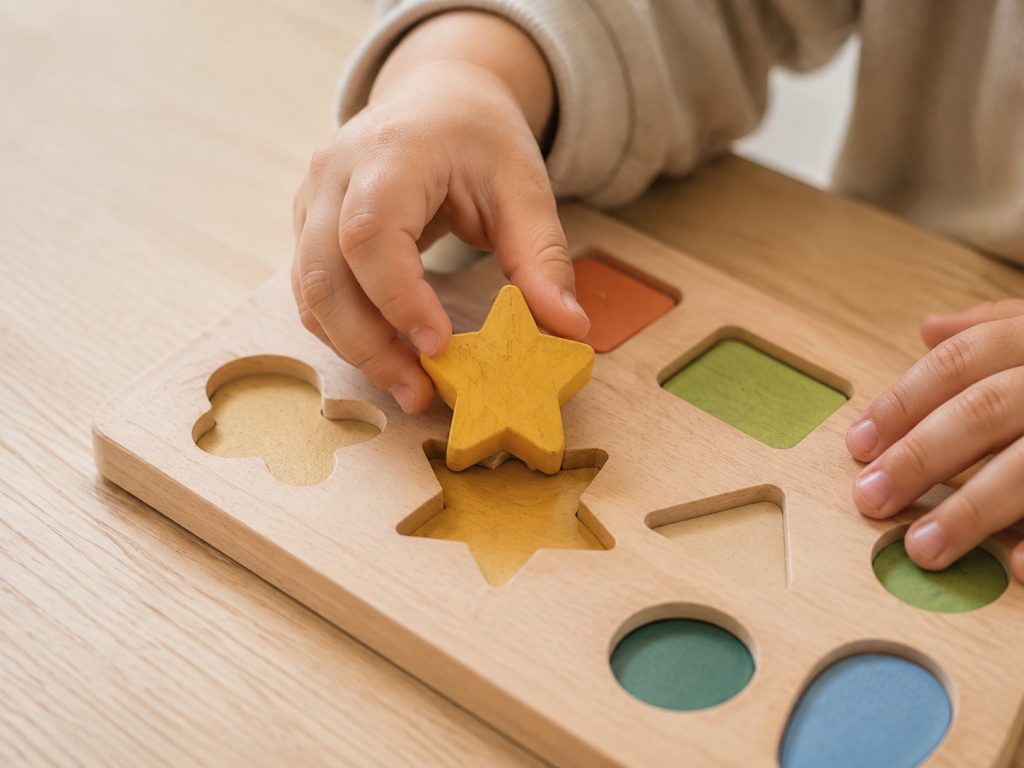
Among the most consistently recommended learning toys for 3 year olds, shape sorting and matching activities address multiple developmental domains simultaneously. A child fitting a shape into the correct slot is practicing spatial reasoning, hand-eye coordination, and visual discrimination at the same time — which is why this category consistently appears in early childhood curriculum frameworks from NAEYC to the Early Years Foundation Stage.
For a 3-year-old specifically, basic circle-square-triangle sorters are typically more appropriate for 18–24 months. The right level of challenge for age 3 introduces color matching alongside shape recognition, or presents 8–12 shape options rather than 3–4. Knobbed wooden puzzle pieces with individual lift points remain the classroom standard: they accommodate developing fine motor control while maintaining durability through hundreds of use cycles.
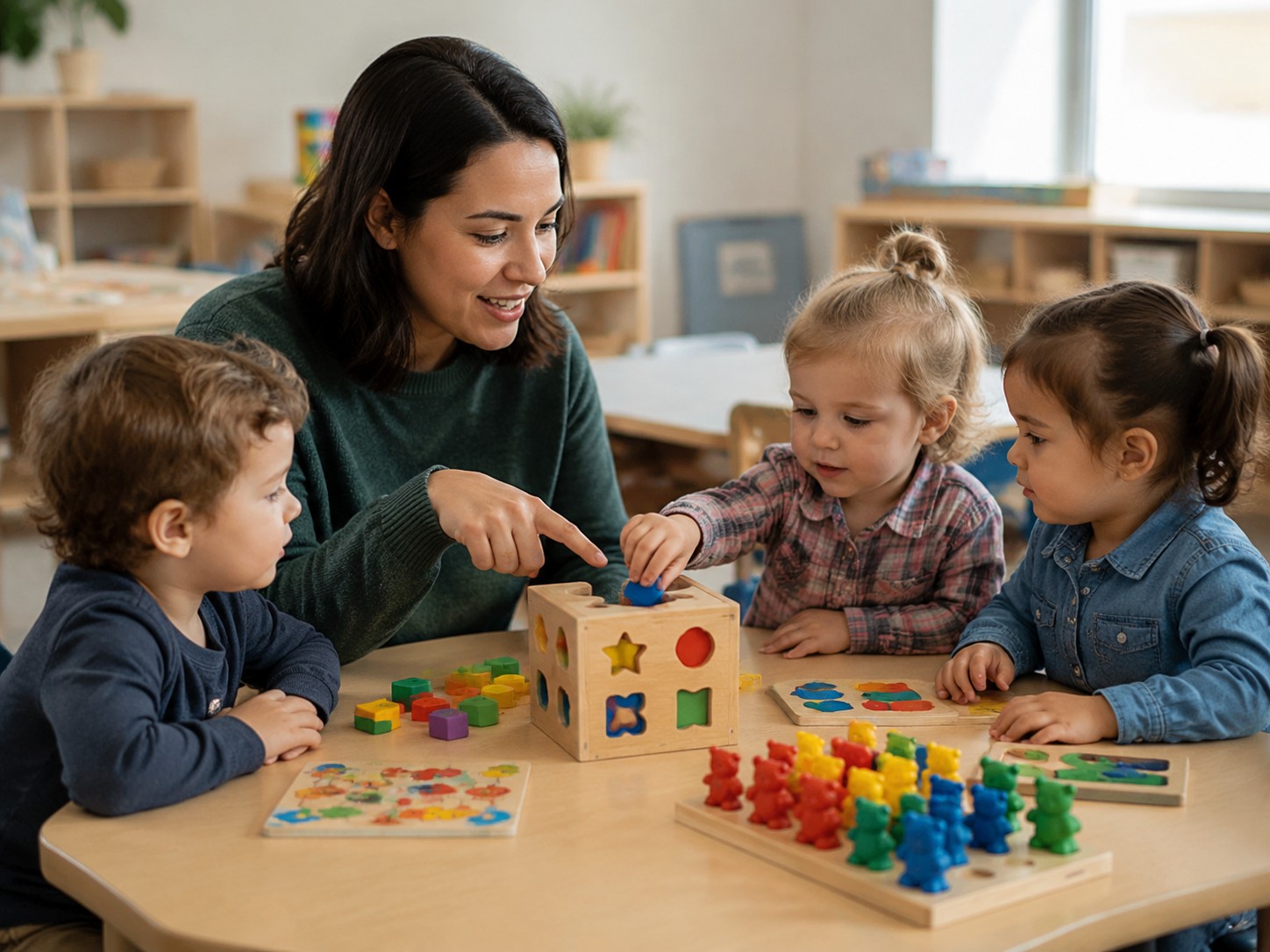
In classroom settings, matching puzzles also serve as informal assessment tools. A child’s approach — trial and error, visual scanning, deliberate placement — tells an experienced educator a great deal about their current cognitive stage without requiring a structured test.
Stacking and Building Toys
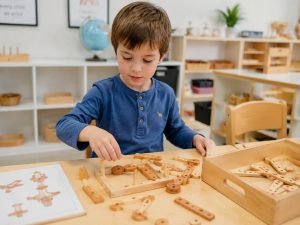
Open-ended building materials — wooden blocks, large interlocking bricks, stacking rings, nesting cups — are foundational precisely because they don’t have a single correct outcome. The child determines the goal, which makes them inherently self-motivating and reusable across different lesson contexts.
At age 3, children build with intention. They’re attempting to replicate structures, create enclosures, or represent spatial ideas through construction. This shift from random stacking to purposeful building is well documented in early childhood development literature and should inform what kind of building toy a classroom stocks.
Large-format interlocking bricks remain one of the most versatile classroom investments for this age. A set of 50–100 pieces gives a classroom group enough material to work with independently, supports teacher-directed activities around color, counting, and pattern recognition, and scales to collaborative projects as social skills develop. For schools already using a particular brick system, sourcing compatible pieces from a manufacturer with verified system compatibility reduces long-term costs without disrupting educational continuity.
Early Counting and Number Toys
Formal math instruction doesn’t begin at 3, but the cognitive infrastructure for number sense does. Research from the National Research Council’s 2009 report Mathematics Learning in Early Childhood identifies early counting and subitizing as foundational skills with lasting effects on mathematical achievement — and physical manipulatives as the most effective medium for developing them at this age.
Counting bears, abacus-style toys, simple peg counting boards, and number puzzles give children a concrete way to interact with quantity before they can process abstract numerical symbols. A set of 100 counting bears in multiple colors, for example, supports sorting and classification activities alongside counting — serving multiple developmental goals with a single material.
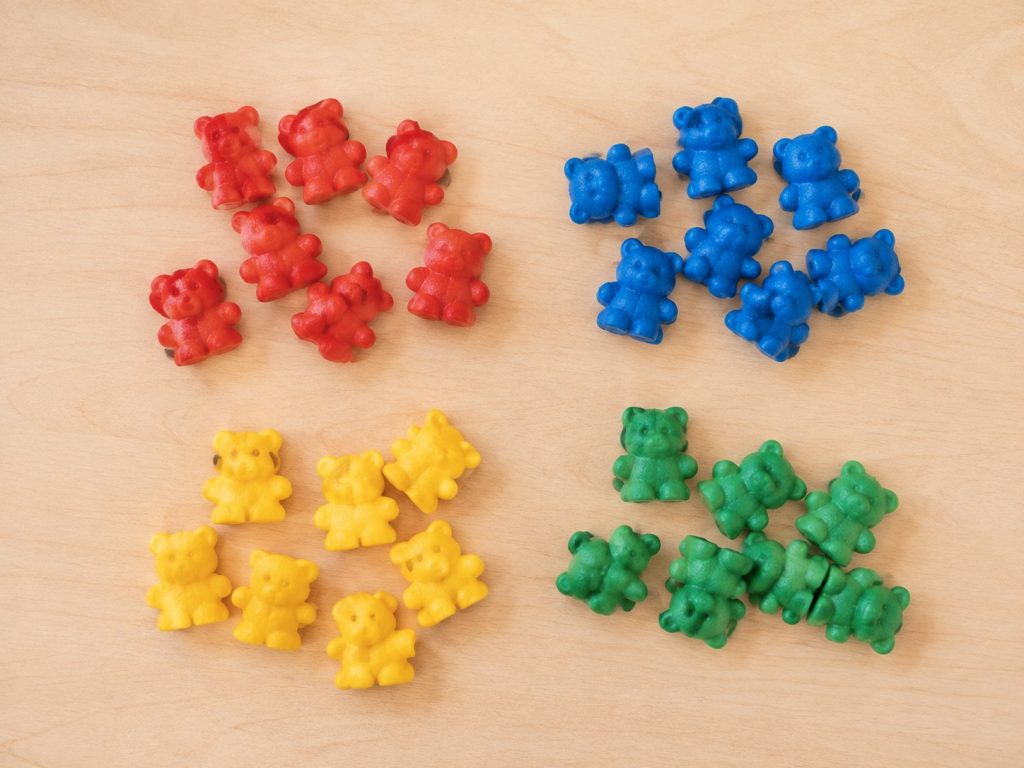
Among practitioners, counting manipulatives are consistently reported as the highest-reuse category in early childhood classrooms. A 2021 survey by the Early Childhood Education Journal found that over 78% of preschool teachers identified hands-on counting materials as the classroom resource they used most consistently across the academic year — more than any other toy or material category. Unlike single-purpose toys, counting manipulatives remain relevant across different lesson objectives and can be differentiated as children’s skills develop through the year.
Role Play and Dramatic Play Toys
Role play is not incidental to development at age 3 — it is central to it. Lev Vygotsky’s research on symbolic play identified dramatic play as the leading driver of cognitive and language development in early childhood, a finding that has been extensively replicated in subsequent studies. Children engaged in role play are simultaneously practicing language production, narrative thinking, emotional regulation, and social negotiation.

For classroom settings, kitchen and household play sets, doctor kits, and simple occupational role play props are among the most productive learning toys for 3 year olds precisely because they generate sustained, language-rich interaction. A child playing with a pretend grocery set isn’t simply mimicking adult behavior — they’re building vocabulary (categorizing food items), practicing social scripts (transaction language, turn-taking), and developing symbolic thinking (using a banana as a phone, treating a block as food). When evaluating role play sets as learning toys for 3 year olds, institutional buyers should prioritize piece size safety, cleanability, and group play capacity over visual complexity.
From a procurement standpoint, role play sets for institutional use require specific evaluation. Pieces should be large enough to avoid small-parts hazards, constructed from materials that can be cleaned between use cycles, and comprehensive enough to support group play rather than just individual scenarios. Sets that include 15–25 components tend to offer the best balance between complexity and manageability for a preschool classroom.
Music and Rhythm Toys
Musical engagement at age 3 supports language development, phonological awareness, and social coordination — three developmental priorities in a single activity category. Research published in Developmental Psychology has linked early musical training to stronger phonological processing skills, which is one of the most reliable predictors of reading readiness.
Simple percussion instruments — egg shakers, hand drums, small xylophones, rhythm sticks — are appropriate learning toys for 3 year olds because they give children immediate auditory feedback from their own actions. This direct cause-and-effect loop is developmentally satisfying and builds the auditory discrimination skills that language learning depends on. Selecting rhythm instruments as learning toys for 3 year olds requires the same durability standard that applies to all institutional materials — tonal consistency and structural integrity across repeated daily use.
For classroom use, rhythm-based group activities using simple instruments serve a dual purpose: they develop individual phonological awareness while simultaneously requiring children to listen, coordinate, and regulate their own behavior within a group — addressing social-emotional development alongside cognitive goals. Instrument sets designed for classroom use should prioritize durability and tonal consistency over appearance; instruments that go out of tune quickly or break under normal use undermine both the educational activity and the investment.
Language and Literacy Development Toys
At age 3, children are not yet reading, but they are developing phonological awareness — the ability to hear and manipulate sounds in language — which is one of the strongest predictors of future reading success. Learning toys that support this take a different form than traditional alphabet toys.
Illustrated picture card sets, rhyming games, and storytelling props support language development in ways that rote alphabet recitation does not. A set of picture cards used to prompt narrative (“What’s happening here? What happens next?”) develops vocabulary, sentence structure, and narrative thinking simultaneously. Puppet sets are particularly well supported by evidence: a 2019 review in the Journal of Early Childhood Literacy found that teacher-facilitated puppet play produced measurable improvements in expressive vocabulary among 3–4 year olds within a 10-week period.
For procurement teams, language development materials should be evaluated on classroom scalability — can a teacher use them in a group circle time, or only with individual children? Materials that only function one-to-one have limited institutional utility.
Fine Motor Development Materials
Fine motor materials are a frequently undervalued category of learning toys for 3 year olds. Threading beads, lacing cards, pegboards, and molding dough support fine motor development when designed with intentional structure. The distinction from pure sensory play matters: molding dough with no accompanying components is sensory stimulation. Molding dough alongside shape cutters, rolling tools, and numeral stamps becomes a fine motor activity with cognitive overlay.
Multi-component fine motor kits offer better procurement value than single-item purchases. A lacing card set with 10–15 different designs, for example, gives teachers flexibility to differentiate — simpler patterns for children with emerging fine motor skills, more complex designs for those ready for greater challenge.
STEM Foundation Toys
When selecting STEM-oriented learning toys for 3 year olds, the goal isn’t circuits or coding — it’s building the cognitive foundations that STEM thinking requires: pattern recognition, spatial reasoning, basic cause-and-effect understanding, and early measurement concepts.
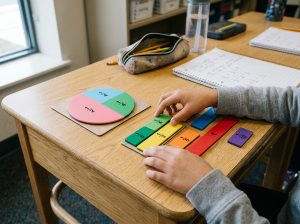
Magnetic tiles, simple gear sets, and pattern block sets make abstract principles concrete and accessible. A child who discovers that a small gear turns faster than a large gear when connected has experienced a physical science principle through direct manipulation. Pattern block sets are particularly versatile: they support mathematical thinking (symmetry, shape composition, area), spatial reasoning, and creative design simultaneously.
For institutional buyers, magnetic toy safety requires specific verification. Any magnetic learning toy selected for a 3-year-old classroom must have magnets fully enclosed in durable, non-separable casing and meet ASTM F963 (US) or EN71 (EU) standards. Loose or accessible magnets present a serious ingestion risk and are a firm disqualifying factor for early childhood procurement regardless of other product merits.
What Separates Classroom-Grade from Consumer Retail
Consumer retail learning toys for 3 year olds are tested for single-user home environments. Classroom-grade materials are designed — or should be — for repeated daily use by multiple children with teacher facilitation in mind.
The practical difference shows in design details. Piece sizes calibrated for developing fine motor control. Color choices that support visual discrimination rather than simply aesthetic appeal. Complexity levels matched to actual developmental stage data, not broad age-range estimates. These are distinctions that manufacturers with genuine early childhood education expertise build into product development from the outset — and they’re visible in the product’s performance over time in real classroom conditions. For institutional settings, sourcing learning toys for 3 year olds from manufacturers who work within recognized early childhood education frameworks is the most reliable way to close this gap.
When evaluating suppliers, procurement teams should request material safety certification documentation, recommended age-range justification, and information on production quality controls. Manufacturers who work within recognized early childhood education frameworks — NAEYC guidelines, Early Years Foundation Stage standards, or equivalent — typically offer more transparency on these specifications than general toy manufacturers.
At Vindstier, product development for learning toys for 3 year olds is grounded in documented developmental frameworks rather than market categories alone. Our materials meet EN71 and ASTM F963 standards, and our product range is designed to support teacher facilitation rather than just independent play. Schools, distributors, and educational product brands looking for a manufacturing partner with this category depth are welcome to contact us directly to discuss catalog sourcing or custom development requirements.
A Procurement Evaluation Framework
| Evaluation Criteria | What to Look For |
|---|---|
| Developmental alignment | Calibrated to age-3 developmental profile, not broad “toddler” range |
| Multi-domain value | Supports more than one developmental area |
| Classroom scalability | Usable with a group, not just one child at a time |
| Evidence base | Linked to recognized developmental frameworks or research |
| Durability | Built for institutional rather than home use |
| Safety certification | ASTM F963 (US), EN71 (EU), or equivalent, with documentation |
| Open-ended potential | Multiple uses across different lesson contexts |
Conclusion
The strongest learning toys for 3 year olds share a common characteristic: they’re built around how children actually develop at this age, not around what photographs well or sells well at retail. For educators and institutional buyers, that means prioritizing developmental alignment, evidence-backed category selection, and materials that support teacher facilitation at scale.
The categories outlined here represent the core range of learning toys for 3 year olds, addressing the distinct developmental needs of this critical window. Sourcing decisions made with this level of specificity deliver superior classroom outcomes and stronger long-term value.