Why Standard Classroom Materials Often Fall Short
Walk into most early childhood classrooms and you’ll find the same scenario: a teacher explaining a concept, children listening, and somewhere between instruction and understanding, a significant number of students quietly falling behind. The problem isn’t effort — it’s abstraction. Young children between ages three and seven are still building the cognitive frameworks needed to process symbolic or verbal-only information. When learning relies primarily on listening and repetition, many children simply can’t connect what they hear to what it means.
This is where problem solving toys change the dynamic entirely. These tools translate abstract thinking challenges into hands-on, manageable experiences while simultaneously building social-emotional competencies that traditional desk work cannot address. For teachers and school buyers evaluating early childhood resources, understanding why these tools work — and how to choose ones that deliver real educational value — is critical to building programs that produce measurable developmental outcomes.
What “Problem Solving” Actually Means in Early Childhood Contexts
The phrase “problem solving” gets used loosely in early childhood education, but in terms of toy design and developmental value, it refers specifically to tasks that require a child to:
- Identify a goal state (what should this look like?)
- Evaluate available options (what can I use?)
- Apply a strategy (how do I get there?)
- Adjust based on feedback (that didn’t work — what next?)
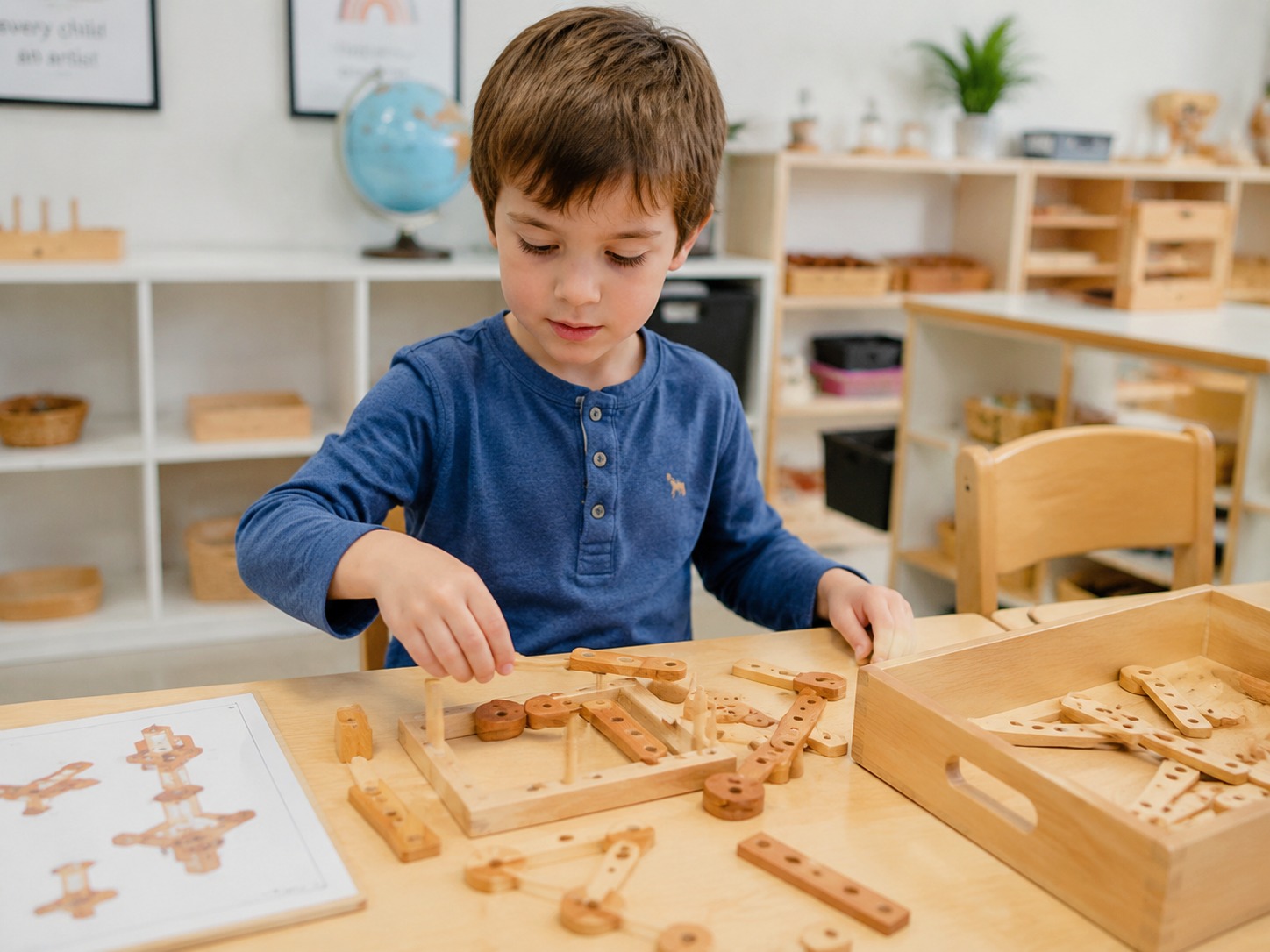
Problem solving toys are products engineered to activate this cycle repeatedly, within age-appropriate difficulty ranges. Puzzles, pattern blocks, nesting and stacking sets, shape-sorting mechanisms, logic grids, and construction systems all operate on this loop. What distinguishes a high-quality educational manipulative from a generic plaything is whether that loop is intentional, scalable, and educationally grounded.
A puzzle that only has one configuration teaches completion. A puzzle system with interchangeable parts and progressive difficulty teaches spatial reasoning, sequential thinking, and persistence — three competencies that research in developmental psychology consistently links to later academic performance.
The Developmental Case: What These Toys Are Actually Building
The educational value of problem solving toys in early childhood isn’t hypothetical. It maps directly to recognized developmental milestones and foundational cognitive skills, with growing empirical support.
Executive Function Development
Executive function — the cluster of mental processes that governs planning, attention, flexible thinking, and impulse control — develops most rapidly between ages three and seven. A longitudinal study published in Developmental Psychology (2018) tracked 150 preschool children over two years and found that those who engaged in structured problem solving play activities at least three times weekly demonstrated 34% stronger executive function scores on the Head-Toes-Knees-Shoulders task compared to control groups using only traditional classroom materials.
Problem solving toys that require children to plan a sequence of moves, hold a mental picture of an end goal, or stop and try a different approach are directly exercising these processes in real time. Unlike worksheets or verbal instruction, play-based problem solving creates low-stakes, high-repetition practice for executive function without the frustration that typically accompanies formal learning.
Spatial Reasoning and STEM Readiness
Spatial reasoning — the ability to mentally manipulate shapes, understand part-to-whole relationships, and interpret visual-spatial information — is one of the strongest predictors of success in mathematics and science. Research from Vanderbilt University’s educational psychology department found that preschool children who used construction-based problem solving toys regularly scored 47% higher on spatial transformation tasks by age six compared to peers with limited access to such materials.
STEM toys for early childhood education, particularly those involving three-dimensional assembly and geometric relationships, consistently strengthen this skill. Teachers who integrate these classroom problem solving activities in pre-K and kindergarten are building the neurological groundwork for STEM comprehension years before formal instruction begins.
Social-Emotional Learning Through Problem Solving Play
Beyond cognitive development, problem solving toys serve a critical function in SEL (social-emotional learning) — an area receiving increased attention from school districts globally. These tools directly support four of the five CASEL core competencies: self-awareness, self-management, social awareness, and relationship skills.
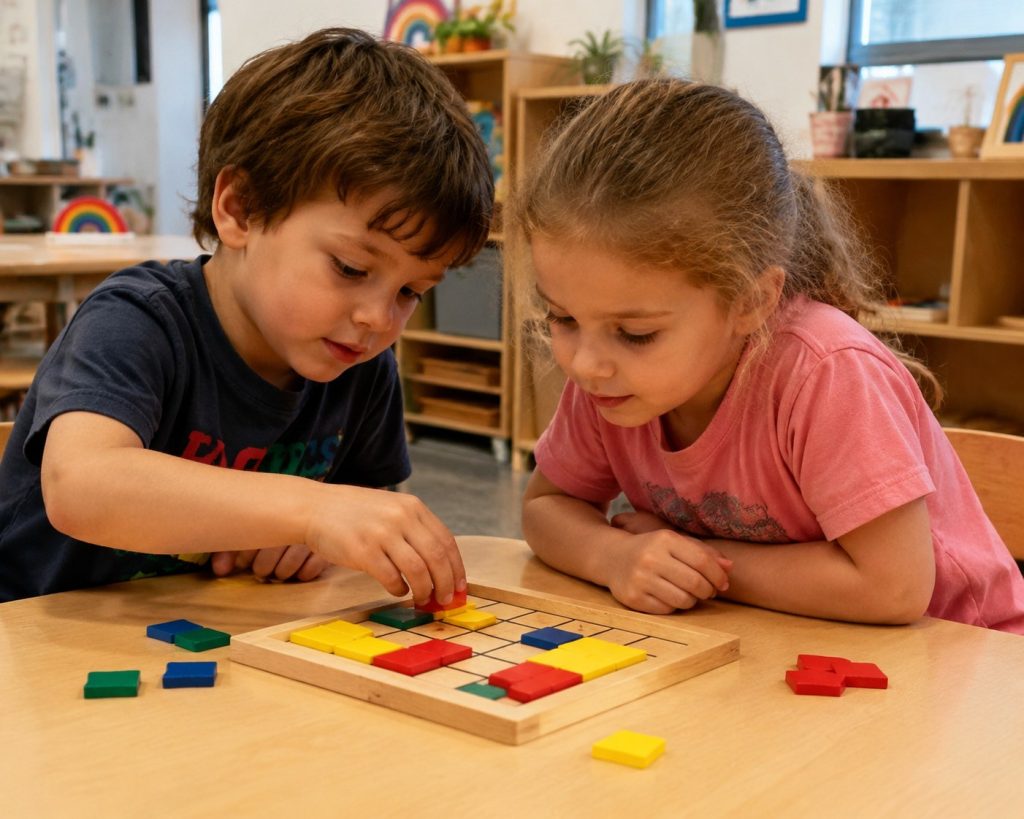
When children work through challenging tasks with educational manipulatives for preschool, they practice recognizing their emotional responses to difficulty, managing frustration, reading social cues from peers during collaborative problem solving, and negotiating solutions together. A 2021 classroom study conducted across eight kindergarten programs in Oregon documented that students using structured problem solving toys in small-group rotations showed measurably improved emotional regulation — specifically, a 41% reduction in frustration-related classroom disruptions over a 12-week period compared to baseline observations.
For educators focused on building the whole child, this dual-function value makes group-compatible problem solving tools particularly worth the investment.
Where Most Schools Get the Selection Wrong
Schools and early childhood programs frequently make two categories of purchasing mistakes when it comes to problem solving toys.
The first is conflating engagement with educational value. Brightly colored, electronically stimulating toys attract children immediately — but passive engagement (watching lights, pressing buttons for sound) doesn’t build problem solving capacity. The cognitive work has to come from the child, not the toy. A well-designed mechanical puzzle or construction challenge keeps a child engaged precisely because it requires active thinking, not because it provides constant external reward.
The second mistake is buying for a single difficulty level. Early childhood classrooms contain a wide developmental range, even within the same age group. A problem solving toy set that offers only one level of challenge will work well for some children and either frustrate or bore others. Procurement decisions should prioritize scalable difficulty and open-ended design — products that can be used in multiple ways across different developmental stages without needing separate purchasing rounds.
This is where working with an educational toy manufacturer that understands classroom realities, rather than just product aesthetics, makes a tangible difference in program outcomes.
Practical Application: How Teachers Are Using These Tools Effectively
Setting Up a Problem Solving Station
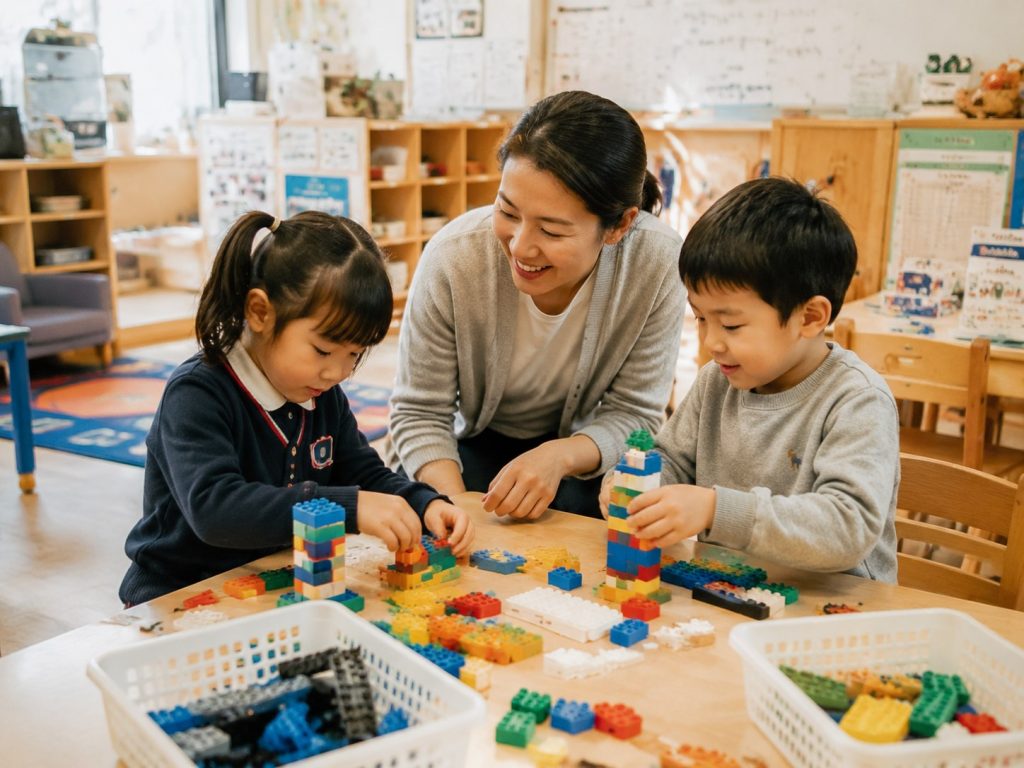
One of the most effective formats for integrating problem solving toys into early childhood classrooms is the dedicated problem solving station — a fixed area of the classroom stocked with three to five rotating toy systems at different challenge levels. Children visit during free choice or guided center time, and teachers observe rather than direct.
Ms. Rivera, a pre-K teacher in Austin, Texas, restructured her classroom centers around this model in fall 2022. She reported that within six weeks, the average task persistence time at her problem solving station increased from under three minutes to over twelve minutes, and children began using the language of strategies unprompted: “I’m going to try the big piece first,” “That didn’t fit — I need a different shape.”
This setup works for several reasons. It removes the pressure of performance, which is particularly important for children who shut down under direct assessment. It allows teachers to observe natural problem solving behavior — how long a child persists, whether they seek help, how they respond to failure — without artificial testing conditions. And it creates a shared language around challenge and effort that builds classroom culture over time.
Whole-Class Problem Solving Challenges
For teachers wanting to use problem solving toys in structured instructional time, whole-class challenge formats work well. A teacher presents a construction task or pattern puzzle to the group, gives each pair of children the same set of materials, and invites multiple solution approaches. The debrief discussion — “what did you try first?”, “what didn’t work?”, “did anyone solve it a different way?” — builds metacognitive language and makes thinking visible.
This model is particularly valuable for demonstrating to school administrators and parents that play-based materials are achieving explicit curricular goals, not just occupying children.
Supporting Children Who Struggle with Frustration
One underappreciated application of problem solving toys is targeted use with children who display low frustration tolerance. Structured problem solving play, when scaffolded correctly — starting at the child’s current success level and gradually increasing difficulty — builds what educators call productive struggle tolerance. Children learn, through repeated low-stakes experience, that difficulty is temporary and solvable. This directly supports emotional regulation and resilience, which are core SEL objectives in early childhood education programs.
What to Look for When Sourcing Educational Manipulatives for Preschool
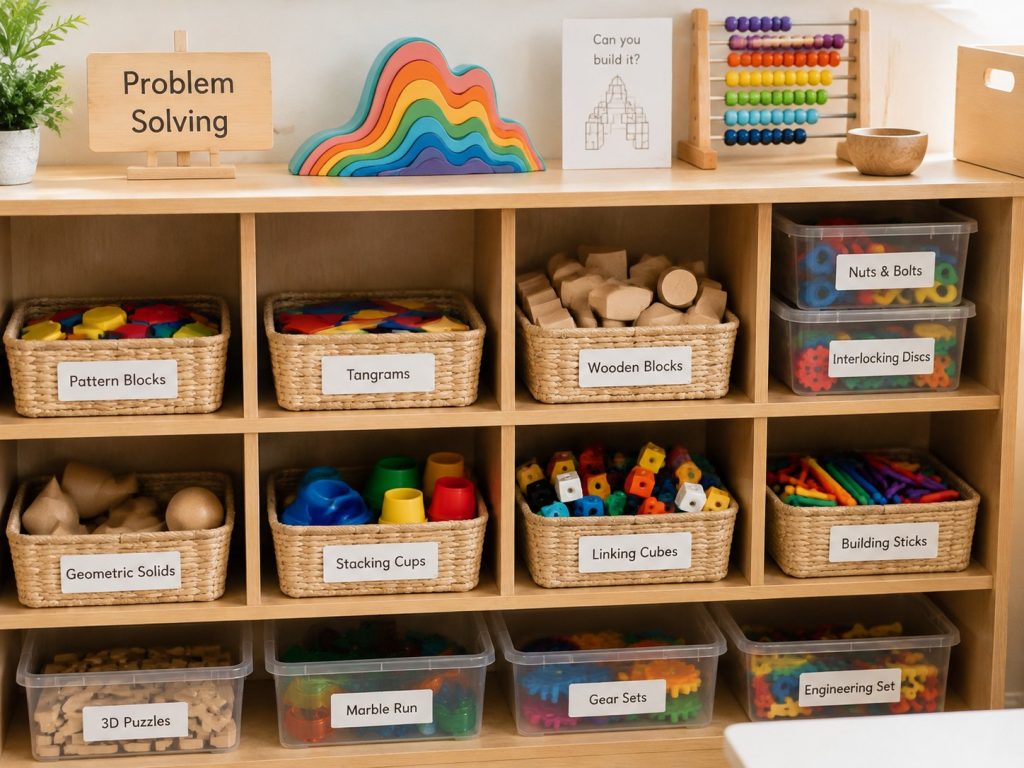
For school buyers, curriculum coordinators, and educational distributors evaluating product lines, the following criteria separate genuinely educational problem solving toys from products that simply carry the label:
Developmental alignment — Does the product align with recognized early childhood development frameworks (such as those from NAEYC or early learning standards by jurisdiction)? Can the manufacturer provide clear developmental rationale for the design?
Open-ended play potential — Can the product be used in more than one way? Does it encourage experimentation rather than a single correct outcome?
Scalable challenge — Does the product offer multiple difficulty levels, either through design or interchangeable components? This directly affects classroom utility and longevity.
Durability for classroom use — Consumer-grade toys are designed for individual home use. Classroom materials face significantly heavier use, shared handling, and less careful storage. Products need to meet institutional durability standards, not retail standards.
Safety certification — For early childhood specifically, material safety is non-negotiable. All products should meet relevant standards (EN71 in Europe, ASTM F963 in North America, or equivalent) with documentation available on request.
At Vindstier, the product development process is built around these criteria from the ground up. Take the Vindstier Magnetic Fraction Puzzle System as a practical example. This product consists of geometric foam pieces with embedded magnets that allow children to build, deconstruct, and reconfigure patterns. What makes it classroom-effective is the three-tier challenge design:
Level 1 provides template cards showing complete patterns. Children ages 3-4 match pieces to the visual guide, building shape recognition and fine motor coordination.
Level 2 removes the template outline but shows the final pattern. Children ages 4-5 must identify which pieces they need and determine spatial orientation independently — exercising planning and spatial reasoning.
Level 3 presents only a verbal or mathematical challenge (“build a rectangle using exactly six pieces” or “create a symmetrical design”). Children ages 5-6 engage in open-ended problem solving, trial and error, and creative application of geometric concepts.
This progressive structure means one product set serves an entire classroom across a two-year developmental span, with each child working at their appropriate challenge level. The magnetic components are encased in non-toxic, washable foam that withstands repeated classroom use, and the pieces are large enough to prevent choking hazards while remaining easy for small hands to manipulate.
This design philosophy — classroom-grade durability, progressive challenge design, and verifiable educational alignment — reflects a manufacturer approach that treats schools as serious institutional partners, not retail consumers.
The B2B Perspective: Why Educational Institutions Are Investing More in This Category
The market for problem solving toys in early childhood education has shifted noticeably in recent years. Several converging factors are driving increased institutional purchasing.
STEM education emphasis at the early childhood level has pushed schools and districts to identify developmentally appropriate entry points for logical thinking and spatial reasoning — areas where well-designed problem solving toys are among the most effective available tools. Programs that previously focused these investments at primary school age are now bringing them earlier.
Simultaneously, the rise of SEL as a formal curriculum priority has made play-based cognitive and emotional development tools more defensible in budget conversations. Administrators who previously viewed manipulatives and problem solving toys as optional extras are increasingly treating them as core curriculum resources aligned with measurable learning outcomes.
According to market research from the early childhood education sector, institutional spending on classroom problem solving activities and educational manipulatives for preschool increased by 28% between 2020 and 2023, outpacing growth in other toy categories.
For toy brands and distributors working in the educational channel, this creates meaningful opportunity — but also higher buyer expectations. Schools are asking harder questions about developmental evidence, classroom durability, and supplier reliability. Brands that can answer those questions credibly, backed by thoughtful product design and educational expertise, are the ones earning institutional contracts.
Conclusion
Problem solving toys occupy a specific and valuable role in early childhood education that generic play materials don’t fill. When designed well, they develop executive function, spatial reasoning, and social-emotional competencies through mechanisms that align with how young children actually learn — through action, feedback, and repeated challenge. Research demonstrates measurable gains in both cognitive and SEL outcomes when these tools are integrated systematically into classroom environments. For teachers, they provide structured tools that support observation and differentiated instruction. For school buyers, they represent high-utility, multi-year investments in foundational development.
The question for educators and procurement teams isn’t whether problem solving toys belong in early childhood classrooms. The evidence is clear on that. The more practical question is which products are worth purchasing — ones built with genuine educational depth, classroom durability, and developmental integrity. That distinction is where sourcing decisions matter most, and where working with a manufacturer that understands both the education and the product side of the equation makes a real difference.