
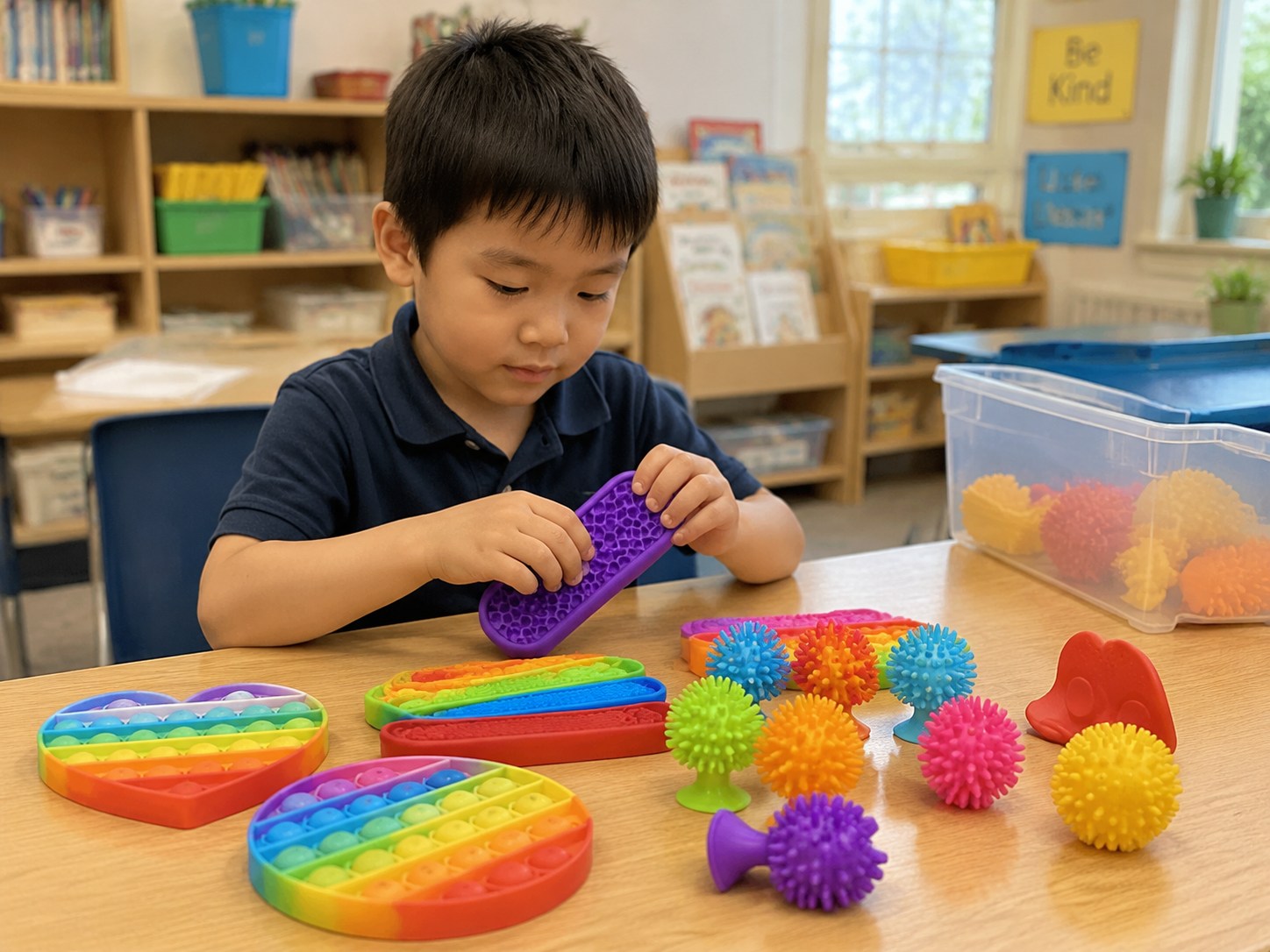
Teachers working with children who have attention difficulties, sensory processing differences, or emotional dysregulation face a consistent challenge: standard classroom tools weren’t designed for how these children actually learn. When a student can’t sit still, can’t maintain focus, or cycles through emotional states that disrupt learning, the problem isn’t willingness — it’s often an unmet sensory need.
Sensory toys have moved well beyond the therapy room, and the range of sensory toys available for educational settings has expanded significantly. Today they’re part of structured classroom environments, special education programs, and early childhood curricula worldwide. The American Occupational Therapy Association (AOTA) formally recognizes sensory-based interventions as within the scope of occupational therapy practice for children with sensory processing difficulties, and its 2020 practice guidelines specifically identify tactile and proprioceptive tools as supporting self-regulation in educational settings. For schools and educational product buyers, the question isn’t whether there’s a foundation for sensory toys in educational practice — there is — but how to implement them with appropriate precision, and what that means for procurement decisions at scale.
The Neurological Foundation: Why Sensory Input Affects Focus
The relationship between sensory input and cognitive regulation comes down to how the nervous system processes stimulation. Children — particularly those with ADHD, autism spectrum conditions, or sensory processing differences — often experience a mismatch between their nervous system’s need for input and what a standard learning environment provides.
When the nervous system is under-stimulated, children seek input in ways that disrupt the classroom: fidgeting, vocalizing, moving constantly. When it’s over-stimulated, the result is withdrawal, meltdowns, or complete cognitive shutdown. Neither state supports learning.
Proprioceptive and tactile input — the kind provided by squeezing, pressing, stretching, or manipulating an object — activates the body’s self-regulation system. A study by Schilling et al. (2003) published in the American Journal of Occupational Therapy examined the effect of therapy ball seating on in-seat behavior and legible word productivity in children with ADHD. Across six participants, in-seat behavior improved by an average of 18% and legible word productivity increased significantly during the intervention phase. While the sample size is small and results shouldn’t be generalized universally, the study is representative of a broader pattern in sensory intervention research: proprioceptive input delivered in classroom-compatible formats produces measurable regulation effects for children with identified sensory and attention profiles.
It’s important to be precise about who this evidence applies to when selecting sensory toys for classroom use. The strongest body of research supports sensory-based tools for children with ADHD, autism spectrum conditions, and diagnosed sensory processing differences. Evidence for neurotypical children is less consistent and more context-dependent. Schools implementing sensory tools as a broad classroom strategy should do so with that distinction clearly in mind.
How Sensory Toys Support Emotional Regulation
Emotional regulation — the ability to manage and respond to emotional experiences in a socially appropriate way — develops gradually through childhood. For many children, especially those with developmental differences, this development needs active support.
Sensory toys contribute to emotional regulation through several evidence-informed mechanisms:
Calming through rhythmic, repetitive input. Squeezing a soft resistance ball, running fingers through kinetic sand, or manipulating a textured fidget provides a predictable, repetitive sensory experience. Repetitive tactile and proprioceptive input is associated with increased parasympathetic nervous system activity, which reduces physiological arousal. A 2019 review in the Journal of Occupational Therapy, Schools & Early Intervention (Ghanizadeh) examined sensory interventions across multiple studies and found consistent evidence for reduced physiological stress markers in children receiving structured proprioceptive input, though the authors noted that effect sizes varied substantially depending on the child’s specific sensory profile and the consistency of implementation.
Providing a physical anchor during emotional flooding. Research on deep pressure stimulation — including Grandin’s early clinical work and subsequent controlled studies, such as Edelson et al. (1999) in the American Journal of Occupational Therapy — supports the calming effect of sustained pressure input on children with autism and high-anxiety profiles. Weighted sensory toys and firm-resistance tools operate on this principle. The effectiveness is not uniform across all children: deep pressure tends to be most beneficial for children with hyperarousal profiles and less relevant for children who are under-responsive to sensory input.
Building self-awareness over time. Consistent, structured use of sensory toys — as opposed to reactive deployment during crises — can help children develop awareness of their own regulatory states. This longer-term benefit requires teacher guidance, not just tool availability. The AOTA’s framework for sensory integration intervention explicitly distinguishes between providing sensory input as a short-term regulatory strategy and building the child’s capacity to self-monitor and self-regulate over time. Both are valid goals; schools should be clear about which they’re pursuing.
Sensory Toy Categories and Their Classroom Application
Not all sensory toys function the same way, and procurement decisions that treat them as interchangeable miss significant differences in educational value. The same tool can have alerting effects on one child and calming effects on another, depending on their baseline arousal level and sensory profile. The table below reflects general tendencies for the population these sensory toys are designed to support — not guaranteed outcomes for every child.
| Category | Primary Sensory Input | General Regulatory Function | Best Classroom Use |
|---|---|---|---|
| Fidget tools | Tactile, proprioceptive | Focus support for children who need movement input during seated tasks | Desk-based learning, reading, listening — for identified children only |
| Resistance toys | Proprioceptive, kinesthetic | Calming, energy release | Transition periods, pre-task settling |
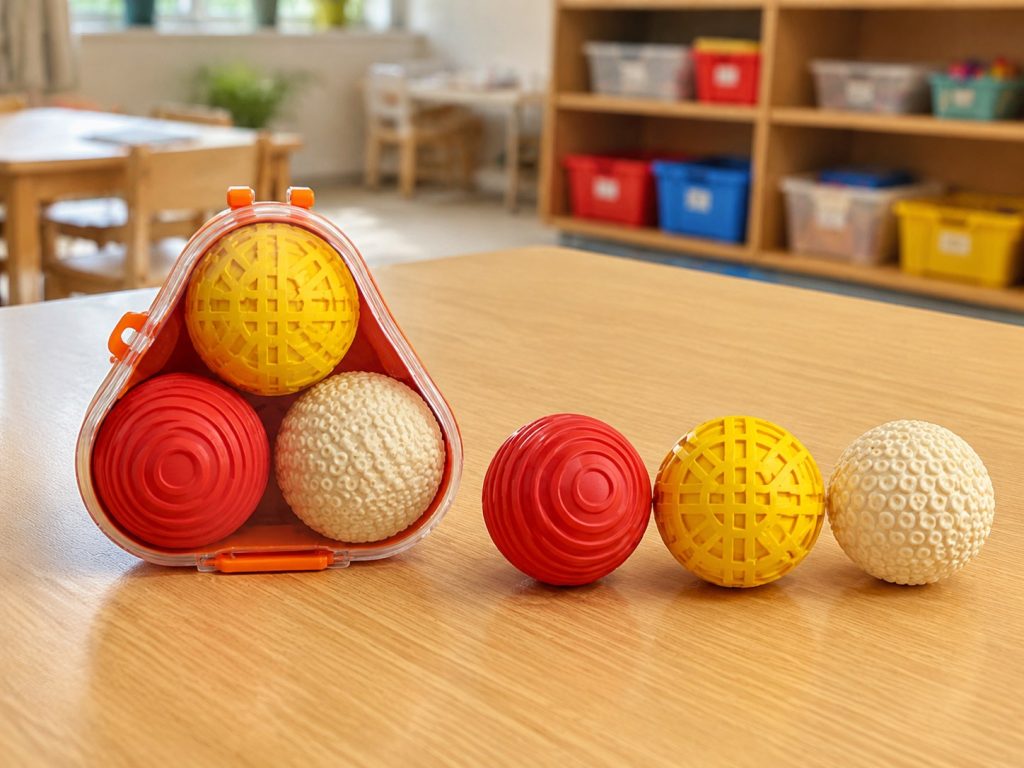
| Textured sensory balls | Tactile, proprioceptive | Alerting or calming depending on texture and pressure level | Sensory breaks, fine motor development |
| Weighted products | Deep pressure, proprioceptive | Calming for hyperarousal profiles — OT guidance recommended for individual use | High-anxiety moments, sustained focus support |
| Kinetic/sensory materials | Tactile, visual | Exploratory play, fine motor development, open-ended sensory engagement | Early childhood, sensory play stations |
| Visual sensory toys | Visual | De-escalation support, visual focus anchoring | Quiet corners, sensory stations |
The distinction between alerting and calming inputs matters for matching tools to individual needs. Rough textures, firmer resistance, and novel stimulation tend to increase arousal — useful for children who are under-stimulated or need help engaging their nervous system. Smooth textures, soft resistance, and repetitive motion tend to reduce arousal — better suited for children who are overwhelmed or anxious. Mismatching tool type to regulatory need can be counterproductive, which is why teacher training is as critical as product selection.
What the Evidence Actually Says About Fidget Tools — and Where the Limits Are
The claim that fidget tools improve focus for all children is not supported by current research, and overstating this damages the credibility of sensory toys in educational settings. This is worth addressing directly.
A study by Hartman et al. (2018) in Occupational Therapy in Schools & Early Intervention examined fidget spinners specifically in a general classroom sample. The results did not show improved attention for the group as a whole, and in some cases off-task behavior increased — particularly when the tools were novel and visually interesting to surrounding students. A separate study by Stalvey and Brasell (2006) found that stress balls used during writing tasks improved legibility scores for students with identified fine motor and attention difficulties, but showed no significant effect for students without those profiles.
The practical implication is clear: fidget tools produce meaningful focus benefits for a defined population — primarily children with ADHD and sensory processing differences — under specific conditions. Those conditions include: the tool being familiar enough to use automatically rather than explored as a novelty, the child having received guidance on appropriate use, and the tool’s visual design being low enough in novelty that it doesn’t attract the attention of other students.
There are also important boundaries around sensory toy use that are frequently overlooked in broad implementation:
High visual stimulation and high novelty are counterproductive in classroom settings. A sensory toy that is brightly colored, features moving parts, or produces sounds may provide sensory input but simultaneously competes with learning tasks for the child’s attention — and disrupts surrounding students. Effective sensory toys for classroom use are deliberately designed to be low in visual complexity.
Age-appropriate calibration matters significantly. Resistance levels, object size, and tactile properties that work for a 10-year-old are not appropriate for a 5-year-old. Developmental stage affects both the sensory input a child needs and their ability to use a tool purposefully rather than simply play with it.
Duration of use requires judgment. Sensory tools are most effective when used for specific durations tied to specific activities, not as permanent desk accessories. Continuous use without intentionality tends to reduce their regulatory value over time.
Practical Classroom Integration: Moving Beyond the “Calm Corner”
One of the most common implementation mistakes is treating sensory toys as emergency equipment — brought out only when a child is already dysregulated. This reactive model limits their effectiveness because the nervous system never develops familiarity with the tool, and the tool becomes associated with crisis moments rather than integrated into normal self-regulation.
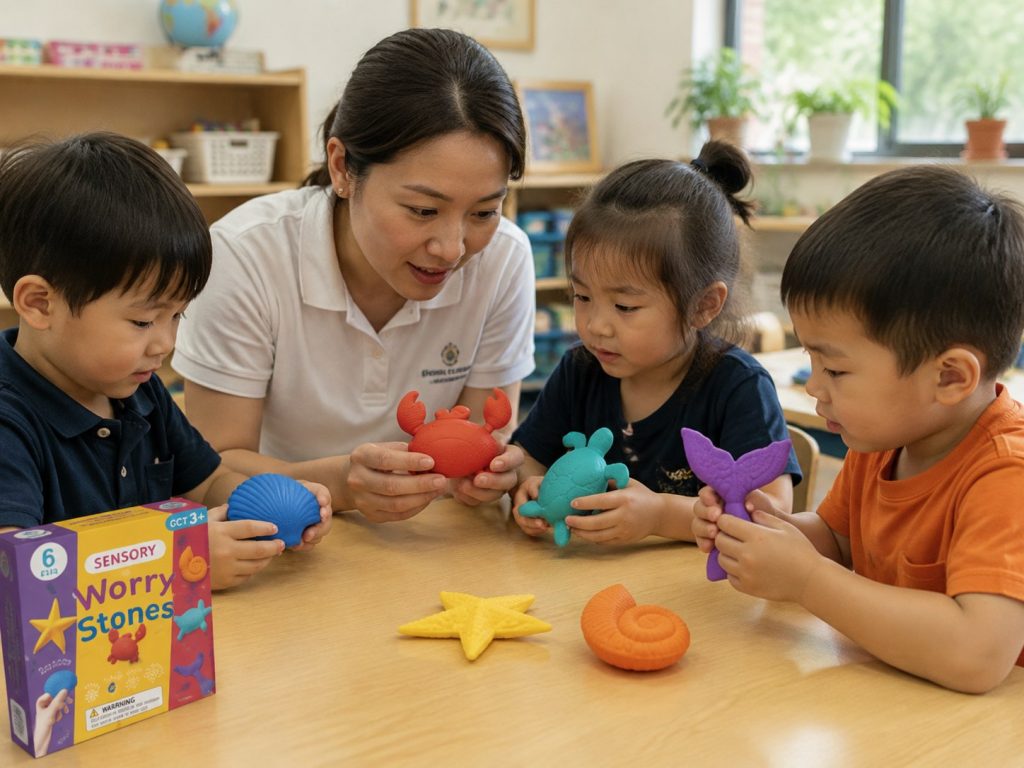
Proactive integration means building sensory input into the ordinary rhythm of the classroom day. A brief proprioceptive activity before seated work — passing a resistance ball around a circle, engaging with textured materials for a few minutes — primes the nervous system for focused work. For children identified as benefiting from desk-based sensory toys, these should be available from the start of a session, not introduced reactively.
Structured sensory breaks built into transitions are more effective than unstructured movement. A short, intentional sensory activity during transition — rather than free movement — helps children arrive at the next learning period in a more regulated state. Research on movement breaks in elementary classrooms, including a 2012 study by Mahar et al. in Medicine & Science in Sports & Exercise, found that structured activity breaks of 10 minutes produced significant improvements in on-task behavior during subsequent seated work, with the greatest gains for children with the lowest baseline attention scores.
This level of integration requires teachers to understand both the children they’re working with and the sensory tools available to them. Implementation without that understanding produces inconsistent results. Schools making procurement decisions should factor in whether professional development support accompanies the products, or whether the supplier can provide implementation guidance.
Application Scenario: Supporting Focus in an Inclusive Classroom
Consider a mixed classroom of 24 students aged 7–8, including four children with identified attention difficulties and two with sensory processing differences confirmed through occupational therapy assessment. The teacher has observed that post-lunch sessions consistently produce the most behavioral challenges: over-stimulation from recess, difficult transition to seated work, and a first 15–20 minutes largely lost to settling.
Following guidance from the school’s occupational therapist, a structured sensory transition protocol is introduced, with specific sensory toys matched to each child’s regulatory profile.
For the six children with identified needs, tools are matched to their individual profiles — resistance-based proprioceptive tools for children who need movement input, low-stimulation tactile tools for a child with a hyperarousal profile. All students participate in a brief whole-class tactile transition activity, which normalizes sensory tool use and supports the broader group’s re-entry into learning.
The teacher tracks behavioral intervention frequency over eight weeks. Reactive interventions during afternoon sessions decrease noticeably in the first month. More significantly, the children with identified sensory needs begin to reach for their sensory toys proactively — a marker that self-regulation capacity is developing, not just that behavior is being managed externally. This aligns with AOTA’s distinction between short-term sensory input strategies and the longer-term goal of building self-regulatory capacity.
What Schools and Educational Buyers Should Evaluate
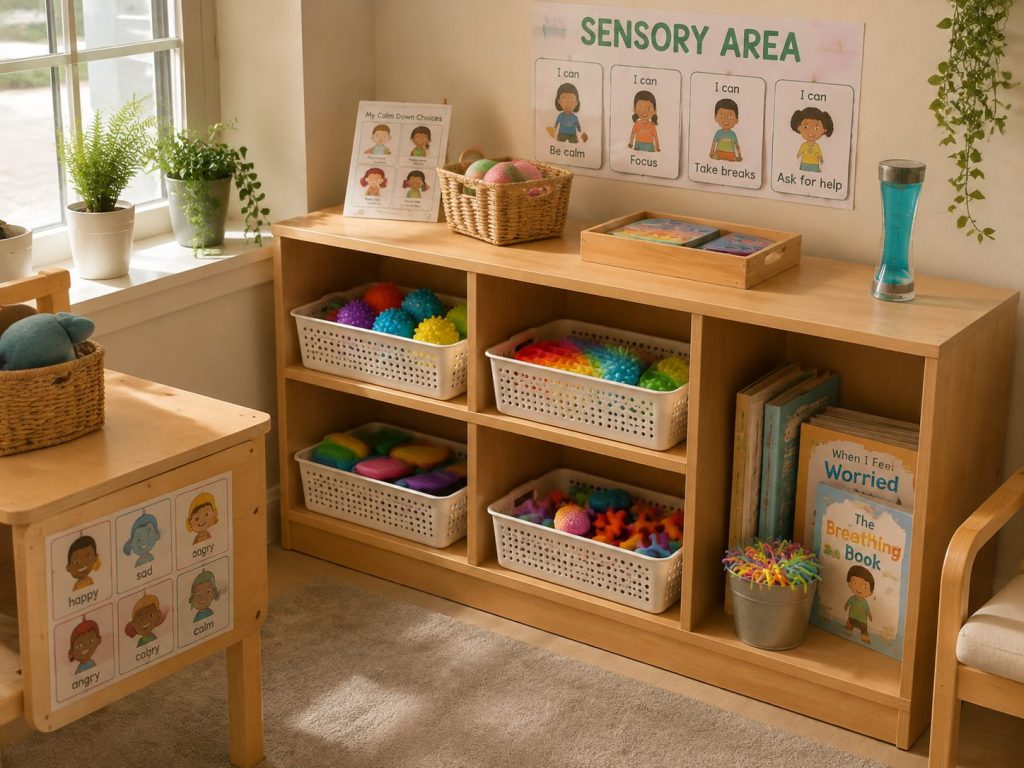
When sourcing sensory toys for educational use, the considerations that matter most in institutional procurement are often different from what’s most visible at the product level.
Safety certification is the non-negotiable baseline. Any sensory toy entering a school environment must meet recognized international safety standards for the relevant age group. Specific certifications buyers should require documentation for include CE marking under EN 71 (European toy safety standard), ASTM F963 (US Consumer Product Safety Standard for Toy Safety), and CPSIA compliance (US Consumer Product Safety Improvement Act — particularly relevant for products used by children under 12, requiring third-party testing and a Children’s Product Certificate). Buyers should request actual certification documentation, not general compliance assurances.
Durability under institutional use determines real-world cost-effectiveness. Sensory tools in a classroom are handled by multiple children, often with significant force, every day. Materials that degrade — losing texture, shape, or structural integrity — lose their sensory effectiveness and introduce safety concerns. A sensory toy that costs 30% less but requires replacement twice as frequently is not the better procurement decision.
Design specificity for educational use is what separates purposefully developed educational sensory tools from repurposed novelty products. The markers are specific: sensory toys with resistance levels calibrated for the target age group rather than general consumer use, tactile properties chosen for sensory input function rather than aesthetic appeal, low visual complexity to avoid classroom distraction, and proportions appropriate for a child’s hand. These are design decisions — they don’t happen by accident.
Range across sensory categories enables effective matching to individual needs. A classroom equipped only with calming tools cannot support a child who needs alerting input to engage. Systematic sensory provision requires both categories, across multiple resistance levels and tactile properties.
Vindstier’s sensory toy range is developed specifically for institutional educational use. Products meet CE (EN 71) and ASTM F963 certification requirements, with documentation available for procurement compliance review. The range spans calming and alerting input categories across age-appropriate variants — not a single product line extended across age groups, but differentiated products calibrated for early childhood (ages 3–6) and primary classroom (ages 6–12) use. For distributors, educational toy brands, and school procurement teams, the ability to source a complete, certified, educationally specified sensory range from a single manufacturing partner simplifies procurement and ensures consistency across a school’s sensory tool inventory. For buyers with OEM or private label requirements, Vindstier supports product development from specification through certification.
The Broader Case: Sensory Tools as Standard Educational Infrastructure
There’s a meaningful shift happening in how progressive schools and educational systems think about sensory support. The older model treated sensory tools as specialist equipment for children with identified disabilities, managed separately from mainstream classroom life.
The emerging model, reflected in the Universal Design for Learning (UDL) framework developed by CAST and adopted by school systems across the US, UK, Australia, and much of Northern Europe, treats sensory regulation support as part of standard classroom infrastructure. UDL’s principle of providing multiple means of engagement explicitly recognizes physical and sensory modes of engagement as legitimate supports for a broader learner population — not only those with diagnosed disabilities. IDEA (Individuals with Disabilities Education Act) in the US further requires that sensory tools identified in a child’s IEP be available in the educational environment, creating a compliance dimension to institutional procurement decisions.
For educational product brands and distributors, this shift represents a market driven by structural changes in educational practice and regulatory requirements — not a trend cycle. The demand is for institutional-quality, certified sensory resources across early childhood and primary classrooms, at procurement volume and with the documentation that school buying processes require.
Conclusion
The case for sensory toys in educational settings is grounded in occupational therapy research, supported by a growing body of classroom studies, backed by AOTA practice guidelines, and increasingly embedded in mainstream educational frameworks including UDL and IDEA. The nuance is important: these tools produce their strongest effects for defined populations — children with ADHD, autism spectrum conditions, and sensory processing differences — under conditions that include appropriate tool selection, teacher understanding, and structured implementation. Schools that treat sensory tools as a universal fix, or distribute them without training and individual matching, will see inconsistent results. Schools that implement them thoughtfully see measurable improvements in regulation, participation, and the frequency of reactive behavioral interventions.
For educational buyers, the practical question is how to build sensory support systematically into learning environments — with products that are certified, durable, educationally specified, and available across the sensory categories a diverse student population needs. That requires sourcing partners with genuine depth in educational application, not just product availability.
If you’re sourcing sensory learning tools for institutional use or exploring a manufacturing partnership for educational sensory products, contact Vindstier to discuss your requirements.