
Parents and gift-givers face a recurring frustration when shopping for four-year-old birthdays: toy stores overflow with licensed character merchandise and electronic gadgets that promise educational value but deliver fifteen minutes of attention before disappearing into toy bins. Teachers report that 60-70% of birthday gifts children bring to show-and-tell generate brief excitement but fail to sustain engagement beyond initial novelty, while the remaining 30% become classroom favorites that children request repeatedly during free play. This pattern reveals a fundamental disconnect between what marketing positions as age-appropriate and what actually matches four-year-olds’ developmental capabilities and learning needs.
At age four, children enter a critical cognitive window where they transition from parallel play to collaborative problem-solving, develop foundational mathematical thinking through hands-on manipulation, and build executive function skills through purposeful activities. Birthday gifts for 4 year olds that align with these developmental milestones create lasting value by supporting skills children actively work to master rather than entertaining passively. Understanding what separates developmental toys from conventional presents determines whether birthday investments advance learning or simply add clutter.
Developmental Priorities That Define Effective Birthday Gifts for 4 Year Olds
Four-year-olds occupy a distinct developmental stage characterized by specific cognitive, physical, and social capabilities that create unique toy requirements. Gifts that succeed generate sustained engagement because they match children’s current abilities while offering challenges within reach through focused effort.
Cognitive Development: Classification and Sequential Thinking
Four-year-olds develop ability to sort objects by multiple attributes (color, size, shape), understand simple patterns, and follow multi-step instructions. Toys supporting these skills allow children to create their own classification systems rather than following single prescribed solutions. Sorting activities, pattern-building materials, and sequential puzzles align with cognitive work children naturally pursue at this age, making engagement self-sustaining rather than requiring adult motivation.
Research from the National Association for the Education of Young Children indicates that classification activities at age four correlate with stronger mathematical reasoning in kindergarten, as sorting by attributes builds foundational understanding of categories and relationships that underpin later arithmetic concepts.
Fine Motor Precision: Refinement Beyond Gross Manipulation
While three-year-olds grasp large objects with whole-hand grips, four-year-olds develop pincer control, bilateral coordination, and ability to manipulate smaller components with increasing precision. Materials requiring careful placement, threading, stacking, or construction challenge emerging fine motor skills without exceeding frustration thresholds. This precision practice directly supports writing readiness, self-care skills (buttoning, zipping), and tool use that children work toward mastering during this developmental period.
Occupational therapists note that fine motor activities maintain four-year-old engagement for 15-25 minutes when difficulty matches skill level, compared to 5-8 minutes for tasks either too simple or excessively complex. Birthday gifts for 4 year olds offering progressive difficulty deliver extended usability across 8-12 months rather than becoming obsolete as children advance.
Social Learning: Cooperative Play and Turn-Taking
Four-year-olds transition from parallel play to collaborative activities requiring negotiation, role assignment, and shared goal pursuit. Materials supporting 2-4 simultaneous users without creating winner-loser dynamics encourage social skill development through natural interaction. Open-ended construction materials, collaborative games without elimination rules, and role-play props facilitate the cooperative experiences that build communication skills and perspective-taking abilities central to four-year-old social development.

For gift-givers considering group settings (preschool classrooms, sibling play, playdates), birthday gifts for 4 year olds that accommodate multiple children deliver higher engagement value than single-user items that create waiting and conflict.
Selection Criteria for Birthday Gifts That Sustain Engagement
Five evaluation dimensions separate toys that deliver lasting developmental value from those that generate brief novelty before abandonment.
Open-Ended Design Without Single Correct Solution
The most engaging birthday gifts for 4 year olds support multiple uses rather than single prescribed outcomes. Building blocks become towers, enclosures, roads, and sculptures based on children’s imagination. Art materials, dramatic play props, and loose parts allow children to direct their own play narratives, building creative problem-solving as they envision and execute self-determined projects. Toys with obvious “correct” solutions provide brief satisfaction but offer no reason for return engagement.
Progressive Complexity Within Single Gift
Strong gifts remain relevant across extended periods by offering layered challenges accessible at different skill levels. Initial use might involve simple sorting or stacking, while advanced use supports pattern creation or complex construction projects. This built-in progression means birthday gifts for 4 year olds purchased in fall remain engaging through spring as children discover new possibilities rather than outgrowing gifts within weeks.
Durability Standards for Active Four-Year-Old Use
Four-year-olds drop objects, apply excessive force, and test materials through experimental play that manufacturers rarely anticipate. Effective birthday gifts for 4 year olds use solid wood construction (minimum 10mm thickness), water-based non-toxic finishes rated for extensive handling, and secure component attachment preventing detachment hazards. Paint should resist chipping, joints should withstand twisting, and small parts should exceed ASTM F963 requirements (minimum 1.25 inch diameter for loose components).
For institutional buyers evaluating birthday gifts for 4 year olds for classroom use, durability directly impacts total cost of ownership. A $45 wooden toy lasting 3-5 years across 20+ children costs approximately $0.03 per child-use-hour, while a $15 plastic alternative requiring replacement after 6 months costs $0.25 per child-use-hour.
Safety Compliance Beyond Age Labels
Age recommendations on packaging reflect choking hazard assessments but don’t guarantee comprehensive safety. Purchasers should verify ASTM F963 compliance for US markets, EN71 certification for European distribution, and CPC documentation confirming third-party testing. Non-toxic finishes should meet CPSIA lead and phthalate restrictions.
For B2B buyers (retailers, distributors, institutional purchasers), compliance documentation protects against liability exposure while demonstrating due diligence. Suppliers unable to provide CPC documentation signal potential compliance gaps that create legal and reputational risks.
Storage and Organization Considerations
Birthday gifts for 4 year olds generating component chaos discourage parent follow-through regardless of educational merit. Materials should include or fit within standard storage solutions, with quantities manageable for four-year-olds to clean up independently. Excessive component counts (200+ small pieces) or awkward shapes create storage friction that leads to gifts being relegated to closets despite initial enthusiasm.
For classroom settings, storage compatibility with existing systems determines whether gifts enter regular rotation or remain in original packaging. Teachers prioritize materials that children can access and return independently.
Vindstier Developmental Toys as Birthday Gift Solutions
Two specific product designs address the selection criteria and developmental priorities that define effective birthday gifts for 4 year olds while solving common pain points parents and educators identify with conventional toy options.
Fruit Sorting Stacking Toy
The wooden base with eight vertical pegs supports 40+ fruit-themed wooden pieces (apples, pears, watermelons, grapes, peaches, blueberries) varying by shape, color, and size. Children begin with simple single-attribute sorting, then progress to multi-attribute classification, pattern sequences, and size gradations—supporting classification and mathematical thinking through hands-on manipulation that builds from initial mastery toward increasing complexity over 10-14 months.
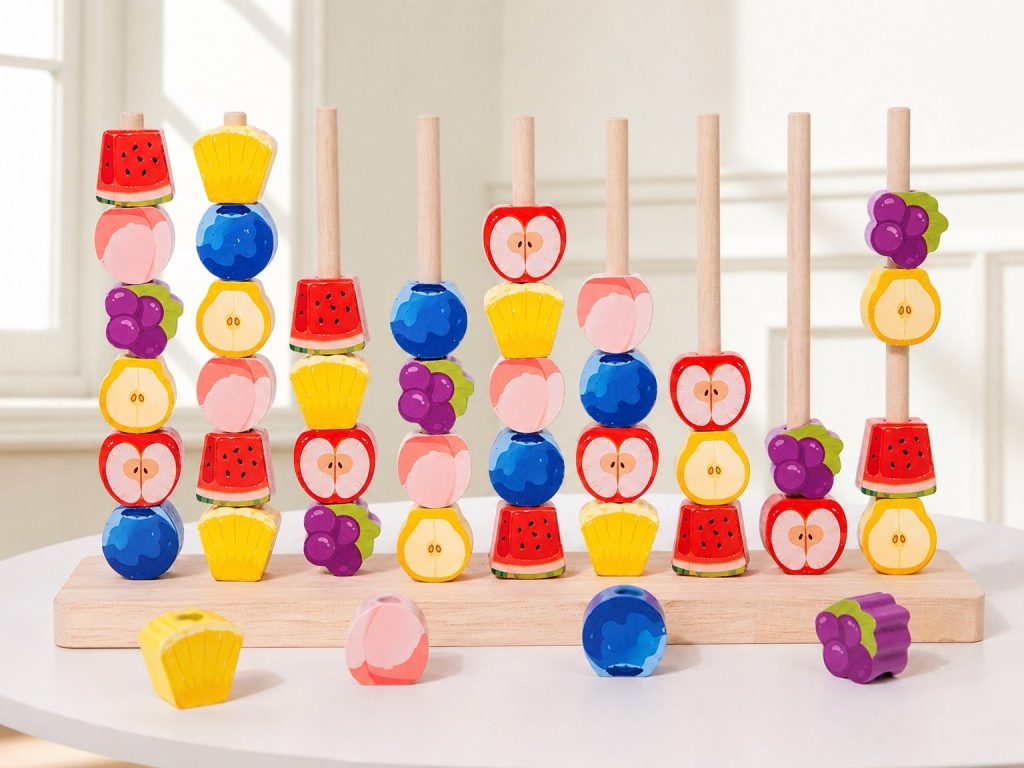
The design delivers four differentiated advantages over conventional sorting toys. Physical constraints provide self-correcting feedback—larger pieces cannot stack atop smaller ones without toppling, mismatched shapes create unstable towers—allowing independent problem-solving without adult intervention. The 40+ piece count supports 3-4 children working simultaneously without access conflicts, reducing teacher mediation in group settings. Beech wood construction with water-based non-toxic finishes withstands institutional use across 3-5 year lifecycles, meeting ASTM small parts safety standards with 3-5cm component sizing. The compact 30x15x2cm base fits standard classroom shelving while maintaining stability during active stacking.
For purchasing decision-makers, the multi-child capacity and extended durability translate to lower per-child-use costs in institutional settings compared to single-user alternatives requiring frequent replacement.
Wooden Falling Ball Game
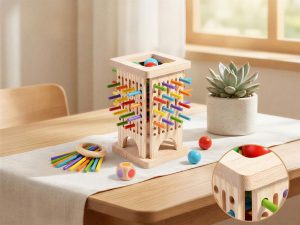
The vertical tower structure (25cm height) with four internal ramps creates repeatable cause-and-effect sequences as wooden balls roll through visible pathways from top opening to base collection point. Children practice precise ball placement developing fine motor control, track moving objects building visual coordination, and recognize predictable sequential patterns supporting logical thinking.

Three core design features differentiate this birthday gift for 4 year olds from conventional ball-drop toys. The open-sided construction allows full visual tracking without requiring children to crouch or reposition, accommodating natural four-year-old observation patterns. Solid beech wood with dove-tail joinery withstands the dropping and impact testing characteristic of active play, while 3.5cm ball diameter exceeds choking hazard thresholds and matches four-year-old grip capabilities. The cross-age appeal extends usability—four-year-olds enjoy basic ball-rolling, while five and six-year-olds create timing experiments and rule-based games—delivering 3+ year household or classroom lifecycle value.
Teachers report 12-20 minute sustained engagement periods with falling ball activities, exceptional duration for four-year-old attention spans, because the immediate visual feedback combined with skill-building challenge creates intrinsically motivating repetition.
Evaluating Gift Success Through Observable Engagement
Purchasing decisions improve when gift-givers apply concrete metrics for assessing whether birthday gifts for 4 year olds deliver promised developmental value.
Voluntary return engagement across multiple days: Strong gifts draw four-year-olds back repeatedly over days and weeks, with children independently choosing materials during free play. Materials generating only single-session interest likely mismatch developmental levels or lack sufficient complexity.
Sustained focus duration: Four-year-olds working with well-matched materials maintain engagement for 12-20 minutes. Gifts consistently producing brief engagement periods suggest either excessive difficulty creating frustration or insufficient challenge causing boredom.
Independent problem-solving without adult intervention: Effective birthday gifts for 4 year olds allow children to identify challenges, attempt solutions, recognize errors, and modify approaches without constant adult guidance.
Integration into varied play scenarios: Open-ended materials appear in diverse play contexts—sorting toys become props in dramatic play, building materials incorporate into art projects. Single-use rigidity indicates design limitations that constrain creative application.
Common Gift Selection Mistakes and Practical Boundaries
Even well-intentioned birthday gifts for 4 year olds face limitations that realistic purchasers must acknowledge.
Character licensing and educational value inverse relationship: Heavily branded character toys typically prioritize marketing appeal over developmental design. Children recognize characters immediately, generating initial excitement, but prescribed play patterns and limited flexibility reduce sustained engagement. Generic developmental toys often deliver superior long-term value despite lower initial “wow factor” at unwrapping.
Electronic features and engagement quality tradeoffs: Toys with lights, sounds, and automated features provide sensory stimulation but often reduce developmental value. Passive watching replaces active manipulation, predetermined sequences replace child-directed exploration. Research from the American Academy of Pediatrics suggests that traditional toys generate 40-60% more verbal interaction between adults and children compared to electronic equivalents.
Age compression and premature complexity: Marketing often positions toys as “advanced” to appeal to parents seeking educational rigor, but birthday gifts for 4 year olds exceeding developmental capabilities create frustration rather than growth. Materials genuinely suited for 6-7 year-olds don’t become appropriate through adult assistance—they generate negative associations with challenge and learning.
Quantity versus quality investment decisions: Budget constraints tempt purchasers toward multiple lower-cost items rather than single higher-quality gifts, but four-year-olds benefit more from one durable, open-ended toy used extensively than five novelty items generating brief interest each.
Conclusion
Selecting birthday gifts for 4 year olds that deliver lasting developmental value requires understanding the specific cognitive, motor, and social capabilities children actively develop at this age. Effective gifts support classification thinking and pattern recognition, challenge emerging fine motor precision, accommodate collaborative play, and offer progressive complexity that sustains engagement across 8-12 months as skills advance.
Evaluation criteria separate quality options from marketing-driven alternatives: open-ended design without single correct solutions, progressive complexity within individual gifts, institutional-grade durability standards, verified safety compliance beyond age labels, and practical storage compatibility. These standards apply equally whether purchasing for home use, classroom deployment, or retail distribution.
For parents and gift-givers, focusing on materials supporting hands-on manipulation and self-directed exploration consistently outperforms character-licensed products or electronic toys. For institutional buyers and retailers, durability specifications, compliance documentation, and multi-child simultaneous use capacity determine total cost of ownership and operational viability beyond initial purchase price.
Birthday gifts for 4 year olds succeed when they match children’s current developmental work—the skills and understandings four-year-olds actively pursue through play—rather than imposing adult-determined objectives. Materials that achieve this alignment generate the sustained engagement that characterizes genuine developmental support rather than mere entertainment. Explore developmental toy collections designed specifically for preschool age groups to find gifts that balance educational value with lasting play appeal.