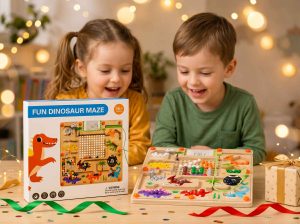
The drum gets grabbed, the shaker gets thrown, and within four minutes the room is louder than the song. Plenty of teachers and parents begin music time with enthusiasm and quietly retire the instrument basket a few weeks later. The trouble is rarely the toys themselves: musical instruments for toddlers usually arrive with no plan for which piece suits which age or which step comes first.
The difference between a noisy flop and a routine that lasts is operational rather than musical. The sections below cover what rhythm play actually builds, where the research stays honest, and how to match pieces to a child’s motor stage. The practical side follows: running a session that stays controlled, plus the safety and supply questions. Those matter to a parent buying one set and to a program placing a bulk order. Done right, rhythm toys and musical instruments for toddlers become a reliable daily routine that builds real developmental skills, not just a passing noisy novelty.
What Rhythm Play Actually Builds in Early Childhood
Beat synchronisation is one of the few toddler-age skills tied to later literacy. At Northwestern University’s Auditory Neuroscience Laboratory, more than 150 preschoolers completed a drumming task. The children who could hold a steady beat scored higher on every preliteracy measure the team ran, from phonological awareness to auditory short-term memory. Their brains also processed speech sounds more precisely (Bonacina et al., 2021, npj Science of Learning).
The link runs through a shared system. Holding a beat asks for fast two-way traffic between ear and hand. The brain later reuses that same auditory-motor loop to pull spoken syllables apart. A drum in a toddler room is early phonological practice in disguise.

Executive function moves as well. In a kindergarten trial in China, 61 preschoolers completed twelve weeks of integrated music activity — singing, movement and role play. They improved on inhibitory control, working memory and cognitive flexibility, and the gains were still measurable twelve weeks after the sessions ended (Shen et al., 2019, Frontiers in Psychology). A Helsinki longitudinal study adds the long view: several years of weekly musical play groups went with faster neural maturation for melody, rhythm and timbre (Putkinen et al., 2019, Scientific Reports).
None of it requires lessons or expensive gear. Every study above used group music play, the same format a teacher or parent runs with a basket of rhythm toys and a ten-minute slot. A floor, a shaker and a routine are the whole entry cost.
Where the Evidence Genuinely Wavers
An honest reading prevents both hype and disappointment. In a two-phase trial across London preschools, three- and four-year-olds who took eight weekly musicianship classes improved on planning and inhibition measures during the first phase. When a second group began the same classes in phase two, the advantage between groups mostly disappeared (Bowmer et al., 2019, Frontiers in Psychology). Program length, novelty and the way skills are measured all move the result.
The kind of musical activity matters more than the label. A German trial with 40 children aged four to six compared rhythm training, pitch training and a sports control. Only the pitch group improved on rhyming, blending and segmenting (Patscheke, Dégé and Schwarzer, 2019, Psychology of Music). Rhythm work did not beat the control on those measures, which argues for a varied basket rather than an all-percussion one.
Two limits belong in any program decision. The strongest rhythm-literacy findings are correlational — children who keep a steady beat may differ from others in home environment, language exposure, or rhythm skill itself. Effects also depend on dose and teaching quality, so one eight-week block is not a transformation.
The most common misuse is passive presentation. Materials that sit on a high shelf while a speaker plays songs deliver none of the above. The active ingredients are sound the child produces, movement, and turn-taking; rhythm toys pay off when small hands reach them daily, in short bursts.
Matching Musical Instruments for Toddlers to Developmental Stages
A two-year-old cannot fail a shaker, but a castanet will defeat one. Grasp patterns and two-handed coordination set the real ceiling on what works at which age, and buying ahead of them produces frustration and thrown pieces. That mismatch explains why so many gift sets contain items a child cannot yet operate.
| Age band | What the hands can do | Instruments that fit | Skills they exercise |
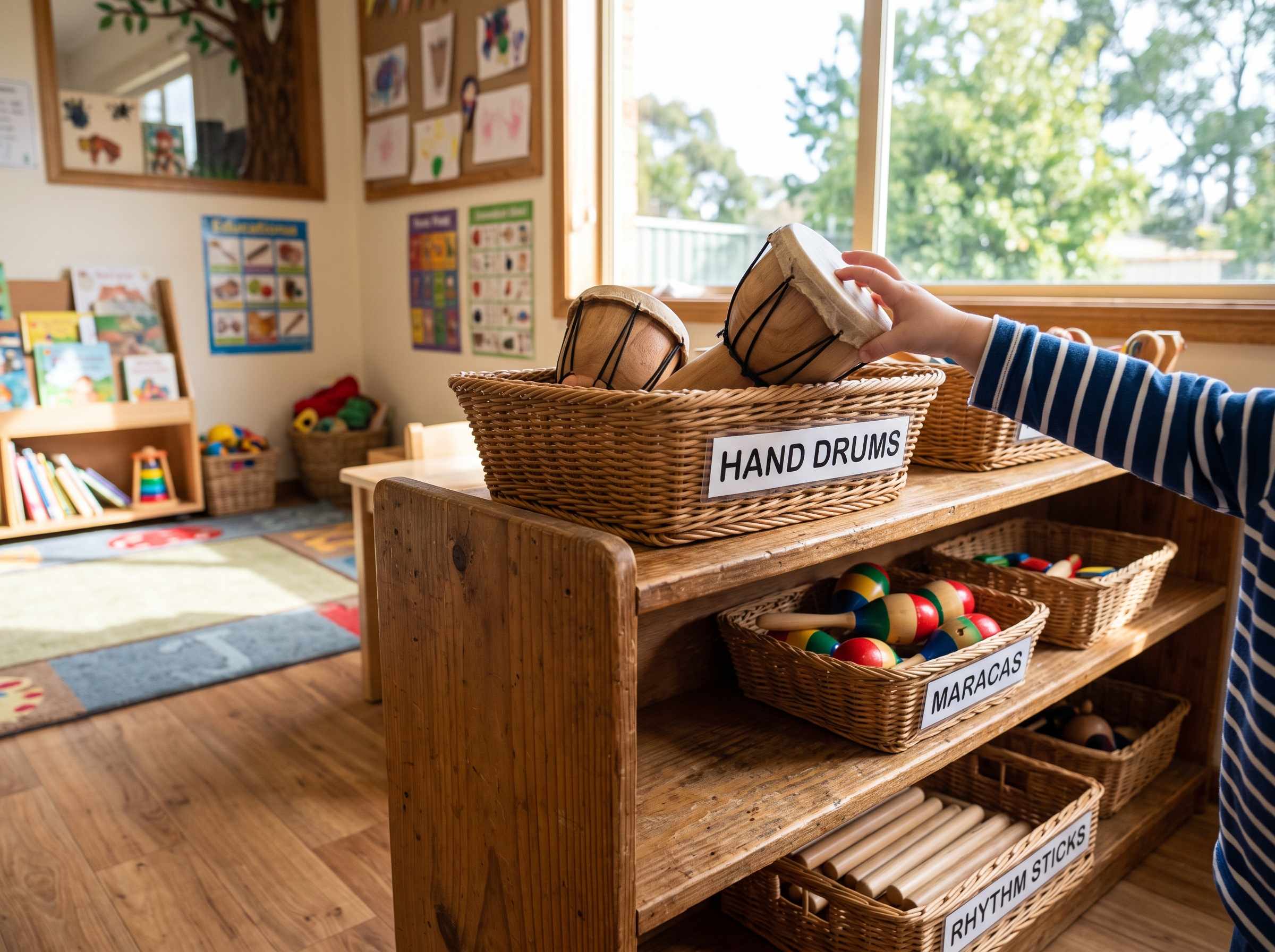
| 12-18 months | Whole-hand grasp, shake, bang | Maracas, cage bells, tambourines, hand drums | Cause and effect, grip strength, auditory attention |
| 18-24 months | Two hands working together | Rhythm sticks, hand drums, wrist bells | Beat production, turn-taking, loud-soft and fast-slow vocabulary |
| 2-3 years | Wrist rotation, finger isolation | Castanets, chunky xylophones, rain sticks | Fine motor precision, pitch discrimination, patience |
| 3-4 years | Sequenced movements, sustained play | Glockenspiels, drum-and-mallet sets, combined rhythm kits | Auditory memory, group synchronization, creative variation |
Failure-proofing is the whole selection principle. Choosing musical instruments for toddlers works better as a rule than as a wish list: every piece should produce a satisfying sound from a movement the child already owns. One clear action, immediate feedback, no wrong way to start — the same single-affordance logic behind screen-free wooden toys that help toddlers focus.
For groups, duplicates beat variety. Two drums and two shakers prevent more meltdowns in a classroom than ten different pieces. Conflict over the red drum is a supply problem rather than a discipline problem, and the one-per-child rule only holds when the basket backs it up.
Mixed-age rooms need two baskets, not one. A single collection shared by toddlers and three-year-olds forces a choice between pieces too small for the youngest and pieces too simple for the oldest. Splitting the shelf by age band costs one extra bin and removes most of the grabbing.
Running Music Time Without Losing the Room
Predictable structure, not musical talent, keeps sessions alive. Three routines prevent most meltdowns: sessions capped at eight to twelve minutes, one consistent start signal, and one instrument per child. The sequence below works because each step stays short enough to hold attention.
- Start with hands only — pats, claps and knee taps — before anything leaves the basket.
- Teach stop-and-go as its own game, pairing a visual cue with a sound cue until the group responds without prompting.
- Run echo games: a two-beat pattern to copy, then three beats, then a deliberately silly one.
- Close with the same ending song every time, and make returning pieces to their bins part of it.
Group size sets the ceiling on what a session can hold. Six to eight children per adult keeps a circle workable; larger groups raise volume faster than participation. Spacing children an arm’s length apart also reduces mallet collisions before they start.
A free-choice verse belongs at the end. Sixty seconds where each child picks any piece and plays along to a familiar song gives the session a clean finish. That window is also where most independent exploration of musical play materials happens, once the rules loosen but the routine still holds.
Volume control is teachable. A whisper round before a loud round gives the words quiet and loud something to attach to, and it hands the adult a dial to point at before noise escalates. Carpet, felt-tipped mallets and rubber drum skins start quieter than metal jingles, which buys a few calm minutes.
Rotation keeps the basket interesting for a whole term. Keeping half the set in storage and swapping it monthly — the same logic behind a loose parts play setup — keeps rhythm toys novel for months rather than weeks. Picture-labeled bins turn cleanup into a sorting game.

Noise, Sharing and Germs: The Operational Realities
Three complaints shut toddler music programs down: noise, fighting and hygiene, and all three have known fixes. Noise yields to smaller groups, a carpeted corner, felt-tipped mallets and rubber skins rather than metal jingles everywhere. Fighting yields to duplicates of favourites plus the one-per-child rule. Hygiene is the one that needs a written routine.
Toddlers explore with their mouths, so handles and mouthpieces get chewed. In group settings, mouthed pieces need cleaning after each session — the same risk-based toy cleaning routine that governs shared toys in daycare applies to shakers and drums. At home, a wash-and-dry cycle after play dates covers it.
Cleanability should outrank tone quality. A piece that cannot survive its own cleaning schedule never reaches its second year in a classroom. Sealed wood, one-piece plastic bodies and machine-washable fabric parts endure years of washing; unsealed surfaces and glued joints do not.
Safety Standards That Separate Keepers From Recalls
Anything handed to a child under three is heading for a mouth. In the United States, toys marketed for children under three must pass small-parts testing under ASTM F963. Federal law makes that standard mandatory through 16 CFR Part 1250, and the European equivalent sits in EN 71. Rhythm toys deserve extra scrutiny, because beads, mallet heads and jingles are classic choke shapes.
Physical checks catch what marketing photos hide. A firm tug on every mallet head and handle, a splinter check along wooden edges, and a pass on cords or neck straps take under a minute per piece. Anything long enough to loop is better left out at this age. Small percussion pieces take more impact per session than anything else on the shelf, so the checks repeat monthly.
Cleaning wears pieces down faster than play does. Every wash cycle loosens what a factory torque test once tightened, so mallets, jingles and glued joints deserve a monthly look rather than a termly one. Retiring one loose mallet head costs far less than a choking incident.
Documentation separates makers from resellers. Reputable suppliers provide current test reports for the batch being shipped, not a certificate file from an earlier production run. If a seller cannot produce batch-level paperwork on request, the discount is not worth the recall risk.
What Program Buyers Should Weigh in a Supplier
A certificate describes the floor a product must reach; a supply program decides whether every batch stays above it. Preschool chains and early-learning brands that want their own instrument lines therefore judge suppliers on process rather than on one good sample.
A toddler music set is a mixed-material product by nature: wooden drum bodies and xylophone frames, child-safe plastic shaker handles and beads, printed packaging and multilingual song cards.
As a cross-material OEM/ODM manufacturer, Vindstier runs all three inside one ISO 9001 system — wood CNC, child-safe plastic components and printed materials. One system removes the handoff gaps that appear when three suppliers each own one piece of the set. SKU-level CPC and CE documentation, FSC-certified timber and 7-to-14-day sampling let buyers verify each claim before a production run.
Spare parts are worth asking about before the first order. Replacement mallets and shaker beads keep a classroom set in service without buying the whole box again. A supplier that holds tooling for its own components can match the original dimensions years later.
One practical test predicts supply reliability. Sourcing a full set across several classrooms raises a single question: can one supplier deliver the whole mixed-material pack with consistent safety documentation and a sample fast enough to evaluate? That question says more about the next three years of supply than any catalogue.

Making Musical Instruments for Toddlers Part of the Daily Routine
A working music corner pays for itself in attention spans, not recitals. The research supports active rhythm and sound play as a builder of auditory discrimination, motor timing, vocabulary and self-regulation. The conditions matter: short sessions, repetition, and hands on the pieces rather than ears near a speaker. The case for musical instruments for toddlers rests on routine, not repertoire.
Starting small beats starting big. One basket, three types of rhythm toy, one stop-and-go signal, ten minutes a day. After a month the observable markers tell the story: whether children wait for the start cue, echo a two-beat pattern, and return pieces without a struggle.
When those markers appear, the next purchase should match the oldest group in the room, favour cleanable one-piece designs, and ask for current batch documentation. Musical instruments for toddlers chosen on those three criteria tend to stay in daily rotation — and daily rotation is the only condition under which any of the documented benefits arrive.