A weekend spent collecting corks, jar lids and driftwood often ends the same way in a preschool classroom: two weeks of enthusiastic chaos, a stray stone in a toddler’s hand at pickup time, and the whole basket quietly returned to the supply cupboard. The idea of loose parts play was never the problem. The collection was assembled without answers to the questions that decide whether it survives — how many pieces, of what size, stored where, and cleaned how often.
The gap between the concept and the classroom is operational, not philosophical. This guide works through those configuration decisions in order: material categories and starting quantities, presentation and storage, safety sizing and cleaning routines, the teacher’s role during play, and what a durable loose parts play collection looks like for programs that buy in volume.
Why Loose Parts Play Efforts Stall After Week One
Most failed implementations are configuration failures, not philosophy failures. The theory itself is half a century old: architect Simon Nicholson proposed the theory of loose parts in 1971, arguing that environments rich in movable, combinable variables invite far more invention than environments of fixed equipment. Nicholson made the case for why variable materials matter, but his essay never specified quantities, sizing, storage or supervision — the operational details that decide outcomes in a room of twenty preschoolers.
Three failure patterns account for most abandoned loose parts play collections. Under-supply comes first: a single box of attractive pieces shared by a whole class produces hoarding and conflict within days, and the adults read the conflict as proof the approach failed. Unsorted presentation follows: one large mixed bin invites scattering rather than building, because nothing in the setup suggests construction. The third is cleanup without a routine — when resetting the shelf costs the staff fifteen minutes of sorting every afternoon, the experiment ends long before the children’s interest does.

What the Research Actually Shows
The evidence base is encouraging, but it comes with caveats worth knowing before a budget is spent. A 2020 systematic review by researchers at the University of Newcastle, published in Nursing & Health Sciences, examined eight intervention studies involving children aged three to seven and reported consistent positive impacts on physical activity, social engagement and emotional wellbeing. A 2025 experimental study in Communications Psychology went further: 60 children around age five played in paired sessions with loose parts and with single-function toys, and observers recorded significantly more spontaneous STEM behaviors — stacking, sorting, patterning, testing balance — in the loose parts condition.
The most recent review tempers that enthusiasm usefully. A 2025 systematic review in the Journal of Intelligence screened 5,721 records down to 25 studies on children from birth to age six; most reported positive associations between loose-parts-style materials and problem-solving, creativity and divergent thinking, but five studies found no association at all, and only one used the term “loose parts” explicitly. The direction of evidence for loose parts play is favorable, yet effect sizes remain unsettled and engagement varies from child to child — a good reason to pilot one shelf before equipping a whole program.
For a director translating this into a purchase decision, the practical reading is straightforward. The strongest documented gains involve behaviors the materials themselves invite — building, sorting, combining, negotiating — rather than guaranteed gains on any single assessment. That makes loose parts play a strong fit for programs that already value play-based learning, and a harder sell where a curriculum demands narrow, measurable skill checkpoints every month.
Four Material Categories That Cover a Whole Curriculum
A workable collection balances four material categories rather than accumulating random objects. Variety feels generous, but a shelf of unrelated finds plays worse than a smaller, deliberately chosen set. The table below reflects how experienced programs organize loose parts play materials so that each category carries a distinct developmental load.
| Category | Examples | What it supports | Starting quantity |
| Natural materials | stones, pinecones, shells, wood slices, seed pods | sorting, counting, transient art, sensory vocabulary | 3-4 labeled jars per class |
| Reclaimed manufactured pieces | corks, jar lids, large bottle caps, fabric scraps, spools, cardboard tubes | threading, sorting, role-play props, collage | 5-6 boxes |
| Structural building pieces | wooden blocks, planks, rings, magnetic tiles | construction, balance, symmetry, cooperative building | enough for 4-5 simultaneous builders |
| Designed manipulatives | pattern blocks, lacing beads, stacking sets | early math concepts, fine motor precision, pattern work | 2-3 classroom sets |
The quantity column is the part most programs get wrong. Conflict in a loose parts play collection almost always signals scarcity rather than a failure of the approach, so budget for more pieces of the same material before adding a new material type. A class of twenty generally needs enough of any one material for four or five children to build at the same time before the play spreads on its own.
Found materials can fill the first two categories at almost no cost, and sourcing them is part of the setup work. Parent donations, carpentry offcuts from local workshops, and end-of-season natural collections each work better with a simple intake rule: every donated piece is inspected, washed and size-checked before it reaches the loose parts play shelf. Skipping intake is how coated scrap and undersized pieces end up in a room of two-year-olds.
Presentation Rules That Keep the Shelf Alive
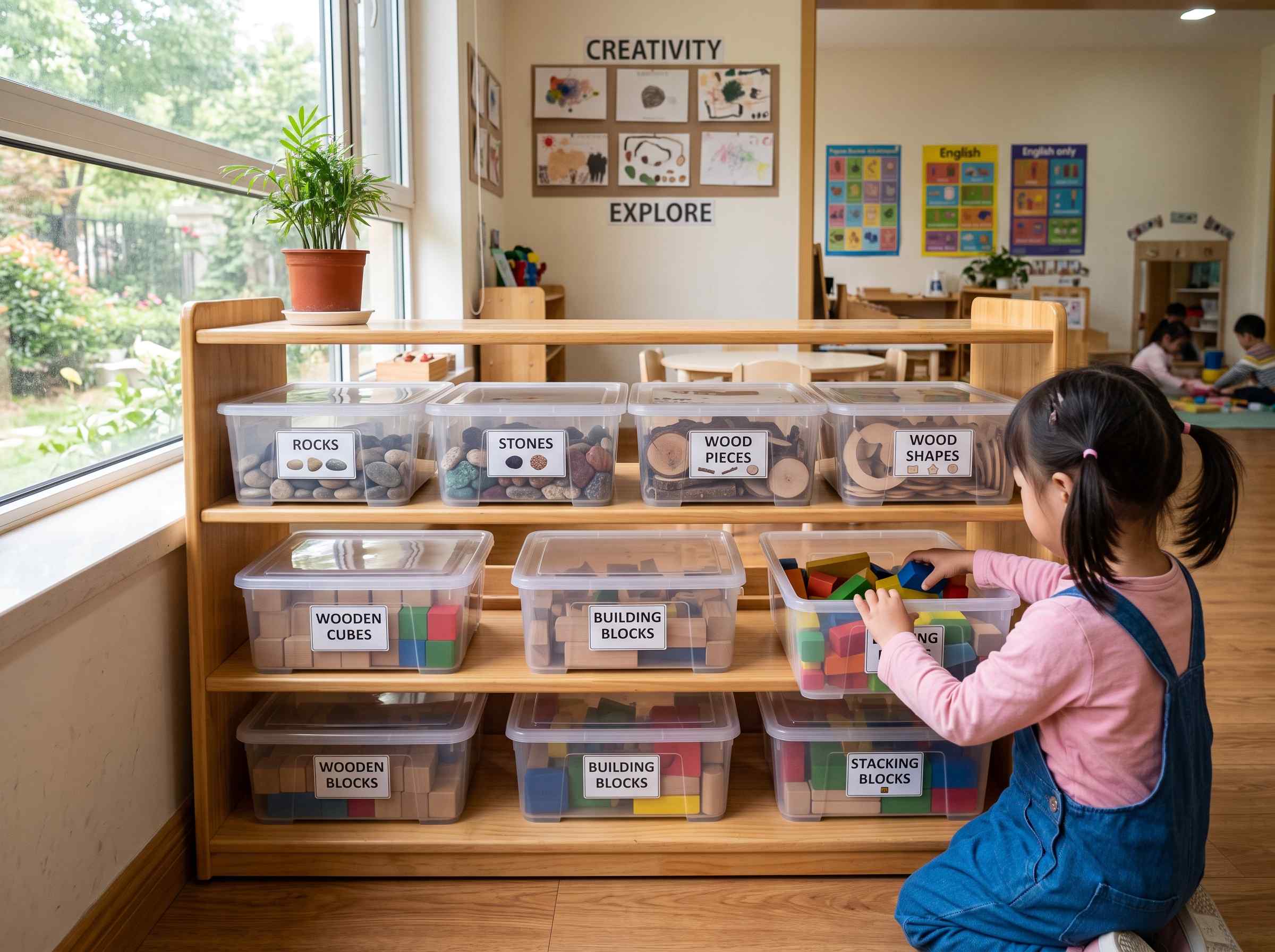
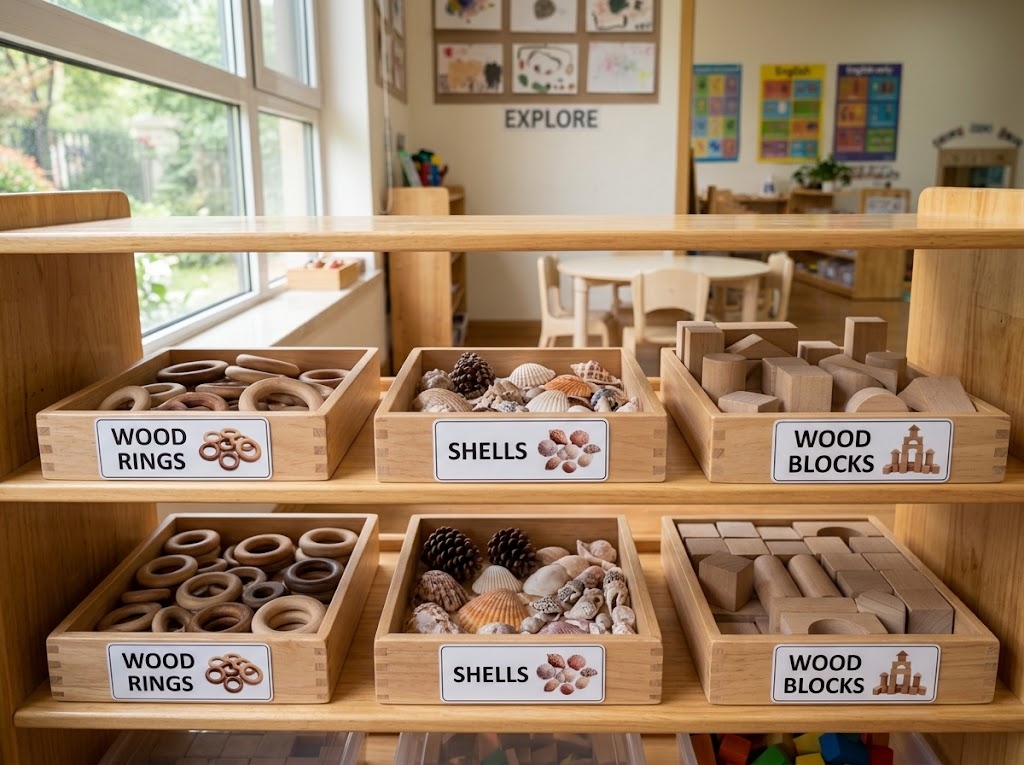
How materials are stored determines whether children build with them or scatter them. Programs influenced by the Reggio Emilia approach treat the environment as a third teacher, arranging materials at child height in transparent or open containers, one material type per container, with picture labels so cleanup stays a sorting game rather than a punishment. Sorted, visible presentation is what separates a loose parts play shelf from a junk box.
Rotation keeps a loose parts play shelf fresh without resetting the whole system, and it is one of the cheapest ways to hold attention across a term. Swapping roughly a third of the materials each month sustains novelty while leaving enough familiar pieces for children who return to the same project across days. A defined workspace matters just as much: trays or play mats give each builder a visible territory, which cuts disputes and makes the cleanup boundary obvious to everyone in the room.
Positioning also shapes how a loose parts play collection gets used. The difference between loose parts and other open-ended toys is that loose parts carry no suggested outcome at all — not even an implied structure — so placement near the art station or the block area quietly suggests what children can combine them with. A shelf wedged behind the drying rack reads as storage rather than invitation.
Safety and Hygiene Without Shutting the Play Down
Risk is managed by sizing, sourcing and cleaning rules, not by restricting the play. Sizing is the first gate: any piece small enough to fit inside a small-parts test cylinder — the standard choking-hazard gauge for children under three — belongs only in classrooms for older children.
Mixed-age programs need a separate under-three collection built entirely from large pieces, stored on a different shelf, because a single stray bead travels fast in a shared room.
Sourcing rules remove the hazards that donated materials can carry. Old painted scrap may carry lead-based coatings, cut metal and plastic edges need filing smooth before they enter a classroom, and loose magnets should never be part of a found collection — swallowed magnets are a documented medical emergency.
Manufactured magnetic pieces belong in a collection only when the magnets are sealed inside tested parts, which is a certification question rather than a marketing claim.
Hygiene runs on the same risk-based logic as any shared classroom material. Mouthed pieces come out of rotation after each session and go through a wash, the full collection gets cleaned weekly, and a monthly inspection retires anything with new splinters or cracks.
A risk-based cleaning routine that holds up through flu season applies to these open-ended materials exactly as it does to plastic toys; the material only changes the cleaning method, not the frequency.
Inspection is also where durability becomes visible. Well-finished wooden pieces survive years of washing; cheaply made ones splinter within a semester and quietly leave the rotation.
That difference in lifespan is worth more over three years than any difference in purchase price, because the replacement cost of a loose parts play collection repeats every time a low-grade batch wears out.
Scaffolding Without Scripting
The adult’s role is to ask questions, not assign outcomes. A teacher narrating what a child has already made — a ring of stones around a tower — adds vocabulary without taking over the play. Posing one open challenge, such as whether a bridge can hold one more block, extends the engineering without prescribing the answer. The balance matters, because guidance that drifts into instructions converts rich materials into a worksheet made of wood.
Executive function skills — working memory, self-control and cognitive flexibility — develop through exactly this kind of hands-on problem solving, as the Harvard Center on the Developing Child summarizes in its guide to executive function. The 2025 MacEwan University study adds a realistic footnote: children’s executive function predicted how long they stayed engaged, so loose parts play is not automatic for every child. Some children need an adult building alongside them for the first few sessions before independent engagement takes hold.
Documentation closes the loop for the program. Photographing structures before cleanup, or keeping a short log of what children built and said, gives directors evidence of learning that a shelf of scattered stones cannot show on inspection day — and it costs nothing but a phone and two minutes.
Where Manufactured Loose Parts Fit in a Durable Collection
General principles are one thing; a collection that survives daily use by twenty preschoolers is another — and that is where designed, classroom-grade materials earn their place next to found objects in a loose parts play program.
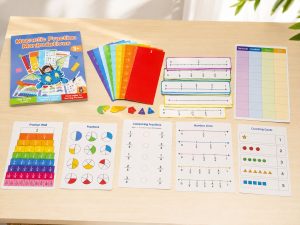
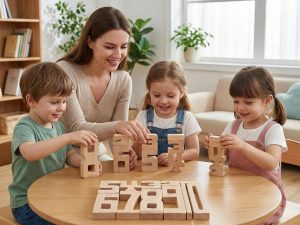
Manufactured pieces solve the two problems donated collections cannot: consistency and durability. A wooden number blocks set that works as a math tool, a balance game and a building set in one gives the shelf a structural core that cork collections cannot match. Magnetic pattern blocks extend the same idea onto vertical surfaces — transient art and early geometry on a classroom whiteboard — with magnets sealed inside tested pieces rather than rattling loose.
A wooden fruit sorting set shows the same value in a form toddlers can grow with: sorting by color and shape, early counting and grocery role play all flow from one box of smooth, oversized pieces, so the set stays in rotation long after a single-purpose sorter has been outgrown. Vindstier manufactures these classroom lines under one ISO 9001 quality system, with FSC-certified wood cut and finished for daily handling and printed storage packaging produced alongside; for buyers, that single-source structure means replacement pieces match the original set years into its service life.
For programs ordering in volume, a few supply-side questions separate a durable core from a disposable one. Whether batches stay dimensionally consistent across orders, whether replacement units can be ordered without buying a full new set, and whether the pieces carry child-safety certification as sold — those questions matter more than catalog styling, and they apply to every manufactured category on the table above.

Where Loose Parts Play Fits in a Balanced Program
A shelf configured this way works as infrastructure, not as an event. The loose parts play collections that survive their second month share the same anatomy: four balanced material categories in generous quantities, sorted and visible storage, sizing and cleaning rules matched to the ages in the room, and an adult who scaffolds without scripting. None of those decisions is expensive; all of them separate a permanent fixture from another abandoned experiment.
Manufactured classroom-grade pieces pull those decisions together in one purchase: certified sizing that already clears the small-parts gauge, finishes that survive weekly washing, and batch consistency that keeps replacement pieces matching years into service. Programs can pilot one designed set beside found materials for a term, then judge it on the same evidence — return visits, sustained building, cleanup that costs minutes rather than the afternoon.
A closing checklist turns a promising basket of corks and stones into a resource the classroom keeps returning to. Directors planning a full loose parts play shelf, and parents weighing the same choices for a playroom, can hold every purchase to the standards described here: certified materials, generous quantities of each type, and construction built to outlast a full year of daily handling.