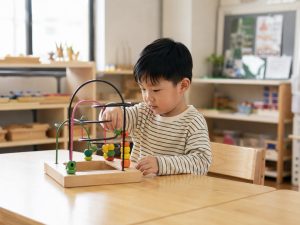
A wood puzzle goes into one toddler’s mouth at 9:15, gets handed to a second child at 9:20, and sits back on the shelf by 9:25. Nobody logged the detour. Six weeks later the same room cycles through coughs, stomach bugs, and parent complaints about bring-home illnesses, while ratios stretch thin on substitute staffing.
Sanitizing toys in daycare classrooms is where that cycle is either broken or quietly fed. The routines that work are shorter and more targeted than most staff schedules assume. This guide lays out the frequency framework, the product chemistry, and the material handling that turn sanitizing toys in daycare rooms into a written routine staff actually follow.
Why Shared Toys Become the Busiest Germ Route in the Room
Shared toys concentrate three conditions pathogens exploit: mouthing behavior, dense hand-to-surface contact, and materials that stay in circulation for hours. At home, one toy serves one or two children; in a licensed room, a single set of blocks passes through a dozen pairs of hands before lunch. A review of fomite research published in Current Environmental Health Reports (Stephens et al., 2019) assembles the numbers. A University of Arizona survey cited in that review sampled more than 300 surfaces from daycare centers and homes and found measurable influenza A on roughly half of common building surfaces during flu season.
The same review reports picornaviruses — the family behind many common colds — on about 20 percent of toys sampled in pediatric waiting rooms, and rotavirus on about 20 percent of daycare fomite samples. Survival times compound the exposure. While foundational studies (like Bean et al., 1982) established that influenza viruses can remain infectious for up to 48 hours on plastic and stainless steel, more recent research on modern pathogens adds even greater urgency. According to the CDC, Respiratory Syncytial Virus (RSV) can survive for several hours on hard toys, while studies published in the New England Journal of Medicine (2020) demonstrated that SARS-CoV-2 can persist on plastic surfaces for up to 72 hours. Even hardier are gastrointestinal bugs like norovirus, which can linger on shared surfaces for days or weeks without proper intervention. Survival windows like these are what make sanitizing toys in daycare rooms a daily operational concern rather than a weekly one.
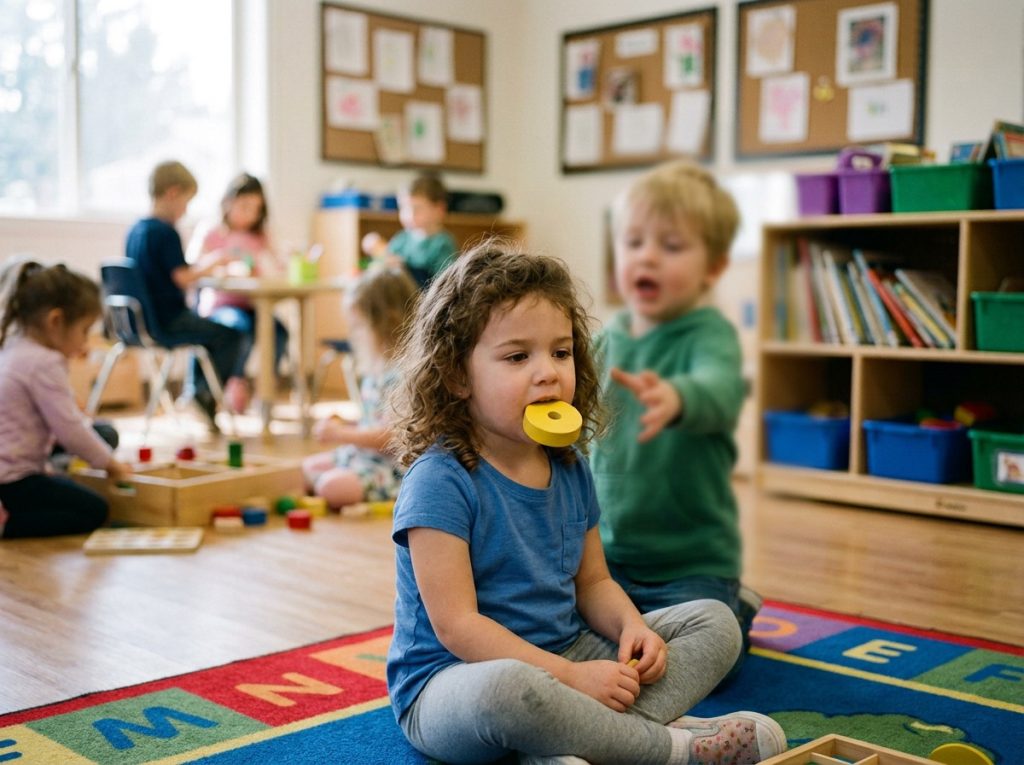
For teachers, the operational point is blunt: a toy that looks clean carries no guarantee. For directors and buyers, the point is commercial. Every illness cluster drives absences up, forces substitute staffing, and tests the family trust that enrollment depends on. The discipline of sanitizing toys in daycare settings is not housekeeping overhead — it is attendance protection.
Clean, Sanitize, or Disinfect: Matching the Chemical to the Risk
Licensing manuals ask staff to separate three operations that everyday language blends together. Cleaning means soap or detergent and water, and it physically lifts dirt, saliva, and most germs off a surface. Sanitizing reduces germs to levels considered safe for public settings — the step required for mouthed toys and anything that touches food. Disinfecting kills bacteria and viruses outright, a stronger treatment reserved for diapering surfaces, body-fluid spills, and outbreak response. Those three definitions form the whole backbone of sanitizing toys in daycare rooms; the rest is scheduling.
The sequence is fixed. A sanitizer applied over visible soil binds to the dirt and never reaches the organisms beneath, which is why public health licensing manuals put cleaning first in every procedure. Skipping the wash is also the quiet reason sanitizing toys in daycare rooms sometimes fails to slow an illness cycle — the product never reached the germs it was meant to hit.
Sanitizing toys in daycare programs typically runs on one of two chemistries. A fresh solution of unscented household bleach — roughly a tablespoon per gallon of cool water — needs one to two minutes of wet contact time and air-dries without leaving residue. Quaternary ammonium products work at 200 ppm with a 10-minute contact time when the label is followed exactly. Bleach must never meet ammonia or other cleaners; the combination releases fumes that have no place in a room full of children.
Product handling carries its own rules, and they come from workplace law rather than child care guidance. Sanitizers and disinfectants stay in labeled original containers, stored where children cannot reach them, with the safety data sheet kept on file and available to every staff member. National workplace standards also require chemical-handling training when staff are hired and refreshed each year — a licensing surveyor can ask for both the sheets and the training log.
A Frequency Framework Built on Risk, Not the Calendar
The Caring for Our Children national health and safety standards — the reference most state licensing rules draw from — set minimum frequencies by how a toy is used rather than how it looks. Frequency is also where hygiene plans drift, because sanitizing toys in daycare classrooms by the calendar instead of by risk either burns labor or misses real exposures. Their schedule translates into a working table:
| Toy category | Minimum frequency | Why the risk justifies it |
| Mouthed toys | Clean and sanitize after each use, before another child plays | Saliva moves germs directly between children |
| Infant room toys | Daily, plus after each mouthed use | Mouthing is the default play mode below age two |
| Shared preschool toys | Weekly, plus whenever visibly soiled | Handling stays high, mouthing drops |
| Play activity centers and shelving | Daily at day’s end | High-touch surfaces collect the whole room’s hands |
| Dress-up clothes and fabric props | Launder weekly | Porous materials hold organisms longer than hard surfaces |
| Water table toys | Drain and sanitize after each session | Standing water multiplies bacterial growth |
Outbreak weeks rewrite the rules. When a room logs its second stomach bug in a fortnight, sanitizing toys in daycare rooms escalates from sanitizer to disinfectant, water and sensory play pauses, and fabric props move out of circulation until the cluster passes — escalation is part of the routine, not a deviation from it. Local licensing regulations govern wherever they run stricter than these minimums.
Two practices make the table stick in real rooms. Written procedures that assign cleaning responsibility by name and by room keep the schedule from dissolving when staffing shifts, and a posted copy of the frequency table where toys are actually processed turns policy into habit. Centers that skip the writing step tend to run a different routine every week, and surveyors notice the drift.
How Sanitizing Toys in Daycare Classrooms Works, Step by Step
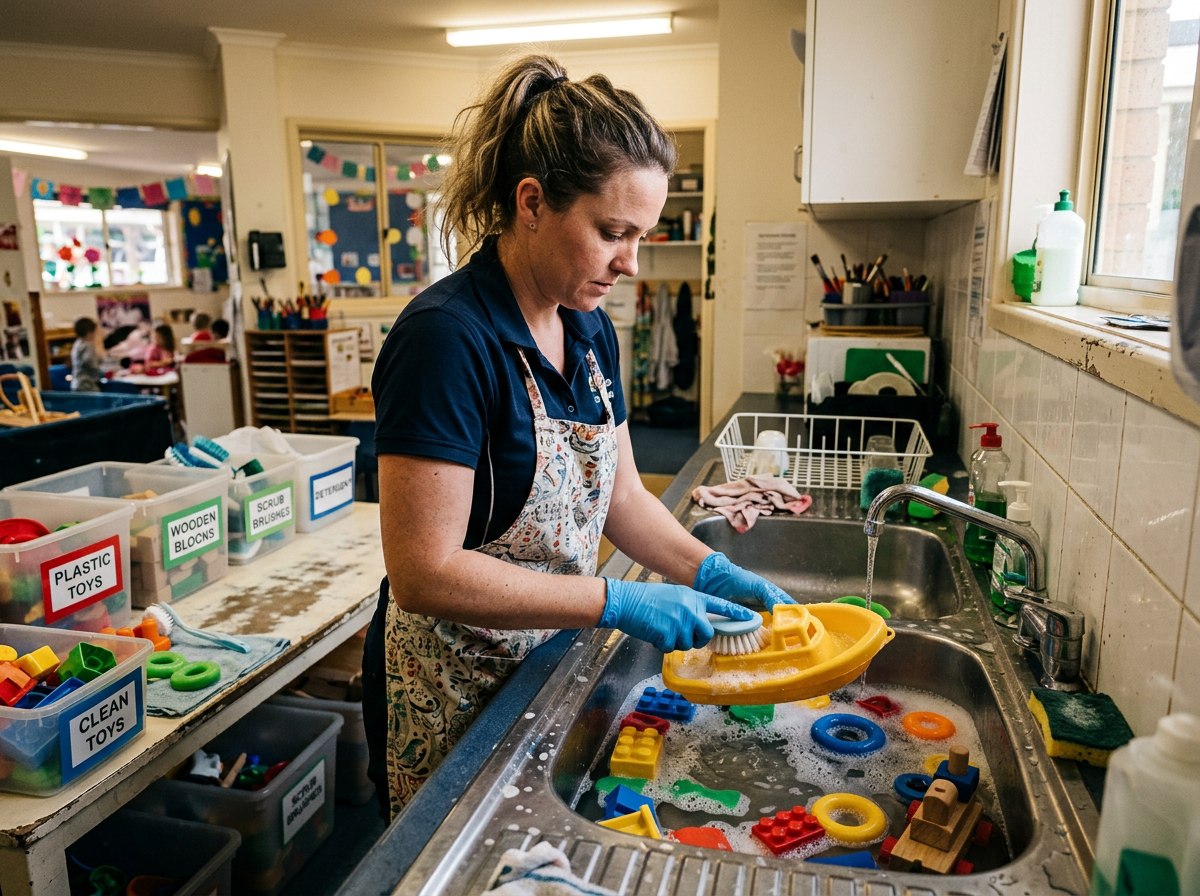
Whatever products the program stocks, the mechanics of sanitizing toys in daycare rooms follow the same sequence. Cleaning comes first and does most of the work: scrub each toy in warm soapy water with a brush that reaches into crevices, then rinse under running water until no soap remains.
The sanitizer bath comes second. Hard toys submerge in the bleach solution — or take a quat sanitizer at the correct dilution — and stay visibly wet for the full contact time on the label, usually around two minutes. Air-drying finishes the process, ideally overnight on a rack. A damp toy left in a closed bin recontaminates itself, which turns a finished job into a wasted one.
Two mechanical shortcuts earn their place in busy rooms. Hard plastic, sealed wood, and metal can run through a complete dishwasher cycle, provided the toys do not share the load with dishes. Fabric props go through a hot washing machine cycle and a full dryer run.
Workflow matters as much as chemistry. A dirty-toy bin, kept out of children’s reach, catches mouthed and soiled items the moment they leave play, so nothing returns to a shelf before processing. Sorting hard and soft toys into separate containers at collection saves rehandling. Staff run the full sequence at naptime or day’s end while a rotating pool keeps favorite pieces in play — the same logic behind a toy rotation system that keeps shelves uncluttered. Gloves protect the person doing the washing, and bleach mixes with nothing but cool water. Workflow is what keeps sanitizing toys in daycare classrooms sustainable on the days everything runs late.

Material Handling Is Where Toy Cleaning Gets Faster or Falls Apart
Material handling is where sanitizing toys in daycare classrooms either gets faster or quietly falls apart. Product chemistry only works when the method matches the material, which means sorting the shelf into four cleaning profiles.
Hard plastic and silicone
Submerge, scrub, sanitize, dry. Cracked or scratched plastic is beyond rescue — damaged surfaces shelter organisms no rag can reach, and licensing guidance directs programs to discard rather than keep trying. Pretend-play food and miniature dishes belong in the mouthed-toy column, because children taste them even when the menu is imaginary.
Wooden toys
Soaking swells the grain and cracks the finish, so sanitizing wooden toys runs on a spray-and-wipe pass: a damp soapy cloth first, then a sanitizer spray wiped off after the contact time, and the piece air-dried flat. Sealed finishes make this a twenty-second job; raw or worn wood cannot be sanitized reliably and belongs out of shared rooms. That material reality is one reason screen-free wooden toys for toddlers hold their classroom place — sealed pieces tolerate daily wipe-downs for years.
Fabric and dress-up props
Machine wash hot, dry completely, rotate. Dress-up props in a dramatic play corner need the same laundering discipline as rest-time linens, and in rooms with children under two, cloth items serve one child at a time and wash between users.
Cardboard books and puzzles
Paper-based materials sit low on the risk list — public health guidance treats children’s books as unlikely transmission routes needing no special cleaning. Spot clean when soiled, and discard anything contaminated with body fluids, since porous pages cannot take a sanitizer.
Buying Toys That Shrink the Cleaning Load
The cleaning schedule is fixed; the toys are a purchasing decision. Every characteristic that makes a piece easy to sanitize shows up on a spec sheet before an order is placed: smooth non-porous surfaces, sealed finishes, no battery compartments in mouthing-age rooms, one-piece construction instead of screw-together joints, and grooves shallow enough for a standard brush. Toy hygiene planning and toy purchasing are the same decision made in two different months. Every minute spent sanitizing toys in daycare classrooms is scheduled labor, and the toy decides how many minutes it costs.
Suppliers make that comparison easier or harder before an order is ever placed. Programs that request written cleaning instructions and material specifications at the quoting stage can predict a toy’s maintenance burden before it enters a room, and manufacturers of classroom-grade toys answer that question routinely. A supplier who cannot describe how to sanitize its own product has answered a different question instead.
Classroom-proven wooden construction
This is where solid wood earns its procurement case. Vindstier’s wooden sorting and stacking sets and its number blocks are finished with smooth sealed surfaces that clear a full sanitize cycle in a single wipe — the difference between a piece that survives years of daily sanitation and a creviced item staff quietly stop cleaning. For buyers pricing the premium, cleaning labor across a school year usually costs more than the upgrade to washable construction. A toy that cannot survive its own cleaning schedule is not cheap at any price.

Where Toy Sanitizing Reaches Its Limits
Sanitizing toys in daycare rooms reduces germs to levels considered safe; it does not sterilize them. Recontamination begins the moment play resumes, so expecting a toy to stay germ-free between Monday morning and Friday afternoon misreads what the process does.
Surface contact is also only one transmission route. Some respiratory illnesses spread through the air, and hand hygiene cleans the one surface every toy shares — children’s hands. The national standards themselves note that ventilation and handwashing carry protective weight that no cleaning schedule replaces. Rooms that treat sanitizing toys in daycare settings as the whole answer have solved the smaller half of the problem.
Materials set hard boundaries. No sanitizer rescues a stuffed animal soaked in body fluids, a cardboard puzzle chewed soft, or a bath toy holding water inside molded seams — licensing guidance in those cases says discard and replace. And the misuse that quietly unravels routines: spraying sanitizer across visibly dirty toys and wiping immediately. The product never reaches the germs and the contact time never completes, so staff conclude the routine fails when the routine never actually ran.
The Bottom Line on Sanitizing Toys in Daycare
A workable toy hygiene plan has four parts: a frequency table matched to how each toy is used, the clean-rinse-sanitize-air-dry sequence run in that order, methods matched to each material, and purchasing standards that favor toys which survive their own cleaning schedule. Getting sanitizing toys in daycare programs onto one written page is the finish line — the document a licensing surveyor asks to see.
Sanitizing toys in daycare programs is the least glamorous attendance protection a center can buy, and it costs less than the winter that tests every room. Teachers planning ahead will find more classroom-tested routines on this blog, from setting up a rotation that keeps shelves manageable to building play areas that stay hygienic by design.