
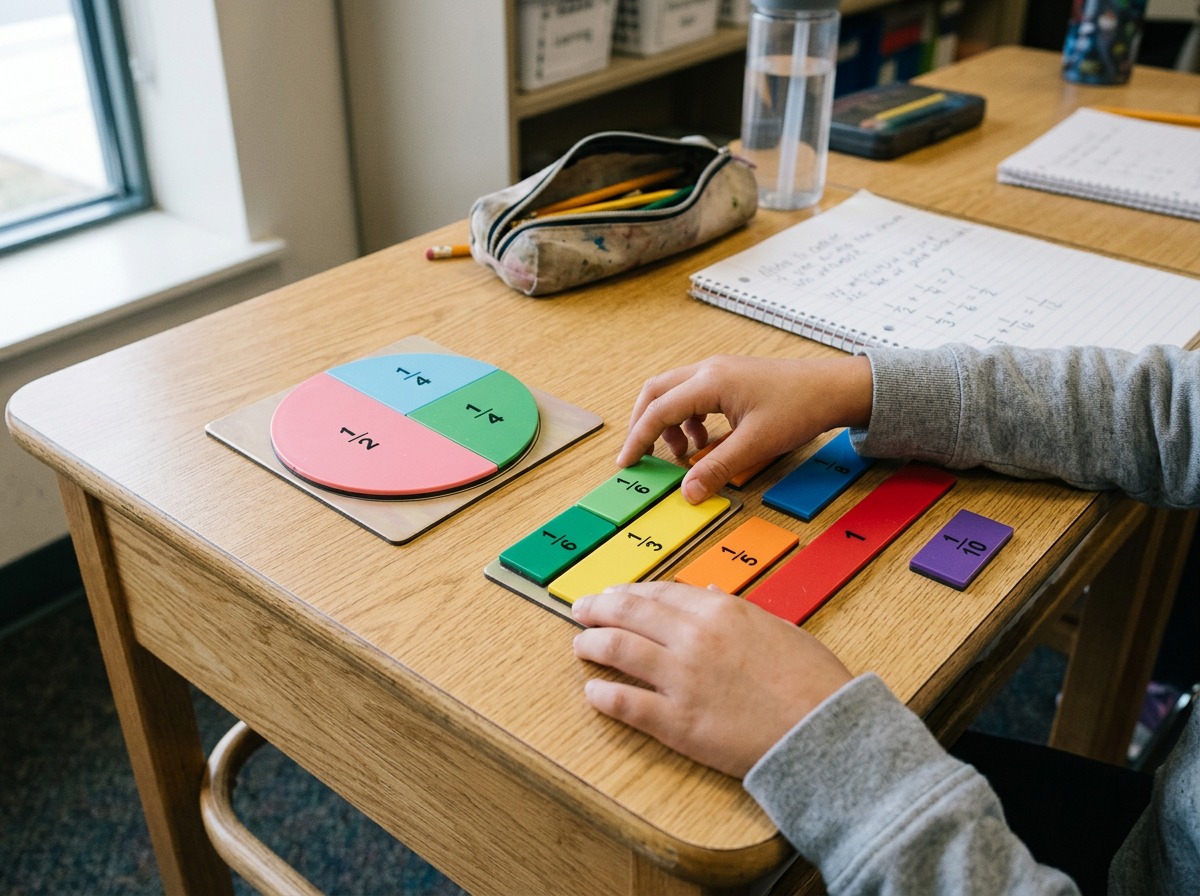
Fractions create a unique teaching challenge in early mathematics. Students who confidently work with whole numbers suddenly struggle when asked to understand that 3/4 represents both three parts and a relationship to a larger whole. This cognitive leap fails for many learners because traditional instruction relies on abstract symbolic notation before building concrete understanding. Teachers witness this disconnect daily: students memorize procedures without grasping what fractions actually represent. Visual teaching methods bridge this gap by making abstract fraction concepts tangible. Research from the National Council of Teachers of Mathematics indicates that students taught through visual and manipulative-based approaches demonstrate 34% higher long-term retention compared to those who learn fractions through symbolic notation alone. This advantage holds across diverse learning styles and continues to affect performance in higher-level mathematics. This is why learning how to teach fractions visually, rather than relying on symbolic drills alone, has become a core focus of modern early math education.
Why Abstract Fraction Instruction Creates Learning Barriers
Traditional fraction curricula typically introduce the concept through written symbols and computational rules. Students see “1/2” or “3/8” on a board and are expected to understand these notations represent specific quantities. Three fundamental problems emerge from this approach.
Perceptual disconnect occurs when learners cannot link abstract symbols to actual amounts. The notation 3/4 carries no inherent meaning until a student sees a whole divided into four equal sections with three highlighted. Without this visual anchor, fractions become arbitrary symbols to memorize rather than quantities to comprehend and compare.
Procedural dependency develops when students learn fraction operations as isolated algorithms. They memorize steps like “find common denominators” or “invert and multiply” without understanding why these procedures work. When faced with novel fraction problems, these learners cannot adapt their knowledge because they lack conceptual foundations. A student might correctly solve 1/4 + 1/4 using memorized steps but be unable to explain why the answer is 1/2 or estimate whether their result makes sense.
Magnitude confusion persists because symbolic notation obscures relative size. Students struggle to determine whether 5/8 or 7/12 is larger without converting to decimals or finding common denominators. This inability to visualize and compare fractional quantities indicates missing foundational understanding. Research by Siegler and colleagues shows that fraction magnitude understanding in elementary school predicts algebra success and overall mathematics achievement years later, independent of whole number knowledge or IQ.
How to Teach Fractions Visually: Three Core Visual Methods
Effective visual fraction instruction follows a deliberate progression from concrete representations to abstract thinking. Each visualization method serves specific cognitive purposes and addresses different aspects of fraction comprehension.
Area Models Establish Part-Whole Relationships
Area models represent fractions as portions of a defined two-dimensional space. A circle divided into six equal wedges with two sections shaded physically demonstrates what 2/6 means—students can see the complete whole, count total parts, and identify the parts being described. This visual representation makes the denominator-numerator relationship concrete rather than abstract.

The instructional value extends beyond simple visualization. When students physically color, cut, or arrange area models, they engage in active sense-making. A teacher might ask students to create fraction strips showing 1/2, 1/3, and 1/4 by folding paper, then physically compare these to discover that 1/2 is larger than 1/3. This hands-on exploration builds intuitive understanding that denominators and size have an inverse relationship—a concept that confuses many learners when presented only symbolically.
Area models work particularly well for introducing equivalent fractions. Students can overlay a shape divided into fourths onto one divided into eighths to visually discover that 2/4 and 4/8 occupy identical space. This concrete experience makes the concept of equivalence meaningful before introducing the algorithmic process of multiplying numerators and denominators.
However, area models have limitations. They can reinforce the misconception that fractions must always be parts of a single whole and can make operations like fraction addition conceptually murky. This is where additional visual methods become necessary.
Linear Models Support Measurement Understanding
Linear models represent fractions as positions or lengths on a number line. Unlike area models that show fractions as parts of a static shape, linear models emphasize fractions as quantities that can be measured, compared, and operated upon. A number line clearly shows that 3/4 falls between 0 and 1, closer to 1, and occupies a specific position relative to other fractions.
This representation builds crucial fraction concepts that area models cannot adequately address. Linear models make it obvious that fractions are numbers with specific locations on a continuum, not just pieces of shapes. They naturally support magnitude comparison—students can see that 5/6 is greater than 2/3 by examining positions on a number line, without any calculation required.
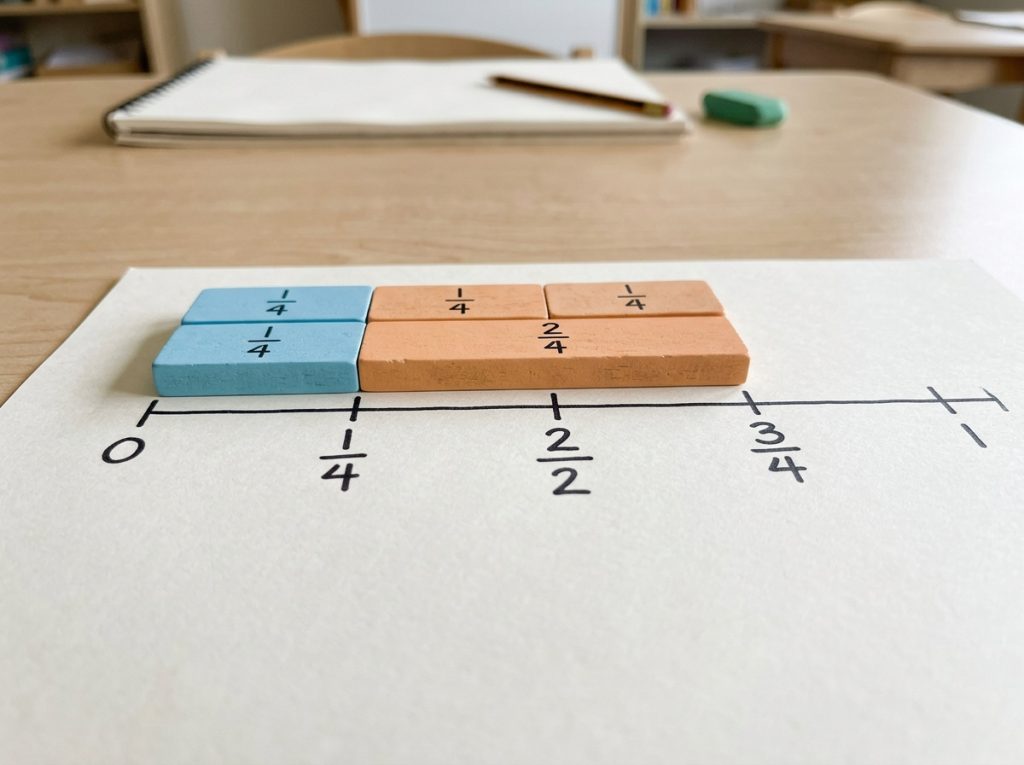
Linear models also provide the foundation for understanding fraction operations. Fraction addition becomes visually clear: to add 1/4 + 2/4, start at 1/4 on the number line and move 2/4 units forward. This visual approach connects fraction arithmetic to the measurement interpretation students already understand from whole number addition.
Teachers can use linear models to address the common error where students add both numerators and denominators (believing 1/4 + 1/4 = 2/8). By marking jumps on a number line, students see that moving 1/4 and another 1/4 lands them at 2/4, making the correct answer visually obvious.
Set Models Connect Fractions to Real-World Contexts
Set models represent fractions as parts of a discrete collection of objects. If a classroom has 12 students and 3 are wearing red shirts, then 3/12 (or simplified, 1/4) of the class wears red. This model proves especially valuable because it mirrors how fractions appear in daily life—portions of groups, not just pieces of continuous wholes.
Set models help students understand that the whole does not need to be a single object. This prevents the rigid thinking that fractions only describe pieces of pizza or portions of shapes. A student working with counters can see that 2/5 of a set of 15 blocks means dividing the 15 into 5 equal groups of 3, then considering 2 of those groups (6 blocks total). This builds flexible thinking about what “the whole” means in different contexts.
Set models also prepare students for ratio and proportion work. Understanding that 3 out of 5 marbles are blue (3/5) builds the foundation for later understanding that a ratio of 3:5 describes a relationship between quantities. This conceptual bridge between fractions and ratios proves essential for middle school mathematics.

The limitation of set models is that they work only when the whole can be evenly divided. Teachers cannot easily show 2/7 of a set of 10 objects. This constraint makes set models a valuable supplement to, not a replacement for, area and linear models.
Comparison: Choosing the Right Model for Your Teaching Objective
| Visual Model | Best For | Key Strengths | Limitations | Ideal Grade Level |
|---|---|---|---|---|
| Area Models (circles, rectangles, fraction bars) | Introducing basic fraction concepts, equivalent fractions, part-whole relationships | Students can physically see and manipulate parts; excellent for building initial understanding; works well for comparing unit fractions | Can reinforce misconception that fractions must be parts of single objects; less effective for showing operations | K-3 (introduction phase) |
| Linear Models (number lines, fraction strips) | Magnitude comparison, fraction operations, understanding fractions as numbers | Shows fractions as measurable quantities on continuum; naturally supports ordering and comparing; clear representation of operations | More abstract than area models; requires understanding of number line concept first | Grades 2-5 (building fluency) |
| Set Models (counters, groups of objects) | Real-world application, connecting to ratios, flexible thinking about “the whole” | Mirrors everyday fraction contexts; prevents rigid thinking; bridges to ratio concepts | Only works when sets divide evenly; harder to show equivalent fractions | Grades 3-5 (application phase) |
Implementing Visual Fraction Instruction in Classroom Practice
Translating these visual methods into effective instruction requires deliberate planning and appropriate tools. Research on mathematics learning suggests several evidence-based practices that maximize the impact of visual fraction teaching.
Sequencing Visual Models for Conceptual Growth
Students benefit from experiencing all three model types, but the sequence matters. Most mathematics educators recommend beginning with area models for initial fraction introduction. Young learners grasp the concept of “parts of a whole” more readily when that whole is a visible shape. Area models allow students to physically create fractions through folding, cutting, and shading—actions that build procedural understanding alongside conceptual knowledge.
After students develop comfort with basic fraction concepts through area models, introducing linear models helps them see fractions as measurable quantities on a continuum. This transition often occurs as students move from understanding fractions as static parts toward understanding them as numbers that can be compared, ordered, and operated upon. Number line work should begin with simple unit fractions (1/2, 1/3, 1/4) before progressing to non-unit fractions and mixed numbers.
Set models typically enter instruction after both area and linear models have established foundational understanding. By this point, students can recognize fractions in diverse contexts and apply their knowledge flexibly. Set models then expand students’ conception of what fractions can represent and how they appear in real-world situations.
This progression does not mean abandoning earlier models. Effective instruction cycles through all three model types regularly, using each to illuminate different aspects of new concepts. When teaching fraction multiplication, for example, a teacher might use area models to show the concept visually, then connect to linear models to demonstrate how the operation affects magnitude, then apply set models to contextualize the operation in a real-world scenario.
Selecting Fraction Manipulatives That Support Learning
The effectiveness of visual fraction instruction depends significantly on the quality and design of physical materials. Not all math manipulatives provide equal learning value. Teachers and parents selecting tools should consider several critical factors.
Manipulatives should clearly represent the target concept without introducing confusing secondary features. Pattern blocks work well for exploring fraction relationships because the shapes have clear mathematical relationships—two red trapezoids equal one yellow hexagon, creating an obvious 1/2 relationship. However, the varying colors and angles can distract younger learners from the core concept being taught.
Magnetic fraction tools offer particular advantages in classroom settings. Products like magnetic fraction circles or bars allow teachers to demonstrate concepts on a vertical surface where all students can see, then students can manipulate identical materials at their desks. The magnetic feature prevents pieces from sliding during manipulation, reducing frustration and keeping attention on mathematical thinking rather than physical coordination.
Effective fraction manipulatives enable students to physically test relationships and make discoveries. Fraction towers, where students can stack differently-sized fraction pieces, let learners physically verify that 1/2 + 1/4 + 1/4 = 1 by building a tower that reaches exactly the height of a whole unit. This self-checking feature builds independence and allows students to verify their thinking without constant teacher confirmation.
Durability matters particularly for classroom use. Wooden building blocks and magnetic materials typically withstand years of student handling better than paper or thin plastic alternatives. While cardboard fraction circles serve adequately for one-time lessons, schools investing in comprehensive fraction instruction benefit from materials that survive multiple years of use. Some educators report that high-quality wooden or magnetic fraction sets purchased for classrooms remain functional after a decade of use, making the initial investment cost-effective compared to repeatedly replacing cheaper materials.
Materials should also support progression from simple to complex concepts. A quality fraction set allows exploration of basic concepts like identifying 1/2 or 1/4, then extends to comparing fractions, finding equivalent fractions, adding fractions with like denominators, and eventually exploring operations with unlike denominators. Sets limited to only simple fractions (halves, thirds, fourths) require replacement as students advance, whereas comprehensive sets including sixths, eighths, tenths, and twelfths support learning across multiple grade levels.
Connecting Visual Models to Symbolic Notation
Visual instruction succeeds only when it eventually connects to formal mathematical notation. The goal is not to keep students manipulating physical objects indefinitely, but to use concrete materials as a bridge to abstract understanding. This transition requires explicit instructional moves.
Teachers should consistently pair manipulative work with written representations. When a student uses fraction bars to demonstrate that 1/4 + 2/4 = 3/4, the teacher writes the symbolic equation alongside the physical demonstration. This repeated pairing helps students see that the symbols represent specific concrete actions and quantities.
Asking students to translate between representations accelerates this connection. A teacher might show 3/5 symbolically and ask students to represent it with manipulatives, then reverse the process by having students create a fraction with manipulatives and write the corresponding notation. This back-and-forth translation builds flexible understanding.
As students gain proficiency, gradually reduce scaffolding. Initial fraction instruction might have students use manipulatives for every problem. As understanding develops, ask students to first estimate or predict using mental visualization, then verify with manipulatives. Eventually, reserve manipulatives for checking uncertain answers or exploring new concepts, while students solve familiar problems using symbolic notation. This gradual release of support helps students internalize visual strategies even when physical materials are no longer present.
Common Visual Teaching Mistakes to Avoid
Even with quality materials and good intentions, certain instructional pitfalls undermine visual fraction teaching. Being aware of these common errors helps teachers and parents use visual methods more effectively.
Over-Relying on a Single Model Type
Some classrooms use only circular area models (fraction circles or “pie pieces”) for all fraction instruction. While these materials effectively introduce basic concepts, exclusive reliance on one model type creates incomplete understanding. Students who only see fractions as pieces of circles struggle when fractions appear on number lines, in word problems about groups of objects, or in measurement contexts.
Each model type develops different aspects of fraction understanding. Limiting instruction to only one model—no matter how well that model is taught—leaves conceptual gaps. Effective instruction deliberately uses all three model types across a school year, helping students build comprehensive and flexible fraction knowledge.
Moving to Symbolic Notation Too Quickly
Premature abandonment of visual models forces students back into rote memorization. Some teachers introduce manipulatives briefly, then focus predominantly on abstract procedures and symbolic notation. While efficiency pressure exists in curriculum-dense environments, rushing this progression undermines the very purpose of using visual methods.
Research on mathematics learning consistently shows that students need extended time working with concrete and visual representations before formal abstract thinking becomes meaningful. The timeline varies by student, but most learners benefit from weeks or months of regular manipulative use when first encountering fraction concepts. Even after students demonstrate competency with symbolic notation, periodic return to visual models strengthens understanding and prevents conceptual drift back toward pure memorization.
Using Models Without Explicit Discussion
Simply providing fraction manipulatives and allowing free exploration does not guarantee learning. Visual tools become instructionally powerful when paired with teacher-facilitated discussion that makes mathematical relationships explicit. A student might manipulate fraction pieces without recognizing the equivalent fraction relationships those pieces demonstrate unless a teacher asks targeted questions: “What do you notice about the size of 2/4 compared to 1/2?” or “How many eighths does it take to equal one fourth?”
Effective visual instruction balances hands-on exploration with structured sense-making conversation. Teachers should plan specific questions that guide students toward mathematical insights, then provide time for students to articulate their observations and reasoning. This combination of manipulation and verbalization develops robust conceptual understanding.
Choosing Fraction Teaching Tools for Home and Classroom
Parents supporting homeschool mathematics instruction and teachers purchasing classroom materials face numerous fraction manipulative options. Several factors should guide selection decisions.
For classroom environments serving multiple students, prioritize demonstration-sized materials alongside individual student sets. Large magnetic fraction pieces that teachers can manipulate on whiteboards while students watch ensure all learners see demonstrations clearly. Pairing demonstration materials with individual sets that mirror the demonstration tools allows students to replicate what they observe, building understanding through imitation and practice.
Consider storage and organization systems. Fraction manipulatives involve many small pieces. Sets that include organized storage containers prevent lost pieces and reduce setup time, making teachers more likely to use materials regularly. Some educators report that poorly designed storage leads to decreased manipulative use simply because the preparation burden becomes too high.
Verify that materials represent fraction concepts accurately. Some inexpensive fraction sets contain mathematical errors—pieces labeled 1/3 that don’t actually represent one third of the whole, or sets where the “eighths” don’t evenly fit into the “fourths.” These errors confuse students and teach incorrect mathematics. Quality manufacturers test materials for mathematical precision and clearly document any design constraints.
Look for materials that accommodate multiple model types. Some comprehensive fraction kits include circular area models, rectangular area models, fraction bars (linear models), and counters or cubes for set model work. These multi-model sets cost more initially but prove more economical than purchasing separate materials for each model type.
For budget-conscious settings, prioritize linear and area models over set models, as set models can be created with common classroom objects like counters, blocks, or even student groups. Magnetic fraction bars that function as both area and linear models provide especially good value, serving double duty for multiple learning objectives.
Magnetic fraction teaching aids from manufacturers like Vindstier offer particular advantages for classroom instruction. Their fraction circle and bar sets use strong embedded magnets that prevent pieces from sliding when positioned on vertical surfaces, maintaining student focus on mathematical relationships rather than managing physical materials. The color-coding system—consistent colors for each fraction family (all fourths one color, all eighths another)—helps students quickly identify equivalent relationships while the distinct shading for each individual piece maintains clear visual differentiation. These sets meet ASTM F963 safety standards and use non-toxic materials, addressing safety concerns particularly important when younger students handle small pieces. For schools purchasing materials that will serve students across multiple years, the wooden construction with sealed magnetic enclosures provides durability that withstands daily classroom use better than plastic alternatives.
Application Boundaries and Realistic Expectations
Visual fraction instruction delivers powerful results but has limitations worth acknowledging. Understanding these boundaries helps educators use visual methods appropriately without overpromising outcomes.
Visual methods work best for building initial fraction concepts and supporting operations with fractions up to and including addition and subtraction with unlike denominators. As students progress to more complex operations like division of fractions or operations with algebraic fractions, visual models become less practical, though the conceptual foundation built through early visual work continues supporting student reasoning.
Some students demonstrate strong symbolic reasoning ability and grasp fraction concepts quickly through notation alone. These learners still benefit from visual instruction—it deepens their understanding and prepares them to explain concepts to peers—but they require less extensive manipulative work than students who struggle with abstract thinking. Differentiation remains important even when using research-based visual methods.
Visual instruction requires more class time than teaching procedures alone. A teacher who spends two weeks building fraction understanding through visual models and hands-on exploration could have “covered” more computational procedures in that time through direct instruction. However, research consistently shows that time invested in conceptual understanding pays off in stronger long-term retention and better transfer to novel problems. The initial time investment reduces later re-teaching needs and better prepares students for advanced mathematics.
Manipulative use does not eliminate the need for practice. Visual models help students understand what 3/4 + 1/4 means and why the answer is 4/4 or 1, but students still need repeated practice to internalize fraction operations and develop computational fluency. Visual instruction and procedural practice work together, not as competing approaches.
Building Lasting Fraction Understanding Through Visual Teaching
Teaching fractions visually transforms abstract mathematical notation into concrete understanding that students can see, touch, and mentally manipulate. By systematically using area models, linear models, and set models, educators help learners build comprehensive fraction knowledge that supports both computational skill and conceptual reasoning.
The evidence supporting visual fraction instruction remains compelling. Students taught through these methods demonstrate stronger long-term retention, better transfer to novel problems, and more accurate magnitude estimation compared to those who learn fractions only through symbolic procedures. These advantages persist into higher-level mathematics, affecting algebra success and overall mathematical achievement.
Implementing visual methods effectively requires quality instructional materials, deliberate sequencing that builds from concrete to abstract, and consistent connection between hands-on work and symbolic notation. While this approach demands more initial instructional time than procedural teaching alone, the investment builds mathematical understanding that lasts.
For teachers and parents selecting fraction teaching tools, prioritize materials that accurately represent mathematical relationships, support multiple model types, and provide durability for extended use. Magnetic fraction sets offer particular advantages in classroom environments, allowing demonstration-based instruction while students work with identical materials.
Learning how to teach fractions visually does not eliminate the need for practice and memorization, but it ensures that procedures build upon solid conceptual foundations. Students who understand what fractions represent and how operations affect them become flexible mathematical thinkers capable of applying fraction knowledge across diverse contexts—the ultimate goal of mathematics education.