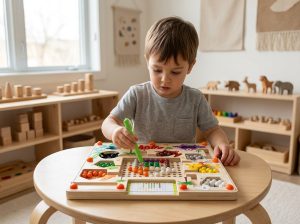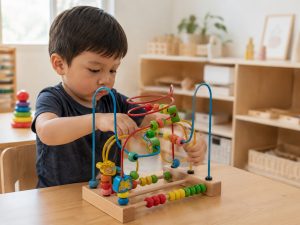
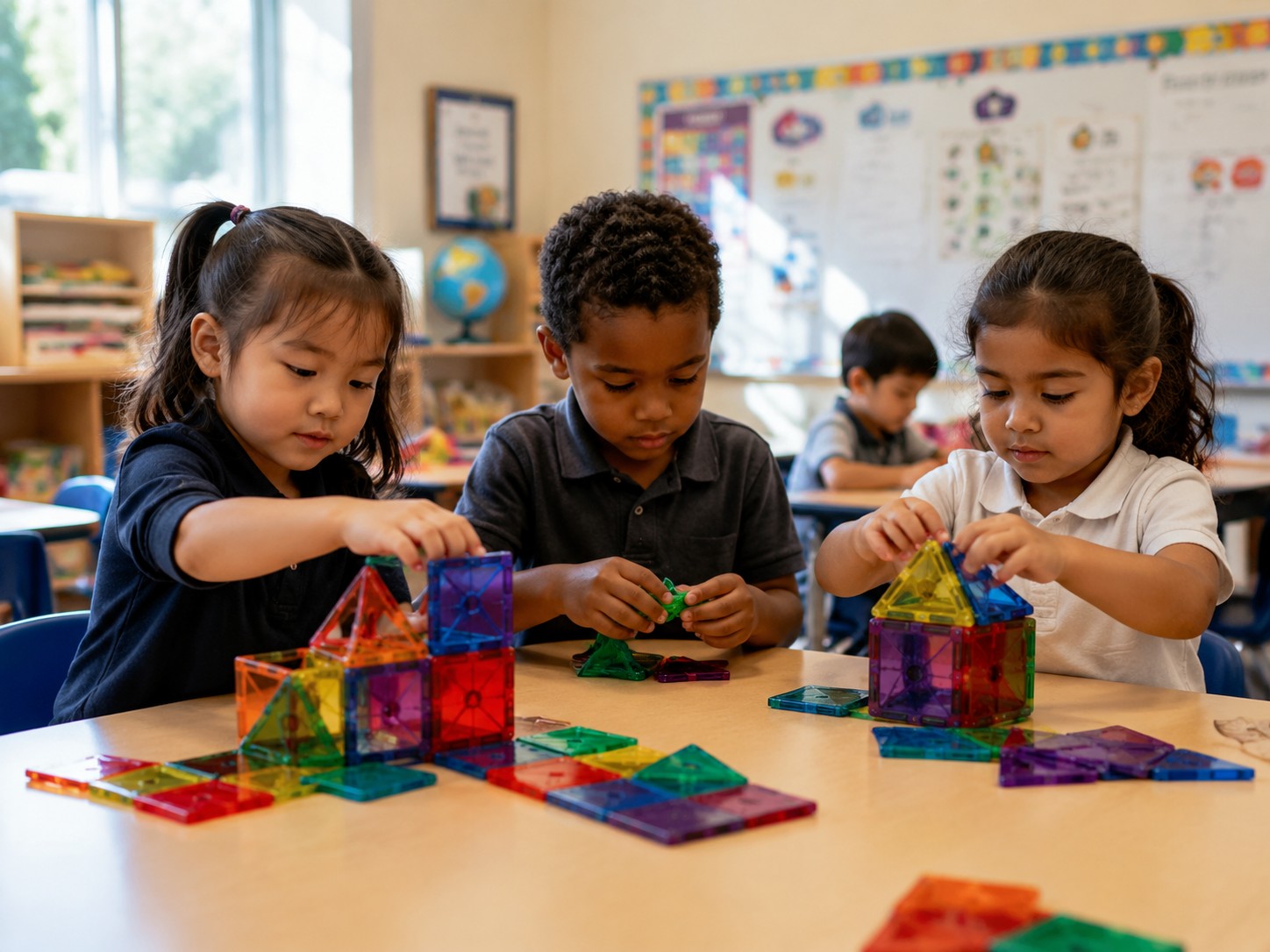
A three-year-old stacks blocks and watches them fall. Is she playing—or conducting her first physics experiment?
A five-year-old discovers two triangles make a square. Is that coincidence—or the beginning of geometric reasoning?
If construction play is secretly STEM learning, why do so many early childhood programs still treat it as recreational time?
The gap between how young children learn and how we teach them remains wide. Traditional early STEM instruction relies on worksheets and rote memorization—approaches that conflict with how developing brains actually build understanding. Construction toys bridge this gap by turning abstract concepts into tangible experiences, but their educational value depends entirely on design quality and classroom implementation.
Why Construction Play Builds Better STEM Foundations Than Direct Instruction
Young children don’t learn by listening to explanations of spatial relationships or force. They learn by manipulating objects and observing consequences.
Construction toys provide immediate, visible feedback that makes cause-and-effect relationships concrete. A child who balances a heavy block on a narrow one discovers weight distribution through experience—not explanation.
This matters because early STEM concepts are fundamentally spatial and mechanical. Understanding how shapes fit together, how structures gain stability, and how forces interact requires three-dimensional thinking that only hands-on work with construction toys can deliver.
A 2014 longitudinal study led by developmental psychologist Verdine found that children who engaged in frequent block play showed 15% higher spatial reasoning scores at age 5 compared to peers with limited construction experience. These spatial skills directly predict math achievement through elementary school.
The problem with conventional early learning materials is concept isolation. A worksheet about shapes teaches recognition but not how shapes function in space. Construction toys force integration—to build successfully, children must simultaneously consider size, shape, balance, symmetry, and structural integrity. This integrated thinking mirrors how STEM professionals actually work.
For curriculum planners: this is why construction play deserves dedicated time in the daily schedule, not just free play filler.
3 Core STEM Skills Built Through Construction Play
Spatial reasoning development
Children who regularly work with construction toys develop mental rotation abilities years ahead of peers who don’t. When a four-year-old experiments with fitting pieces together at different angles, she’s building the visual-spatial skills that will later help her understand geometry, read technical diagrams, and visualize molecular structures.
Newcombe’s spatial development research (2010) demonstrates that early spatial play with construction toys predicts not just mathematics performance but also science and engineering career interest through high school. The foundation isn’t incidental—it’s critical infrastructure for technical thinking.
Early engineering thinking
Construction play introduces the engineering design process naturally. A child building a tower faces a real problem: how to make it taller without collapse. She forms a hypothesis, tests it, observes results, and modifies her approach—this is iterative design thinking emerging organically through play.
What makes this valuable isn’t just problem-solving practice. It’s learning that failure provides information. When a structure collapses, children naturally analyze what happened and adjust their next attempt. This resilience is precisely what STEM education aims to develop, and it’s one of the most underrated benefits of quality construction toys.
Mathematical concept formation
Construction toys make mathematical relationships visible and manipulable:
- Symmetry isn’t an abstract term—it’s what happens when you mirror your block pattern on both sides
- Patterns aren’t worksheet exercises—they’re the repeating elements that make structures aesthetically pleasing and structurally sound
- Fractions emerge when children discover that two small triangles equal one square
This concrete-to-abstract progression is exactly what mathematics education research recommends. The physical manipulation creates neural pathways that abstract instruction alone cannot build, making construction toys one of the most effective early math learning tools available.
Educational vs. Recreational Building Toys: What’s the Difference?
Not all construction toys support learning equally. Educational value lies in specific design features that either promote or limit cognitive development.
| Feature | Educational Construction Toys | Generic Building Sets |
|---|---|---|
| Design goal | Support cognitive development and skill-building | Complete specific models, prioritize visual appeal |
| Manufacturing precision | Tight tolerances, consistent connection performance | Loose tolerances, inconsistent fit |
| Age range | Progressive complexity serves ages 3-6+, multi-year use | Age-specific design, quickly outgrown |
| Support materials | Lesson frameworks, assessment tools, teacher training | Assembly instructions only |
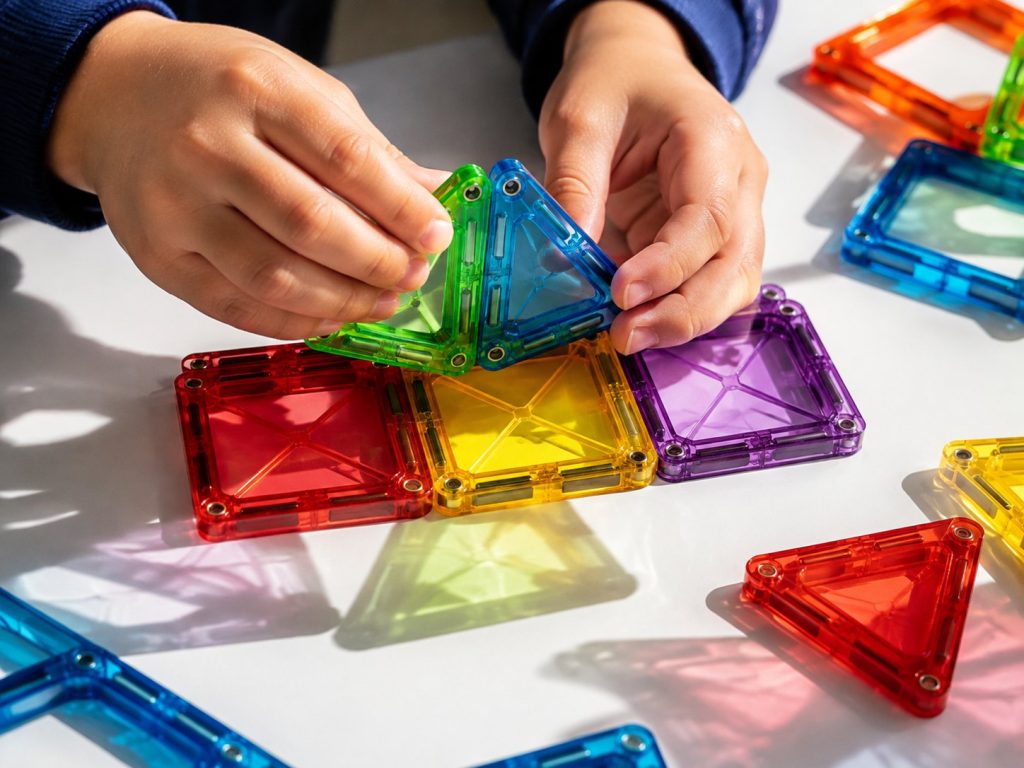
Precision and consistency in manufacturing
When pieces don’t fit together reliably, children blame themselves rather than the materials. This undermines the trial-and-error learning that construction play should foster.
High-quality construction toys maintain tight manufacturing tolerances so connection methods work consistently. The difference is particularly apparent in classroom settings where materials receive heavy use—poorly manufactured sets develop loose connections and warped pieces within weeks, effectively ending their educational usefulness.
For procurement teams: investing in construction toys with tight manufacturing tolerances eliminates months of frustration and unexpected replacement costs later.
Progressive complexity that grows with children
Educational construction toys should offer multiple entry points. A three-year-old and a six-year-old playing with the same set should both find appropriate challenge levels.
This requires thoughtful design that allows simple constructions while also enabling complex builds for more advanced users. Sets designed purely for visual appeal often lack the architectural integrity needed for open-ended building—they come with instruction manuals for specific models but don’t support creative exploration.
Educational construction toys prioritize structural possibilities over predetermined outcomes, giving children agency to design rather than just following steps.
Material properties that teach physical principles
The physical characteristics of construction toys determine what STEM concepts children can explore through hands-on play:
- Wooden blocks teach weight, gravity, and friction through natural properties
- Magnetic construction sets reveal force relationships and polarity in ways other materials cannot
- Interlocking plastic systems demonstrate connection strength and load distribution
Quality educational suppliers design sets with specific learning objectives in mind, considering what physical principles the materials will make visible and tangible.
Classroom Implementation That Maximizes Learning Outcomes
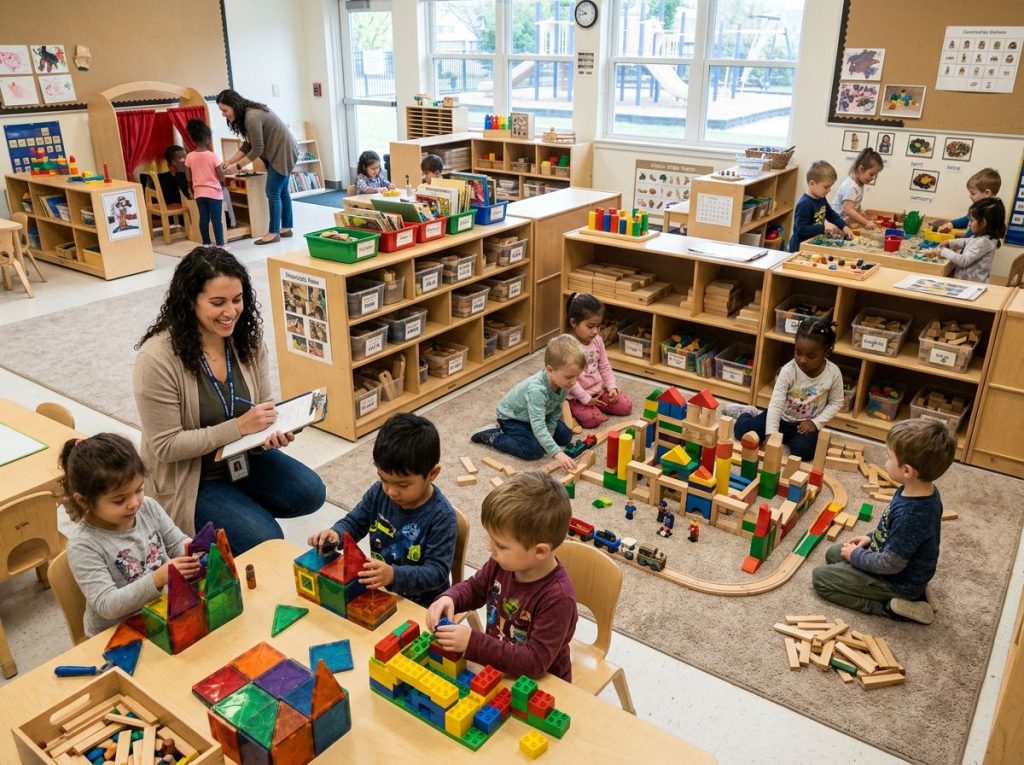
Providing construction toys isn’t enough. The learning potential of construction toys emerges from how teachers structure the experience and extend children’s thinking during play.
Structured free play with strategic challenges
The most effective approach combines open exploration with periodic constraints that push learning forward: build something that can hold weight, create a structure with four-way symmetry, or construct a bridge that spans a specific distance.
These challenges work because they’re authentic problems without predetermined solutions. A child might solve a bridge-building challenge through triangular supports while another uses arched designs. Both discover legitimate engineering principles through different paths.
Observation and strategic questioning
Skilled teachers use construction play as an assessment opportunity. But observation alone isn’t enough. Instead of praising completed structures generically, effective teachers ask questions that promote reflection:
- “What made this side more stable than that side?”
- “How could you make this taller without it falling over?”
These questions prompt analytical thinking and help children articulate the principles they’re discovering through experience.
For classroom teachers: this 10-second questioning habit doubles the STEM value of otherwise unstructured play.
How Vindstier Construction Toys Address Real Classroom Challenges
Many schools invest in construction materials only to find connections loosen, children lose interest quickly, or teachers struggle to see the educational value.
Vindstier’s magnetic construction blocks address the precision problem that undermines many competitive sets. The magnetic strength is calibrated specifically for small hands—tested at 800-1200 gauss, strong enough that structures hold together during manipulation, but not so strong that young children struggle to separate pieces. This means children can successfully build complex structures without adult assistance, maintaining the autonomy essential for self-directed learning.
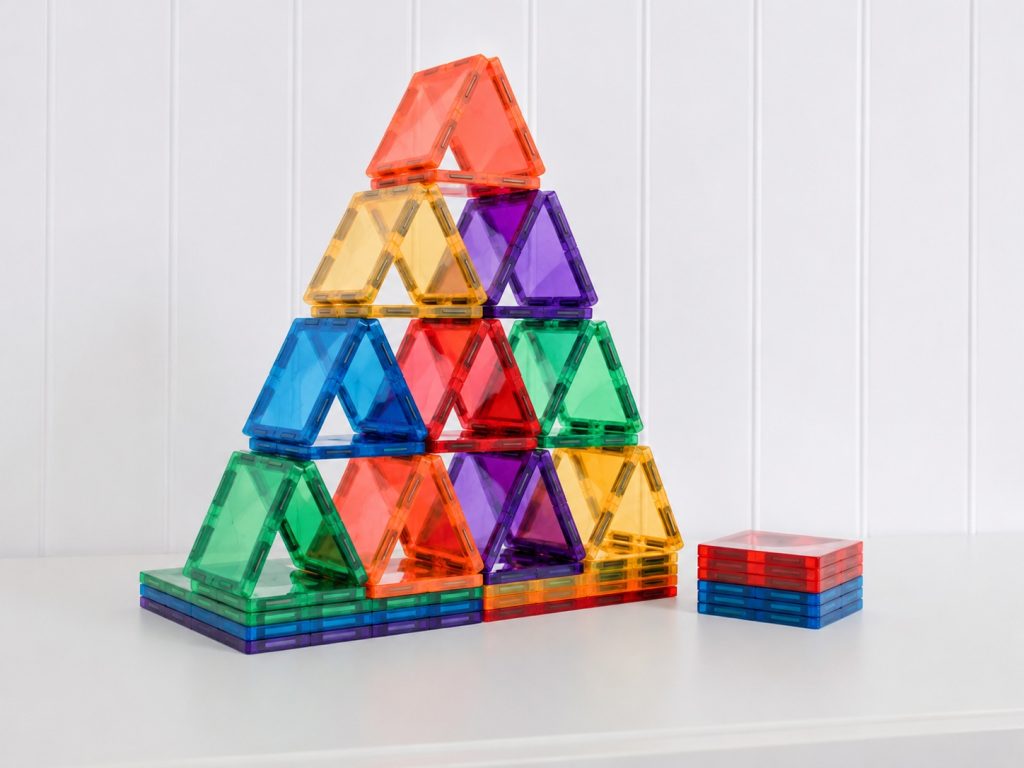
The set’s geometric variety supports progressive complexity that keeps materials relevant as children develop. Three-year-olds start with simple stacking. Four-year-olds discover three-dimensional forms and symmetry. Five and six-year-olds construct elaborate architectural designs and experiment with structural stability. The same set serves multiple developmental levels simultaneously—crucial for mixed-age classrooms.
The translucent colored pieces make internal structures visible, allowing children to see how triangular supports strengthen rectangular frames or how geometric patterns create larger forms. This visibility is pedagogically intentional—it makes structural principles observable rather than hidden inside opaque materials.
The magnetic encapsulation method prevents the common failure point where magnets detach from plastic housings after repeated use. In pilot programs with intensive classroom use, sets maintained full functionality after 10,000+ connection cycles—longevity that makes per-student cost remarkably low compared to materials requiring replacement within 12-18 months.
For early childhood programs looking to invest in durable, pedagogically sound construction toys, Vindstier’s calibrated magnetic sets deliver measurable long-term value.
How to Measure Real Learning From Construction Play
Schools investing in construction toys for STEM need ways to document that play actually develops the claimed competencies. This requires understanding what to observe and how to interpret what children demonstrate during building activities.
Observable spatial skill indicators:
- Can the child mentally rotate pieces to visualize how they’ll fit before attempting connection?
- Does she plan construction sequences that require inserting pieces in specific orders?
- Can he create symmetrical designs by mirroring previous construction?
The progression is typically clear over time. Younger children use trial and error exclusively. Developing spatial skills show in reduced random attempts and increased purposeful positioning. Advanced spatial reasoning appears when children begin planning multi-step constructions that require placing foundation elements with the final structure in mind.
Problem-solving development markers:
- Does the child abandon projects immediately when they don’t work, or analyze what failed and modify the approach?
- When a structure collapses, does he start over identically or incorporate learning from the failure?
- Does the child consistently choose simple constructions, or attempt projects at the edge of current ability?
The willingness to tackle difficult problems and persist through multiple failures strongly predicts later academic success but is rarely addressed in traditional curriculum.
When Construction Toys Aren’t Enough: Implementation Realities
Construction toys are not a universal solution. Their effectiveness depends on support structures that many programs lack.
Teacher preparation gaps represent the most significant barrier. Without professional development on how construction play develops specific competencies, even high-quality materials become underutilized. Teachers need training on what to observe, how to document learning, and how to create challenges that extend thinking.
Budget constraints create real access inequalities. Quality educational construction sets require significant upfront investment that many early childhood programs cannot afford. The long-term cost-per-student may be lower than cheap materials requiring frequent replacement, but initial budget allocation remains a barrier.
Neurodivergent learners may require additional scaffolding. Some children with sensory processing differences find the tactile experience overwhelming. Others with executive function challenges may need more structured guidance to move beyond repetitive building patterns.
Storage and organization present practical challenges in resource-limited classrooms. Keeping sets complete, preventing piece loss, and maintaining organized access requires systems that many programs struggle to implement consistently.
Key Takeaways: Making Construction Play Work as STEM Investment
The connection between early construction play and later STEM achievement is grounded in decades of developmental research on how spatial reasoning develops and how hands-on experience builds conceptual understanding. But realizing that potential requires intentional implementation.
For schools and procurement decision-makers:
- Treat purchases of construction toys as curriculum investments requiring professional development, not just equipment procurement
- When selecting construction toys, evaluate suppliers on educational support (implementation resources, teacher training, assessment frameworks) as much as product quality
- Consider total cost of ownership: durability engineering and manufacturing precision determine whether materials maintain educational value for years or need replacement within months
For classroom teachers and curriculum coordinators:
- Integrate construction play with assessment systems—develop frameworks for observing spatial reasoning, problem-solving, and collaborative skills during building activities
- Use strategic questioning to transform free play with construction toys into documented STEM learning that communicates value to parents and administrators
- Create challenges that push learning forward while maintaining the autonomy essential for self-directed learning
For educational product distributors:
- Partner with suppliers who understand classroom context and provide implementation support beyond product sales
- Recognize that quality differentiation in this category comes from manufacturing precision, progressive complexity design, and pedagogical intentionality—not just price points
Children with strong construction play backgrounds enter formal STEM instruction with significant advantages. When geometry introduces concepts like congruence and symmetry, these students already have physical experiences that make abstract concepts concrete. When physics introduces force and motion, they’ve spent years observing these principles through building.
The educational return on construction toy investment depends entirely on treating them as legitimate STEM curriculum materials. When design quality, teacher preparation, and intentional implementation align, construction toys become foundational STEM curriculum that develops thinking patterns formal instruction alone cannot build.