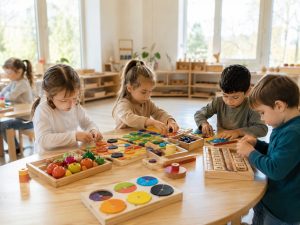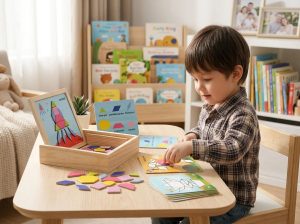
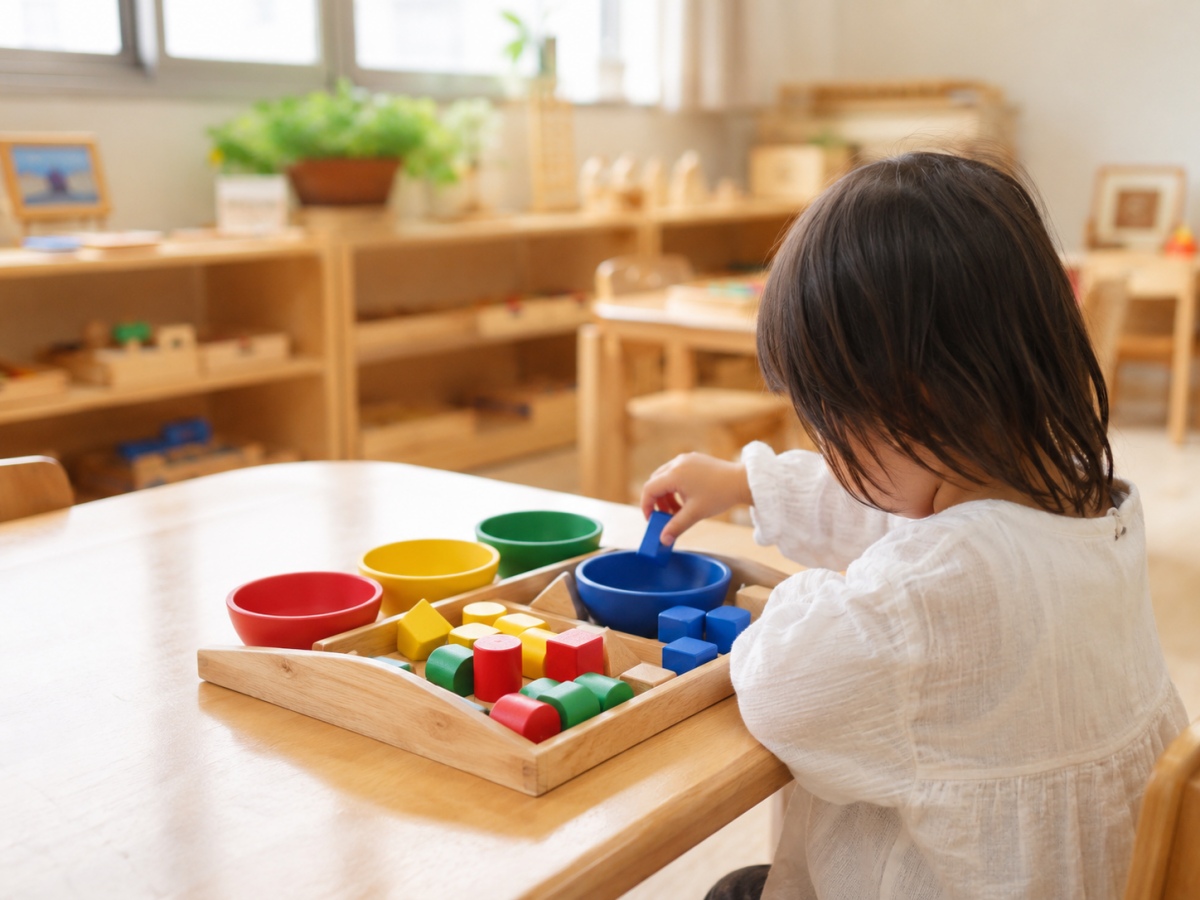
Walk into a Montessori classroom during the morning work cycle, and you’ll notice something interesting. While some children are quietly building towers or tracing sandpaper letters, others are deeply focused on arranging colorful wooden pieces into groups. There are no flashing lights, no electronic sounds, and very little instruction from the teacher. Instead, children observe, compare, test different ideas, and gradually discover patterns on their own.
This simple classroom scene illustrates why sorting toys have remained one of the most widely used Montessori learning materials for decades. Rather than entertaining children for a few minutes, they encourage repeated exploration through meaningful, hands-on learning. Every decision—whether sorting by color, shape, size, or quantity—helps children strengthen observation, logical reasoning, concentration, and fine motor coordination.
Educational research supports this approach. Studies published in Frontiers in Psychology have shown that manipulating physical learning materials contributes to the development of executive function and cognitive flexibility during early childhood. The American Academy of Pediatrics also emphasizes that play-based learning plays an important role in cognitive, language, and social-emotional development. These findings help explain why Montessori classrooms continue to prioritize concrete learning experiences before introducing abstract concepts.
At the same time, demand for sorting toys has expanded far beyond Montessori schools. Preschools, early learning centers, educational retailers, and toy brands are increasingly looking for products that combine educational value with long-term durability. As a manufacturer working with educational brands and distributors in different international markets, we’ve also observed that professional buyers rarely evaluate sorting toys based on appearance alone. More often, they ask practical questions: Can one product support multiple classroom activities? Will it withstand daily use? Can it be customized for local curriculum requirements or private-label collections?
These changing expectations have transformed sorting toys from simple preschool products into an important category within the global educational toy industry.
In this article, we’ll examine why sorting toys continue to play such an important role in Montessori learning environments, explore the developmental benefits supported by educational research, and discuss what educators, distributors, and educational brands should look for when selecting high-quality learning materials.
What Are Sorting Toys in Montessori Education?
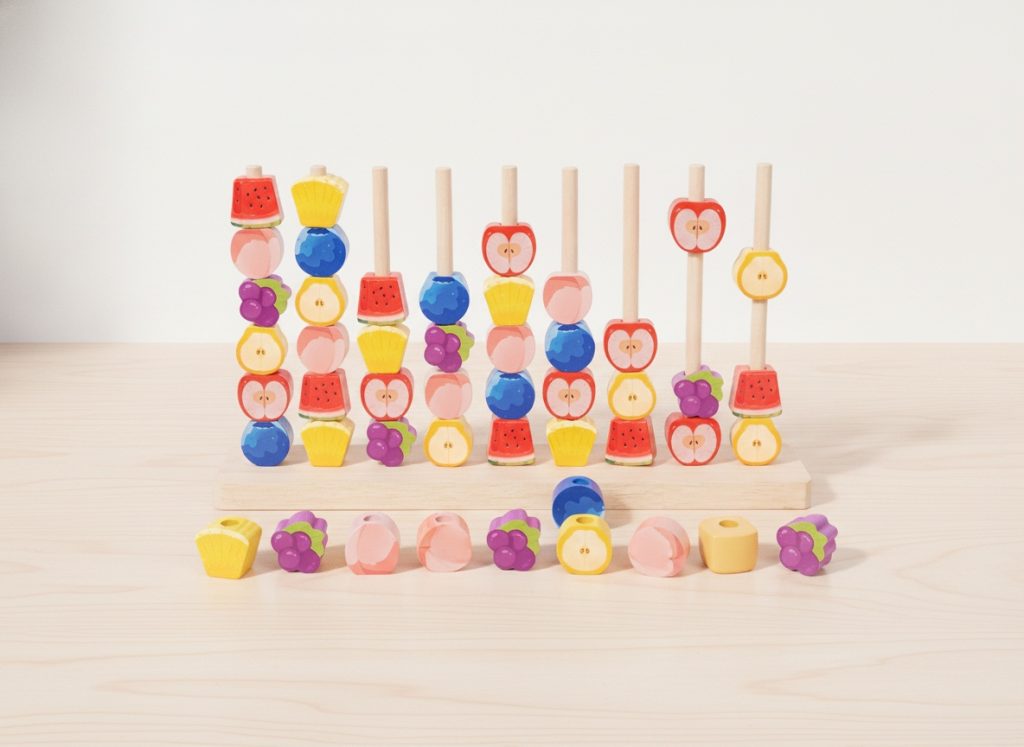
Although they may appear straightforward, sorting toys are carefully designed educational manipulatives that encourage children to organize objects according to shared characteristics. Depending on the activity, children may classify pieces by color, shape, size, texture, quantity, or pattern. As their abilities grow, they begin combining several of these characteristics simultaneously, gradually developing more advanced reasoning skills.
Unlike many electronic learning products that guide children toward predetermined answers, Montessori-inspired sorting toys leave room for exploration. Children are encouraged to make observations, test different possibilities, recognize mistakes independently, and repeat activities until they feel confident with the results. This process reflects one of the central ideas behind Montessori education: meaningful learning occurs when children actively construct knowledge through experience.
Today, sorting activities are used in many educational settings beyond Montessori classrooms. They are commonly found in preschools, early intervention programs, occupational therapy sessions, and homeschooling environments because they provide flexible learning opportunities that can be adapted to different developmental stages.
Why Hands-On Learning Makes a Difference
Imagine a child receiving a tray containing wooden circles, squares, and triangles in four different colors. Without being told exactly what to do, the child first groups the pieces by color. After finishing, curiosity takes over, and the same objects are reorganized by shape. A few minutes later, the child notices differences in size and creates an entirely new sorting method.
Nothing about the materials has changed, yet the learning challenge continues to evolve.
This is one of the greatest strengths of Montessori materials. Rather than offering only one correct answer, they encourage children to think, observe, and experiment from different perspectives. The learning experience becomes richer with every repetition.
Research published in Frontiers in Psychology suggests that repeated interaction with physical educational manipulatives supports executive function, sustained attention, and problem-solving abilities during early childhood. These findings align closely with Montessori’s long-standing emphasis on learning through purposeful activity rather than passive observation.
Because children physically manipulate each object during sorting activities, they engage visual perception, movement, and reasoning at the same time. This combination creates stronger cognitive connections than simply watching demonstrations or completing digital exercises.
Why Are Sorting Toys So Effective in Montessori Learning Environments?
The popularity of sorting toys is closely connected to the way young children naturally learn. Before children can understand abstract ideas such as mathematical classification or logical relationships, they first need opportunities to experience these concepts through concrete objects they can touch, move, and compare.
Montessori classrooms are intentionally designed around this principle. Instead of presenting information through lectures, teachers prepare environments where carefully selected learning materials guide discovery. Sorting toys fit naturally within this educational philosophy because every activity encourages children to make independent decisions based on careful observation.
Spend time observing a Montessori classroom and another pattern quickly becomes clear. Children rarely complete a sorting activity only once. Many return to the same materials several times over the course of a week, approaching them differently each time. A child who initially sorted objects by color may later begin organizing them by shape, then by size, and eventually by combinations of multiple characteristics. This repetition is not simply practice—it reflects the gradual development of increasingly sophisticated thinking.
Our experience working with educational buyers has revealed a similar perspective. Schools and distributors often prefer sorting toys that remain relevant across several developmental stages rather than products designed for a single activity. Materials that can support multiple classroom objectives generally provide better long-term educational value while reducing the need for frequent product replacement.
The relationship between Montessori principles and sorting activities can be summarized below.
| Montessori Principle | How Sorting Toys Support Learning |
| Independent exploration | Children make decisions without continuous adult direction. |
| Self-correction | Materials naturally reveal mistakes through observation and repetition. |
| Concrete learning | Physical objects help children understand abstract concepts step by step. |
| Order and organization | Classification activities strengthen structured thinking and logical sequencing. |
| Sustained concentration | Purposeful repetition encourages longer periods of focused attention. |
Rather than teaching isolated academic knowledge, sorting toys cultivate learning habits that continue benefiting children throughout their education. Observation, persistence, organization, and independent problem-solving are valuable not only in mathematics but also in science, language development, and everyday life.
How Educational Sorting Toys Support Cognitive Development
Parents often associate sorting toys with learning colors or shapes, but educators generally see them as tools for building broader cognitive abilities. Every sorting activity requires children to observe details, compare differences, identify relationships, and make logical decisions. Although these actions appear simple, they form the foundation for many later academic skills.
Building Logical Thinking Through Everyday Discovery
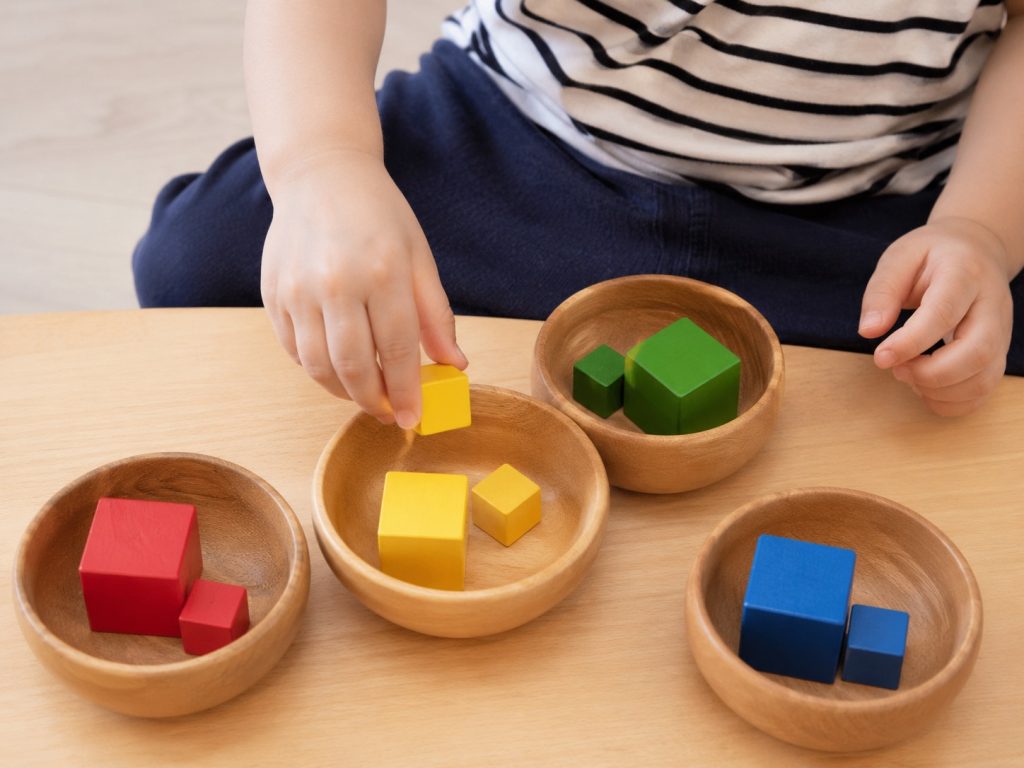
Consider another common classroom example. A teacher places several bowls and a collection of wooden objects on a shelf without explaining the activity. One child immediately groups everything by color, while another notices that some pieces are larger than others and begins sorting according to size instead. Neither approach is incorrect. Both children are developing the ability to recognize patterns and organize information based on observable evidence.
As children become more confident, the same educational manipulatives introduce increasingly complex challenges. Instead of sorting according to one characteristic, they begin considering several variables simultaneously, such as grouping red triangles separately from blue triangles while also arranging them from smallest to largest.
Educational researchers frequently describe classification as one of the earliest foundations of mathematical thinking because it teaches children how information can be organized before numbers and calculations become more abstract.
This gradual progression explains why well-designed educational sorting toys continue providing learning value long after children have mastered basic color recognition.
Fine Motor Coordination, Visual Perception, and Independent Learning
The developmental benefits of sorting toys are not limited to cognitive growth. Every movement involved in grasping, rotating, positioning, and releasing individual pieces strengthens fine motor coordination and hand-eye control. These physical skills later contribute to handwriting, drawing, using classroom tools, and completing practical life activities independently.
Visual perception develops alongside motor coordination. As children repeatedly distinguish subtle differences between geometric shapes, colors, and dimensions, they improve their ability to process visual information accurately. This ability becomes increasingly important when learning to recognize letters, distinguish similar symbols, or identify patterns in mathematics and science.
From a product development perspective, thoughtful design makes a measurable difference. Professional educational buyers increasingly request detailed specifications instead of broad marketing descriptions. For example, a classroom sorting set may include 24 FSC-certified beech wood pieces, six geometric shapes, and six matching sorting bowls, with each component measuring approximately 45–55 mm to support comfortable preschool handling. Water-based surface coatings that comply with EN71-3 requirements and precision-rounded edges further contribute to long-term classroom usability.
Sharing this level of product information helps educators and distributors compare learning materials objectively while demonstrating a manufacturer’s understanding of practical classroom needs.
What Makes High-Quality Sorting Toys Stand Out?
As interest in Montessori education continues to grow around the world, the market now offers an enormous variety of sorting toys. While many products appear similar in online catalogs, experienced educators and purchasing managers often evaluate them using very different criteria than first-time buyers.
One of the most important questions is whether a learning material continues to create educational value after the first few activities. A product that only teaches simple color matching may quickly lose its usefulness, whereas open-ended educational manipulatives can support classification, sequencing, counting, pattern recognition, storytelling, and collaborative classroom activities without requiring additional equipment.
During conversations with distributors and private-label brands, another trend becomes apparent. Buyers increasingly look for products that simplify curriculum planning rather than adding complexity. Educational materials capable of supporting multiple lesson objectives reduce storage requirements, improve classroom efficiency, and offer better long-term value for schools.
Material quality also deserves careful attention. Instead of using broad descriptions such as “premium” or “eco-friendly,” manufacturers can provide measurable information that helps professional buyers evaluate products with confidence. Details such as 12 mm FSC-certified hardwood, food-grade platinum silicone components, precision-machined edges, and clearly documented technical specifications communicate far more practical value than generic promotional language.
Equally important is thoughtful product design. High-quality wooden sorting toys should encourage children to explore independently, discover multiple solutions, and return to the same materials with new ideas as their abilities develop. This flexibility reflects the Montessori philosophy while also increasing the product’s commercial value for schools, educational retailers, and distributors.
Another factor that experienced buyers increasingly consider is how easily a product fits within a broader educational collection. For example, many manufacturers organize their Montessori materials into complementary categories, allowing schools and retailers to combine sorting toys with products such as Montessori practical life materials, wooden educational toys, or sensory learning resources. (Internal Link Suggestion: Montessori Toys Collection / Wooden Educational Toys.)
How Should Schools and Educational Brands Choose the Right Sorting Toys?
Selecting sorting toys involves more than comparing prices or choosing the largest product set. Schools and educational buyers increasingly evaluate whether a product supports long-term learning outcomes while remaining practical for everyday classroom use.
A Montessori teacher, for example, may use the same set of sorting materials in several different lessons over the course of a school year. Younger children might begin by matching colors, while older preschoolers use the same pieces to identify patterns, compare quantities, or create logical sequences. Because the learning objectives evolve, the materials should be versatile enough to grow alongside children’s developmental progress.
Our conversations with distributors and educational brands reveal a similar trend. Products that encourage multiple learning activities are generally preferred over highly specialized toys with limited applications. They not only reduce purchasing costs over time but also help retailers build more cohesive Montessori product collections.
When evaluating sorting toys, buyers often consider the following educational priorities.
| Learning Objective | Recommended Product Characteristics |
| Early classification | Clearly distinguishable colors and simple geometric shapes |
| Logical reasoning | Multiple sorting rules involving shape, size, color, and pattern |
| Fine motor practice | Comfortable object dimensions with smooth rounded edges |
| Classroom collaboration | Organized storage and sufficient components for group activities |
| Long-term educational value | Open-ended design suitable for progressively challenging lessons |
Beyond the product itself, many purchasing managers also assess whether the supplier provides clear documentation, responsive communication, and consistent manufacturing quality. These practical factors often influence long-term partnerships just as much as the product design.
If your website includes related product pages, this section is also an excellent place to naturally guide readers toward additional resources, such as Montessori Learning Materials, Wooden Educational Toys, or Early Childhood Classroom Supplies. Well-planned internal links improve user navigation while helping search engines understand your site’s topical structure.
What Should Importers and Educational Brands Look for When Sourcing Sorting Toys?
As global demand for Montessori-inspired learning materials continues to grow, sourcing decisions have become increasingly strategic. Importers and educational brands are no longer purchasing sorting toys simply as standalone products. Instead, they are building complete educational collections designed for schools, retailers, and early learning programs.
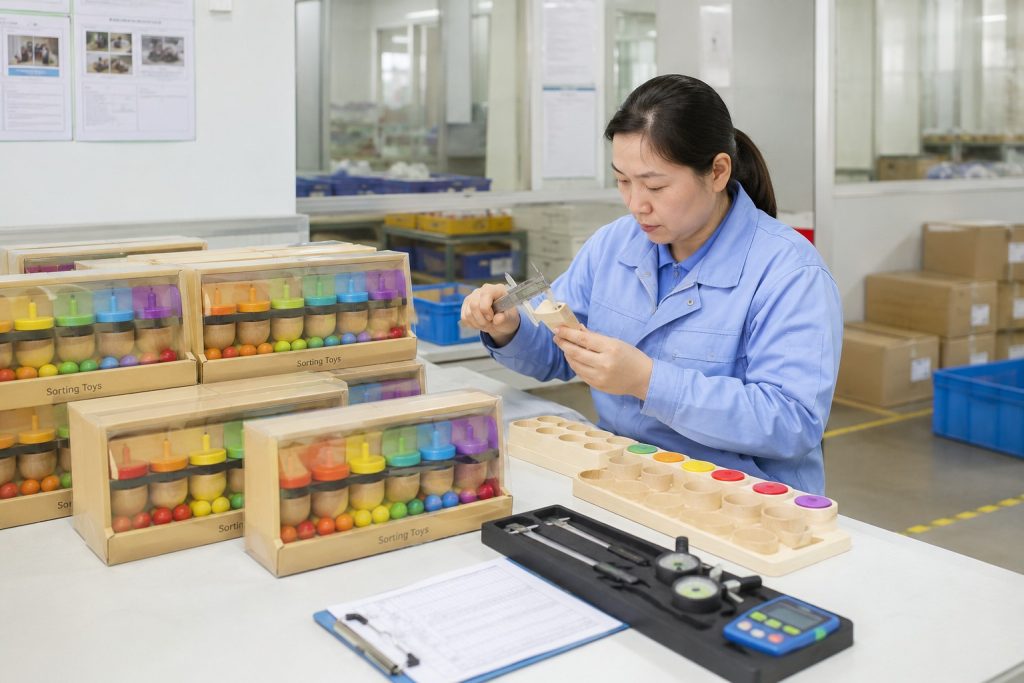
From our experience supporting OEM and ODM projects, purchasing discussions usually extend beyond manufacturing costs within the first few conversations. Buyers often focus on questions such as product consistency, packaging customization, curriculum compatibility, and long-term supply stability. These considerations become especially important when developing private-label product lines or serving institutional customers.
For this reason, experienced manufacturers generally provide more than product catalogs. They support customers throughout product development by offering prototype refinement, packaging recommendations, logo customization, multilingual instruction manuals, and quality documentation. This collaborative approach helps educational brands shorten development timelines while ensuring products meet local market expectations.
Some of the most common topics discussed during sourcing projects include:
- OEM and ODM development capabilities
- Private-label branding and customized packaging
- Product specifications and material documentation
- Reasonable minimum order quantities for new product launches
- Stable production capacity for long-term cooperation
- Packaging suitable for retail, e-commerce, or educational distribution
- Product adaptation for different regional markets
While every project is different, buyers consistently value suppliers who understand both manufacturing processes and classroom applications. This combination often leads to stronger long-term partnerships than competing on price alone.
If your company also provides services such as OEM Manufacturing, Custom Educational Toys, or Private Label Solutions, this section offers a natural opportunity to connect readers with those pages through internal links rather than direct sales language.
Why Are Sorting Toys Becoming More Popular Worldwide?
The continued growth of sorting toys reflects broader changes taking place across early childhood education. Around the world, educators are placing greater emphasis on learning through exploration, creativity, and problem-solving instead of relying exclusively on memorization-based instruction.
Research has contributed significantly to this shift. The American Academy of Pediatrics continues to recognize play as an essential component of healthy childhood development, highlighting its contribution to cognitive, language, and social-emotional skills. Likewise, studies published in Frontiers in Psychology suggest that hands-on interaction with educational materials supports executive function, attention control, and cognitive flexibility during the preschool years.
These research findings align closely with what many educators observe in practice. Children who regularly engage in meaningful sorting activities often become more confident in recognizing patterns, organizing information, and approaching new challenges independently. Although every child’s developmental journey is unique, the consistency between classroom experience and educational research helps explain why Montessori-inspired learning materials continue gaining worldwide recognition.
Market trends point in the same direction. Educational distributors increasingly report demand for products that combine curriculum relevance, durable construction, and flexible classroom applications. Instead of introducing short-lived novelty items, many brands now focus on educational manipulatives that remain useful across multiple stages of early childhood education.
This combination of educational research, classroom practice, and changing purchasing priorities has established sorting toys as one of the most stable categories within the global educational toy industry.
FAQs
At What Age Can Children Start Using Sorting Toys?
Simple sorting toys are often introduced during the toddler years, while more advanced sorting activities continue throughout preschool education. Rather than focusing strictly on age, educators usually select materials according to each child’s ability to recognize visual differences, manipulate objects comfortably, and complete increasingly complex classification tasks.
Are Wooden Sorting Toys Better Than Plastic or Silicone Versions?
Different materials serve different educational environments. Wooden sorting toys are widely appreciated in Montessori classrooms because of their durability, natural tactile experience, and timeless appearance. Silicone materials may be preferred where frequent cleaning or water-based sensory activities are required. Ultimately, educational value depends more on thoughtful design than on the material itself.
How Many Pieces Should a Classroom Sorting Set Include?
Many classroom sets contain approximately 30–60 pieces, allowing several children to participate simultaneously while giving teachers enough variety to create different sorting activities. Modular designs with interchangeable components are particularly useful because they support progressively challenging lessons without requiring entirely new products.
Can Sorting Toys Be Customized for Private Label Brands?
Yes. Many manufacturers provide OEM and ODM services that include customized colors, logo printing, packaging design, instruction manuals, activity cards, and barcode labeling. These services allow educational brands to develop product collections that reflect their own identity while meeting regional market requirements.
Conclusion
The enduring popularity of sorting toys in Montessori learning environments is supported by both educational research and everyday classroom experience. By encouraging children to classify, compare, and organize objects through direct interaction, these learning materials help strengthen logical reasoning, fine motor coordination, visual perception, concentration, and independent problem-solving.
From an educational perspective, their greatest strength lies in flexibility. A thoughtfully designed sorting set can support increasingly sophisticated learning objectives as children develop, making it a valuable resource for Montessori classrooms, preschools, therapy centers, and homeschooling environments alike.
From a commercial perspective, sorting toys continue to represent a strong and sustainable product category. Schools, retailers, and educational brands increasingly seek products that combine measurable educational value with reliable manufacturing quality, thoughtful design, and long-term durability.
If your business is expanding a Montessori product range or developing a private-label educational collection, choosing a manufacturing partner that understands both classroom needs and product development can make a meaningful difference. Beyond consistent production quality, experienced suppliers can support OEM and ODM customization, branded packaging, and product solutions tailored to different educational markets. Exploring related resources such as OEM & ODM Services, Montessori Toys, or Wooden Educational Toys can also help you identify complementary products for a complete educational offering.